

Description
Vintage Wedgwood Blue Jasperware Aurora Chariot Dish
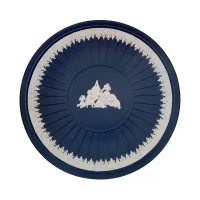
This Wedgwood Blue Jasperware Aurora Chariot Dish features an elegant neoclassical composition depicting Aurora, the Roman goddess of dawn, traveling across the sky in a horse-drawn chariot. Delicately modeled white relief stands against the characteristic Wedgwood blue ground, while a continuous grapevine border surrounds the central mythological scene.
Measuring approximately 4 3/8 inches in diameter, this small decorative dish captures the refinement of Wedgwood’s celebrated Jasperware tradition. Its restrained palette, intricate classical ornament and finely modeled figures make it an attractive example of English decorative ceramics.
Aurora and the Chariot of Dawn
In Roman mythology, Aurora personifies the dawn, announcing the arrival of daylight as she travels across the heavens. Her Greek counterpart, Eos, likewise represents the first light of morning and frequently appears in classical literature and art.
Artists traditionally portrayed Aurora as a beautiful, youthful goddess whose appearance signals the transition from darkness to daylight. Images of the goddess traveling in a chariot drawn by horses became an enduring artistic symbol of renewal, awakening and the beginning of a new day.
The central relief on this Wedgwood dish follows that classical tradition. A draped figure rides in a chariot pulled by spirited horses, while the cloud-like forms beneath the composition suggest movement across the heavens.
The subject conveys both the elegance and dynamism of classical mythology, condensed into a remarkably small decorative composition.
Classical Inspiration and Wedgwood Jasperware
Josiah Wedgwood (1730–1795) established his pottery business in Staffordshire, England, in 1759. Through technical experimentation, artistic collaboration and innovative manufacturing, he transformed English pottery and established one of the most influential names in European decorative arts.
During the eighteenth century, Wedgwood embraced the growing enthusiasm for ancient Greek and Roman art. Classical mythology, archaeological discoveries and the decorative traditions of antiquity provided inspiration for many of the company’s most recognizable designs.
Wedgwood introduced Jasperware in the 1770s, developing a distinctive unglazed stoneware that could accommodate finely modeled relief decoration. The contrast between white classical figures and a colored ceramic ground became one of the company’s defining artistic achievements.
Although Wedgwood produced Jasperware in several colors, its soft blue ground became especially famous. Today, the combination of blue stoneware and white classical relief remains instantly recognizable.
The Art of White Jasperware Relief
One of the most appealing characteristics of this dish is the sculptural quality of its decoration. Rather than relying on painted imagery, Wedgwood creates the composition through applied white relief against the matte blue ceramic surface.
The central scene depicts Aurora’s chariot and horses in miniature, with carefully modeled forms suggesting movement and depth. The contrast between the pale figures and the blue background gives the composition clarity despite its small dimensions.
The technique reflects Wedgwood’s longstanding interest in adapting the appearance of ancient carved cameos and classical sculpture to ceramic decoration.
An Elaborate Grapevine Border
A continuous white grapevine frames the central mythological scene. The border features deeply modeled leaves, clusters of grapes and curling tendrils arranged around the circular rim.
Grapevines have a long history in classical decorative art. Associated with abundance, fertility and Dionysus, the god of wine, they frequently appeared in ancient Roman ornament and later neoclassical designs.
On this Wedgwood dish, the grapevine provides an elaborate contrast to the open blue ground surrounding Aurora’s chariot. The decorative wreath also creates a sense of balance, drawing the eye toward the mythological composition at the center.
Wedgwood Made in England Backstamp
The underside bears the impressed WEDGWOOD® / MADE IN ENGLAND mark, identifying the manufacturer and English origin.
The form of the mark is consistent with later twentieth-century Wedgwood production. Although an exact manufacturing date has not been established, the dish belongs to the company’s continuing tradition of reproducing classical designs in Jasperware.
This distinction reflects an important characteristic of Wedgwood collecting: the company preserved and revisited many of its historic decorative subjects over successive generations, allowing designs inspired by antiquity to remain part of its production for centuries.
Condition and Collectible Appeal
This vintage Wedgwood dish remains in good condition, with no observed cracks or losses to the white relief decoration. The blue Jasperware ground retains its characteristic matte appearance, and the classical composition presents attractively.
Minor signs of age and handling are visible, particularly around the underside foot ring. These do not significantly detract from the decorative appearance of the piece.
With its recognizable Wedgwood blue color, elaborate grapevine border and classical depiction of Aurora, this small dish offers an appealing combination of mythology, English ceramic history and neoclassical design.
Its compact size makes it particularly suitable for display in a cabinet, on a shelf or as part of a collection of Wedgwood Jasperware.