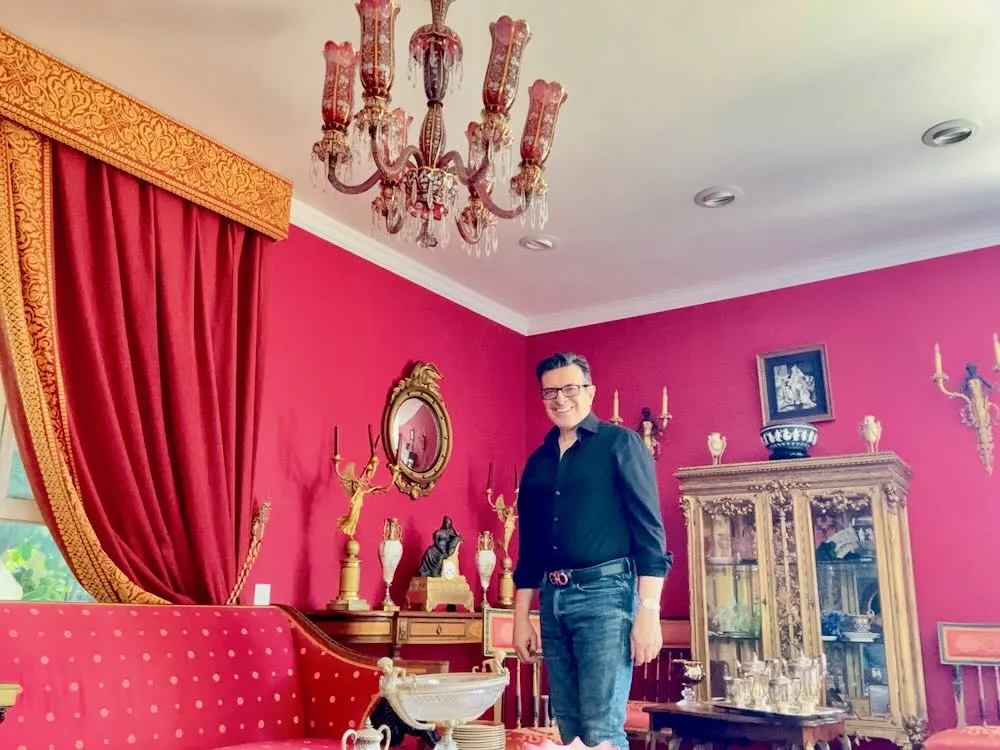

A Lifelong Exploration of Design, Craftsmanship, and Decorative Arts
Dino is a collector, designer, writer, and lifelong student of antiques and the decorative arts. His interest began early, growing up surrounded by antique objects and developing an appreciation not only for their beauty, but also for the craftsmanship, history, and cultural traditions they preserve. That early exposure encouraged a curiosity that has continued throughout his life: who made an object, how they made it, why they decorated it in a particular way, and what its materials and construction can reveal about the people and culture that produced it.
He studied Art and Architecture at the University of Southern California (USC), where his education strengthened his understanding of proportion, structure, ornament, materials, color, and visual composition. Architecture also taught him to look beyond the surface of an object. Construction, function, craftsmanship, and historical context often provide as much information as decoration, and this approach continues to shape the way he studies antiques today.
His professional work as a graphic designer and surface pattern designer further developed his eye for pattern, typography, color, repetition, and decorative detail. These disciplines naturally intersect with the study of decorative arts, where seemingly small choices in motif, technique, material, and composition can help distinguish one period, region, workshop, or artistic tradition from another.
Fine Arts and Painting
Dino also creates abstract acrylic paintings, exploring rhythm, movement, color, texture, and composition through a more personal visual language. Painting and design have strengthened his sensitivity to the qualities that make handmade objects distinctive—the irregularities of the hand, subtle variations in color and surface, and evidence of the processes used to create them.
Travel has played an equally important role in shaping his interests. Encountering objects and artistic traditions within different cultural settings gave him a broader appreciation for the ways craftsmanship moves across regions and generations. Rather than viewing antiques simply as decorative objects, he approaches them as tangible records of cultural exchange, changing tastes, traditional skills, everyday life, and individual artistry.
Through years of collecting and handling antiques, he has developed a practical familiarity with ceramics, glass, metalwork, jewelry, textiles, embroidery, and other forms of decorative art. He particularly enjoys examining the details that can easily escape notice: an old maker’s mark, the reverse of an embroidered textile, evidence of hand construction, an unusual material, a traditional motif, or the signs of age and use that form part of an object’s history.
Research and Articles
Research forms an important part of that process. Dino combines close observation of the object itself with historical references, museum collections, specialist resources, and comparative examples. When an attribution remains uncertain, he believes that uncertainty should remain part of the discussion rather than forcing an object into a convenient category. For him, researching antiques often means following evidence gradually and allowing new information to refine an earlier understanding.
Through his writing, Dino hopes to share that process as well as what he discovers. His articles explore individual objects alongside the broader subjects surrounding them—from makers and manufacturing techniques to traditions, historic design movements, cultural influences, and the origins of decorative motifs. The goal is not simply to identify an antique, but to understand something of the world from which it came.
Photography and gardening add two more dimensions to his creative life. Photography encourages close observation of texture, proportion, light, and detail, while gardening provides an endless source of natural forms, colors, and patterns. Both reinforce the same habit of looking carefully that informs his work as a designer, artist, and collector.
Across all of these interests runs a common thread: curiosity about how things are made, why they look the way they do, and what they can tell us about the people who made and used them. For Dino, antiques offer a particularly compelling way to bring together art, design, craftsmanship, history, and culture—and to preserve those stories for others to discover.