
Description
Vintage Persian Chlorite Plate with Achaemenid-Inspired Carvings
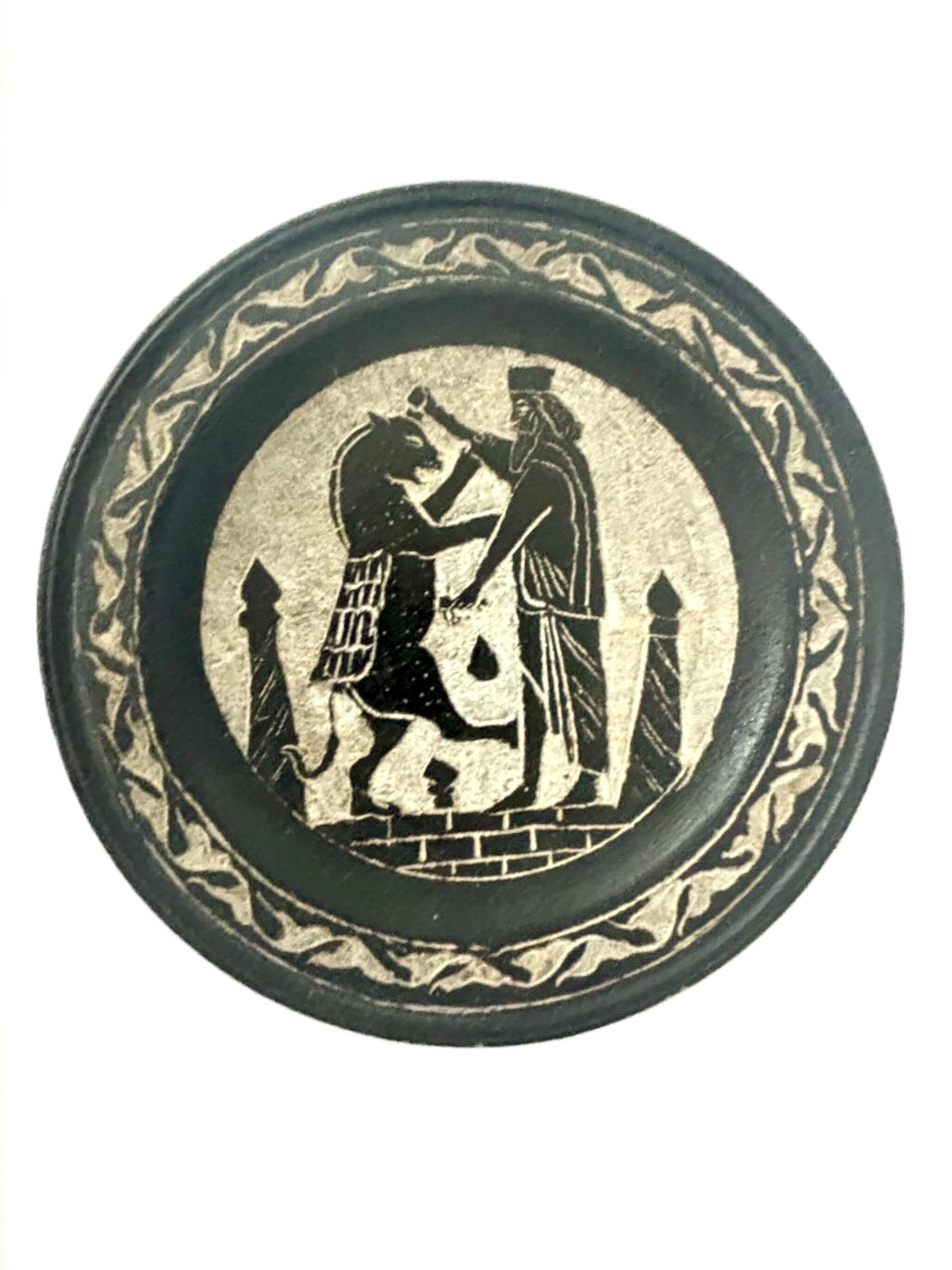
This distinctive vintage Persian chlorite sgraffito plate features a dramatic scene inspired by the royal hero reliefs of ancient Persepolis. At its center, a Persian royal figure confronts a mythical creature resembling a winged lion or griffin. The composition recalls one of the most recognizable themes in Achaemenid art: the royal hero demonstrating his strength and authority over a formidable beast.
The artisan has adapted this monumental subject to a small decorative plate, using the traditional Persian technique of stone sgraffito. Dark figures stand against the natural grey chlorite background, while fine engraving defines their garments, facial features, and ornamental details.
The royal figure wears a long, pleated garment and a distinctive headdress associated with Achaemenid imagery. Opposite him, the mythical creature rises in a dynamic pose, creating a striking contrast between the human figure and the powerful animal form.
A continuous border of scrolling foliage surrounds the central scene. Its flowing ornament softens the dramatic composition and complements the plate’s circular shape.
Although modest in size, the plate has a strong visual presence. Its carefully arranged figures, contrasting surfaces, and traditional craftsmanship make it an appealing example of vintage Persian decorative art.
The Achaemenid Royal Hero and Mythical Beast
The central engraving draws inspiration from the celebrated royal hero reliefs of Persepolis, the ceremonial capital of the Achaemenid Empire. Construction of the palace complex began under Darius I around 518 BCE, and subsequent rulers expanded its magnificent halls, stairways, and monumental gateways.
Among the most remarkable carvings at Persepolis are scenes depicting a royal hero confronting lions and mythical creatures. These include composite beasts with features of lions, birds, and other powerful animals.
The royal figure typically wears elaborate Persian court dress and grasps or subdues the creature. Some reliefs show the hero wielding a weapon, while others emphasize the physical struggle between the two figures.
Scholars commonly interpret these encounters as expressions of royal strength and authority. The triumph of the hero over a threatening creature can also symbolize the maintenance of order against destructive or chaotic forces.
These powerful images formed part of the visual language of Achaemenid kingship. Their influence continued long after the empire itself disappeared, inspiring later generations of Persian artists and craftsmen.
On this plate, the artisan has reinterpreted the ancient subject through the contrasting dark and natural grey surfaces of chlorite. The result transforms a monumental royal theme into an intimate work of decorative art.
The imagery suggests the traditional Achaemenid royal hero rather than a securely identifiable historical king. Likewise, the creature recalls the mythical lion-griffins of Persepolis, although its precise identity cannot be established with certainty.
Traditional Persian Stone Sgraffito
Persian stone sgraffito is a distinctive decorative technique particularly associated with the stone-carving workshops of Mashhad, Iran.
Artisans traditionally worked with chlorite, a relatively soft natural stone that could be shaped into bowls, plates, and other decorative vessels. Its fine texture made it suitable for detailed engraving and ornamental carving.
The process began with shaping and smoothing the stone. Craftsmen then treated its surface with oil, which darkened the natural material.
Using specialized carving tools, the artisan removed selected areas of the darkened surface to reveal the lighter grey stone beneath. The untouched darker areas formed the figures and decorative motifs, while the carved background provided contrast.
Additional engraved lines defined clothing, facial features, architectural elements, and ornamental borders.
Unlike painted decoration, the imagery emerged directly from the carved stone surface. This technique required patience, precision, and an understanding of how contrasting areas could create a balanced composition.
The plate illustrates these characteristics particularly well. Its dark figural silhouettes stand against a lighter background, while fine incised details bring definition to the scene.
Mashhad and the Persian Stone-Carving Tradition
Mashhad, in northeastern Iran, became an important center for traditional stoneworking. Craftsmen in the region produced practical vessels as well as decorative objects, using locally available stone and established carving techniques.
Grey chlorite was particularly suitable for ornamental engraving. Its relatively soft composition allowed artisans to create detailed designs while retaining the substantial character of natural stone.
Decorative plates and bowls often featured floral patterns, architectural motifs, historical figures, and imagery inspired by the artistic heritage of ancient Persia.
The revival and reinterpretation of Achaemenid subjects became especially appealing in twentieth-century Iranian decorative arts. Craftsmen adapted familiar images from Persepolis to objects intended for domestic display and the market for traditional handicrafts.
This plate is consistent with the Mashhad chlorite sgraffito tradition, although its precise workshop and place of manufacture remain unidentified.
Ornamental Border and Artistic Composition
The plate’s decorative border provides an elegant frame for the central confrontation.
A continuous arrangement of scrolling foliage follows the circular edge, creating a rhythmic pattern around the figures. The contrasting dark and light areas emphasize the movement of the leaves and ornamental forms.
The central composition is comparatively open, allowing the royal hero and mythical creature to remain the focal points.
Their opposing gestures create a sense of movement and tension, while the circular border contains the scene within a balanced decorative arrangement.
This combination of narrative imagery and ornamental craftsmanship demonstrates the artisan’s ability to adapt a complex historical subject to a relatively small stone surface.
The black-and-grey palette also gives the design a graphic quality reminiscent of ancient carved reliefs, while retaining the distinctive character of Persian stone sgraffito.
A Distinctive Example of Vintage Persian Decorative Arts
Acquired in Iran during the 1970s, this plate represents a traditional form of Persian craftsmanship that combines historical inspiration with decorative stone carving.
Its approximately 6-inch diameter makes it particularly suitable for display on a small stand, shelf, or within a cabinet of collected objects.
The Achaemenid-inspired imagery gives the piece additional interest for collectors of Persian art, Persepolis-related decorative objects, and traditional Iranian handicrafts.
Its appeal lies not only in the historical subject but also in the way the artisan interpreted that subject through a distinctive regional craft.
The result is a compact decorative object that brings together ancient Persian imagery, ornamental design, and the enduring traditions of Iranian stoneworking.
Condition and Provenance
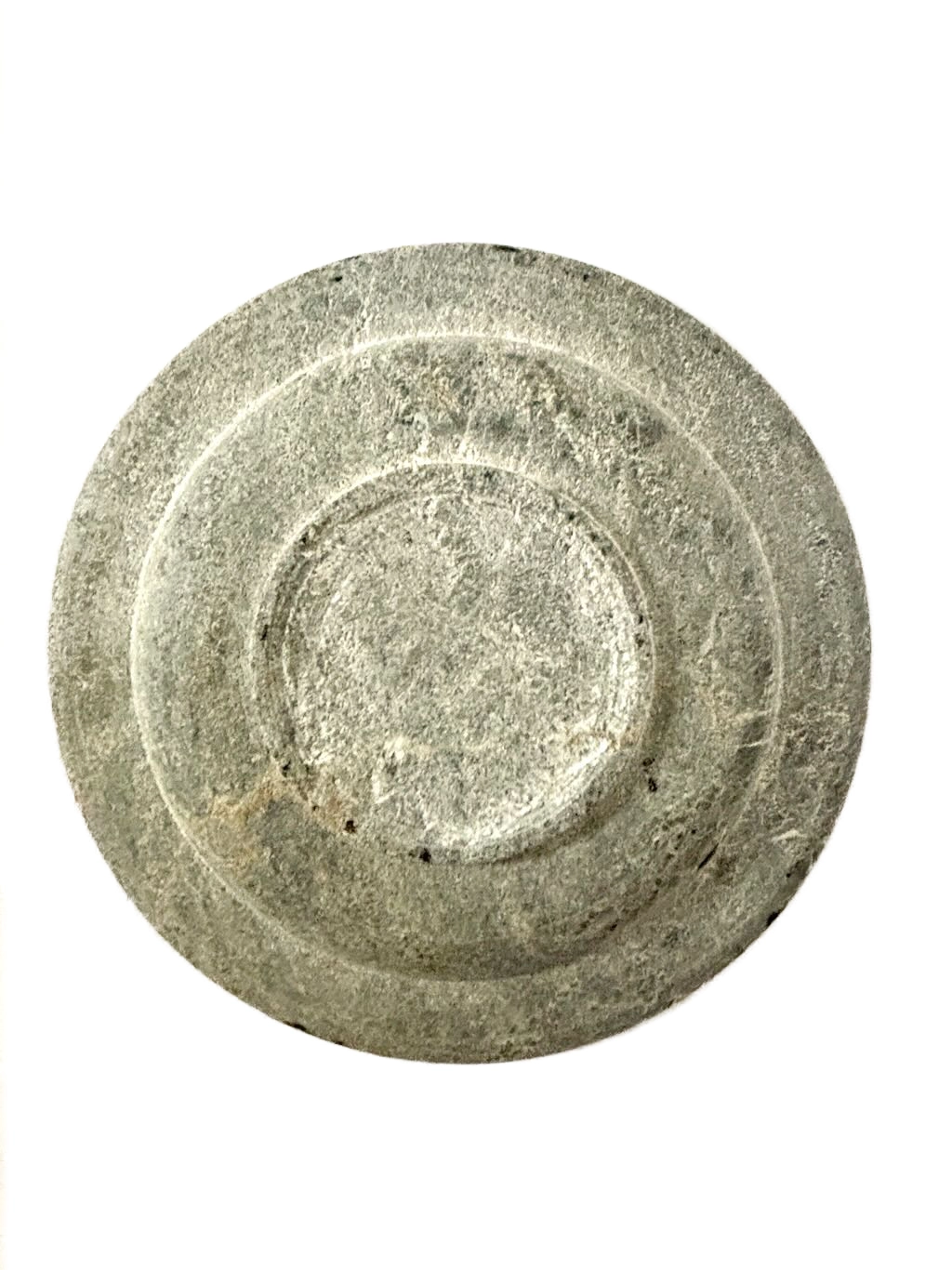
The plate remains in good vintage condition, with surface characteristics consistent with its age and traditional hand-carved construction. Please examine the photographs carefully, as they form an important part of the description.
Acquired in Iran during the 1970s and preserved in the Bernardi Family Collection, this plate offers an attractive example of vintage Persian chlorite sgraffito. Its exact date of manufacture remains unknown.