

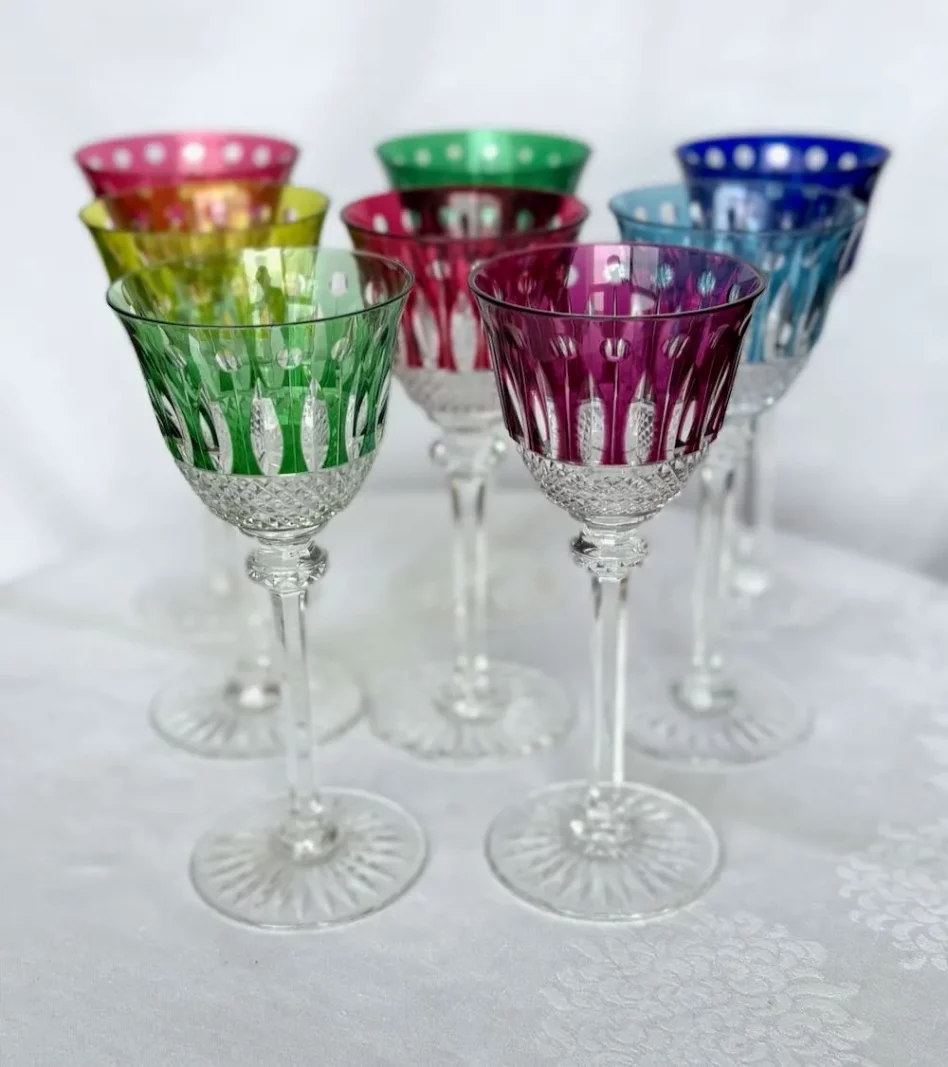
Saint-Louis Tommy crystal occupies a rare place in the world of luxury decorative arts. Few stemware patterns manage to remain historically important, technically impressive, and visually dramatic for nearly a century while still feeling relevant in contemporary interiors. Introduced in 1928, the Tommy collection became one of the defining achievements of French crystal craftsmanship and remains among the most recognizable luxury stemware patterns ever created.
The pattern combines deeply cut crystal, vivid overlay colors, architectural symmetry, and extraordinary brilliance into a design that instantly commands attention. Whether displayed in a formal dining room, illuminated inside a cabinet, or arranged across a candlelit table, Tommy crystal transforms light into part of the experience itself.
Unlike minimalist stemware designed to disappear quietly into the background, Tommy was created to be seen. Every cut, facet, and polished surface exists to magnify brilliance and reinforce the sense of ceremony associated with fine crystal entertaining.
The Origins of the Tommy Pattern
Saint-Louis introduced the Tommy pattern during the late 1920s, a period when luxury craftsmanship and decorative refinement still defined elite European table culture. By this time, the French crystal house had already spent centuries refining techniques in cutting, polishing, engraving, and colored overlay crystal.
The Tommy collection quickly distinguished itself through its complexity. Rather than relying on a single decorative motif, the design combines several cutting techniques within one glass. Diamond cuts, elongated bevel cuts, pearl-like lenses, radiating star cuts, and polished geometric surfaces interact together to create remarkable optical depth.
The visual effect changes constantly depending on the surrounding light. Daylight emphasizes transparency and color, while evening illumination intensifies reflection and brilliance. Candlelight in particular causes the cuts to shimmer almost like gemstones.
This dynamic relationship with light became one of the reasons Tommy crystal achieved such enduring popularity among collectors, entertainers, and luxury decorators.
The Crystal of Versailles
The Tommy pattern gained international prestige after the celebrated 1938 state banquet at the Palace of Versailles honoring King George VI and Queen Elizabeth of the United Kingdom. The French government selected Saint-Louis Tommy crystal for the elaborate diplomatic table settings, exposing the pattern to international admiration at one of the most important ceremonial events of the era.
That association permanently elevated Tommy beyond ordinary luxury stemware. The pattern became connected with aristocratic entertaining, formal dining traditions, and European state ceremony.
Over time, Tommy crystal earned a reputation as “the glass of kings,” a description that reflected both its visual richness and its historical prestige.
Even today, the pattern retains that ceremonial presence. A table set with Tommy crystal feels intentionally theatrical in the best possible way. The stemware does not merely accompany the occasion; it helps create it.
The Complexity Behind Tommy Crystal
One reason Tommy crystal remains so respected is the extraordinary technical skill required to produce it correctly. The pattern may appear effortless at first glance, but each glass involves multiple demanding stages of hand craftsmanship.
The lower portion of the bowl typically features dense diamond cutting that acts almost like a field of miniature prisms. Above this section, long vertical bevel cuts rise upward through the colored overlay crystal, revealing portions of the clear crystal beneath. Near the rim, small rounded pearl cuts capture and refract light from different angles.
The stems themselves remain remarkably slender considering the weight and density of the crystal bowls. At the base, radiating star cuts create another layer of brilliance while reinforcing the architectural symmetry of the design. Together these elements produce a visual rhythm that feels simultaneously elegant and powerful.
Because Saint-Louis crystal remains largely hand-finished, small variations naturally occur between production periods and individual examples. Collectors often value these subtle differences because they reveal the human craftsmanship behind the object rather than the uniformity of industrial production.
The Beauty of Colored Overlay Crystal
Although clear Tommy crystal remains highly admired, colored examples possess a particularly dramatic visual presence. Saint-Louis became world famous for overlay crystal, sometimes called cased crystal, where molten colored crystal is layered over clear crystal before cutting.
The cutter then carves deeply enough through the colored layer to reveal the transparent crystal beneath. This process creates extraordinary contrast between color and light.
Ruby red, emerald green, chartreuse, cobalt blue, sky blue, and amethyst became some of the most celebrated Tommy colors. When displayed together, the glasses resemble a collection of illuminated jewels rather than ordinary stemware.
Each color behaves differently during production. Ruby crystal traditionally derives from gold compounds, making it especially difficult and expensive to produce. Slight differences in firing temperatures, mineral formulas, and cutting depth can subtly alter the final shade.
Because of this, collectors often appreciate slight tonal differences between glasses acquired during different years or decades. A ruby glass produced in the late 1980s may display slightly different depth and warmth compared to one created during the 1990s. Similar variations appear in emerald and chartreuse examples as well.
Rather than diminishing a set, these nuanced differences often enhance its individuality and confirm the handmade nature of the crystal.
Hock Glasses, Roemers, and the Art of Entertaining
The tall colored Tommy stemware often referred to as hock glasses or Roemers were originally designed primarily for white wines and Rhine wines. Their elongated stems, generous bowls, and vivid colors descend from centuries of European wine traditions where color-coded stemware sometimes helped distinguish different vintages or serving sequences.
Over time, however, Tommy hock glasses evolved beyond strict functionality. They became symbols of formal entertaining, luxury hospitality, and sophisticated table presentation.
A multicolored arrangement of Tommy crystal immediately creates visual drama. The glasses interact with flowers, candlelight, silver, and porcelain in ways that transform the entire dining environment. Even modern interiors benefit from the contrast between contemporary minimalism and richly colored historic crystal.
This decorative flexibility helps explain why Tommy crystal continues attracting younger collectors and interior designers despite its historical origins.
Why Vintage Tommy Crystal Remains Desirable
Vintage late twentieth-century Tommy crystal from the 1980s and 1990s remains especially appealing to many crystal enthusiasts. Collectors often admire the sharpness of the cutting, the depth of the overlay colors, and the strong hand-finished character associated with this period.
Surviving original Saint-Louis labels further enhance desirability because they suggest careful ownership and minimal use. Acid-etched Saint-Louis marks beneath the bases confirm authenticity and connect the glasses directly to the French crystal house’s long tradition of craftsmanship.
Condition also plays a major role in value. Crystal free from chips, flea bites, cloudiness, or dishwasher etching becomes increasingly difficult to locate, especially in multicolored matching sets.
Complete or near-complete color assortments hold particular appeal because assembling them over time can be challenging. Slight variations in tone between examples from different acquisition periods often create a more organic and visually interesting grouping than perfectly uniform sets.
Caring for Fine Saint-Louis Crystal
Tommy crystal deserves careful handling to preserve its brilliance and clarity for future generations. Hand washing remains strongly recommended. Use lukewarm water and mild soap rather than aggressive detergents or high dishwasher temperatures. Wash glasses individually to prevent contact damage, especially around the delicate rims and stems.
When drying, support the bowl rather than twisting the stem against the base. Fine crystal stems remain structurally strong during normal use but should never experience unnecessary torque during cleaning.
Storage also matters. Crystal stemware should stand upright rather than resting on the rim. Soft cabinet liners and adequate spacing help protect the deeply cut surfaces from accidental contact. Properly cared for, Saint-Louis Tommy crystal can maintain its brilliance for decades while continuing to function both as luxury stemware and decorative art.
A Lasting Symbol of Luxury
Saint-Louis Tommy crystal endures because it captures something increasingly rare in modern design: unapologetic beauty combined with exceptional craftsmanship. The pattern embraces ornament, reflection, color, and ceremony without restraint. Yet beneath that richness lies extraordinary technical discipline developed through centuries of French crystal making.
Even a single Tommy glass carries remarkable presence. A full multicolored table setting becomes unforgettable.
That ability to transform ordinary light into spectacle explains why Tommy crystal remains admired by collectors, designers, entertainers, and lovers of fine decorative arts around the world. The glasses do far more than hold wine. They create atmosphere, communicate refinement, and celebrate the enduring appeal of handcrafted luxury.