

Description
Vintage Wedgwood Sage Green Jasperware Muses Watering Pegasus Dish
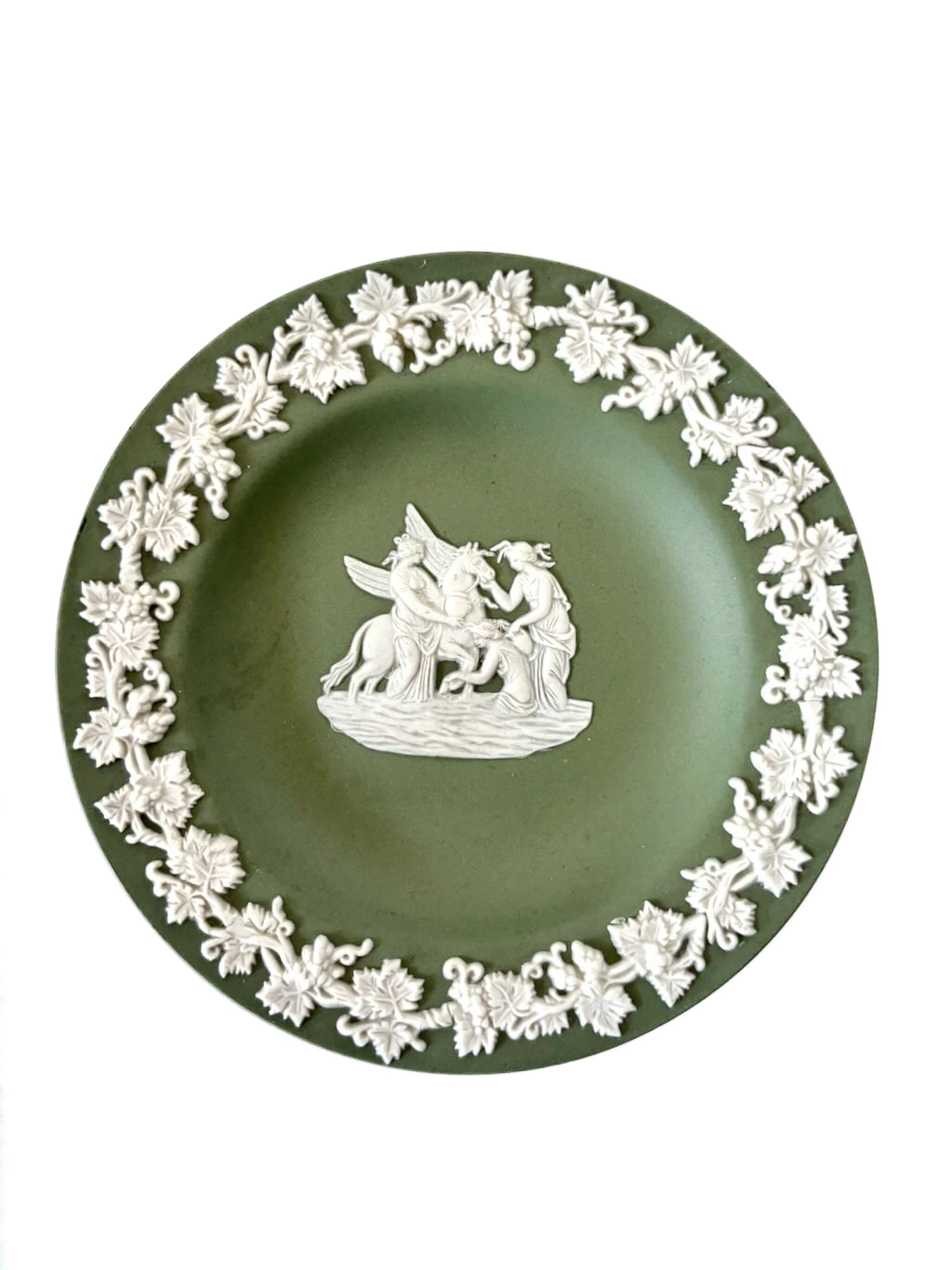
This Wedgwood Muses Watering Pegasus dish combines one of Wedgwood’s enduring classical subjects with an attractive sage green Jasperware ground. Crisp white applied relief depicts the Muses attending the winged horse Pegasus, while an elaborate grapevine border encircles the composition.
Measuring approximately 4 3/8 inches across, the small round dish has a remarkably detailed design for its size. The restrained green and white palette emphasizes the sculptural quality of the relief and gives the piece the unmistakable appearance associated with Wedgwood Jasperware.
The Muses Watering Pegasus on Mount Helikon
The central relief depicts The Muses Watering Pegasus on Mount Helikon, a classical composition designed for Wedgwood by the important English sculptor and modeler John Flaxman around 1780. Although this particular dish was produced much later, its decoration continues a design tradition reaching back to the formative years of Wedgwood’s neoclassical production.
Pegasus, the famous winged horse of Greek mythology, became closely associated with the Muses and poetic inspiration. According to classical tradition, the spring Hippocrene on Mount Helicon came into being when Pegasus struck the ground with his hoof. Its waters subsequently became associated with the Muses and the inspiration of poets.
The imagery was therefore especially appropriate for the neoclassical decorative arts. It joined mythology, poetry and antiquity within a composition that Wedgwood could translate beautifully into shallow sculptural relief.
A John Flaxman Design for Wedgwood
John Flaxman played an important role in the development of Wedgwood’s neoclassical decoration during the eighteenth century. His refined linear compositions were particularly suited to the company’s Jasperware, where figures modeled in pale relief could stand dramatically against a contrasting colored ground.
The original Wedgwood composition of The Muses Watering Pegasus on Mount Helikon dates to approximately 1780. The scene itself draws upon imagery from antiquity, reflecting the intense eighteenth-century interest in recently studied classical art and archaeology.
Wedgwood continued to reproduce successful classical reliefs long after their introduction. As a result, twentieth-century Jasperware such as this dish preserves a direct visual connection with designs developed during the company’s great neoclassical period.
Sage Green Wedgwood Jasperware
Although pale blue remains the color most immediately associated with Wedgwood Jasperware, the company produced the distinctive ceramic body in a variety of colors. This example uses a muted sage green ground that creates a particularly attractive contrast with the white relief.
The matte surface is an essential part of the Jasperware aesthetic. Rather than depending upon painted decoration or a glossy glaze, the design achieves its effect through color, modeling and the contrast between the ground and applied ornament.
On this small dish, the white figures stand prominently against the green center while the surrounding border creates a second level of intricate decoration.
Grapevine Border
A continuous grapevine surrounds the mythological scene. Individual leaves, curling tendrils and clusters of grapes form a dense but graceful wreath around the edge.
The vine imagery complements the classical character of the central relief and gives the small dish considerably more visual complexity. The fine modeling of the individual leaves and fruit also demonstrates how effectively Wedgwood could reproduce intricate ornament in applied Jasperware relief.
Rather than functioning merely as a border, the vine creates a frame around the mythological scene and draws attention toward Pegasus and the Muses at the center.
Wedgwood Made in England Mark
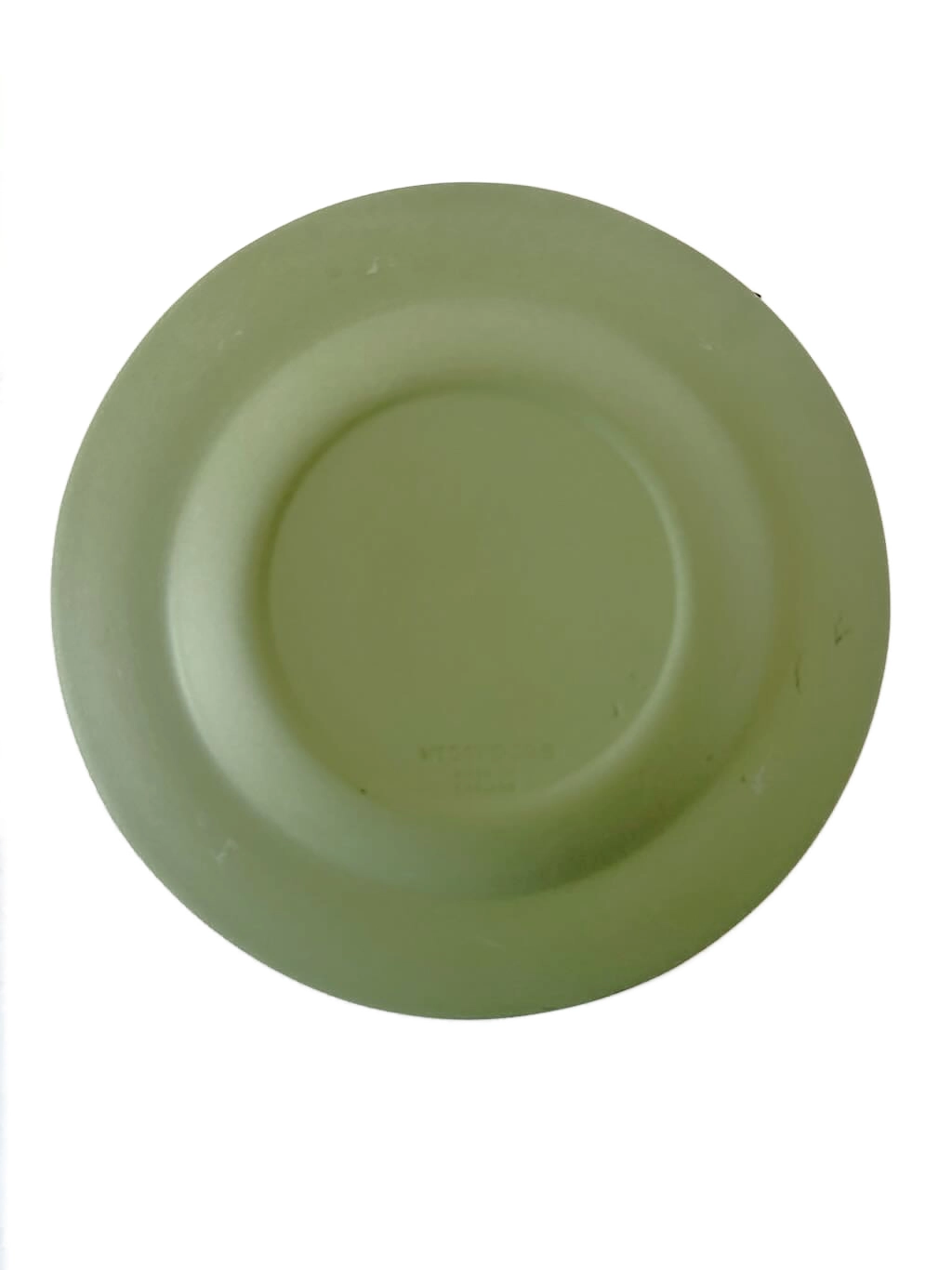
The underside carries the impressed WEDGWOOD® / MADE IN ENGLAND mark. The registered trademark symbol and form of the impressed mark are consistent with later twentieth-century Wedgwood production.
The dish is therefore a later production of a much earlier Wedgwood design rather than an eighteenth-century piece. A cautious dating of approximately c. 1975–1980s recognizes the evidence of the mark without assigning an unsupported exact production year.
This distinction is important because Wedgwood frequently returned to its historic designs. The age of the physical object and the age of the design decorating it can consequently differ by nearly two centuries.
Very Good Vintage Condition
The Wedgwood Muses Watering Pegasus dish remains in very good vintage condition. The sage green ground presents attractively, while the detailed white relief remains an important visual feature of the piece.
Minor signs of age and handling can be seen, particularly on the underside, but they do not detract significantly from its presentation. The photographs show both the decorative surface and impressed Wedgwood mark and should be reviewed as part of the condition description.
A Classical Wedgwood Design in Miniature
At only approximately 4 3/8 inches across, this small Jasperware dish brings together several elements central to Wedgwood’s artistic identity: classical mythology, sculptural white relief, contrasting colored Jasperware and a design with roots in the eighteenth century.
The historic Flaxman composition makes the piece more than a simple decorative dish. It represents the remarkable longevity of Wedgwood’s neoclassical design vocabulary, reproduced for new generations of collectors nearly two centuries after its creation.