

The Meaning Behind the Surface
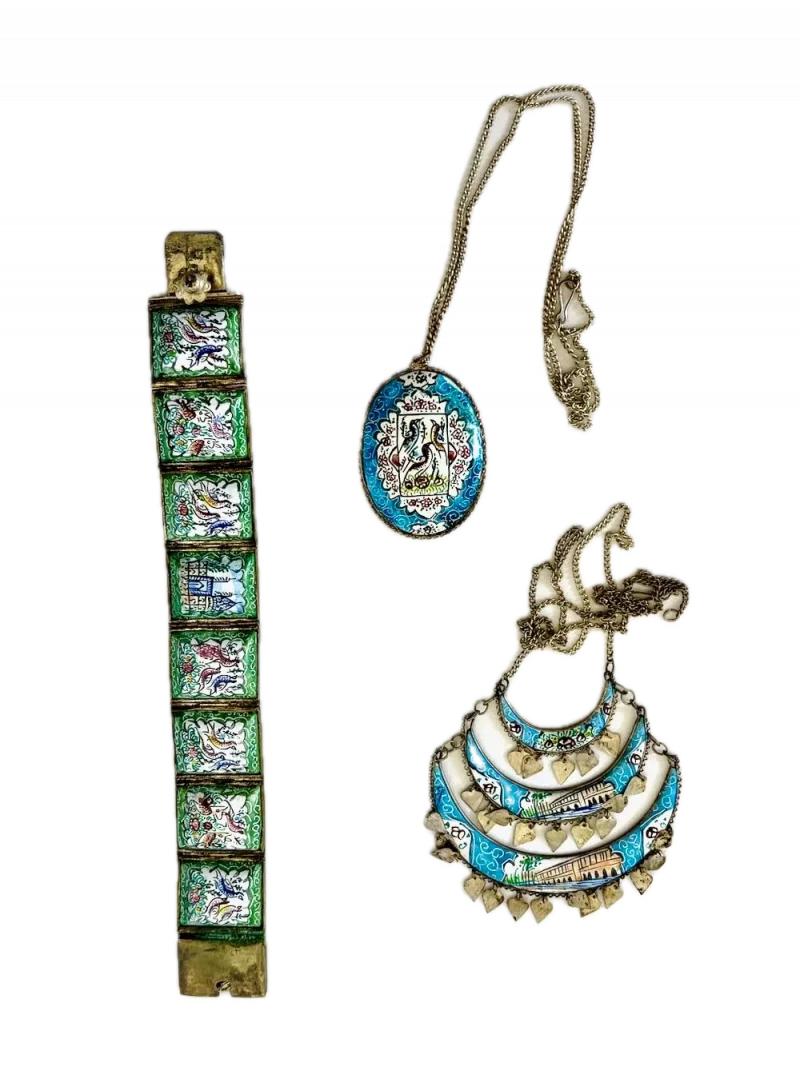
Minakari (Persian Enamel) is the Persian art of enamel on metal, a practice that transforms copper into something luminous and enduring. The word itself—mina—refers to the blue of the sky, or more precisely, the color associated with heaven. From the beginning, the intention of the craft has been clear: to create objects that carry something of that celestial quality into the material world.
This is not painting in the conventional sense. Fire drives the entire process. Artisans grind glass into fine powder, blend it with mineral pigments, and apply it directly onto metal. They then place the piece in a kiln, where intense heat melts and bonds the material into a smooth, glass-like surface. The result is not surface decoration but transformation—color fuses permanently into the object itself.
Minakari, or Meenakari, connects most strongly to Isfahan, where artisans refined the craft to its highest level. Generations of masters protected their techniques with care. Families passed color recipes from one generation to the next, often keeping them unwritten. Artisans treated certain tones—especially deep reds and rare greens—as closely guarded knowledge. Over time, some of these formulas disappeared, which gives surviving pieces even greater significance.
Survival and Revival
The history of Minakari is not uninterrupted. The Mongol invasions of the 13th century nearly erased the craft, scattering artisans and destroying workshops. What survived did so through fragments—objects, memory, and the persistence of a few practitioners who rebuilt the knowledge over time.
By the Safavid period, particularly under Shah Abbas I in the 16th and 17th centuries, Minakari experienced a major revival. Isfahan became a center of artistic production, and enamel work flourished alongside architecture, textiles, and manuscript painting. Pieces were not only made for local use but also sent abroad as diplomatic gifts, eventually finding their way into European collections.
Centuries later, the craft faced decline again. By the mid-20th century, only a handful of master artisans remained. A deliberate revival effort brought it back from the edge, ensuring that the techniques—and the philosophy behind them—would continue.
Minakari today is not a static tradition. It is a revived one, shaped by continuity and interruption.
Plates and Bowls: Structure Through Pattern
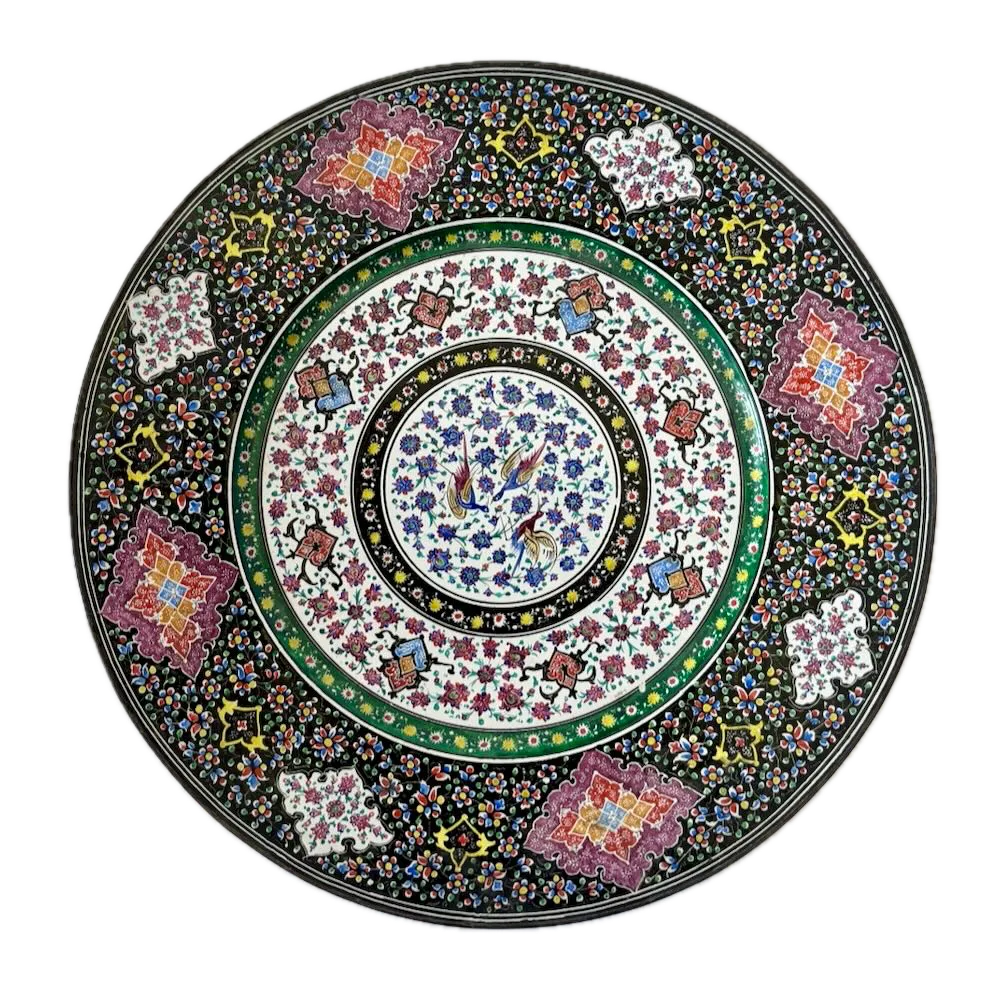
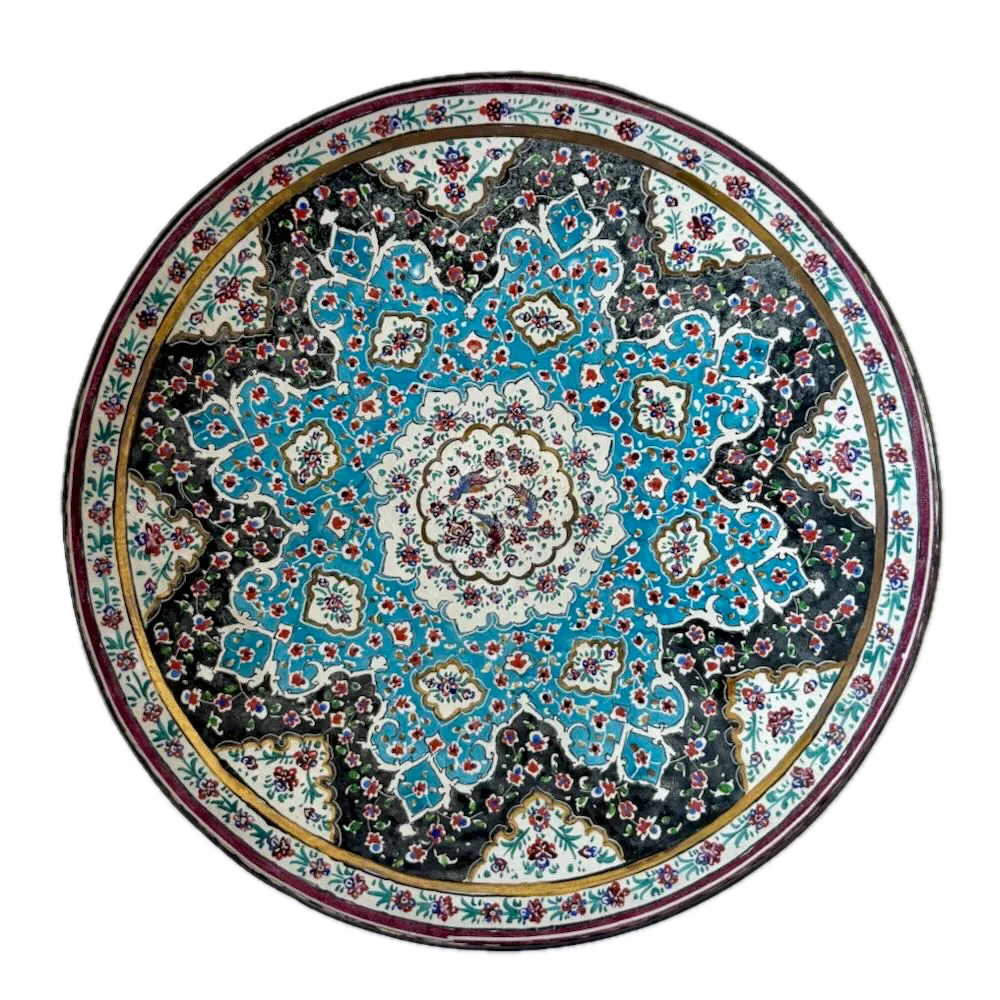
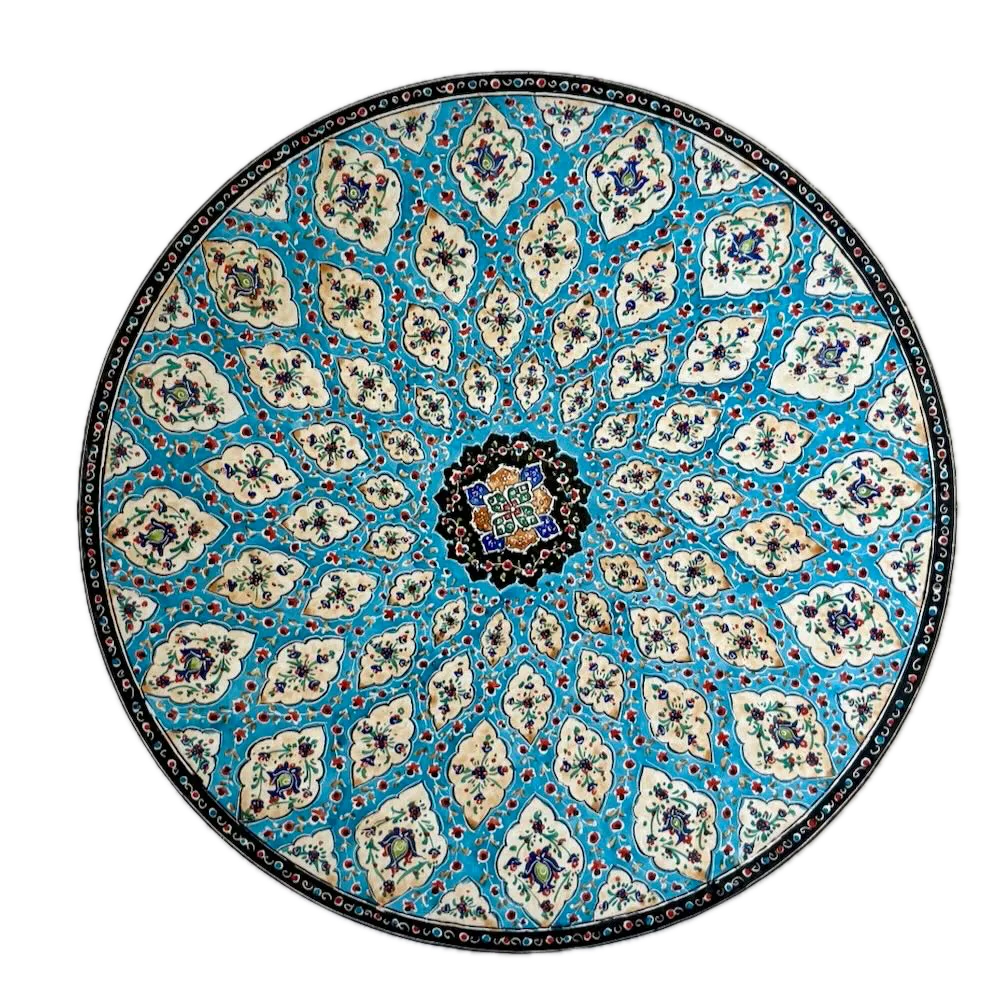
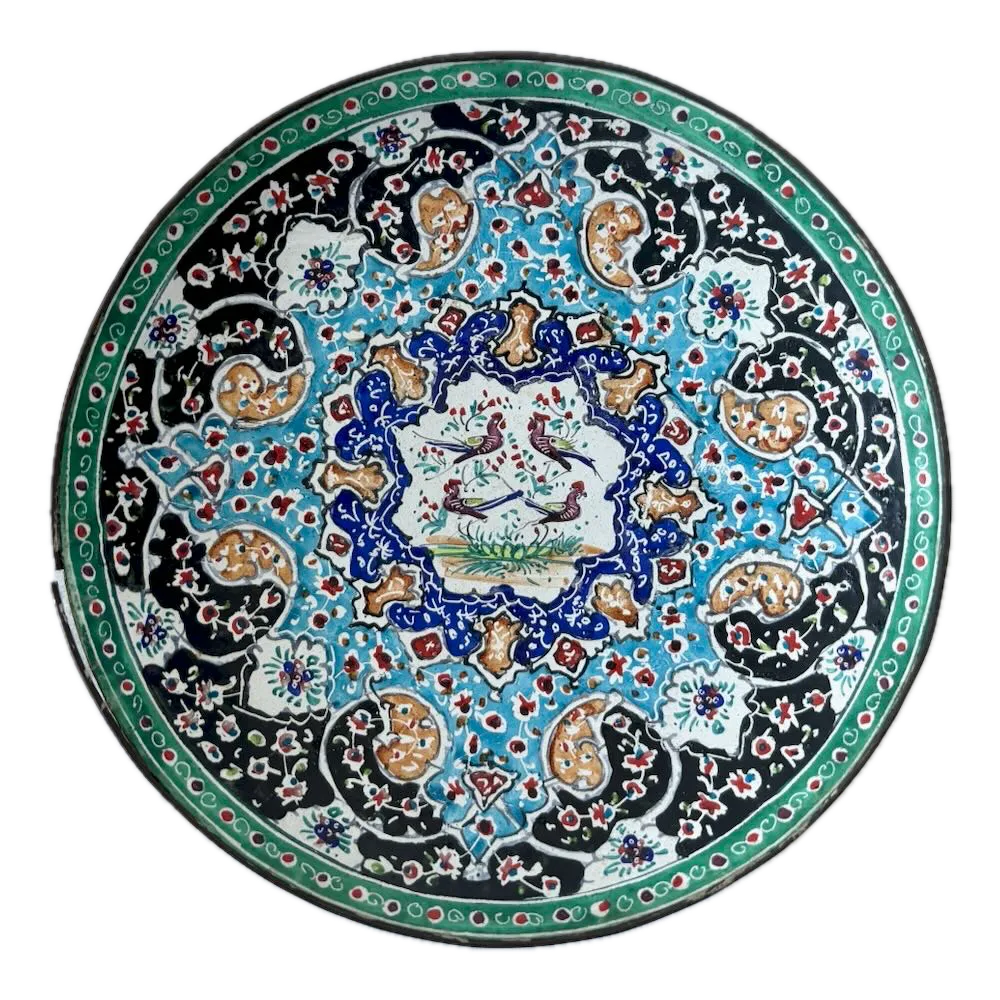
A large enamel plate often begins with a central medallion. From that point, the composition expands outward in a carefully organized system. Floral motifs repeat, shift, and interlock, creating a sense of movement without losing balance. The structure is precise. Each element relates to the whole, and nothing feels arbitrary.
The turquoise ground, so characteristic of Persian enamel, plays a crucial role. It provides both contrast and depth, allowing white reserves and fine floral details to stand out clearly. The result is a surface that feels open yet complete, intricate yet controlled.
Other variations introduce darker grounds—black, deep green, or layered tones—where the pattern becomes denser. Instead of radiating outward, the design builds inward, creating a more compact and richly textured surface. The difference is not only visual but structural, offering another way to organize the same decorative language.
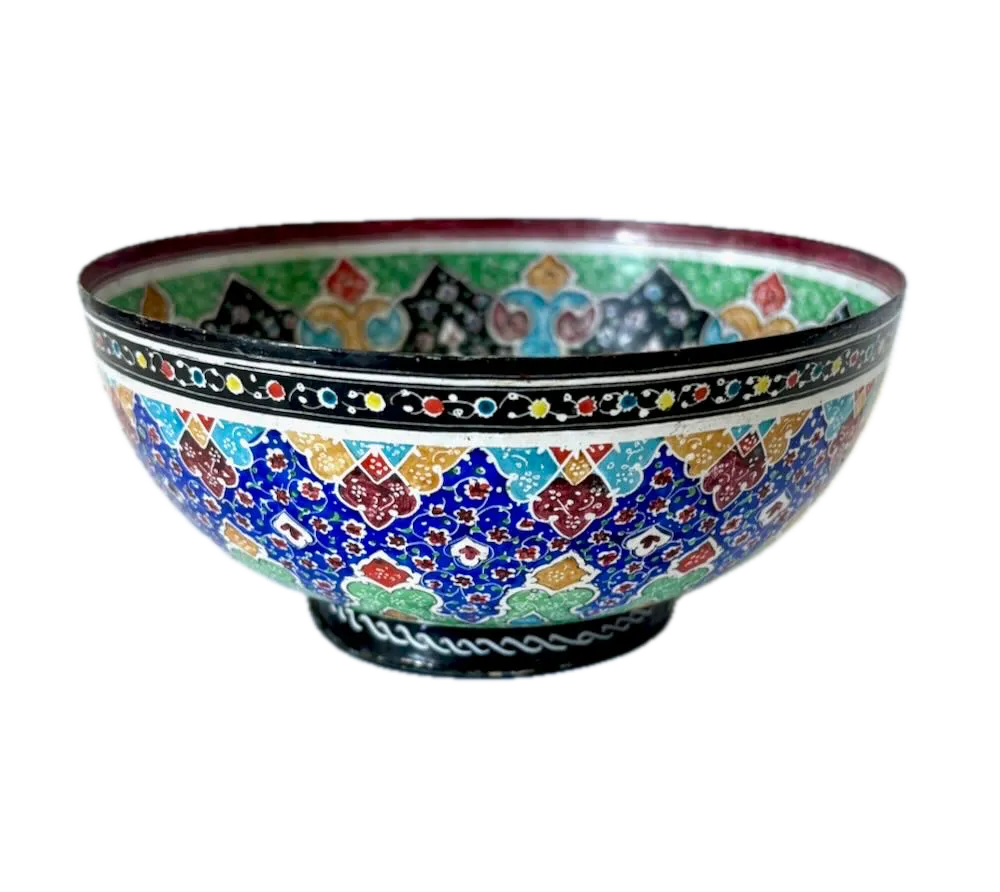
Bowls introduce a further complexity. The curvature alters the experience of the pattern. It wraps, compresses, and expands depending on the viewer’s perspective. The design is no longer taken in at once but revealed gradually, shifting with movement and light.
Across these forms, the objective remains consistent: to create a surface that is unified, continuous, and internally coherent.
Narrative Objects: The Language of Miniature
While plates and bowls emphasize structure, smaller objects—such as cases and boxes—often introduce narrative.
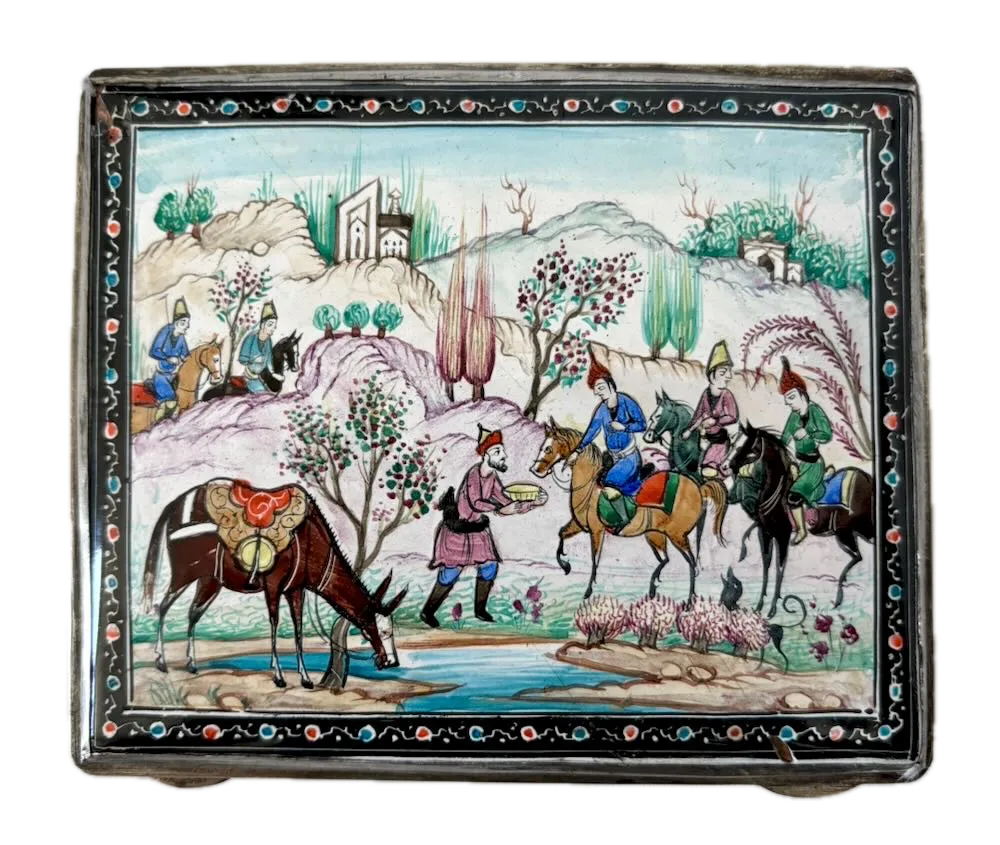
A rectangular enamel case, for example, may present a finely painted scene on one side. Figures move through a stylized landscape, arranged not by perspective but by relationship. The composition unfolds across the surface rather than receding into depth. This approach reflects the tradition of Persian miniature painting, where storytelling is layered and symbolic rather than strictly representational.
The figures themselves are often engaged in quiet action—a rider pausing, an attendant offering an object, a moment suspended rather than dramatized. The emphasis lies in the composition, in how each element contributes to the whole.
The reverse side of such an object typically shifts into dense ornament. Floral motifs, symmetrical arrangements, and repeating patterns take over, creating a surface that feels rhythmic and continuous. One of the most enduring themes is Gol-o-Bolbol—the flower and the nightingale—where the relationship between the two carries symbolic meaning tied to longing, beauty, and the poetic tradition.
Inside, the object often reveals a softer, mottled blue enamel surface. This interior is quieter, more restrained, yet still consistent with the exterior language. Even functional elements, such as retaining bands or fitted interiors, integrate into the overall design rather than interrupt it.
These objects are meant to be handled, opened, and experienced in sequence. They are not static. Their meaning unfolds through interaction.
Technique and Material
The technical process behind Minakari is as important as its visual result.
The base is typically copper, chosen for its ability to expand and contract without cracking under heat. The surface is first coated with a white enamel ground, fired multiple times to create a smooth, stable foundation. Only then does the painting begin.
Artisans use extremely fine brushes to apply the designs, working with pigments derived from mineral oxides. Cobalt produces deep blues, copper yields turquoise tones, and other compounds create reds, greens, and yellows. Each color responds differently to heat, requiring careful sequencing during application.
The final firing transforms the painted surface. The pigments melt and fuse with the base, creating a durable, glass-like finish. The brilliance of the colors is not added afterward—it emerges from the firing itself.
This process demands precision. A single miscalculation in temperature or timing can alter the outcome. Mastery lies not only in drawing but in understanding the behavior of materials under extreme conditions.
A Conversation Across Traditions
Enameling is not unique to Persia, but the approach taken in Minakari differs significantly from other traditions.
French enamel, particularly from Limoges, treats the surface more like a canvas. Layers of enamel are built gradually, allowing for shading and painterly effects. The emphasis is on image and illusion.
Russian enamel, especially cloisonné, introduces structure through metal. Fine wires divide the surface into compartments, each filled with color. The result is precise and jewel-like, with the metal framework clearly visible.
Indian meenakari, influenced by Persian techniques through Mughal exchange, often shifts toward precious materials. Gold and silver become the base, and the palette expands into richer, more saturated tones. The work frequently appears in jewelry, where color interacts with form and material in a different way.
Persian Minakari remains distinct in its balance. It relies on line and pattern to unify the surface, creating compositions that feel continuous rather than segmented or illusionistic.
Time and Surface
Minakari is durable, but it is not immune to time.
Edges may show wear. Small chips can reveal the copper beneath. These are natural outcomes of enamel as a material, not necessarily flaws. In many cases, they reflect the history of the object—its use, its handling, its movement through time.
The central design, however, tends to endure. The fired surface retains its color and clarity, preserving the original intent of the artist even as the object ages.
This combination of resilience and vulnerability gives Minakari its particular character. It is both permanent and fragile, controlled and exposed.
Conclusion
Minakari is an art of transformation. It takes metal, mineral, and fire and turns them into something that carries both structure and meaning.
Whether in a large plate, a curved bowl, or a small handheld case, the same principles apply. The surface is carefully constructed. The colors are not applied but fused. The design is not random but deeply considered.
What remains is an object that exists somewhere between function and expression—rooted in tradition, shaped by time, and defined by a quiet but unmistakable precision.