

Siam sterling silver or Thai repouseé silver tends to make a quiet impression at first, and then it stays with you. You notice the weight when you lift a tray. You see the surface shift as light moves across it. The decoration does not sit flat. It rises, recedes, and carries a sense of movement that feels deliberate rather than ornamental. That quality comes from a long tradition of metalwork, translated into objects designed for daily use and international taste.
Most collectors begin with the mark. “MADE IN SIAM STERLING” suggests age, and in some cases, rarity. It is easy to assume that anything bearing the name Siam must belong to an earlier period. In reality, many of these pieces come from the mid-20th century, produced in Bangkok workshops during a time when Thailand actively exported silver to Western buyers. The name remained because it was familiar. It carried recognition, and it sold.
Understanding Siam sterling requires a shift in focus. The mark matters, but the object matters more. You read these pieces through their construction, their surface, and the way decoration interacts with form.
The Language of the Surface
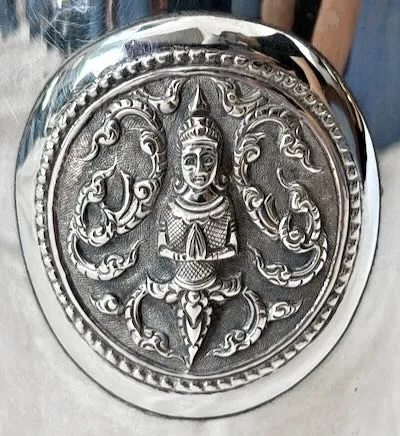
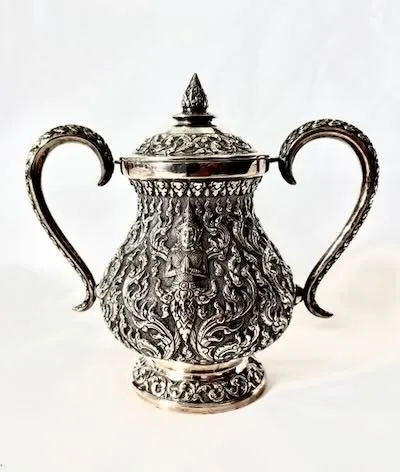
The defining feature of Siam sterling is its use of repoussé. The maker works from the reverse side of the metal, pushing forms outward before refining the detail from the front. When this process is done well, the result feels sculptural. Figures stand forward with clarity, while the background recedes just enough to create contrast.
You can see the difference immediately when you compare stronger and weaker examples. In a well-made piece, the edges remain sharp and the composition feels controlled. In a lesser one, the design appears flattened, as if pressed rather than formed. The surface loses depth, and the light no longer moves across it in the same way.
This is one of the easiest ways to judge quality, even without knowing the subject of the decoration.
The Figure and Its Meaning
At the center of many Siam sterling designs, you will find a figure seated or standing in a frontal pose, hands pressed together. This is the wai, a gesture used throughout Thai culture to express respect, greeting, and devotion. It is a quiet gesture, but a deeply meaningful one.
In decorative contexts, you will often recognize this figure as a Thep Phanom, a celestial attendant drawn from Thai temple art. Artists place these figures in murals and carvings not as dominant characters, but as part of a broader visual language of reverence. They do not act. They acknowledge.
That distinction matters. It explains why these figures appear so often in silverwork. Craftsmen adapt them easily into decorative form without losing their meaning. At the same time, many listings misidentify them. Sellers often label them as Buddha or assign them to specific Hindu deities, even when the visual details do not support that claim. A careful description stays grounded in what you can clearly see and recognize within the tradition.
Around the figure, decoration unfolds into flowing, flame-like forms known as kranok motifs. Designers draw these patterns from stylized lotus and vegetal shapes, then refine them into a more rhythmic structure. The lines create motion without chaos. They frame the stillness of the central figure while adding a sense of controlled energy. These figures appear widely in Thai temple art, as seen in major museum collections such as those of The Metropolitan Museum of Art.
Western Form, Thai Identity
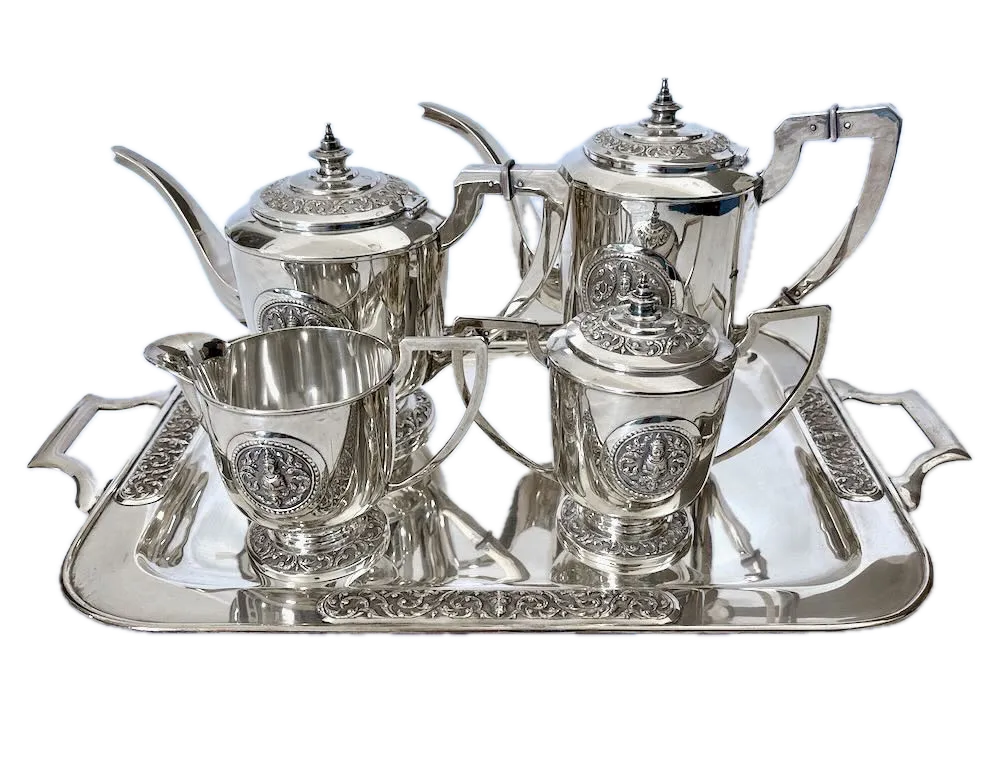
One of the most interesting aspects of Siam sterling is the way it combines familiar forms with a distinct visual identity. A tea service follows a Western model: teapot, coffee pot, creamer, sugar bowl, and tray. These are objects shaped by European tradition and expectation.
Yet the surface tells a different story. Thai silversmiths adapted these forms rather than copying them outright. They created objects that fit comfortably into Western use while preserving the decorative language of their own culture. The result feels balanced. You can use the set without explanation, but when you look closely, it reveals its origin.
A complete service usually includes several key elements:
- a teapot, often with a built-in strainer for loose-leaf tea
- a taller coffee or hot water pot
- a covered sugar bowl and a matching creamer
- a tray that anchors the entire set
- tongs, which are frequently lost over time
Completeness affects both visual impact and value. A full set presents as a single idea rather than a collection of parts.
Craftsmanship and Construction
Handling the object tells you as much as looking at it. A well-made Siam sterling piece feels solid without being heavy for its size. The walls hold their shape. The lid fits properly. The handle sits comfortably in the hand.
Several details often signal a higher level of workmanship. Gold-washed interiors appear in pieces like sugar bowls, providing both protection and contrast. Teapots may include integrated strainers, showing that the object was designed for real use. Some handles incorporate insulating elements, small inserts placed where the hand meets the metal, intended to reduce heat transfer.
These are not decorative additions. They reflect decisions made by experienced craftsmen who understood both function and presentation.
Dating and Reading the Object
Dating Siam sterling precisely can be difficult, and it is often better not to force it. The presence of “Made in Siam” alone does not place a piece in the 19th century. Most examples encountered today belong to the mid-20th century export period.
Instead of relying on marks alone, collectors look at a combination of factors:
- the depth and clarity of the repoussé work
- the weight and thickness of the metal
- the overall sharpness of the design
Earlier mid-century pieces tend to show stronger execution. Later production often appears lighter and less defined. The difference is not always dramatic, but it becomes clearer with experience.
Value and What Actually Matters
Silver always carries intrinsic value, but that is only the starting point. What matters more is how the piece was made and whether it has survived intact.
Collectors tend to focus on a few consistent factors:
- the strength and clarity of the decoration
- the presence of all original components
- the relationship between the pieces in a set
- the overall condition and usability
A matching tray plays a significant role. It ties the set together visually and reinforces its original purpose. Tongs, though small, also matter because they are often missing. Their presence suggests the set remained intact over time.
Learning to Recognize Quality
At first glance, Siam sterling can appear simply ornate. With time, the differences become clearer. You begin to see how the figure holds the composition. Follow the movement of the kranok patterns. You notice how light interacts with depth. This is where understanding develops. You move beyond labels and begin to read the object itself.
Siam sterling silver reflects a moment when traditional craftsmanship met global demand. These pieces were made to be used, but they were also made to carry meaning. That balance is what gives them their lasting appeal. A complete example of this type can be seen in this Siam sterling silver tea service.