

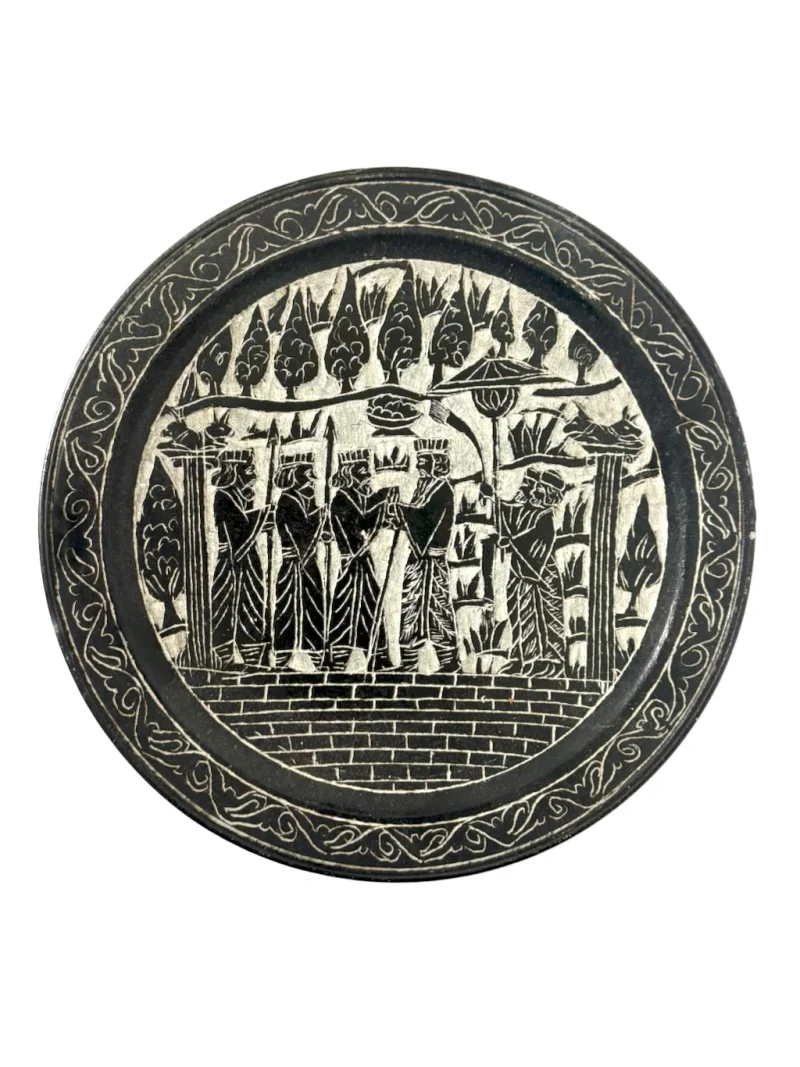
Persian stone sgraffito or sometimes spelled sgrafitto is a distinctive decorative art that combines traditional stone carving with striking contrasts of black and grey. Artisans transform carefully shaped stone vessels into intricate works of art. They create floral ornaments, geometric compositions, and historical scenes through a combination of surface treatment and precise carving. The results reveal both the beauty of natural stone and the remarkable skill of Persian craftsmen.
Among the most fascinating examples are decorative plates and bowls inspired by the ancient Achaemenid Empire. Their designs recall the monumental reliefs of Persepolis, where royal attendants, ceremonial processions, and symbolic animals appear in carefully arranged compositions. These modern interpretations connect traditional Iranian handicrafts with the visual heritage of ancient Persia.
Although sgraffito appears in several artistic traditions, Persian stone sgraffito has its own materials and methods. In particular, the chlorite workshops of Mashhad developed decorative vessels that use the natural contrast between darkened surfaces and freshly exposed stone. This technique gives even modest objects an impressive graphic presence.
The Ancient Tradition of Stone Carving in Persia
Stone has played an important role in Persian art for thousands of years. Ancient craftsmen worked with marble, alabaster, chlorite, and other materials to produce vessels, architectural elements, and decorative objects. Their work ranged from practical household utensils to elaborate ceremonial pieces.
Archaeological discoveries in southeastern Iran provide evidence of sophisticated stone carving during the third millennium BCE. Excavations at sites such as Tepe Yahya revealed workshops, unfinished objects, and stoneworking debris. These discoveries demonstrate the technical abilities of early Iranian craftsmen and the importance of stone vessels in regional artistic traditions.
The ancient settlement of Shahdad also produced remarkable carved stone objects. Among them were vessels decorated with animals and elaborate relief compositions. Such discoveries reveal the long history of artistic experimentation with stone across the Iranian plateau.
During the Achaemenid period, stone carving reached extraordinary architectural and sculptural refinement. The palaces of Persepolis featured monumental columns, carved stairways, and ceremonial reliefs. Their sculptors represented royal authority through balanced compositions, disciplined figures, and carefully organized decorative details.
However, the surviving evidence does not establish an uninterrupted history of the modern sgraffito technique from antiquity. Instead, contemporary Persian stoneworkers drew upon a much older artistic heritage while developing and preserving their own craft traditions.
Mashhad and the Persian Chlorite Tradition
Mashhad, in northeastern Iran, became an important center for decorative stoneworking. The city is widely associated with religious pilgrimage, traditional markets, and skilled handicraft production. Stone vessels formed part of this broader craft economy.
Historical documentation identifies Mashhad and Qum as two significant centers of Iranian stoneworking. Their workshops used different materials and developed distinctive products. Mashhad craftsmen worked with a relatively soft chlorite stone, typically grey with a subtle greenish character. The material could be shaped, carved, and polished using traditional tools. Its workability made it particularly suitable for decorative vessels with intricate surface designs.
Artisans also used chlorite for practical cooking vessels known as dizi. These sturdy stone pots belonged to a different branch of the same broad stoneworking tradition. Their continued production demonstrates the relationship between everyday utility and specialized craftsmanship. For finer decorative objects, Mashhad workshops produced plates, bowls, and other vessels with engraved ornamentation. Their designs included floral compositions, repeating patterns, and historical subjects. Some craftsmen favored traditional Persian ornament, while others incorporated imagery from ancient monuments.
The popularity of such objects among visitors and collectors helped preserve this distinctive form of Iranian craftsmanship during the twentieth century.
What Is Persian Stone Sgraffito?
The word sgraffito derives from an Italian term associated with scratching or scraping. In decorative art, it generally describes a technique that exposes a contrasting surface beneath an upper layer. Many people associate sgraffito with pottery. Ceramic artists often scratch through a colored slip to reveal the clay or another contrasting layer underneath. Persian stoneworkers, however, employed a different approach.
In the documented Mashhad tradition, craftsmen first treated the surface of a chlorite vessel with oil. This darkened the stone, producing a nearly black appearance. They then carved away selected areas to expose the lighter natural material beneath. The darkened, untouched portions formed the raised decorative motifs. Meanwhile, the carved background retained the stone’s natural grey appearance.
This reversal of positive and negative space is central to the technique’s visual appeal. A dark figure might emerge against a pale background, with delicate engraved lines defining its features and clothing. The finished composition resembles a graphic illustration, yet its appearance results from physical carving rather than applied paint.
Preparing the Stone Vessel
The process begins with a rough piece of stone. Craftsmen gradually reduce the material to the desired shape using hand tools and traditional turning methods. Historical photographs document artisans shaping stone with heavy picks and then refining the surfaces with smaller tools. They also show craftsmen working with a bow-powered lathe.
This traditional lathe operates through a cord wrapped around the stone. By moving the bow backward and forward, the craftsman rotates the workpiece. He can then shape and smooth its surface with a cutting tool. Such methods require patience and considerable control. The artisan must maintain the vessel’s proportions while gradually removing excess stone. Once the plate or bowl takes shape, the craftsman prepares its surfaces for decoration.
Darkening and Carving the Surface
The artisan oils the prepared stone, creating the characteristic dark appearance. This treatment establishes the contrast needed for the subsequent engraving. Next comes the most visually demanding stage. The craftsman determines which areas will remain dark and which will become the lighter background. He carefully removes selected portions of the darkened surface. The exposed stone creates a contrasting field around the design.
Fine incisions add details such as facial features, textile folds, animal anatomy, and architectural elements. These marks can be exceptionally delicate, particularly in densely populated historical scenes. The result combines broad areas of contrasting tone with intricate linear drawing. This relationship between bold silhouettes and fine engraving gives Persian stone sgraffito its distinctive character.
The Importance of Handcraftsmanship
Traditional stone sgraffito requires more than the ability to reproduce a drawing. The craftsman must understand the stone’s structure, control the depth of each cut, and maintain the composition’s balance.
Unlike painting, carving removes material permanently. Consequently, an error can alter the design or damage the surrounding surface. The technique rewards steady hands, thoughtful planning, and experience with traditional tools. Small differences between individual objects also reflect the personal decisions of their makers.
Persepolis and the Revival of Achaemenid Imagery
One of the most compelling aspects of twentieth-century Persian decorative arts is their use of ancient Achaemenid imagery. The Achaemenid Empire, founded by Cyrus the Great in the sixth century BCE, became one of the ancient world’s most influential civilizations. Its territories extended across much of western Asia and beyond.
Persepolis, established under Darius I and expanded by his successors, became an extraordinary expression of imperial architecture and royal ceremony. Its surviving reliefs remain among the most recognizable achievements of ancient Persian art. These carvings portray dignitaries, attendants, guards, and representatives of the empire’s many peoples. Their orderly arrangements communicate dignity, authority, and ceremonial purpose.
The artists also developed a distinctive visual language. Figures often appear in profile, wearing carefully detailed garments and elaborate headdresses. Their gestures are restrained, while repeated forms create a sense of rhythm and procession. Modern Persian craftsmen found a rich source of inspiration in these ancient compositions.
Royal Guards and Ceremonial Processions
Images of Achaemenid guards and attendants became particularly suitable for decorative plates and bowls. Their upright postures, distinctive headdresses, and carefully rendered garments translate effectively into carved stone. Spears, staffs, and other attributes introduce strong vertical lines that organize the composition.
On a circular plate, the artisan may arrange several figures within a decorative border. Architectural elements, trees, and stylized foliage provide additional context. The resulting scene does not necessarily reproduce a specific Persepolis relief exactly. Instead, it may combine recognizable historical elements into a new decorative interpretation. This distinction is important. Such objects celebrate ancient Persian artistic traditions without claiming to be archaeological artifacts or exact copies of surviving monuments.
The Royal Hero and Mythical Animals
Another recurring Achaemenid subject depicts a royal figure confronting a powerful animal or fantastic creature. Persepolis reliefs include dramatic scenes involving a heroic figure and animal adversaries. Scholars have interpreted these images in several ways, including royal strength, cosmic order, and the triumph over threatening forces.
Later Iranian decorative arts adapted these compositions into smaller formats. Their dramatic silhouettes work especially well on circular plates, where the figures can occupy the central field. The contrast between a human figure and a powerful animal creates immediate visual tension. Flowing garments, muscular forms, and carefully positioned limbs contribute to the composition’s movement. These motifs also demonstrate how historical imagery can acquire a renewed decorative life long after its original creation.
Decorative Styles and Persian Ornament
Not all Persian stone sgraffito features historical figures. Many examples concentrate on the ornamental traditions of Iranian art. Floral scrolls, stylized leaves, geometric arrangements, and symmetrical compositions frequently appear on plates and bowls. These designs reflect the broader vocabulary of Persian decorative arts.
Some compositions feature elaborate central medallions surrounded by repeating borders. Others organize their ornament around intersecting axes or radiating patterns. The contrast between darkened and exposed stone emphasizes the precision of these arrangements. Repeated elements create rhythm, while small variations prevent the decoration from appearing mechanical.
Floral Borders and Arabesque Motifs
Persian decorative arts have long celebrated the beauty of flowing botanical ornament. Curving stems, stylized leaves, and interwoven floral forms appear across ceramics, textiles, metalwork, and architectural decoration. Stone sgraffito adapts these motifs to the limitations and possibilities of carving.
A narrow border may contain a continuous scrolling vine. More elaborate examples feature multiple ornamental bands surrounding a central composition. These borders serve both decorative and structural purposes. They frame the principal design and create a transition between the central image and the vessel’s outer edge. On plates featuring Achaemenid scenes, floral borders can soften the formality of the historical imagery. They also connect the ancient subject with later Persian decorative traditions.
Persian Stone Vessels as Decorative Art
The appeal of Persian stone sgraffito lies partly in its unusual combination of material and imagery. Stone gives the objects substance and permanence. Their carved decoration introduces an unexpected delicacy, especially when the artisan includes numerous figures or fine ornamental details.
A plate may resemble a monochromatic illustration when viewed from above. However, its thickness, weight, and carved surface reveal its sculptural character. Bowls offer another opportunity for artistic expression. Their curved exterior allows figures and decorative motifs to unfold around the vessel.
As the viewer turns the bowl, new elements enter the composition. This continuous arrangement makes the decoration particularly engaging. Although traditional stone vessels sometimes served practical purposes, finely decorated sgraffito pieces are especially attractive as display objects. Their strong contrast makes them effective in both traditional and contemporary interiors.
Collecting Vintage Persian Stone Sgraffito
Twentieth-century Persian stone sgraffito occupies an interesting place among traditional handicrafts and decorative collectibles. These objects represent skilled regional workmanship while reflecting a renewed interest in Iran’s artistic heritage. Their appeal extends to collectors of Persian art, carved stone, and historically inspired decorative objects.
When examining a piece, the quality of the carving deserves particular attention. Well-executed examples display clear silhouettes, balanced compositions, and carefully controlled incised details. The treatment of figures is especially revealing. Faces, garments, and small accessories can demonstrate the craftsman’s ability to work within a limited decorative space. The overall arrangement also matters. A successful composition uses the vessel’s shape effectively rather than treating it as a flat surface.
Materials, Dating, and Attribution
Mashhad chlorite provides a documented historical basis for identifying this type of stonework. However, appearance alone cannot conclusively establish the geological composition of every individual object. Similarly, an Achaemenid subject does not determine the age of the vessel. Craftsmen continued to reproduce and reinterpret ancient Persian imagery during the twentieth century.
Many traditional handicrafts carry no maker’s signature. In such cases, collectors must rely on workmanship, materials, provenance, and comparisons with documented examples. Historical photographs and publications are particularly useful. They can establish that certain materials, techniques, and decorative forms belonged to an identifiable craft tradition. Nevertheless, they should not be used to assign an exact date or workshop without additional evidence.
The Appeal of Individual Craftsmanship
Hand-carved objects often reveal subtle variations in line, proportion, and surface finish. These characteristics contribute to their individuality. Collectors may prefer complex historical scenes, while others favor floral and geometric ornament. Both approaches demonstrate the versatility of Persian stone sgraffito. For many enthusiasts, the most rewarding examples combine confident craftsmanship with a memorable composition.
Caring for Carved Chlorite Objects
Carved stone vessels benefit from careful handling and stable display conditions. Although chlorite can appear substantial, it is relatively soft compared with many other decorative stones. Sharp impacts and abrasive cleaning materials can damage carved details.
Use a soft, dry cloth or a gentle brush to remove loose dust. Avoid harsh chemicals, aggressive scrubbing, and prolonged exposure to water. Because traditional examples may have oil-treated surfaces, cleaning products can also alter their appearance. Collectors should avoid applying new oils, waxes, or polishing compounds without appropriate conservation advice.
Display plates and bowls on secure supports that distribute their weight evenly. Avoid placing pressure on delicate rims or projecting details. With thoughtful care, these objects can retain their distinctive surfaces and intricate craftsmanship for generations.
A Continuing Expression of Persian Artistic Heritage
Persian stone sgraffito demonstrates how traditional craftsmanship can connect different periods of artistic history. Its materials belong to a long Iranian stoneworking tradition. Its methods reflect the practical knowledge of skilled artisans. Meanwhile, its decorative subjects often look back to the monumental achievements of ancient Persia.
The combination is particularly compelling in twentieth-century plates and bowls inspired by Persepolis. Ancient guards, ceremonial figures, and symbolic animals gain new life through carefully carved stone. At the same time, floral and geometric examples demonstrate the enduring appeal of Persian ornament.
These works deserve appreciation not merely as souvenirs or decorative accessories, but as expressions of regional craftsmanship. They preserve the relationship between material, technique, and artistic imagination that defines so much of Iran’s decorative heritage. For collectors and admirers of Persian art, carved chlorite vessels offer a tangible connection to that tradition. Their distinctive black-and-grey compositions make them recognizable, while their individual workmanship gives each piece its own character.