

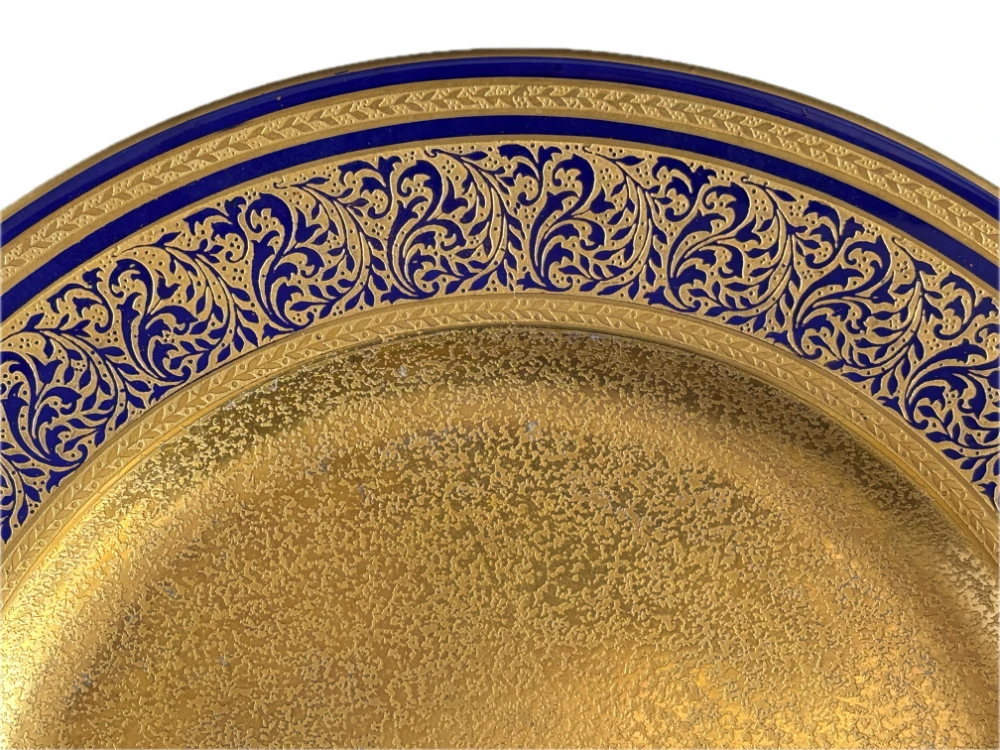
Acid-textured, often called encrusted or raised gold decoration, stands as one of the most luxurious and technically demanding finishes in fine porcelain. When you see it, you recognize it immediately. The surface catches light in a soft, granular way. It feels slightly textured under the fingertips. It signals craftsmanship, expense, and intent. This is not everyday tableware. It is decoration designed to impress.
Collectors often encounter this finish on cobalt blue and ivory grounds, where the contrast heightens the richness of the gold. The effect feels both classical and dramatic. It draws from European decorative traditions but reached a refined peak in English porcelain during the late 19th and early 20th centuries.
What Acid-Textured Gold or Encrusted Really Means
The term “acid-textured” refers to a specific method used to prepare the porcelain surface before applying gold. Artisans did not simply paint gold onto a smooth glaze. Instead, they altered the surface first. They used controlled acid etching to create a slightly recessed or roughened area. This prepared ground allowed the gold to grip more firmly and build texture.
After etching, decorators applied layers of gold paste. They fired the piece, then often burnished or worked the surface to achieve contrast between matte and polished areas. The result is what collectors describe as “encrusted” gold. It appears thicker, deeper, and more dimensional than flat gilding.
This process required precision at every step. Too much etching could damage the porcelain. Too little would not hold the gold properly. The balance defined the final quality.
Why It Became a Mark of Luxury
Manufacturers did not use this technique for ordinary production. It required time, skilled labor, and expensive materials. Gold itself added significant cost. The multi-step process increased production time and risk.
Because of this, factories reserved acid-textured gilding for high-end wares. These pieces often served as cabinet plates, presentation items, or formal dining services. They were meant to be displayed as much as used.
During the height of its popularity, this finish aligned with the tastes of the Gilded Age. Wealthy buyers wanted richness, depth, and visible craftsmanship. Acid-textured gold delivered all three.
English Factories That Perfected the Technique
Several English porcelain factories embraced and refined this method, especially in Staffordshire, the historic center of British ceramics.
Crown Staffordshire stands out as one of the most recognized names associated with encrusted gold work. Their pieces often feature deep cobalt grounds paired with intricate scrollwork and heavy gilding. Many of their early 20th-century plates and services display the classic combination of acid-textured gold and neoclassical motifs.
Minton also produced exceptional examples. Known for innovation and technical excellence, Minton used raised gilding to elevate their most elaborate designs. Their work often blends refined patterning with strong architectural balance.
Coalport contributed significantly as well. Their pieces frequently show rich gilding layered over colored grounds, with a slightly softer aesthetic but equal attention to detail.
Royal Crown Derby brought its own interpretation. While often associated with Imari-style decoration, the factory also produced heavily gilded wares that reflect similar techniques and craftsmanship.
Spode and Copeland occasionally used encrusted gold in their higher-end production, particularly for export markets where demand for ornate decoration remained strong.
These factories did not always name their patterns. Instead, they identified them through internal pattern numbers. That makes exact identification more complex today, but the visual language remains unmistakable.
The Role of Cobalt Blue and Contrast
You will often see acid-textured gold paired with cobalt blue. This pairing was not accidental. The deep blue provides a dramatic backdrop that enhances the brilliance of gold. It creates contrast, depth, and visual weight.
Designers used this combination to frame borders, highlight scrollwork, and define the structure of a plate or service piece. The gold appears richer against the dark ground. The texture becomes more visible. The entire piece feels more dimensional.
This color pairing became a signature look for luxury porcelain, especially in export markets such as the United States.
Cabinet Ware and Display Culture
Many acid-textured pieces fall into the category of “cabinet ware.” This term refers to objects created primarily for display rather than daily use. Owners placed them in cabinets, on stands, or within formal dining rooms.
These pieces often feature elaborate borders, restrained centers, and highly controlled symmetry. The decoration draws the eye outward, encouraging appreciation of craftsmanship and detail.
Even when used at the table, they appeared during special occasions. They communicated status, taste, and refinement.
Influence of Retailers and Global Markets
During the late 19th and early 20th centuries, luxury retailers played an important role in shaping design trends. High-end stores in cities like London and New York sourced fine porcelain from English factories.
These retailers often requested specific styles. They favored rich gilding, strong contrast, and decorative impact. As a result, factories produced lines that aligned with these expectations.
While not every piece carries a retailer’s mark, the style itself reflects this broader demand. The aesthetic speaks to a global market that valued craftsmanship and visual richness.
Identifying Encrusted or Acid-Textured Gilding Today
When you examine a piece, look closely at the gold. Flat gilding appears smooth and reflective. Encrusted gold shows texture. It may look slightly granular or raised. Light scatters across it rather than reflecting evenly.
You can also feel the difference. Run your finger lightly across the surface. A textured area will feel subtly uneven, almost like fine sand beneath a polished finish.
Look for contrast between matte and polished sections. Skilled decorators often combined both to create depth within the same design.
Backstamps help with identification, but they do not always tell the full story. Many pieces rely on style, technique, and quality to reveal their origin.
Care and Preservation of Encrusted Gold
These pieces require careful handling. The gold layer, while durable, can wear over time if treated roughly. Avoid dishwashers and harsh cleaning agents. Use mild soap, lukewarm water, and a soft cloth.
Do not scrub textured areas. Instead, clean gently and dry immediately. Store pieces with separation to prevent abrasion.
Proper care preserves both appearance and value. Over time, even light wear can soften the texture, so gentle handling remains essential.
Enduring Appeal in the Modern Market
Acid-textured gilding continues to attract collectors because it combines artistry with craftsmanship. Each piece reflects a level of effort that modern mass production rarely matches.
The finish also bridges decorative styles. It feels classical, yet bold. It suits both traditional interiors and curated modern spaces.
Collectors value these pieces for their visual impact, historical context, and technical complexity. Whether displayed individually or as part of a set, they hold attention and reward close inspection.
A Craft That Defined an Era
Acid-textured encrusted gold represents more than decoration. It reflects a moment in ceramic history when craftsmanship, material, and design aligned at a high level. English factories, especially in Staffordshire, refined the process and produced pieces that still resonate today.
When you hold one of these plates, you see the result of multiple skilled hands. You see intention in every line and surface. Most of all, you see how technique transforms simple materials into objects of lasting beauty.