

Rosenthal porcelain occupies a unique position in the history of European ceramics. Few manufacturers have managed to balance tradition and innovation so consistently, evolving from a small porcelain painting workshop in Bavaria into a global design house associated with some of the most influential artists and designers of the 20th century.
At the heart of this evolution lies a philosophy articulated by Philip Rosenthal: “He who believes he is something has ceased to become something.” It is a statement not of confidence, but of continuous reinvention—a principle that shaped the company’s identity across generations.
From Workshop to Global Brand
The Rosenthal story begins in 1879, when Philipp Rosenthal established a porcelain painting business in Selb, Germany. Initially decorating blanks sourced from other manufacturers, the company quickly grew, opening its own factory in 1891.
By the early 20th century, Rosenthal had already distinguished itself through its commitment to both quality and progressive thinking. In 1910, it established its own Kunstabteilung (Art Department)—a significant move that placed artistic production at the core of the company’s identity rather than at its margins.
This decision set Rosenthal apart. While many porcelain manufacturers focused on scale and repetition, Rosenthal created space for experimentation, individual artistry, and higher-end decorative work.
The Kunstabteilung: Where Porcelain Becomes Art
The Kunstabteilung Selb represents one of the most important aspects of Rosenthal’s legacy. Pieces produced under this designation were not standard factory wares but part of a more elevated artistic output.
These works often feature:
- hand-painted decoration (Handgemalt)
- richer, more complex surface treatments
- unique or less conventional forms
- and visible evidence of the decorator’s hand
Rather than simply applying a pattern, artists working within the Kunstabteilung interpreted designs, introducing subtle variation and individuality into each piece.
This approach bridges the gap between functional porcelain and studio art, and it is within this context that patterns like Zaubergarten should be understood.
Zaubergarten: A Painterly Approach to Porcelain
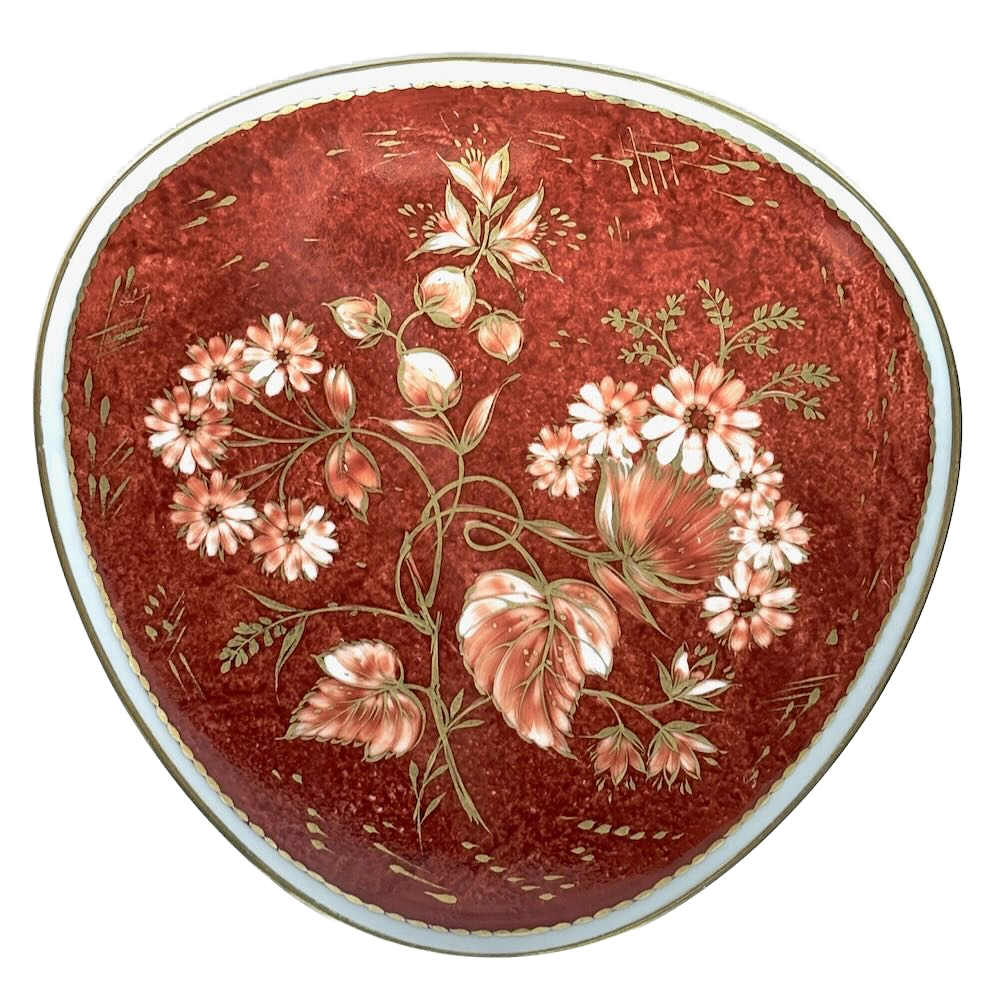
The Zaubergarten (“Magic Garden”) pattern reflects Rosenthal’s mid-20th-century embrace of expressive surface design. Unlike traditional repeating patterns, Zaubergarten compositions feel fluid and organic.
A defining characteristic is the richly mottled ground—typically in deep red, rust, or rose tones—which creates depth beneath the decoration. Floral elements emerge from this layered surface, connected by fine gilded lines that guide the eye across the composition.
Because the decoration is hand-applied, each piece carries slight variation. Differences in tone, brushwork, and intensity give the pattern a painterly quality, reinforcing its connection to the Kunstabteilung’s artistic objectives.
Forms also evolved during this period. Alongside traditional shapes, Rosenthal introduced softer, more sculptural formats, including subtly triangular or asymmetrical plates. These forms align with mid-century design sensibilities, where decorative objects were increasingly valued for display as well as function.
From Decoration to Design: Bjørn Wiinblad and Romanze
While Zaubergarten represents a painterly, surface-driven approach, Rosenthal’s later collaborations demonstrate a shift toward more graphic and narrative design.
One of the most recognizable contributors to this evolution is Danish artist Bjørn Wiinblad, whose work for Rosenthal introduced a distinctive visual language. His Romanze line, characterized by flowing linework and romantic figural compositions, reflects a different but complementary direction—less about surface texture, and more about storytelling and form.
Where Zaubergarten invites close inspection through layered color and gilding, Romanze engages through line, rhythm, and composition. Together, they illustrate the breadth of Rosenthal’s artistic range during the mid-20th century and beyond.
Reading Rosenthal Marks
Rosenthal porcelain provides a relatively rich system of marks, offering insight into both production and decoration.
Key elements often include:
- the Rosenthal crown and crossed rods mark
- the designation Kunstabteilung Selb (Art Department production)
- Handgemalt, indicating hand-painted decoration
- pattern names such as Zaubergarten
- impressed model or form numbers
- and small painted letters identifying decorators
These markings allow collectors to connect each piece not only to the factory but also to its artistic context.
Collecting Rosenthal Today
Rosenthal’s broad production means that not all pieces carry equal weight in the market. However, certain characteristics consistently attract interest:
- hand-painted decoration
- association with the Kunstabteilung
- strong visual surface (color, gilding, composition)
- less common forms
- and good overall condition
Patterns like Zaubergarten appeal to collectors who value decorative richness and painterly surfaces, while designer collaborations such as Wiinblad’s Romanze attract those interested in modernist and artistic expression.
A Legacy of Reinvention
Rosenthal’s continued relevance lies in its ability to adapt without losing its identity. From early hand-painted wares to Bauhaus collaborations and later partnerships such as Rosenthal meets Versace, the company has consistently explored new ways to engage with design.
Zaubergarten and Romanze, though different in execution, share a common foundation: they reflect a belief that porcelain can be more than functional—it can be expressive, narrative, and evolving.
That idea continues to define Rosenthal today, and it is what makes these pieces not only collectible, but enduring.