


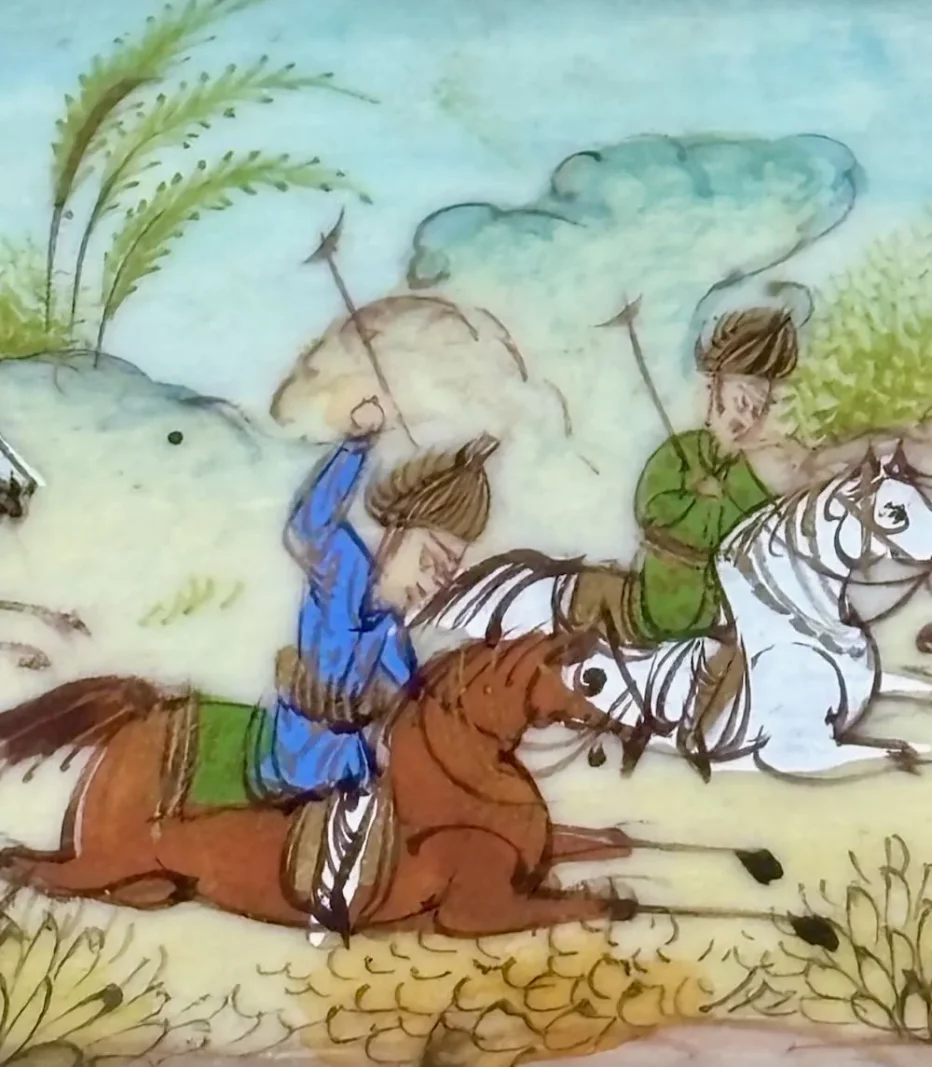
Few sporting traditions possess a history as rich and influential as Chogan, the ancient Persian game that gave rise to modern polo. For centuries, Persian kings, princes, military commanders, and noble families played the game not only for recreation but also as a demonstration of horsemanship, strategy, discipline, and leadership. Artists, poets, and craftsmen celebrated Chogan in manuscripts, paintings, textiles, ceramics, and decorative objects, ensuring that the sport became deeply woven into the fabric of Persian culture.
Today, many people recognize polo as an international sport played on manicured fields around the world. Far fewer realize that its origins lie in ancient Persia, where riders thundered across open grounds long before the game reached India, Central Asia, China, or Europe. Persian miniature paintings preserve some of the most beautiful visual records of this tradition. Through these remarkable works of art, we can still witness the excitement, elegance, and cultural significance of a game that captivated generations.
The Ancient Origins of Chogan
The history of Chogan stretches back more than two thousand years. Historians generally agree that the game developed in ancient Persia, where skilled horsemanship formed an essential part of military and aristocratic life. Horses played a vital role in transportation, warfare, communication, hunting, and ceremonial activities. As a result, riding skills carried enormous importance throughout Persian society.
Many scholars believe that Chogan originally served as a form of military training. Riders learned to maneuver at speed, coordinate with teammates, maintain control of their horses, and react quickly to changing situations. These same abilities proved valuable on the battlefield. Over time, however, the game evolved beyond its practical origins and became a popular courtly pastime.
Persian rulers embraced the sport enthusiastically. Royal courts organized matches that attracted nobles, military leaders, and spectators. Participation reflected both social status and personal accomplishment. Success required physical skill, tactical awareness, courage, and an exceptional relationship between rider and horse.
As Persian influence expanded across neighboring regions, Chogan spread as well. Variations of the game appeared throughout Central Asia and beyond, carrying Persian traditions into new cultural settings while retaining their essential character.
Why Persian Kings Loved the Game
To understand the importance of Chogan, it helps to understand the values admired by Persian rulers and aristocrats. The ideal nobleman combined physical ability with intelligence, refinement, discipline, and self-control. Chogan provided an opportunity to display all of these qualities simultaneously.
A successful player required more than strength. He needed to anticipate movements, coordinate with teammates, manage his horse, and make rapid decisions under pressure. Victory depended upon judgment and strategy as much as athletic ability. These characteristics mirrored the qualities expected of effective leadership.
Court chronicles often describe rulers participating in matches or sponsoring competitions. Such events reinforced social bonds while showcasing the ruler’s abilities before the court. Spectators admired both the athletic performance and the elegance of the participants. Fine horses, luxurious garments, and ceremonial equipment transformed matches into impressive public spectacles.
The game also reflected broader Persian ideals concerning balance and mastery. Riders sought harmony between human skill and animal power. The finest players appeared effortless even while performing difficult maneuvers at speed. This combination of discipline and grace appealed strongly to Persian artistic and literary traditions.

Chogan in Persian Literature
Persian poets frequently incorporated Chogan into their works. The game provided a rich source of imagery that writers adapted for romantic, philosophical, and spiritual themes.
In classical Persian poetry, the polo ball often symbolized the human soul, destiny, or the lover drawn irresistibly toward the beloved. The mallet represented the forces that shape human experience, while the movement of the game suggested the unpredictable nature of life itself. These metaphors allowed poets to transform a familiar sporting activity into a vehicle for deeper reflection.
The great Persian poet Nizami included references to Chogan in his celebrated romantic epics. Courtly audiences immediately recognized these allusions because the sport formed a visible part of elite culture. The imagery carried emotional and symbolic significance far beyond the playing field.
Persian literature frequently connected horsemanship, noble conduct, and personal excellence. Chogan embodied these ideals perfectly. Consequently, references to the game appear throughout Persian literary traditions, reinforcing its status as both a sport and a cultural symbol.
Chogan and the Art of Persian Miniature Painting
Few artistic traditions captured the excitement of Chogan more effectively than Persian miniature painting. These highly detailed works transformed sporting events into vibrant visual narratives filled with movement, color, and energy.
Miniature painters faced a unique challenge. They needed to portray speed and action within a static image while maintaining the elegance and balance characteristic of Persian art. Their solutions often proved remarkably inventive. Riders gallop across the page, horses twist dynamically through the composition, and spectators observe from pavilions, gardens, or palace terraces. Every figure contributes to the overall sense of activity.
Artists paid particular attention to horses. Persian painters possessed a deep appreciation for equine beauty and movement. They carefully rendered musculature, posture, harnesses, and decorative trappings. Each horse appears individualized, displaying its own character and temperament.
The surrounding environment often receives equal attention. Landscapes include flowering trees, rolling hills, gardens, streams, and architectural details. Rather than functioning merely as backgrounds, these elements create a complete visual world in which the action unfolds.
Many surviving Chogan scenes date from the Timurid and Safavid periods, two of the most celebrated eras in Persian painting. Royal workshops attracted exceptional artists who refined the miniature tradition to extraordinary levels of sophistication. Their works remain among the finest achievements in the history of book illustration.
Horses at the Heart of Persian Culture
The prominence of Chogan in Persian art reflects a broader cultural appreciation for horses. Throughout Iranian history, horses symbolized nobility, freedom, strength, and refinement. They appear frequently in literature, painting, metalwork, and decorative arts.
Persian horse breeding earned widespread admiration throughout the ancient and medieval worlds. Certain regions became known for producing animals prized for endurance, agility, and beauty. These qualities made them ideal companions for both warfare and sport.
Artists often used horses to communicate status and character. Royal figures typically ride magnificent mounts adorned with elaborate equipment. The relationship between rider and horse becomes a visual expression of harmony, discipline, and mutual trust.
In Chogan scenes, this relationship occupies center stage. The game could not exist without skilled riders mounted on responsive, athletic horses. Consequently, miniature painters devoted considerable attention to depicting both with accuracy and elegance.
Beyond Manuscripts: Chogan in Persian Decorative Arts
The popularity of Chogan extended far beyond illustrated manuscripts. As Persian artists adapted miniature painting traditions to other media, scenes of polo players and horsemen appeared across a wide range of decorative objects.
Metalworkers engraved riders pursuing the ball onto trays, vessels, plaques, and decorative panels. Ceramic artists painted polo scenes on tiles and plates. Textile designers incorporated mounted figures into intricate patterns suitable for luxury fabrics and embroideries.
During the Qajar period and later, miniature painters frequently transferred Chogan imagery onto lacquer objects such as pen cases, mirror cases, jewelry boxes, and decorative plaques. These portable works allowed collectors to enjoy traditional subjects outside the context of books and manuscripts.
The theme remained popular well into the twentieth century. Artists continued to create Chogan scenes on ivory substitutes, bone, mother-of-pearl, and other decorative surfaces intended for display. These works appealed both to local patrons and to visitors fascinated by Persian artistic traditions.
As a result, collectors today encounter Chogan imagery in many different forms. The subject serves as a bridge connecting Persian sport, literature, history, and decorative art.
From Persia to the Modern World
Although Chogan originated in Persia, its influence eventually spread across much of the world. The game traveled eastward through Central Asia and into China, where it became popular among imperial elites. Variations also appeared throughout the Indian subcontinent.
Centuries later, British observers encountered polo in India and introduced the sport to Europe during the nineteenth century. Modern polo evolved from these traditions, eventually becoming an international sport played on several continents.
Despite these transformations, the Persian origins of the game remain widely acknowledged. In recent years, scholars and cultural institutions have devoted increasing attention to preserving and promoting awareness of Chogan’s historical significance. The game stands as one of Persia’s most enduring contributions to world sporting culture.
Why Collectors Appreciate Chogan Scenes Today
Collectors often gravitate toward Chogan scenes because they combine multiple themes that define Persian art. They showcase magnificent horses, elegant costumes, dynamic movement, courtly culture, and exceptional craftsmanship within a single composition.
These works also tell a story. Unlike purely decorative motifs, a Chogan scene captures a specific activity rooted in history and tradition. Viewers can appreciate the image aesthetically while also engaging with its cultural context.
The finest examples reveal extraordinary artistic skill. Whether painted on a manuscript page, engraved into metal, or rendered on a decorative plaque, successful compositions balance complexity with clarity. Every figure contributes to a carefully organized visual narrative.
For collectors interested in Persian art, Chogan scenes offer a compelling connection to the values, traditions, and achievements of Iranian civilization. They celebrate athletic excellence while preserving an important chapter in cultural history.
An Enduring Legacy of Art and Tradition
The story of Chogan demonstrates how a sport can become far more than a game. What began as a form of horsemanship and military training evolved into a symbol of nobility, refinement, and cultural identity. Persian rulers embraced it, poets celebrated it, and artists immortalized it through some of the most beautiful works ever produced in the Islamic world.
Today, Persian miniature paintings continue to preserve the excitement of riders racing across the field in pursuit of the ball. Decorative objects carry the same imagery onto metal, ceramics, textiles, and luxury goods. Through these works, modern audiences can still experience the energy and elegance that made Chogan one of Persia’s most beloved traditions.
Its influence survives not only in museums and collections but also in the modern sport of polo itself. Every match played today carries a distant connection to the royal courts and artistic workshops of Persia, where the ancient game first inspired generations of riders, poets, and artists.
While researching the history of Chogan, we were fortunate to study an early twentieth-century Persian miniature depicting the ancient royal game. Hand-painted on natural bone and acquired in Iran during the 1920s–1930s, it illustrates many of the artistic traditions discussed in this article, including dynamic horsemanship, elegant composition, and the enduring importance of Chogan within Persian culture. You can explore this remarkable miniature in our Early Persian Chogan (Polo) Miniature on Bone c. 1920–1935, where we examine the artwork, its craftsmanship, and its historical context in greater detail.