

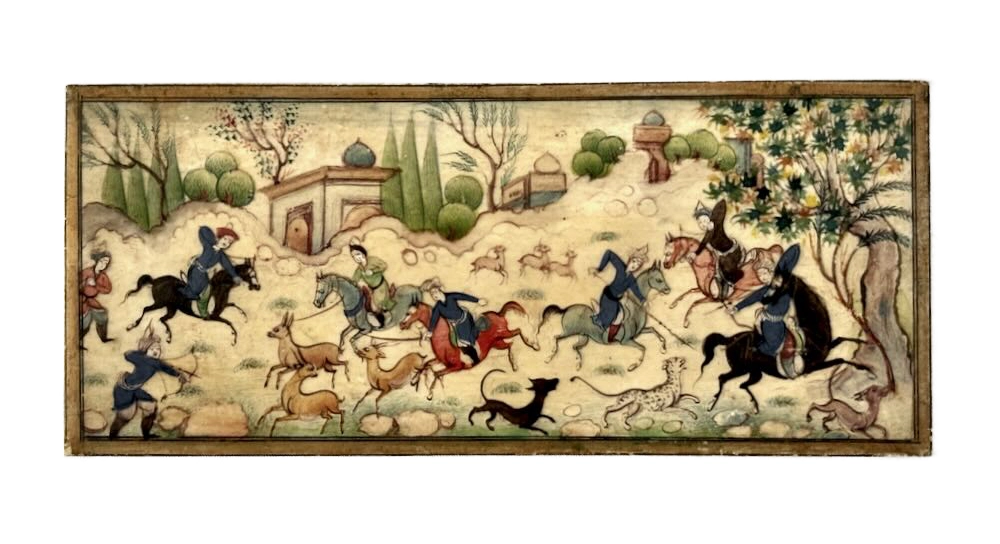
Persian miniature painting stands among the most refined artistic traditions in world history. Delicate brushwork, luminous colors, intricate detail, and poetic storytelling define an art form that flourished for centuries across Persia, modern-day Iran, and neighboring regions. Unlike many Western painting traditions that sought realism and perspective, Persian miniatures pursued beauty, symbolism, and narrative harmony. Artists created idealized worlds where heroes hunted across golden landscapes, lovers met in flowering gardens, kings presided over magnificent courts, and legendary stories unfolded in scenes rich with movement and meaning.
Today, Persian miniatures attract collectors, historians, and art enthusiasts around the world. Their influence extends far beyond illustrated manuscripts. The same artistic language appears on lacquer boxes, pen cases, ceramics, textiles, jewelry, mother-of-pearl plaques, and decorative objects. Understanding the history and symbolism of Persian miniature painting provides valuable insight into Persian culture and helps explain why these works continue to fascinate viewers centuries after their creation.
The Origins of Persian Miniature Painting
The roots of Persian miniature painting reach deep into the history of Iran. Ancient Persian civilizations celebrated visual storytelling long before miniature painting emerged as a distinct art form. Relief carvings at Persepolis, Sassanian silver vessels, textiles, and illuminated manuscripts all contributed elements that later artists incorporated into miniature painting.
The miniature tradition began to develop in a recognizable form during the medieval Islamic period. Persian scholars translated scientific, literary, and historical texts into richly illustrated manuscripts. Artists decorated these books with colorful scenes that helped readers visualize stories and events. Over time, painters moved beyond simple illustration and developed a highly sophisticated artistic language of their own.
The Mongol conquest of Persia in the thirteenth century brought significant changes. Although the invasion caused immense destruction, it also introduced artistic influences from Central Asia and China. Persian artists adapted these new ideas while preserving their own traditions. As a result, miniature painting evolved rapidly during the Ilkhanid period and reached new levels of refinement. By the fifteenth century, Persian miniature painting had become one of the most prestigious forms of artistic expression in the Islamic world.
The Golden Age of Persian Miniatures
The fifteenth and sixteenth centuries marked the golden age of Persian miniature painting. Powerful rulers supported artists through royal workshops known as kitabkhanas, where painters, calligraphers, illuminators, and bookbinders collaborated on luxury manuscripts.
Several artistic centers gained international fame during this period. Herat emerged as one of the most important centers under the Timurids. Artists there developed extraordinary levels of detail and sophistication. Their compositions displayed remarkable balance while maintaining a sense of movement and vitality.
Tabriz flourished during the Safavid period. Royal patronage attracted leading painters from across Persia. The city produced some of the finest illustrated manuscripts ever created, including lavish copies of the Shahnameh, the Persian Book of Kings.
Later, Isfahan became the artistic capital of Persia. Painters there explored new styles and subjects. Single-page paintings gained popularity alongside traditional manuscript illustrations. Artists focused increasingly on individual figures, courtly scenes, and elegant portraits.
These centers did not compete in isolation. Artists traveled between courts, exchanged ideas, and influenced one another. As a result, Persian miniature painting developed a remarkable combination of regional variety and artistic unity.
The Masters Who Defined the Tradition
Great artistic traditions often depend upon exceptional individuals, and Persian miniature painting produced many masters whose work continues to inspire admiration.
Among them, Kamal ud-Din Behzad occupies a special place. Many historians consider him the greatest Persian miniature painter. Active during the late fifteenth century, Behzad transformed narrative painting through dynamic compositions and psychological depth. His figures appear lively and expressive rather than static and decorative. He organized complex scenes with remarkable clarity, allowing viewers to follow multiple actions within a single composition.
Another influential master was Sultan Muhammad, who worked during the Safavid period. His paintings display extraordinary imagination and technical brilliance. Rich colors, intricate landscapes, and dramatic storytelling characterize many of his finest works.
Reza Abbasi emerged as the leading artist of the Isfahan school during the early seventeenth century. He introduced a more intimate style that emphasized elegant individuals rather than crowded narrative scenes. His graceful figures and refined line work influenced generations of artists. These painters did more than create beautiful images. They established artistic standards that shaped Persian painting for centuries and influenced neighboring traditions in Ottoman Turkey, Mughal India, and Central Asia.
The Materials Behind Persian Miniatures
Part of the enduring appeal of Persian miniatures comes from the remarkable materials artists employed. Traditional painters worked with pigments derived from natural sources. These materials produced vibrant colors that often remain brilliant centuries later. Blue frequently came from lapis lazuli, a semi-precious stone prized throughout the ancient world. Artists ground the mineral into powder and transformed it into one of the most luxurious pigments available.
Green pigments often originated from malachite and other minerals. Red came from organic dyes, minerals, or insect-derived pigments. Gold played an especially important role. Artists applied gold leaf or powdered gold to create luminous highlights, decorative borders, architectural details, and celestial elements.
Fine brushes allowed painters to render astonishingly small details. Some brushes contained only a few hairs, enabling artists to create lines so delicate that they remain impressive even under magnification. The painting surface varied according to the intended purpose of the work. Traditional manuscript pages used carefully prepared paper. Decorative objects sometimes incorporated ivory, bone, lacquer, wood, or mother-of-pearl. Regardless of the material, artists prepared the surface meticulously before applying color.
Stories at the Heart of Persian Miniatures
Persian miniature painting developed primarily as a narrative art form. Artists illustrated stories that held deep cultural significance and transformed literature into visual experiences.
The Shahnameh, written by the poet Ferdowsi around the year 1000, provided one of the richest sources of imagery. This epic recounts the legendary history of Persia through heroic battles, royal adventures, mythical creatures, and dramatic encounters. Artists painted famous scenes repeatedly across generations, creating visual traditions that audiences immediately recognized.
The Khamsa of Nizami offered another popular source. These romantic and philosophical poems inspired countless miniature paintings depicting lovers, kings, sages, and heroic quests. Court life also provided abundant material. Artists portrayed royal banquets, hunting expeditions, diplomatic receptions, musicians, scholars, and garden gatherings. These scenes documented aristocratic culture while celebrating ideals of refinement and elegance.
Religious and mystical subjects appeared as well. Sufi themes encouraged artists to explore symbolic imagery that expressed spiritual concepts through visual storytelling. Even seemingly simple scenes often contained multiple layers of meaning. A hunting expedition might symbolize royal authority. A garden gathering could represent paradise. A journey through mountains might suggest both physical travel and spiritual transformation.
Symbolism and Meaning
Persian miniature paintings communicate through symbols as much as through narrative. Artists selected every element carefully, creating compositions rich with cultural meaning. Gardens occupy a central role. In Persian culture, gardens symbolize beauty, harmony, and paradise. Flowing water, flowering trees, and carefully arranged landscapes reflect humanity’s desire to create order and tranquility.
The cypress tree appears frequently. Its evergreen nature symbolizes endurance, dignity, and spiritual aspiration. Birds often represent freedom, beauty, or the soul itself. Horses play an especially important role in Persian art. They symbolize nobility, courage, and power. Many heroic narratives center upon magnificent horses whose presence reinforces the status of riders and rulers.
Color also carries meaning. Gold suggests divine light, authority, and luxury. Blue evokes spirituality, wisdom, and the heavens. Green often conveys renewal, growth, and paradise. Rather than pursuing photographic realism, Persian artists arranged these elements to create harmonious visual poetry. Every detail contributes to the emotional and symbolic atmosphere of the scene.
How Persian Miniatures Were Created
Creating a Persian miniature required patience, skill, and extraordinary precision. Artists often spent months completing a single work. The process began with preliminary drawings that established the composition. Once the design satisfied the artist, outlines transferred onto the final surface.
Painters then applied colors gradually, building layers and refining details. Gold decoration frequently followed. Burnishing enhanced the brilliance of metallic surfaces and created subtle variations in texture. Fine details came last. Artists painted facial features, textiles, architectural ornament, vegetation, and animals using brushes capable of producing remarkably delicate lines.
Many works involved collaboration. A master painter might design the composition while assistants handled preliminary coloring or decorative elements. Calligraphers often contributed text, and illuminators decorated borders with elaborate floral motifs. The result reflected a collective artistic tradition while still allowing individual masters to express their unique vision.
Persian Miniatures Beyond Manuscripts
Although many people associate Persian miniatures exclusively with books, artists applied the tradition to numerous decorative arts. During the Safavid and Qajar periods, miniature paintings appeared on lacquer pen cases known as qalamdans. These elegant objects combined practical function with artistic sophistication.
Mirror cases, jewelry boxes, and writing accessories often featured miniature scenes. Wealthy patrons commissioned painted objects that reflected literary themes, historical events, or romantic subjects.
Mother-of-pearl provided another attractive surface for miniature painting. Artists exploited its natural iridescence to create luminous backgrounds that enhanced the beauty of painted figures and landscapes. Hunting scenes, courtly gatherings, and equestrian subjects proved especially popular on these decorative objects.
Ceramics, textiles, and architectural decoration also absorbed miniature influences. The visual language developed within manuscripts spread throughout Persian material culture, shaping the appearance of countless objects. As a result, collectors today encounter miniature painting in many forms, not merely as framed manuscript pages.
Collecting Persian Miniatures Today
Persian miniatures continue to attract collectors because they combine artistic beauty, historical significance, and cultural richness. However, the market includes objects from many periods and varying levels of quality. Older examples often reveal remarkable craftsmanship through their pigments, brushwork, and materials. Natural mineral colors, genuine gold decoration, and hand-painted details usually indicate higher quality.
Collectors examine condition carefully. Damage, restoration, fading, or later overpainting can affect both historical value and market desirability. Provenance also matters, especially for significant works. Not every miniature carries a signature. Many authentic examples remain anonymous because artists worked within workshop traditions where individual attribution held less importance than artistic excellence.
Knowledge of historical styles helps collectors distinguish period pieces from modern reproductions. Careful study remains one of the most valuable tools available to anyone interested in Persian miniature painting.
Why Persian Miniature Painting Endures
Persian miniature painting survives because it offers something rare in art history: a perfect balance between technical mastery and poetic imagination. These works invite viewers into worlds where literature, symbolism, history, and beauty converge. Every scene rewards close observation. New details emerge with each viewing, revealing the extraordinary skill and creativity of the artists who created them.
Centuries after their creation, Persian miniatures continue to inspire painters, designers, collectors, and scholars around the world. Their influence extends across decorative arts, contemporary illustration, and cultural heritage preservation. More importantly, they remain powerful reminders of a civilization that celebrated knowledge, craftsmanship, storytelling, and artistic excellence.
Whether encountered in an illuminated manuscript, a lacquer box, a mother-of-pearl plaque, or a carefully preserved decorative object, Persian miniature painting continues to captivate the eye and enrich the imagination. Few artistic traditions combine elegance, narrative depth, and technical brilliance so successfully, and that enduring achievement explains why Persian miniatures remain among the treasures of world art.