

Ironstone and semi-porcelain often sit in the shadow of fine bone china, yet they tell an equally important story in the history of English ceramics. Many collectors come across heavy, richly decorated pieces and assume they are porcelain. In reality, a large portion of these wares belong to a different category altogether. Understanding what ironstone and semi-porcelain are, and how they differ from true porcelain, will help you identify pieces more accurately and appreciate their place in ceramic history.
What Ironstone Really Is
Ironstone is a type of refined earthenware developed in England in the early 19th century. Manufacturers designed it to be stronger and more durable than traditional pottery while still allowing for decorative finishes. Despite its name, ironstone does not contain iron. The term was used as a marketing tool to suggest strength and reliability.
Unlike porcelain, ironstone is dense and fully opaque. It feels heavier in the hand and does not allow light to pass through. This durability made it ideal for everyday use, especially in households that needed practical yet attractive tableware.
Factories across Staffordshire quickly adopted ironstone production. They created large quantities of plates, bowls, and serving pieces, many of which were exported to international markets.
The Role of Semi-Porcelain
Semi-porcelain sits somewhere between ironstone and true porcelain. It was never a strictly defined material. Instead, it served as a commercial term used by manufacturers to describe a refined, higher-quality body that looked more elegant than standard earthenware.
This category allowed potteries to produce wares that resembled fine china without the cost or fragility of porcelain. The surface could carry detailed decoration, including transfer prints, hand painting, and gilding.
In many cases, it is difficult to separate ironstone from semi-porcelain without technical analysis. Both share similar physical characteristics, and factories often used the terms interchangeably depending on how they wanted to position the product.
Why These Materials Became So Popular
Ironstone and semi-porcelain gained popularity because they solved a practical problem. Fine porcelain looked beautiful but could be fragile and expensive. Households wanted something that offered durability without sacrificing style.
Staffordshire potteries responded by producing wares that combined strength with decorative appeal. They created pieces that could withstand daily use while still presenting well in formal settings.
Export markets played a major role in this growth. Buyers in North America and other regions wanted English ceramics that looked refined but could handle regular use. Ironstone met that demand perfectly.
How to Tell Ironstone from Porcelain
Identifying the difference between ironstone and porcelain becomes easier once you know what to look for. Several visual and physical clues can guide you.
Start with the weight. Ironstone feels heavier and more solid. Porcelain tends to feel lighter and more delicate.
Next, look at translucency. Hold the piece up to light. Porcelain will allow some light to pass through, while ironstone will remain completely opaque.
Examine the body closely. Ironstone often shows small specks or irregularities in the clay. These are natural and do not indicate poor quality. In fact, they can help confirm the material.
The foot ring also provides useful information. Many ironstone pieces have a broader, more defined foot, sometimes fully glazed or even decorated. Porcelain pieces usually show a more refined finish.
Finally, consider the overall feel. Ironstone presents as sturdy and grounded. Porcelain feels finer and more delicate.
Decoration and Design in Ironstone Wares
One of the most interesting aspects of ironstone and semi-porcelain is how manufacturers used decoration to elevate the material. Even though the body was not porcelain, the surface could be richly finished.
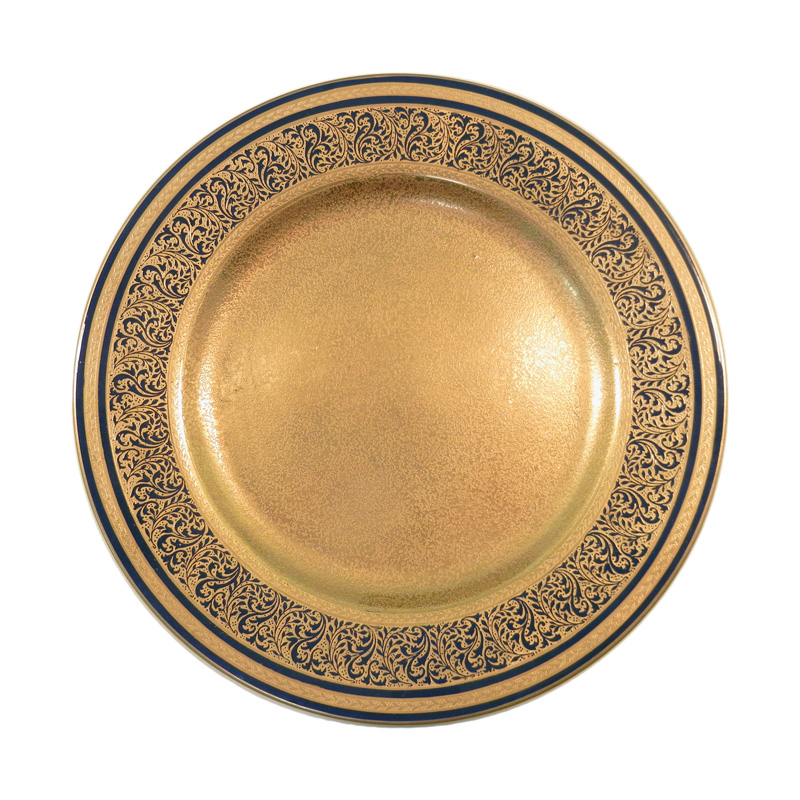
You will often find cobalt blue grounds paired with gold decoration. These combinations created a strong visual contrast and helped the pieces resemble more expensive wares.
Techniques such as acid-textured or encrusted gilding appear on some higher-end examples. This process added texture and depth to the gold, giving the surface a more luxurious appearance.
These decorative choices were not accidental. They allowed potteries to produce pieces that looked refined enough for display while remaining practical for use.
Staffordshire and the Rise of Export Ceramics
The Staffordshire region became the center of this production. Towns such as Longton, Burslem, and Stoke-on-Trent developed a network of factories that specialized in ceramics.
Well-known names in ironstone and semi-porcelain production include:
- Alfred Meakin
- Johnson Brothers
- Wood & Sons
- Furnivals
- Grindley
These factories produced vast quantities of decorated wares for both domestic use and export. Many pieces carried generic marks, especially those intended for overseas markets. This makes exact identification difficult today, but it also reflects the scale and efficiency of production during that period.
Common Misconceptions
Many collectors assume that weight indicates lower quality. That is not always true. Ironstone was designed to be durable, and its weight reflects that purpose.
Another common belief is that all finely decorated pieces must be porcelain. In reality, many richly gilded and decorated wares are ironstone or semi-porcelain.
Understanding these distinctions helps you evaluate pieces more accurately and avoid misidentification.
Why Ironstone Still Matters Today
Ironstone and semi-porcelain remain highly relevant in the world of antiques and collectibles. Their durability means many pieces have survived in good condition. Their decorative styles reflect the tastes of the Victorian and Edwardian periods, making them attractive for both collectors and interior design.
These wares also tell a broader story. They show how manufacturers balanced beauty with practicality. They highlight the importance of export markets and the role of Staffordshire as a global center of ceramic production.
For collectors, they offer an accessible entry point into antique ceramics. For more experienced buyers, they provide depth and variety within a collection.
Final Thoughts
Ironstone and semi-porcelain deserve more attention than they often receive. They may not carry the same prestige as fine porcelain, but they represent a significant chapter in ceramic history. Their strength, versatility, and decorative range make them both practical and visually compelling.
Once you learn to recognize their characteristics, you begin to see them everywhere. More importantly, you begin to understand the craftsmanship behind them. That understanding adds value, not only in a financial sense, but in the appreciation of the objects themselves.