

Qajar Portrait Bottles and Their Story
Bohemian cobalt glass or blue glass with rich gilding and portrait medallions stands out immediately. These pieces feel bold, detailed, and unmistakably historic. At first glance, many assume they come from Persia itself. The story behind them is more layered and far more interesting.
These bottles and jars were often made in Europe—primarily in Bohemia—and created specifically for export to the Persian market during the late 19th and early 20th centuries. They represent a unique meeting point between European craftsmanship and Persian royal imagery.
Once you understand that connection, these objects become much more than decorative glass.
A Crossroads of Craft and Culture: Bohemian Glass for the Persian Market
During the late 1800s, Persia (modern-day Iran) maintained strong trade relationships with Europe. At the same time, European glassmakers—especially in Bohemia—had developed advanced techniques in colored glass, enamel decoration, and gilding.
Workshops began producing luxury items tailored to Persian tastes. These were not generic exports. Makers designed them specifically for elite buyers, incorporating imagery and symbols that resonated within Persian culture.
Portraits of rulers, rich colors, and intricate decoration all served a purpose. They signaled status, refinement, and connection to the Qajar court.
Bohemian Cobalt Glass: Why Cobalt Blue?
The deep cobalt blue seen in these pieces is not accidental. It plays a central role in their appeal.
Cobalt glass has a long history in both European and Middle Eastern decorative arts. In this context, it provided a dramatic background that allowed gold decoration and enamel colors to stand out clearly.
The contrast between dark blue glass and bright gilding creates depth and movement. Even small pieces feel visually strong because of this combination.
Collectors often look for this exact pairing—cobalt and gold—as a key indicator of quality in these export wares.
The Qajar Portraits: More Than Decoration
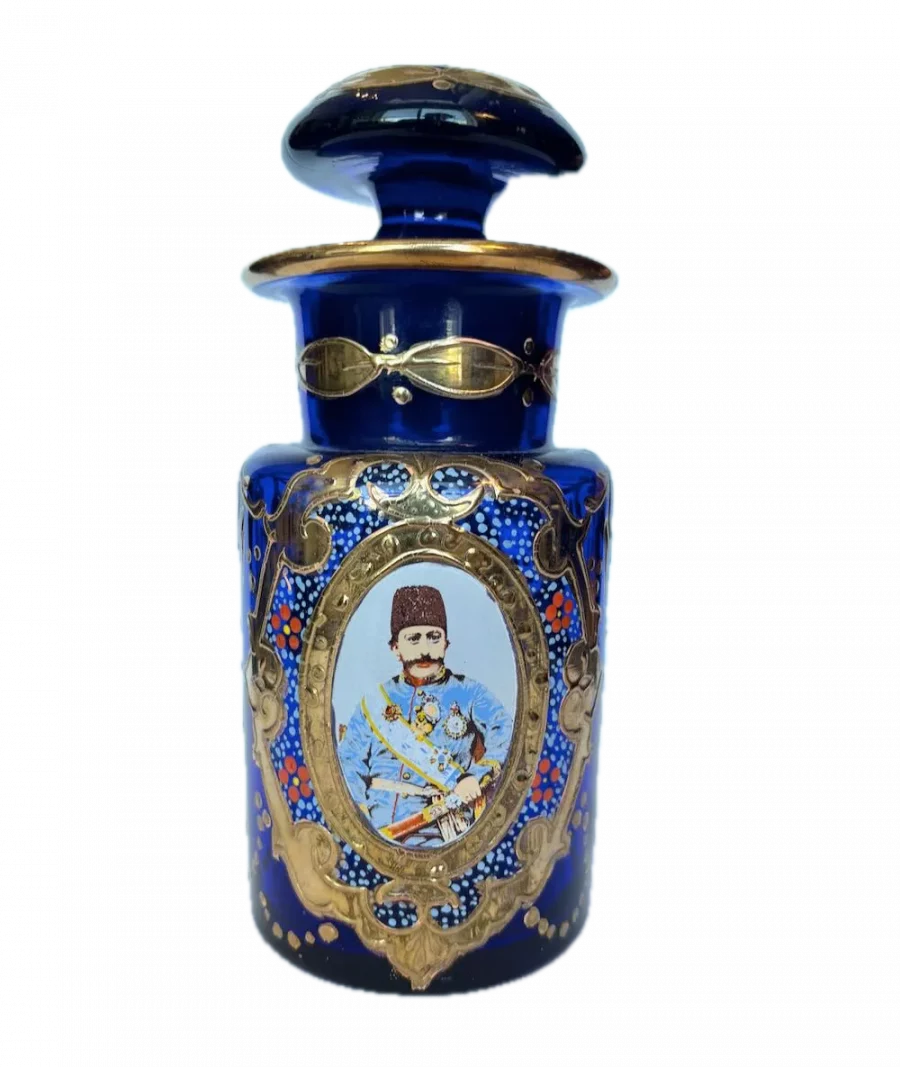
Many of these bottles feature portrait medallions of Persian rulers, most commonly from the Qajar dynasty.
The most frequently depicted figure is Naser al-Din Shah Qajar (r. 1848–1896). His image appears across a wide range of decorative objects produced for export. You will often recognize him by his distinctive hat, formal pose, and decorated military attire.
Some pieces include two different portraits. These typically represent Naser al-Din Shah alongside his successor, Mozaffar al-Din Shah (r. 1896–1907).
This pairing matters.
It suggests the piece was produced after the transition between the two rulers, placing it firmly in the early 20th century. It also adds a layer of historical context that single-portrait pieces do not have.
For collectors, this makes multi-portrait examples more interesting and often more desirable.
How These Pieces Were Made
These objects combine several techniques, each contributing to their distinctive look.
The glass itself was usually hand-blown, often showing subtle variations in thickness and form. Even in higher-quality examples, small irregularities can appear and should be expected.
The portraits were typically applied using early transfer printing methods. Under magnification, you can often see a fine dot or stipple pattern. This technique allowed for consistent imagery while still integrating with hand-applied decoration.
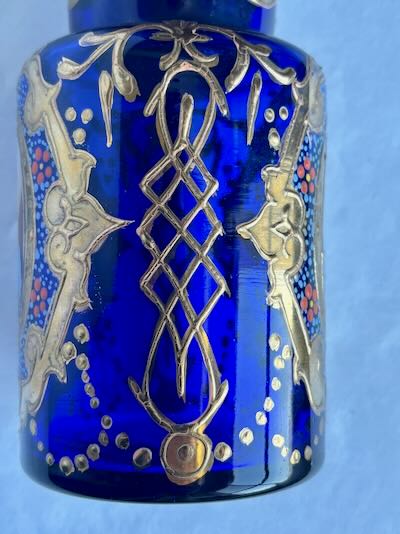
Gilding and enamel work came next. Artisans added gold scrollwork and raised enamel dots by hand. These details vary slightly from piece to piece, which helps distinguish authentic examples from later reproductions.
Signs of Age and Authenticity
Collectors often look for specific characteristics when evaluating these pieces.
Natural wear in the gilding is one of the most important indicators. Gold tends to soften on raised areas while remaining stronger in recessed sections. Over time, it can develop a warmer tone where the surface wears.
Enamel decoration should show slight variation. Perfect uniformity often suggests later production.
Portraits should appear integrated into the surface rather than sitting on top. The transfer process creates a slightly softened image rather than a sharp, modern print.
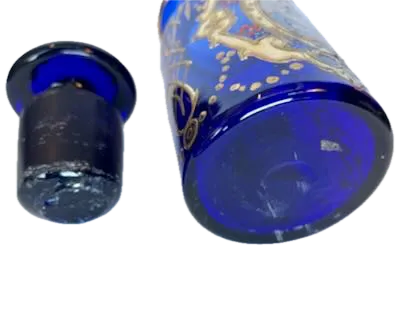
Glass surfaces may show minor wear, especially on the base or stopper. These details develop naturally over decades of handling and use.
Dating These Bottles and Jars
Most Bohemian cobalt glass pieces made for the Persian market fall into a broad range between the late 19th century and the early decades of the 20th century.
Pieces featuring only Naser al-Din Shah can date slightly earlier, often around 1880–1900.
Examples that include both Naser al-Din Shah and Mozaffar al-Din Shah usually fall between 1900 and 1930, with many produced closer to the early part of that range.
Later reproductions exist, but they tend to show different characteristics, including brighter gilding, more uniform decoration, and sharper printed imagery.
Function and Use
These objects were not purely decorative, although they often function that way today.
Originally, they served as:
- Dresser bottles
- Perfume containers
- Small storage jars
- Decorative display pieces
Their function depended on size and form, but their visual impact remained central.
Today, collectors often display them as standalone objects or as part of a curated grouping. Even a single piece can anchor a display due to its strong color and detail.
Why Collectors Still Seek These Bohemian Cobalt Glass Pieces
These pieces appeal to collectors for several reasons.
First, they represent a clear moment in global decorative arts, where European production met Persian cultural identity.
Second, they combine multiple techniques—glassmaking, gilding, enamel work, and printed imagery—in a single object.
Third, they offer strong visual presence without requiring large scale. Even smaller examples feel significant.
Finally, each piece carries subtle variation. No two are exactly alike, which adds to their individuality.
Bohemian Cobalt Glass: A Distinct Category Worth Exploring
Bohemian cobalt glass made for the Persian market sits in a category of its own. It does not fit neatly into European or Middle Eastern traditions. Instead, it reflects a blend of both.
That blend is what makes these objects so compelling.
Whether you collect them for their history, their craftsmanship, or their visual impact, they offer a depth that goes beyond decoration. They tell a story of trade, influence, and design that still resonates today.
Search our Store for Bohemian Cobalt Glass