

Silver Filigree: A Craft That Feels Almost Impossible
Chinese silver filigree censers have a way of stopping you mid-glance. At first, you notice the shimmer of metal and color. Then you look closer—and suddenly the entire piece reveals itself as something far more intricate than expected.
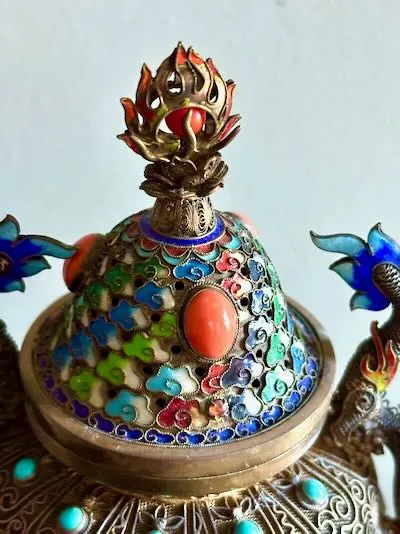
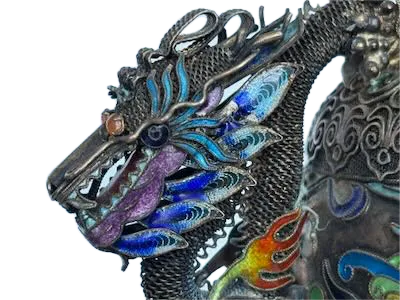
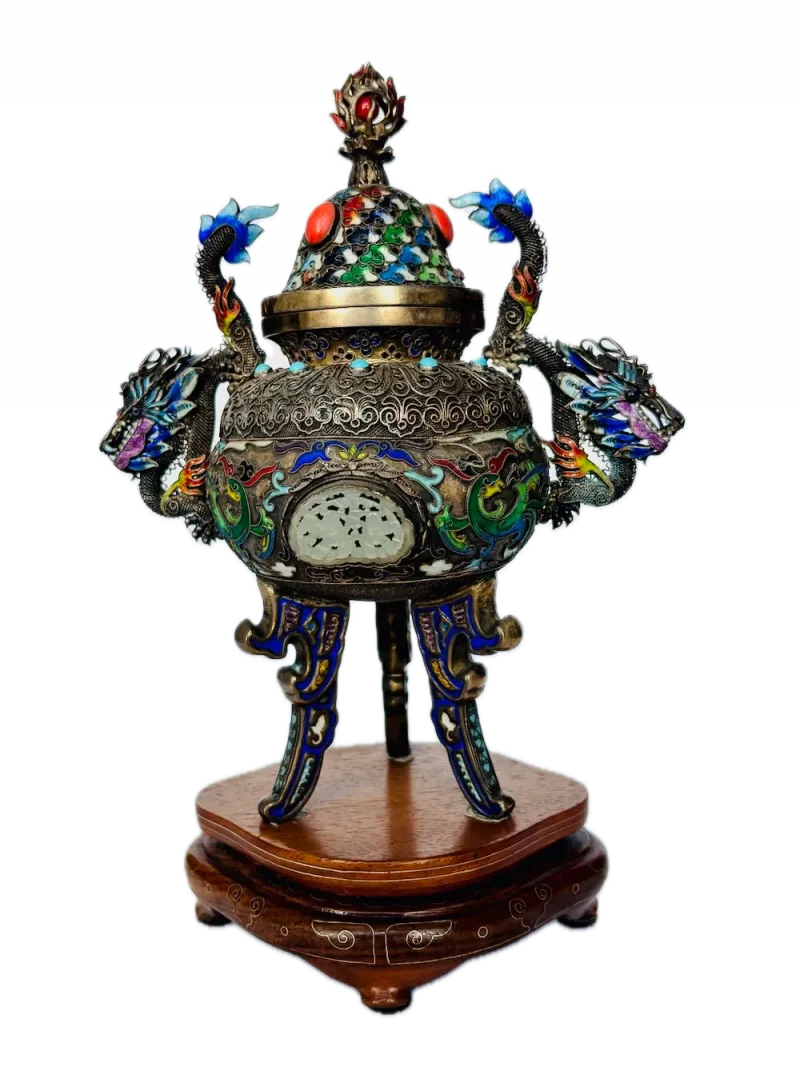
Every surface seems alive. Fine silver wires twist and loop into patterns that resemble woven fabric or lace. Enamel flows through the design in soft blues, greens, and deep jewel tones. Small stones catch the light. Even the handles—often shaped as dragons—feel sculptural and deliberate.
It raises a natural question: how was something this delicate even made?
The answer lies in filigree, a technique that demands patience more than force. Artisans worked with extremely thin strands of silver, shaping and placing each one by hand. There is no shortcut in this process. The structure grows slowly, wire by wire, until it becomes something surprisingly strong despite its airy appearance.
That balance—fragile yet durable—is part of what gives these pieces their lasting appeal.
More Than Decoration: The Meaning Behind the Form
Although many of these censers are now collected for display, their form has deeper origins.
Traditionally, a censer was used to burn incense. You would place it on a table, light the incense inside, and allow the smoke to rise gently through the openings. That rising smoke carried symbolic meaning. It represented calm, reflection, and a connection between the everyday world and something beyond it.
Even when these pieces were later created for decorative purposes, they retained that sense of presence. The tripod base, the domed lid, and the openwork body all follow a language that had been established centuries earlier.
So when you look at one today, you are not just seeing an object. You are seeing a form that has traveled through time, adapting but never losing its identity.
When Tradition Met a Global Market
By the mid-20th century, Chinese craftsmanship entered a new phase. Workshops in Hong Kong and the Guangdong region began producing silver filigree pieces for export.
This shift changed the look—but not the skill behind it.
Artisans started to lean into color and ornament. Enamel became more vivid. Decorative stones appeared. Gilding added warmth and contrast. The goal was no longer just tradition, but also visual impact.
Travelers visiting Hong Kong in the 1950s, 60s, and 70s often brought these pieces home. They were drawn to the craftsmanship, but also to the richness of the design. These objects felt luxurious, detailed, and unmistakably different from Western decorative styles.
Today, many of these censers still carry that history. When a piece comes with a story tied to mid-century travel, it adds another layer of authenticity that collectors appreciate.
The Quiet Difference Between Antique and Vintage
At first glance, it can be difficult to tell whether a filigree censer is antique or vintage. Both share similar techniques and forms. But the feeling they give off is often different.
Earlier pieces tend to feel more restrained. The focus sits on the metalwork itself. Decoration is present, but it does not overwhelm the structure.
Vintage export pieces, on the other hand, embrace a more expressive approach. Color becomes part of the design language. Gilding softens the surface. Decorative elements—dragons, stones, carved panels—become more prominent.
Neither is better. They simply reflect different moments in the life of the craft.
Understanding that difference allows you to appreciate each piece on its own terms, rather than trying to fit it into a single category.
The Beauty of Age and Wear
One of the most misunderstood aspects of these pieces is their finish over time.
Many were originally covered in gold gilding. When new, they would have appeared brighter and more uniform. But as decades pass, that gilding softens. It wears away on edges and raised surfaces. Silver begins to show through.
To someone unfamiliar, this might look like damage. To a collector, it tells a story.
The surface becomes warmer, more complex. Highlights and shadows develop naturally. The object no longer looks manufactured—it looks lived with.
This kind of patina cannot be replicated easily. It comes from time, handling, and exposure. And it is often one of the most attractive qualities of a vintage piece.
Details That Reward a Closer Look
What makes these censers especially satisfying is how much they reveal when you spend time with them.
You start to notice small variations in the filigree. No two sections are perfectly identical. The enamel shifts slightly in tone. Stones sit just off-center. Even the marks—sometimes faint or nearly invisible—hint at the workshop that produced the piece.
These are not flaws. They are evidence of the human hand.
In a world where so many objects are perfectly uniform, that kind of variation feels refreshing. It reminds you that someone made this, patiently and deliberately.
Why Chinese Silver Filigree Still Matter Today
Chinese silver filigree censers continue to attract collectors because they offer more than one thing at once.
They bring together craftsmanship, history, and visual richness in a way that feels complete. They are decorative, but not superficial. Detailed, but not overwhelming.
They also adapt well to modern interiors. A single piece can stand alone as a focal point. A group can create depth and interest. Either way, they hold attention without needing explanation.
And perhaps that is the most important quality—they invite you to look closer.
A Living Category of Collectible Art
These censers sit at an interesting intersection. They carry forward traditional Chinese techniques, but they also reflect a moment when those techniques reached a global audience.
That combination gives them lasting relevance.
Whether you approach them as antiques, vintage collectibles, or simply beautiful objects, they reward attention. The more you study them, the more they give back.
And once you notice the level of detail in one piece, it becomes hard not to look for the next.