

Neyret Frères created paintings in a way most people never expect. They did not print them. They built them. Each portrait came to life thread by thread on a Jacquard loom, using silk as both structure and medium. When you look at one of their woven works, you are not looking at decoration applied to fabric. You are looking at an image constructed inside the fabric itself. That distinction defines both their craftsmanship and their lasting appeal.
Collectors who handle these pieces quickly notice the difference. The surface shifts with light. The tones soften and deepen depending on angle. The image feels closer to an engraving than a textile, yet it carries a warmth that only silk can deliver.
The Neyret Frères origins in Saint-Étienne
Neyret Frères emerged from Saint-Étienne, one of France’s most important textile centers during the 19th century. The region built its reputation on ribbon weaving, silk production, and early industrial innovation.
The Neyret family began working in this environment in the early 1800s. Like many weaving families, they started with narrow textiles such as ribbons and trims. Over time, they expanded both their technical reach and their artistic ambition.
By the mid-19th century, the firm operated under the name Neyret Frères, or Neyret Brothers. From that point forward, they moved beyond simple production and began to define themselves through precision weaving and innovation.
The Jacquard loom and the birth of woven imagery
The rise of Neyret Frères closely followed the widespread adoption of the Jacquard loom. This technology transformed weaving into a controlled system. Instead of relying on manual patterning alone, weavers used punched cards to direct thread movement. Each card dictated how threads lifted and crossed, allowing complex designs to emerge with remarkable consistency.
Neyret Frères pushed this system further than most. They increased thread density and refined tonal transitions. They treated silk not just as material, but as a language capable of describing light, shadow, and depth. That approach made something entirely new possible—woven images that mimic engraving and early photography.
Neyret Frères: The rise of pictorial weaving
By the late 19th century, Neyret Frères had established themselves as leaders in woven imagery.
They produced:
- Portraits of historical figures
- Religious scenes
- Landscapes and architectural views
- Literary and classical subjects
- Commemorative and exhibition pieces
This period, roughly 1870 to 1930, marks their golden age.
Woven portraits appealed to a growing middle class that wanted refined, affordable art. These works offered detail, craftsmanship, and cultural significance without the cost of painting or sculpture. They also traveled well, making them ideal for souvenirs and export markets.
Napoleon and the power of subject matter
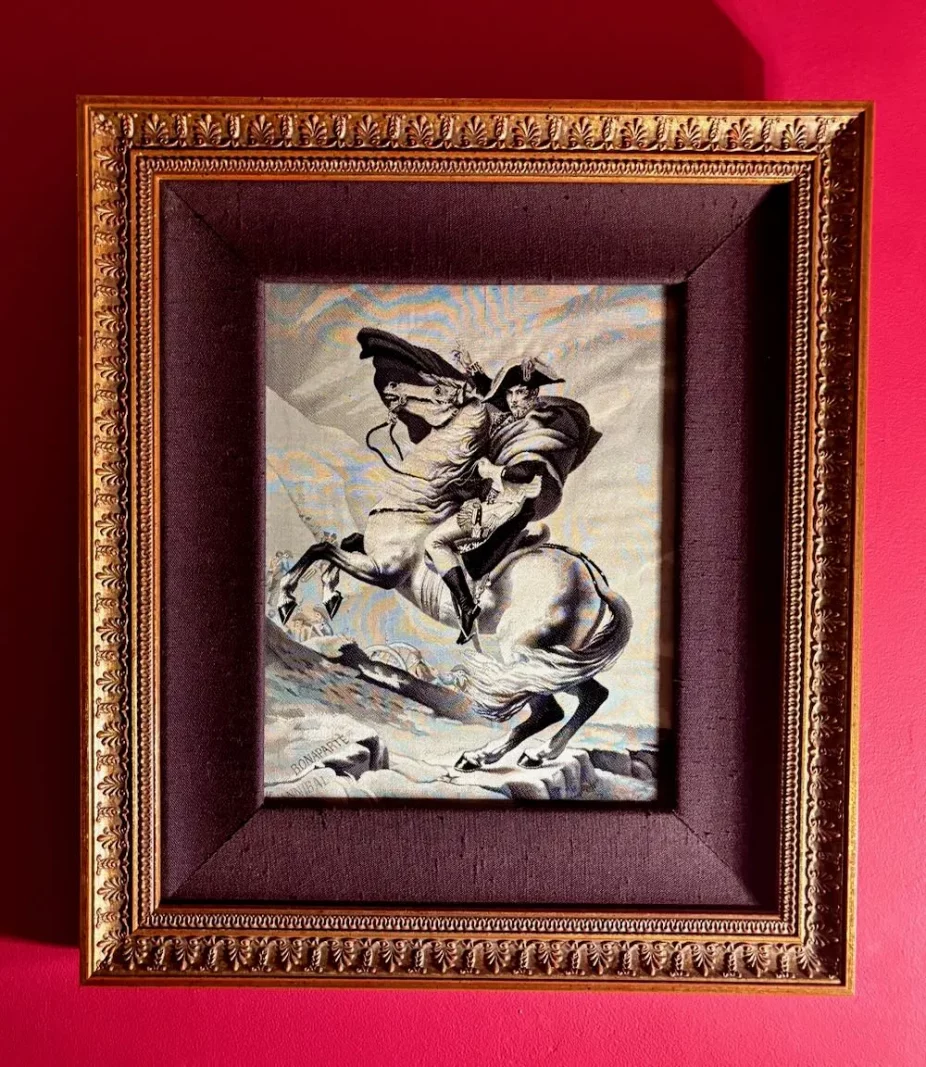
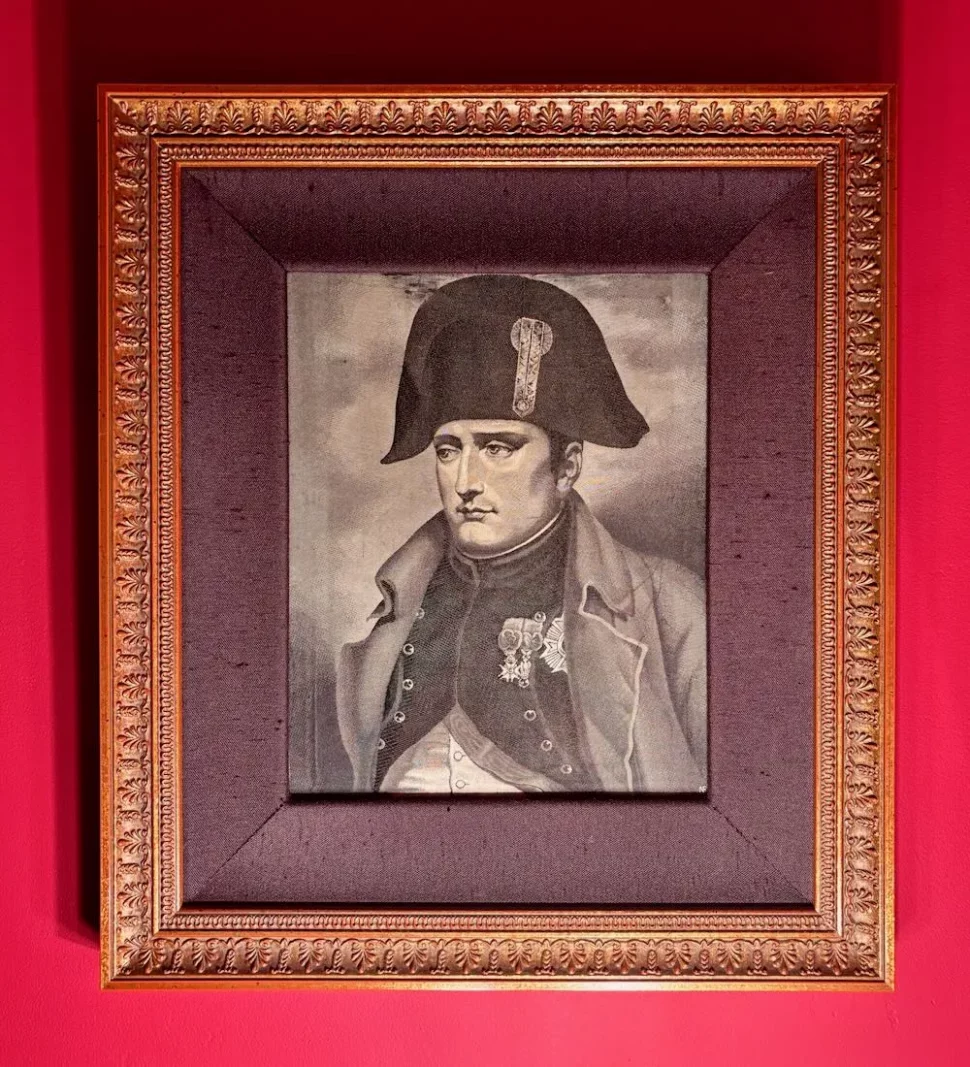
Certain subjects defined the success of these textiles, and Napoleon stood at the center. His image carried strong national identity in France. It also translated perfectly into woven form. The structure of his uniform, the contrast of light and shadow, and the unmistakable silhouette of his hat all worked naturally within the constraints of Jacquard weaving.
Neyret Frères produced multiple variations of Napoleon portraits. Some emphasized tonal depth. Others experimented with subtle color shifts. Your example, with its faint red tone, falls into a more interesting category.
Rather than relying purely on grayscale threads, the weavers introduced a second color into the structure. This technique, often called changeable or shot silk, allows the image to shift depending on light and angle. The red tone does not sit on the surface. It lives within the weave. Collectors notice this immediately once they understand what they are seeing. It adds both visual depth and technical interest.
Beyond portraits: translating fine art into silk
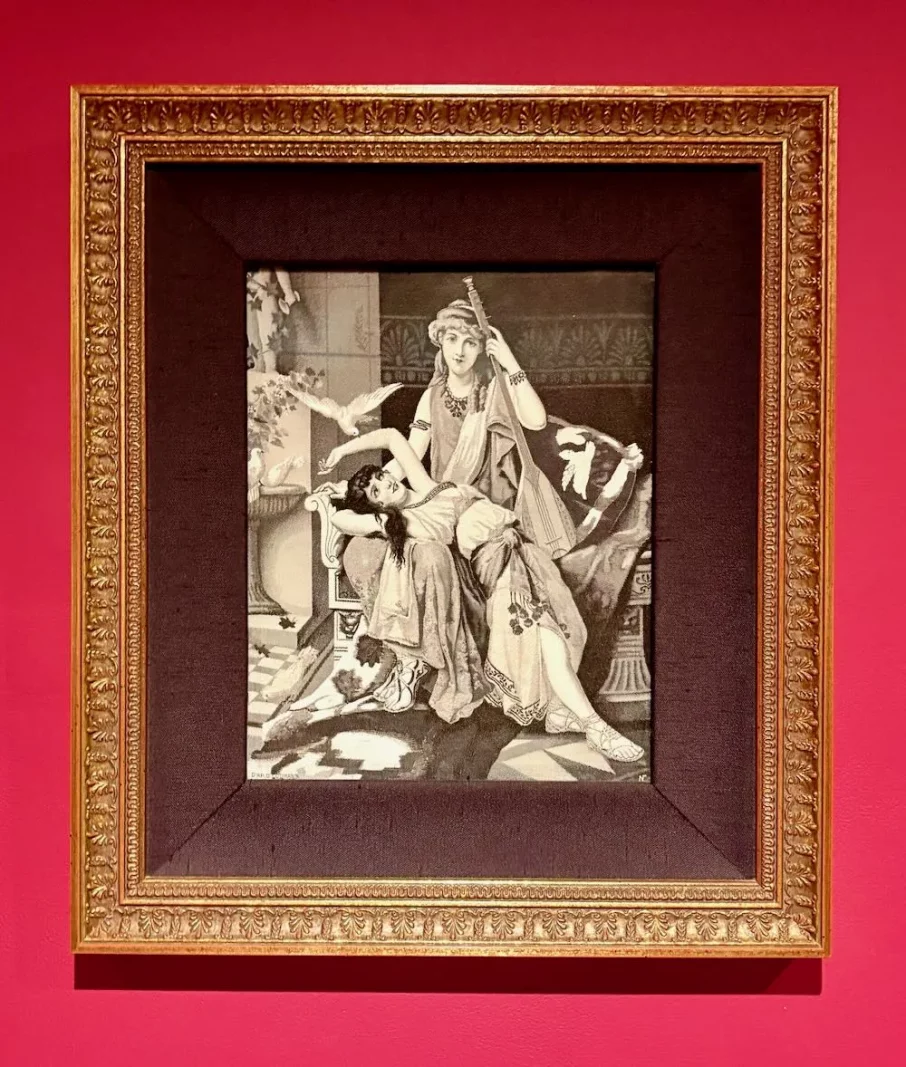
Neyret Frères did not limit themselves to historical figures. They also translated well-known artworks into woven form. One example connects directly to your second piece: The Storm by Pierre-Auguste Cot.
This painting, now held at The Metropolitan Museum of Art, shows a young couple rushing through a dark landscape as rain begins to fall. The composition relies on movement, contrast, and emotional tension.
Translating a painting like this into silk required a different approach than portraiture. The weavers had to capture motion through thread direction. They had to suggest atmosphere through tonal variation. They had to balance softness and structure so the figures did not disappear into the background.
When done well, the result does not feel like a reproduction. It feels like an interpretation shaped by the limits and strengths of the loom.
The NF mark and what it tells you
Many Neyret Frères pieces originally carried paper labels. Those rarely survive. When you find a woven “NF” monogram, you are looking at something more intentional. The maker integrated the mark into the design itself.
Collectors associate this detail with:
- Higher-quality production runs
- Greater attention to detail
- Early 20th-century manufacture
- Pieces intended to last
It does not guarantee rarity, but it does place the piece in a stronger category than unmarked examples.
Technical mastery: how these pieces were made
Every woven portrait required planning long before the loom began to run.
The process included:
- Translating an image into a grid-based structure
- Assigning tonal values through thread combinations
- Creating a sequence of punch cards for the loom
- Maintaining precise tension during weaving
The weaver did not draw lines. The loom did not print color. The image emerged through structure. Dark areas required dense intersections of thread. Highlights required spacing and contrast. Mid-tones depended on subtle shifts in thread interaction. This explains why the best examples feel alive. The image responds to light instead of simply reflecting it.
Market demand and changing tastes
Neyret Frères thrived during a period when decorative arts expanded alongside industrial innovation. The Industrial Revolution made complex production more accessible. It also created a market that valued decorative objects with both technical and artistic appeal.
Woven portraits fit perfectly into that moment. However, by the early to mid-20th century, tastes began to change. Photography became widespread. Printing improved. Consumers moved toward faster and less labor-intensive forms of image reproduction.
At the same time, the cost of producing high-density woven images remained high. Neyret Frères adapted. They shifted focus toward ribbons, medals, and industrial textiles—areas where demand remained steady and scalable. As a result, woven portraits gradually disappeared from production.
Collectibility and why these pieces still matter
Today, Neyret Frères silk portraits sit in a unique category.
They combine:
- Mechanical innovation
- Artistic interpretation
- Historical subject matter
- Material quality
Collectors value them for both what they show and how they were made.
Certain factors increase desirability:
- Presence of the NF monogram
- Strong, clear imagery
- Unusual tonal effects such as color shift
- Recognizable subjects like Napoleon
- Good preservation of the silk
Your two pieces—Napoleon and The Storm—represent two important directions within their work. One reflects historical portraiture. The other reflects the translation of fine art into textile form. Together, they show the full range of what Neyret Frères achieved.
A tradition that adapted over time
Neyret Frères did not fade away when demand for woven portraits declined. The company adapted. They began as a family weaving operation in Saint-Étienne in the early 19th century. By the mid-1800s, they had established themselves as a formal firm and embraced the Jacquard loom, which allowed them to move beyond ribbons into complex woven imagery.
From the late 1800s through the early 20th century, they reached their peak. During this period, they produced the finely detailed silk portraits and pictorial weavings that collectors recognize today. Subjects ranged from historical figures like Napoleon to literary scenes and well-known works of art.
After the 1930s, the market began to shift. Photography and printing replaced labor-intensive woven imagery, and demand for pictorial silk declined. Neyret Frères responded by returning to areas where they could scale production more efficiently. They focused on ribbons, medals, and technical textiles—fields where precision weaving still mattered but where demand remained consistent.
The company never disappeared. It evolved. Today, Neyret continues to operate as a modern textile manufacturer, producing high-quality ribbons, branding textiles, and woven materials for luxury and industrial use. The techniques have advanced, but the foundation remains the same: control of thread, structure, and detail.
A final perspective on Neyret Frères
It helps to look at these works differently. Do not think of them as images placed on silk. Think of them as images built from silk. Every thread contributes to the final result. Every intersection defines light or shadow. The structure holds the image in place long after other materials would fade or deteriorate.
That combination of durability, craftsmanship, and quiet complexity explains why these pieces continue to hold attention today—and why collectors keep coming back to them.