

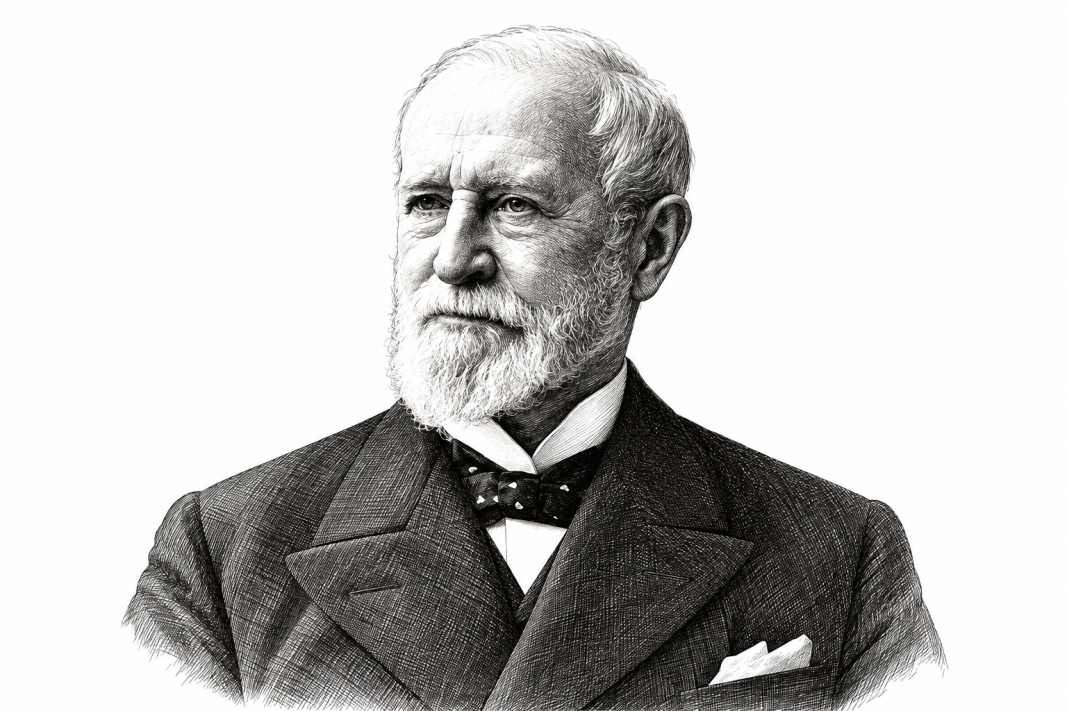
Few luxury houses have influenced the appearance of modern jewelry, watches and personal accessories as profoundly as Cartier. Founded in Paris in 1847, the Maison grew from a family jewelry business into an international name associated with royalty, extraordinary gemstones, innovative watches and some of the most recognizable designs of the 20th century.
Yet Cartier’s history extends far beyond diamonds and precious jewelry. Over more than a century and a half, the house has created watches, clocks, silver and precious objects, vanity cases, writing instruments, leather goods, eyewear and fragrances. Its designers repeatedly transformed functional objects into expressions of the same attention to proportion, materials and detail found in Cartier jewelry.
That ability to expand without losing a recognizable identity helps explain Cartier’s unusual longevity. The company has moved through the Belle Époque, Art Deco, postwar modernism and the enormous expansion of international luxury while continually returning to ideas developed earlier in its history. The panther, Tank watch, Trinity ring, Love bracelet, mystery clock and burgundy Must de Cartier leather goods belong to very different periods, yet all became part of a design vocabulary that Cartier continues to reinterpret.
Louis-François Cartier and the Beginnings of the Maison
The history of Cartier begins in Paris in 1847, when Louis-François Cartier took over the workshop of his master, Adolphe Picard. Paris already possessed a sophisticated culture of jewelry, fashion and decorative arts, providing an ideal environment for an ambitious young jeweler.
Louis-François established a reputation that allowed the business to grow, and his son Alfred Cartier assumed control in 1874. Alfred recognized the opportunities created by the extraordinary concentration of wealth, fashion and international society in late 19th-century Paris.
The decisive transformation, however, came with the next generation. Alfred’s sons Louis, Pierre and Jacques Cartierturned the family jeweler into an international luxury house. Each brother would eventually contribute to a different geographic center of the business, creating the Paris, London and New York branches that shaped Cartier during the 20th century.
Cartier Moves to the Rue de la Paix
In 1899 Cartier moved to 13 rue de la Paix, close to the Place Vendôme and the center of fashionable Paris. The location placed the Maison among couture houses, jewelers and businesses serving an international clientele of aristocrats, industrialists and wealthy travelers.
Louis Cartier remained closely associated with the Paris operation and became particularly important in establishing the creative identity of the house. He understood that Cartier could do more than provide exceptional stones in traditional settings. Jewelry itself could express a distinctive design language.
At the beginning of the 20th century, Cartier became celebrated for delicate platinum settings that allowed diamonds to dominate visually while minimizing the apparent weight of their mounts. Garlands, bows, scrolls and other motifs inspired by 18th-century French decorative arts became characteristic of what is now commonly called Cartier’s Garland Style.
The strength of platinum allowed jewelers to create remarkably fine structures while securely holding substantial stones. The result suited the elegance of the Belle Époque and helped establish Cartier’s reputation among Europe’s wealthiest clients.
The Jeweler of Kings
Royal patronage played an important role in Cartier’s international reputation. The house supplied members of European royal families and courts, creating tiaras, necklaces, ceremonial jewels and personal objects for clients whose public appearances attracted international attention.
When Cartier established itself in London at the beginning of the 20th century, the connection with the British court became particularly significant. King Edward VII granted Cartier a Royal Warrant in 1904. Other royal warrants followed from courts around Europe and beyond.
Royal clients offered Cartier more than prestige. Their commissions demanded exceptional gemstones, technical skill and the ability to produce objects suited to formal court life. Tiaras became one of the most spectacular demonstrations of the Maison’s abilities, combining structural engineering with extraordinarily delicate visual effects. Cartier’s clientele eventually extended far beyond hereditary royalty. Industrialists, financiers, performers, film stars and prominent international families became the new aristocracy of the 20th century, and Cartier successfully moved with that changing world.
Three Brothers Create an International Cartier
The international development of Cartier was closely connected with the three grandsons of Louis-François Cartier. Louis remained in Paris, Jacques became associated with London, and Pierre developed the American business, giving the Maison an unusual international structure.
London provided access not only to British society but to an empire whose wealthy travelers brought Cartier into contact with cultures and materials far beyond Europe. Jacques Cartier traveled to India in 1911, developing relationships with Indian princes and gaining direct exposure to historic Indian jewelry and gemstones. Pierre Cartier looked westward. Cartier established a New York presence in 1909, entering a rapidly expanding American market filled with newly wealthy industrial families.
In 1917 Pierre secured one of the most famous addresses in luxury retail: the mansion at 653 Fifth Avenue. The property was acquired through an extraordinary transaction involving a valuable double-strand natural pearl necklace desired by the wife of financier Morton Plant. The former residence became Cartier’s New York home and remains associated with the Maison today.
Looking Beyond Europe for Inspiration
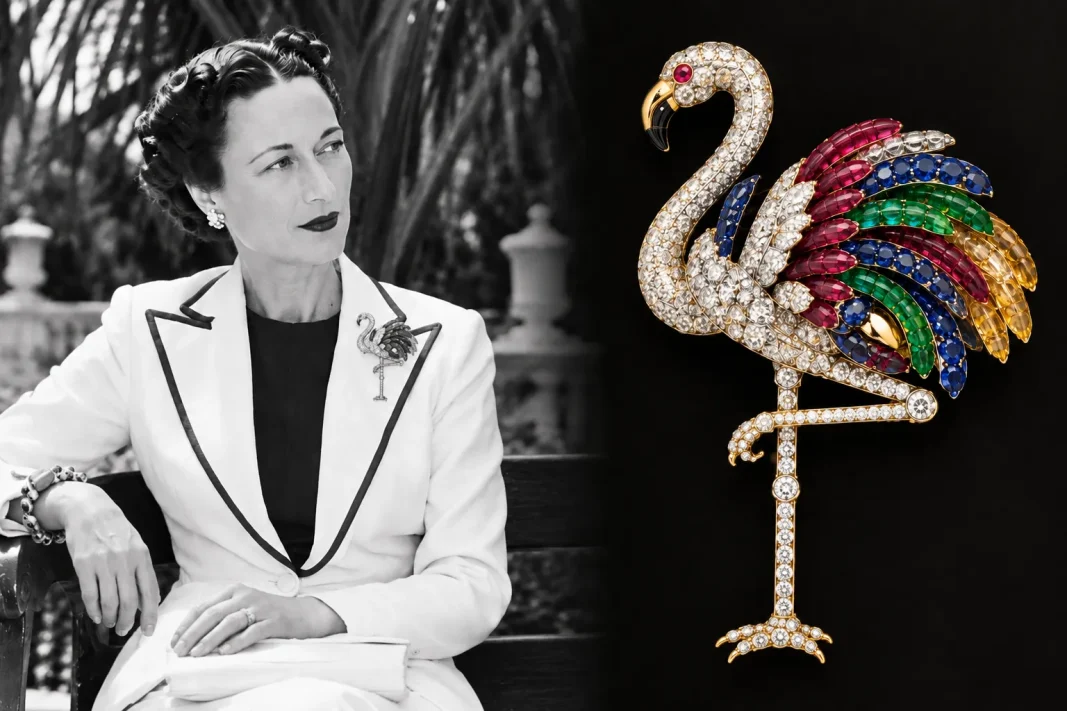
One of the most important characteristics of Cartier design has been its willingness to study decorative traditions from different cultures and reinterpret them rather than simply follow contemporary European jewelry. India became particularly important. Cartier encountered magnificent carved emeralds, rubies, sapphires and traditional Indian forms, sometimes resetting historic Mughal stones for European and American clients. The relationship also worked in the opposite direction, as Indian rulers commissioned Cartier to redesign or remount stones from their own collections.
The brilliantly colored combinations of carved emeralds, sapphires and rubies that later became associated with Cartier’s Tutti Frutti jewelry grew from this dialogue between Indian jeweled traditions and European Art Deco design. The resulting pieces remain among the most recognizable examples of Cartier’s ability to combine cultural influences into something distinctly its own.
Islamic decorative arts also provided inspiration through geometry, color and ornamental abstraction. Chinese and Japanese art contributed additional motifs, materials and forms, particularly to Cartier’s precious objects and clocks. Jade, lacquer, coral, rock crystal and hardstones could appear alongside gold, platinum and diamonds.
These influences should not be understood simply as a catalogue of exotic motifs. Cartier designers studied architecture, textiles, objects and historical ornament, extracting shapes, color relationships and structural ideas that could be transformed into jewelry and decorative objects.
Cartier and the Birth of the Modern Wristwatch
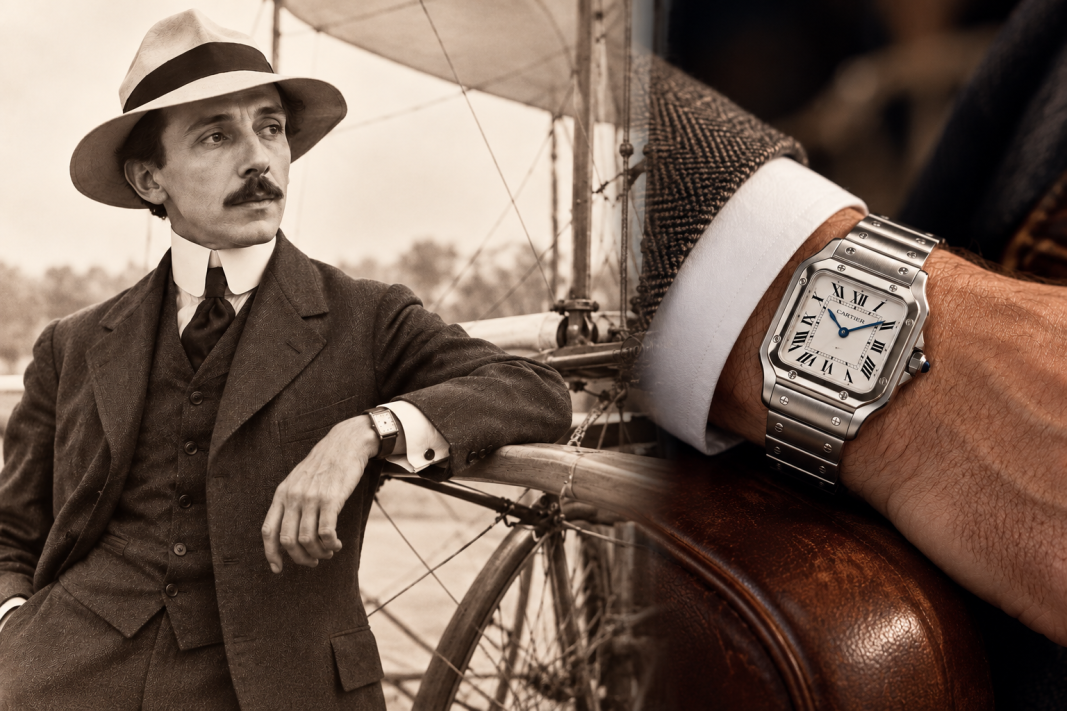
Cartier’s influence on watchmaking became almost as important as its jewelry. At the beginning of the 20th century, pocket watches still dominated men’s timekeeping, but changing lifestyles created demand for a watch that could be read without reaching into a pocket. Louis Cartier’s friendship with Brazilian aviation pioneer Alberto Santos-Dumont became part of this transition. Santos-Dumont needed to check the time while controlling an aircraft, making a conventional pocket watch inconvenient.
Cartier developed a wristwatch for him, and the Santos became one of the earliest wristwatch designs associated with modern men’s fashion. Its geometric case and visible screws eventually became enduring elements of Cartier watch design.
The significance of the Santos lies not simply in putting a watch on a strap. Cartier approached the watch as an object of design in which the case, dial, strap and attachment could form a coherent composition. That approach would become central to the Maison’s watchmaking identity.
The Tank and the Power of Geometry
Cartier introduced another extraordinary watch design during the First World War. The Tank took the geometry of the wristwatch in a new direction, using strong parallel side elements and a rectangular dial to create a composition that seemed architectural.
Introduced in the late 1910s and developed through numerous later versions, the Tank became one of the most enduring watch forms of the 20th century. Roman numerals, blued hands, a sapphire-set winding crown and carefully controlled proportions became recognizable elements of the design.
Its longevity demonstrates one of Cartier’s greatest strengths. The company could establish a basic visual idea strong enough to survive repeated reinterpretation. Tank watches could change in size, proportion, materials and movement while remaining unmistakably related to the original concept.
Other shaped watches followed different paths. The Tonneau, Baignoire and later Panthère designs demonstrate Cartier’s continuing interest in treating the watch case as an aesthetic form rather than simply a container for a movement.
Cartier Mystery Clocks
Cartier’s clocks reveal another side of its creativity. Among the most celebrated are the mystery clocks, developed through Cartier’s collaboration with clockmaker Maurice Couët during the early 20th century.
The first Model A mystery clocks appeared in 1912. Their hands seemed to float within transparent rock crystal without any visible connection to the movement. The illusion depended upon transparent discs carrying the hands, while the mechanism remained concealed within the surrounding structure.
The technical trick alone does not explain their appeal. Cartier transformed the mechanism into elaborate decorative objects using rock crystal, onyx, jade, coral, enamel, diamonds and precious metals.
During the 1920s, some mystery clocks incorporated East Asian architectural forms, carved animals and hardstones. Others resembled miniature gateways, screens or temples. Timekeeping became almost secondary to the experience of contemplating an object that combined horology, jewelry, sculpture and illusion.
Cartier and Art Deco
The arrival of Art Deco suited Cartier exceptionally well. Geometry, strong contrasts and stylized ornament had already begun appearing in the Maison’s work before the movement received its familiar name.
At the 1925 Exposition Internationale des Arts Décoratifs et Industriels Modernes in Paris, Cartier exhibited in the Pavillon de l’Élégance alongside leading couturiers. Jewelry was presented as part of the same modern world as fashion rather than isolated as a traditional craft.
Black onyx and white diamonds created dramatic contrasts. Coral, jade, lapis lazuli, emeralds and other colored stones introduced saturated color, while platinum provided the structural precision necessary for increasingly geometric designs.
Cartier’s Art Deco creations could be extraordinarily modern while simultaneously drawing upon ancient Egypt, India, China, Japan and Islamic decorative traditions. This combination of historical reference and modern abstraction became one of the defining qualities of the house.
The Panther Becomes a Cartier Symbol
Few motifs have become as closely associated with a luxury house as the Cartier panther. Its development took place gradually rather than through the appearance of a single famous jewel.
A 1914 Cartier wristwatch used an abstract pattern of diamonds and onyx suggesting panther skin. Over subsequent decades, the animal evolved from pattern into increasingly figurative jewelry.
The extraordinary Jeanne Toussaint became central to this development. Associated with Cartier from the early 20th century and later responsible for important creative direction within the house, Toussaint herself became known as “La Panthère.”
Under this evolving creative vision, the panther could appear naturalistic, stylized, playful or predatory. It might wrap around a wrist, climb across a brooch or crouch over a gemstone. The motif allowed Cartier to combine sculpture and jewelry while giving the Maison an animal symbol capable of endless reinvention.
Precious Objects for Everyday Life
Cartier never restricted its creativity to objects worn on the body. The house produced an extraordinary range of precious objects, applying jewelry techniques and luxury materials to the routines of everyday life. Vanity cases, cigarette cases, powder boxes, desk accessories, writing instruments and travel nécessaires could incorporate enamel, lacquer, hardstones, precious metals and gemstones. A functional object might become a miniature exercise in Art Deco geometry or an exploration of Chinese-inspired lacquer and jade.
These objects are important to understanding Cartier because they reveal an idea that would later become fundamental to the modern luxury industry: a prestigious house could create an entire environment around its client. Jewelry was only one part of that environment. A Cartier customer might own a watch, cigarette case, evening vanity, desk clock and writing instrument alongside jewelry. Each served a different purpose, but craftsmanship and recognizable design connected them.
Cartier Through War and Social Change
The middle decades of the 20th century brought profound change. Two world wars altered European society, royal courts lost some of their earlier importance, and new forms of wealth and celebrity transformed the luxury market. Cartier adapted. Hollywood actors, musicians, socialites and international business figures increasingly joined royalty among the Maison’s most visible clients. Jewelry became connected as much with personal style and modern celebrity as with inherited rank.
At the same time, the three historic Cartier branches in Paris, London and New York developed with considerable independence. Each responded to its local clientele while sharing the broader Cartier heritage, creating variations within what had become an international identity. The deaths of Louis and Jacques Cartier in 1942 marked the end of an extraordinary family generation. Pierre continued until his death in 1964, but eventually the separate branches passed out of direct Cartier family control.
Cartier Finds a New Modern Language
The postwar decades demanded a different kind of luxury. Formal tiaras and elaborate evening jewels remained important at the highest level, but changing lifestyles created demand for jewelry that could be worn more easily and more frequently. Cartier demonstrated that simplicity did not require anonymity. A design could become more restrained while remaining unmistakable.
The Trinity ring, originally designed by Louis Cartier in 1924, provided an early example of this approach. Three interlocking bands in different colors of gold created movement, symbolism and visual identity without gemstones or elaborate ornament. Several decades later, this ability to turn simple forms into powerful design would become increasingly important.
Cartier New York and the Love Bracelet
In 1969, Italian-born designer Aldo Cipullo created the Love bracelet for Cartier New York. Its form was radically different from traditional precious jewelry. The oval bracelet fitted closely around the wrist and deliberately exposed its screw motif. Rather than hiding the mechanism, Cartier made fastening part of the visual identity. The bracelet was secured with a small screwdriver, turning the act of putting it on or removing it into a ritual.
The design also reflected a changing idea of luxury. Its impact came primarily from concept, proportion and form rather than from an elaborate display of gemstones.
Cipullo followed this idea with another transformation of an everyday object. In 1971 he designed a bracelet based on a simple nail, later known as Juste un Clou. Once again, Cartier took something ordinary and changed its scale, material and context until it became jewelry. These designs helped move Cartier into a modern world in which luxury could be graphic, conceptual and informal while still depending upon exceptional execution.
Reuniting Cartier
By the early 1970s, the historic Paris, London and New York businesses were no longer controlled as a single family enterprise. A new chapter began as investors worked to reunite the separate operations. This restructuring did more than restore a common corporate identity. It created the conditions for Cartier to become a much broader international luxury house.
The transformation became particularly associated with Robert Hocq and Alain-Dominique Perrin, whose approach recognized that Cartier possessed enormous value not only in high jewelry but in its name, design history and ability to create desirable objects across multiple categories.
This was a delicate proposition. Expanding Cartier too broadly could have weakened the exclusivity accumulated over more than a century. Managed successfully, however, expansion could introduce Cartier to customers who might never commission a diamond tiara or high-jewelry necklace.
Les Must de Cartier Changes the Business
The development of Les Must de Cartier during the 1970s represented one of the most important transformations in the modern history of the Maison. The idea extended Cartier into objects that could reach a much wider international audience while retaining recognizable elements of Cartier design.
“Must” suggested something desirable enough to be essential. Rather than attempting to make high jewelry inexpensive, Cartier created additional categories of luxury goods capable of standing on their own.
Watches, writing instruments, lighters, leather goods and other accessories could carry Cartier’s identity into daily life. These products occupied a space between traditional high jewelry and ordinary consumer goods, helping establish a model that would become enormously important throughout the luxury industry.
A customer did not need to purchase an exceptional diamond necklace to enter the Cartier world. A pen, wallet, watch, lighter or leather accessory could provide that connection.
Burgundy Leather and a New Cartier Identity
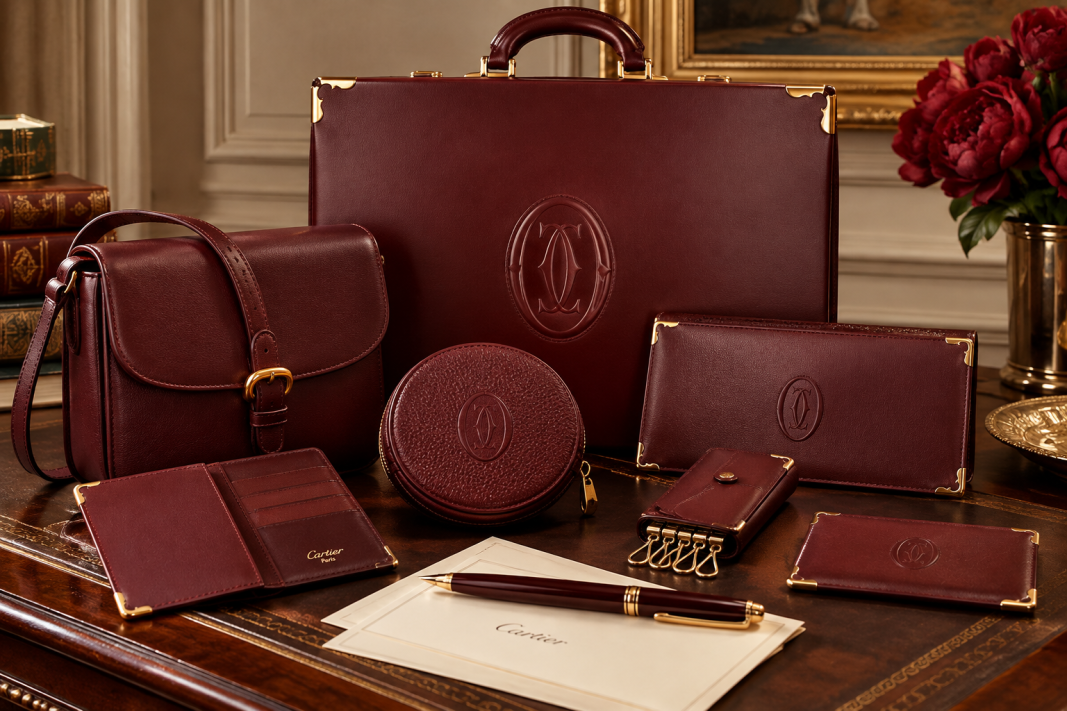
Leather goods became one of the clearest expressions of the Must de Cartier era. Deep burgundy leather, discreet gold-colored hardware and the Double C monogram created an identity that was luxurious but restrained. The color became particularly recognizable. Rather than relying upon repeated logos across every surface, Cartier could make a document case, wallet, eyeglass case or shoulder bag identifiable through the combination of burgundy leather, proportion, metal details and carefully positioned branding.
Period Cartier catalogues demonstrate how broad this leather-goods world became. Clutches, shoulder bags, small purses, pouches and practical cases appeared alongside watches, eyewear, scarves and other accessories. Cartier was presenting not simply isolated products but an entire vocabulary of personal luxury. The designs also reflected the working and traveling lifestyles of their period. Document holders, agendas, wallets and writing accessories translated Cartier into objects that might be used every day rather than reserved for formal occasions.
That development remains particularly interesting for collectors because many vintage Must de Cartier leather goods have survived precisely as personal objects. Natural wear can record decades of use, while well-preserved examples reveal the understated richness of the original leather and gold-colored details.
Cartier Writing Instruments and Personal Accessories
Writing instruments fitted naturally into this expanded Cartier world. A pen combines engineering, tactile design and personal ritual in much the same way as a watch. It can also function as a visible expression of taste without being overtly decorative.
Cartier applied precious-metal finishes, lacquer and characteristic details to pens and pencils while producing desk and writing accessories that could accompany them. In the Must era, these objects allowed the Cartier name to move into offices, briefcases and everyday professional life. Eyewear offered another opportunity. Frames could incorporate gold-colored metal, distinctive shapes and recognizable Cartier details while remaining functional objects worn directly on the body.
Lighters, key holders and other small accessories extended the idea further. Cartier was no longer simply creating jewelry to accompany clothing; it was designing many of the objects a customer might carry and use throughout the day.
Must de Cartier Enters the World of Fragrance
Cartier’s expansion eventually reached something even less tangible than jewelry or leather: fragrance. Must de Cartier became the Maison’s first perfume. The move was significant because perfume allowed Cartier’s identity to exist without precious materials at all. The product depended upon scent, bottle design, packaging and the emotional associations of the Cartier name.
The original Must de Cartier fragrance combined green galbanum with floral, powdery and vanilla notes, creating a perfume quite different from the visual objects for which Cartier had previously been known. Yet the concept followed the same expansion already visible in leather goods and accessories: Cartier was becoming a complete luxury universe.
Fragrance also introduced the Maison to an enormously broader audience. Someone encountering Cartier through perfume might later discover its watches, leather goods or jewelry, while established clients could extend their relationship with the brand into another part of daily life.
From Jewelry House to Luxury Maison
By the 1980s and 1990s, Cartier had become something considerably broader than the Paris jewelry house founded in 1847. Jewelry and watchmaking remained at its core, but the Cartier name now encompassed leather goods, pens, eyewear, fragrance and a wide variety of accessories.
Period catalogues make this transformation particularly visible. Watches can appear only a few pages away from burgundy leather bags, scarves, sunglasses and wallets. The message is unmistakable: Cartier was offering a way of living with the Maison rather than merely purchasing an occasional jewel.
Yet Cartier generally maintained distinctions between categories. High jewelry remained a field of exceptional stones and craftsmanship, while accessories allowed a broader audience to participate in the identity of the house. This balance between accessibility and exclusivity became one of the central challenges facing modern luxury companies. Cartier’s experience with Must helped demonstrate how a historic specialist house could expand while continuing to cultivate its highest traditions.
Preserving Cartier’s Own History
Interestingly, Cartier’s commercial expansion coincided with a growing awareness of its own heritage. In 1973 the company purchased a historic Portique mystery clock at auction, an early step toward assembling examples of its past creations. The Cartier Collection, formally created in 1983, eventually grew to encompass more than 3,000 historical pieces. Jewelry and watches form major parts of the collection, but Cartier also preserves objects such as pens, vanity cases and travel nécessaires.
This institutional collecting changed the relationship between a luxury company and its own past. Earlier generations of jewelers created objects and sold them; Cartier began actively buying important historical Cartier pieces back from the market. The archives provide another dimension. Cartier preserved documentation relating to the design and sale of its creations, allowing objects to be connected with drawings, production information and historical clients.
Beginning in 1989, major museums increasingly presented exhibitions devoted to Cartier. The house’s work could therefore be considered not simply within commercial luxury but within histories of jewelry, fashion, decorative arts and design.
Cartier and the Modern Luxury Group
Another major corporate transformation took place as Cartier became part of what developed into Richemont, one of the world’s major luxury groups. Richemont was formed in 1988 with interests that included Cartier alongside other luxury businesses. This corporate structure differs enormously from the family business operated by Louis, Pierre and Jacques Cartier. Yet the continuing importance of historical designs demonstrates how strongly the modern company depends upon the creative capital accumulated during the family era.
The Santos and Tank remain important watches. Trinity, Panthère and Love continue as major jewelry identities. Juste un Clou transformed a 1970s design into a contemporary collection, while Must remains a recognizable name in leather goods and fragrance. Rather than continually replacing established designs, Cartier has become particularly skilled at reinterpretation. Proportions change, materials evolve and collections expand, but recognizable ideas connect new objects with earlier generations.
Why Cartier Design Remains Recognizable
Cartier does not have one visual style. A diamond Garland Style tiara, an Art Deco mystery clock, a Tank watch, a panther brooch and a burgundy leather portfolio may look completely different. What connects them is a particular attitude toward design. Cartier repeatedly emphasizes strong proportions, clearly defined forms and materials selected not merely for cost but for visual effect.
Contrast appears throughout its history. Diamonds meet black onyx; emeralds meet sapphires and rubies; transparent rock crystal meets opaque hardstone; burgundy leather meets gold-colored corners. Even the Love bracelet depends upon the contrast between polished precious metal and industrial-looking screws.
Cartier has also repeatedly found luxury in recognizable shapes. A rectangle becomes a Tank watch. Three circles become Trinity. A nail becomes Juste un Clou. Spots become a panther. A simple burgundy leather case becomes unmistakably associated with Must de Cartier through color, proportion and discreet details. This ability to reduce an idea to something memorable helps explain why Cartier designs can survive changes in fashion.
Cartier Jewelry, Watches and Objects as Collectibles
For collectors, the breadth of Cartier presents both opportunity and complexity. An antique Cartier jewel belongs to a different market from a vintage Must de Cartier wallet, yet both form part of the history of the same Maison. Signatures, serial numbers, hallmarks, materials and construction can all contribute to identification, but they must be interpreted in relation to the type and period of the object. Cartier operated through different historic branches, worked with specialist workshops and expanded into numerous product categories over time.
Provenance becomes particularly valuable when it survives. Original boxes, receipts, catalogues and documented family histories can help place an object within its period. Condition also needs to be judged according to purpose. Jewelry may have been worn occasionally, while a wallet, document case or eyeglass case was designed for repeated handling. Honest evidence of use can therefore be entirely consistent with the history of a vintage leather object.
Collectors should also distinguish between rarity and significance. Some Cartier designs were commercially successful and survive in considerable numbers precisely because customers loved them. Their historical importance may come from the role they played in expanding the Maison rather than from extreme scarcity.
The Importance of Cartier Catalogues
Vintage Cartier catalogues provide particularly valuable evidence because they show how the Maison presented its own products at a specific moment. Individual objects separated from their original context cannot always reveal how Cartier intended customers to understand them. A catalogue can place a watch beside related models, show the range of leather accessories available in a particular color, or demonstrate how Cartier combined bags, eyewear, scarves and personal accessories into a coordinated luxury world.
Descriptions can also preserve terminology that later sellers may replace with invented names. For collectors and researchers, contemporary Cartier documentation therefore deserves considerable weight when identifying a vintage object. The catalogues also reveal changes in marketing. Earlier Cartier imagery often emphasized individual precious creations, while later publications could present groups of products as elements of a lifestyle. That visual transition parallels Cartier’s evolution from specialist jeweler into international luxury Maison.
Cartier Today
Cartier today remains strongly identified with jewelry and watchmaking, but the broader world developed during the later 20th century has not disappeared. The Maison continues to offer leather goods, writing accessories, eyewear and fragrance alongside jewelry and watches.
Some of the connections with earlier Cartier remain remarkably direct. Contemporary Must leather goods still include burgundy calfskin and gold-colored details, while the Double C continues to identify the collection. A design language strongly associated with vintage Cartier accessories therefore remains alive rather than existing solely as nostalgia.
At the same time, Cartier continues to produce high jewelry at an entirely different level of craftsmanship and value. The coexistence of these categories is essential to understanding the modern Maison. A customer might encounter Cartier through perfume, a wallet or a pair of glasses, while another commissions exceptional jewelry. Both participate in a brand identity whose origins reach back to a Parisian jewelry workshop established in 1847.
A Living Archive of Design
Perhaps the most remarkable aspect of Cartier history is how many apparently contradictory identities the Maison has managed to accommodate. Cartier can represent royal tiaras and industrial screws, Mughal emeralds and minimalist gold rings, mysterious clocks and practical leather portfolios.
Its history is therefore not simply a progression from jewelry into watches and then accessories. Different periods continually overlap. A contemporary designer can return to a century-old motif, while an object developed for a more accessible market can itself become a collectible piece of design history.
The Cartier Collection makes that continuity tangible. By preserving thousands of its own historical creations, the Maison treats earlier work not as a closed archive but as a continuing source of design knowledge. This may be one reason Cartier has avoided becoming defined entirely by a single decade. The company can look backward without simply reproducing the past because its history contains so many different directions from which to draw.
The Continuing History of Cartier
From the workshop established by Louis-François Cartier in Paris in 1847, Cartier developed into one of the defining names in international luxury. Alfred Cartier strengthened the family enterprise, while Louis, Pierre and Jacques transformed it into a house spanning Paris, London and New York.
Its designers helped change the appearance of jewelry, explored cultural influences far beyond France and treated watch cases as exercises in modern design. Cartier created mystery clocks that concealed their mechanics, transformed the panther into a sculptural emblem and reduced jewelry to elemental forms in Trinity, Love and Juste un Clou.
The later expansion of Must de Cartier added another important chapter. Burgundy leather goods, pens, eyewear, fragrance and personal accessories brought Cartier into everyday life and demonstrated that a historic jeweler could expand into a complete luxury Maison without abandoning high jewelry and watchmaking. That history also explains why seemingly modest vintage Cartier objects deserve attention. A leather notebook cover, eyeglass case, wallet, pen or bottle of perfume may occupy a very different place from a diamond tiara, but each can document a stage in Cartier’s evolution.
Together, these objects tell a much larger story about changing ideas of luxury. In the 19th century, Cartier built its reputation by serving an elite clientele with precious jewelry. During the 20th century, it added watches, clocks and objects of extraordinary ingenuity, then extended its identity into products that could accompany people through ordinary daily life.
More than 175 years after its founding, Cartier remains unusual because its history is still visibly present in what it makes. The Tank, Santos, Trinity, Panthère, Love, Juste un Clou and Must collections do not merely borrow famous names from an archive. They connect contemporary Cartier with successive generations of designers, craftspeople and clients who transformed a Paris jewelry workshop into an international Maison.