

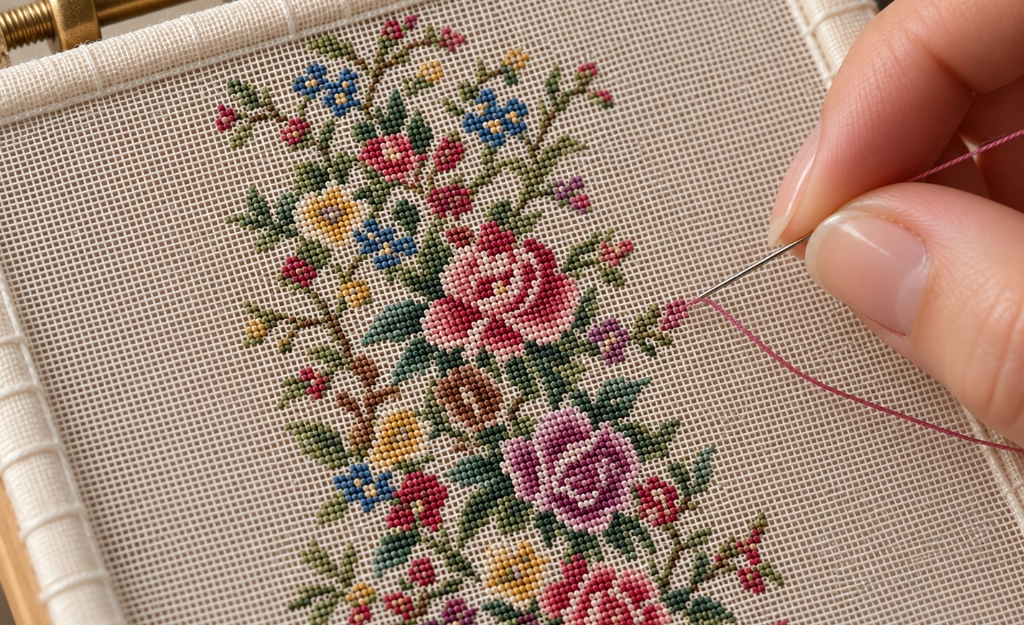
Petit point embroidery transforms thousands of tiny stitches into flowers, landscapes, figures, ornaments and miniature scenes that can appear almost painted rather than sewn. At its finest, the individual stitches become difficult to distinguish with the naked eye. Instead, they merge into subtle changes of color and remarkably detailed images created entirely with thread.
Although collectors often associate petit point with Vienna, the art belongs to a much broader European needlework tradition. France played an important role in its early development. England, Hungary, Italy and other European countries produced notable examples, while Germany developed its own traditions and later became an important source of embroidered fashion accessories. Austria, however, brought the technique to an extraordinary degree of refinement. Viennese workshops became especially celebrated for extremely fine silk gauze, minute stitches, sophisticated color gradations and elaborate pictorial designs.
Petit point also changed dramatically over the centuries. Needleworkers once used it for large furnishings, bed hangings and decorative panels. Later generations transformed the same fundamental technique into diminutive works of art for handbags, purses, spectacle cases, mirrors, jewelry and other personal accessories. Understanding this history helps explain why objects described as petit point can look remarkably different from one another.
What Is Petit Point Embroidery?
Petit point belongs to the larger family of canvas-work embroidery. The embroiderer works small diagonal stitches across the intersections of an evenly woven ground. Traditionally, the stitch passes over a single intersection of the ground rather than covering the larger area associated with coarser forms of canvas work.
The French name itself conveys the idea: petit point means “small stitch” or “small point.” The technique appears simple when reduced to its basic movement. However, extraordinary skill becomes necessary as the ground grows finer. Every stitch must remain consistent in size, tension and direction. Moreover, the embroiderer must place each color precisely because a shift of only a few stitches can alter the curve of a petal, the expression of a face or the perspective of a building.
Consequently, fineness matters enormously. A relatively coarse canvas produces visible, easily distinguished stitches. A very fine ground allows many more stitches within the same area. Those additional stitches give the embroiderer far greater control over outlines, shading and color transitions.
This explains why exceptionally fine petit point can resemble miniature painting. A rose no longer consists simply of pink stitches surrounded by green ones. Instead, numerous shades can create highlights, shadows, curling petals and depth within a flower scarcely larger than a thumbnail.
Petit Point, Needlepoint and Tapestry
The terminology surrounding petit point often creates confusion. Needlepoint or canvas work describes the broader category of embroidery worked on an open, evenly structured ground. Petit point generally describes particularly small-scale canvas embroidery worked over individual thread intersections.
Meanwhile, tapestry is technically different. True tapestry is woven. The design forms as the textile itself is woven on a loom. Petit point creates a design by passing embroidery threads through an already existing ground.
Nevertheless, antique dealers and manufacturers have long used terms such as “tapestry purse,” “tapestry embroidery” and “Gobelin bag” rather loosely. Therefore, an old description that calls an embroidered handbag a tapestry bag does not necessarily mean that a loom produced it. The distinction becomes especially important when identifying antique and vintage accessories.
The European History of Petit Point
The history of petit point embroidery reaches much further back than the small floral handbags that many people now associate with the name. European needleworkers practiced forms of fine canvas embroidery for centuries. By the sixteenth and seventeenth centuries, embroiderers used tiny counted stitches to produce elaborate pictorial and ornamental textiles. Surviving works include furnishings, decorative panels, cushions, purses and other objects.
The technique flourished in aristocratic households as well as professional workshops. Fine needlework formed part of the education and accomplishments expected of many upper-class European women. At the same time, professional embroiderers produced increasingly ambitious decorative works.
Designs frequently drew inspiration from paintings, prints and engravings. This relationship between needlework and the graphic arts became particularly important because engravings allowed compositions to circulate across national borders. A print produced in France or the Low Countries could eventually inspire an embroidered design elsewhere in Europe.
As a result, petit point never developed within completely isolated national traditions. Designs, materials and fashions traveled. That movement helps explain both the similarities and the striking regional variations found in surviving examples.
French Petit Point and the Courtly Tradition
France occupies an important place in the history of petit point. Fine canvas embroidery appeared in French court and aristocratic settings well before the eighteenth century. During the reign of Louis XIV, needlework also formed part of the education offered at the Maison Royale de Saint-Louis at Saint-Cyr, founded under the influence of Madame de Maintenon for daughters of impoverished noble families.
The association became strong enough for fine canvas work to acquire the name point de Saint-Cyr in some French traditions. French examples ranged far beyond fashion accessories. Needleworkers produced embroidered furnishings, chair coverings, decorative panels and objects for interiors. Floral ornament, classical subjects, figures and pastoral scenes all provided inspiration.
The close relationship between embroidery and France’s celebrated textile arts also contributed to later confusion in terminology. Aubusson and Gobelins became internationally recognized names associated with French tapestry production. Consequently, later embroidered objects that imitated the appearance of historic woven tapestry sometimes acquired descriptions such as “Aubusson-style” or “Gobelin.”
However, these terms should not automatically identify the technique or place of manufacture. An embroidered petit point purse inspired by a French tapestry remains embroidery rather than Aubusson tapestry. This distinction matters because nineteenth- and twentieth-century makers across Europe freely borrowed earlier French imagery. Courtship scenes, shepherdesses, gardens, ruins, flowers and Rococo ornament could evoke eighteenth-century France even when an object was made somewhere else.
Viennese Petit Point: An Extraordinary Refinement
Among the European traditions, Viennese petit point became particularly famous for its extreme fineness. The Viennese tradition traces its development from earlier French court needlework. The technique reached Austria during the Baroque period and flourished in Vienna during the Rococo. French and Dutch prints and paintings supplied important sources for the landscapes, figures and ornamental compositions that came to characterize much Viennese work.
However, Viennese embroiderers did more than reproduce existing imagery. They progressively refined the physical scale of the embroidery. Threads became finer. Grounds became more delicate. Color ranges expanded. As stitch counts increased, needleworkers could reproduce increasingly complicated imagery within surprisingly small areas. The result could approach miniature painting.
A face might occupy only a tiny portion of a handbag yet contain enough stitches to suggest eyes, features, hair and expression. Landscapes could include buildings, trees, clouds and distant horizons. Floral arrangements could incorporate dozens of subtly shaded petals and leaves. Therefore, the reputation of Viennese petit point rests on measurable craftsmanship rather than nationality alone.
The Remarkable Fineness of Viennese Petit Point
Surviving Viennese workshops provide an unusually clear picture of just how fine the technique can become. Traditional silk gauze can accommodate hundreds of stitches within a single square centimeter. Different grades allow progressively greater detail. At the finer end, the embroiderer may work under magnification because individual stitches become extraordinarily small.
Historic Viennese specialist workshops have also used hundreds of shades of thread to reproduce complicated designs. Such fineness requires enormous amounts of time. An experienced needleworker may complete only hundreds of stitches in an hour, while an elaborate handbag can require months of embroidery. That labor explains why the finest examples look so different from ordinary needlepoint. From a normal viewing distance, the stitches begin to disappear. Color and image take over.
Vienna’s Twentieth-Century Petit Point Workshops
Vienna maintained its petit point tradition even as European fashion changed during the twentieth century. The enterprise now known as Vienna Petit Point traces its history to 1928, when Vilma Frankl-Mihalek established the business. The family tradition has continued through subsequent generations.
Maria Stransky established another important Viennese petit point business in 1932. Its artisans continue to produce hand-embroidered accessories using fine silk gauze and traditional designs. Twentieth-century Vienna also supported other specialist workshops. J. Jolles Studios produced sophisticated petit point handbags and experimented with more contemporary imagery as well as traditional designs. By the 1930s, advertisements and newspaper coverage promoted modern pictorial handbags alongside the more familiar historical and floral subjects.
These workshops demonstrate that Viennese petit point did not simply preserve an eighteenth-century craft unchanged. Makers adapted it to twentieth-century fashion while maintaining the extraordinarily labor-intensive hand embroidery that distinguished the tradition.
From Rococo Pictures to Modern Accessories
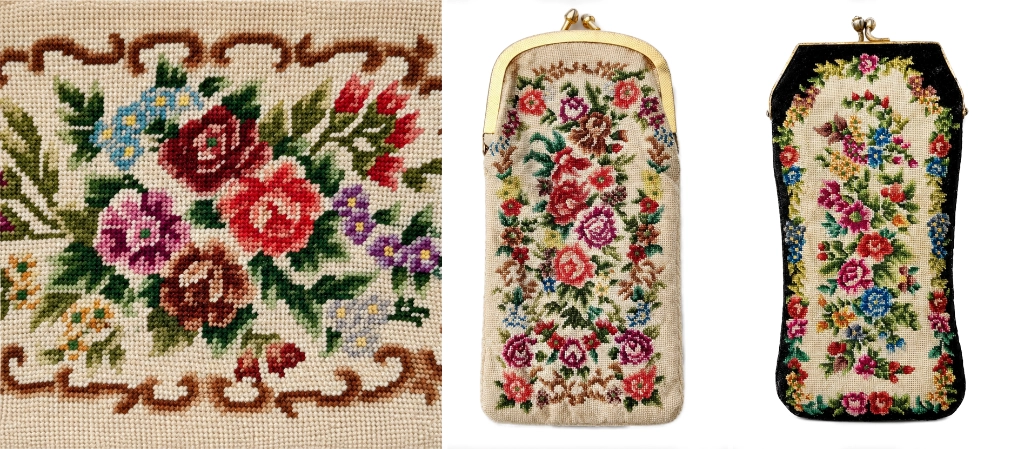
Viennese artisans applied petit point to an impressive variety of objects. Handbags remain among the most spectacular. Some feature embroidery on the front while silk forms the back and sides. Others carry embroidery around the entire bag. Floral designs might repeat on both sides, while pictorial bags could present different scenes on the front and back.
However, handbags represented only part of the market. Artisans also produced purses, spectacle cases, compacts, mirrors, jewelry and other small personal objects. Petit point proved particularly suitable for these accessories because its minute scale allowed an elaborate picture to fit within a very limited surface.
A small eyeglass case could therefore contain an entire garden of roses. A compact might carry a miniature bouquet. A purse could reproduce a landscape. The practical object became a tiny decorative artwork.
German Petit Point and the Rise of Fashion Accessories
Germany also forms an important part of the European petit point story. German-speaking regions already possessed strong traditions of canvas work and embroidery. During the nineteenth century, the enormous popularity of Berlin wool work further encouraged counted canvas embroidery throughout Europe. Berlin publishers distributed colored patterns internationally, making German design and materials highly influential even when the finished needlework was completed elsewhere.
Petit point should not simply be equated with Berlin wool work. The latter generally used larger-scale canvas and brightly colored wool, although embroiderers sometimes reserved finer petit point for detailed areas such as faces and hands. Nevertheless, the German needlework industry helped popularize charted canvas embroidery on an enormous scale.
By the twentieth century, German makers also produced petit point handbags and accessories. Surviving early twentieth-century German evening bags show all-over embroidered surfaces, floral designs and decorative metal frames. After World War II, manufacturers in West Germany supplied another recognizable group of petit point accessories.
West German Petit Point
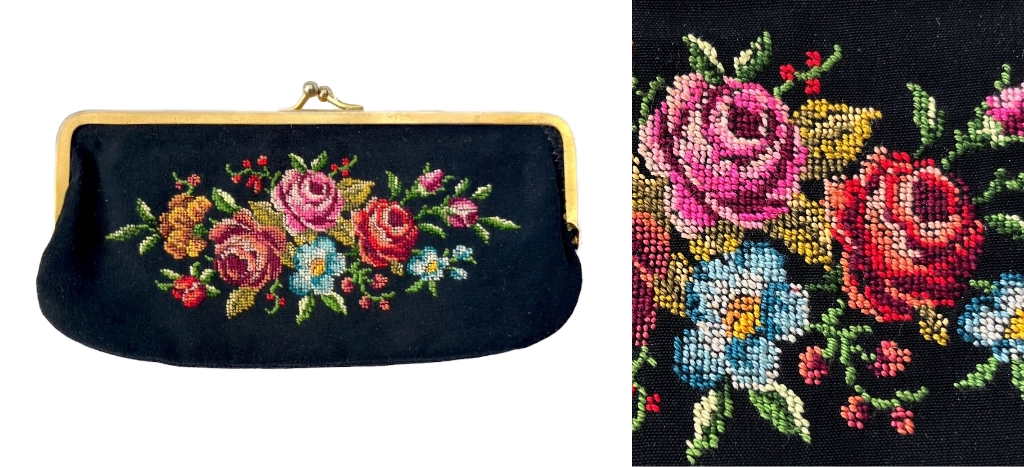
West German production included evening bags, coin purses, powder compacts, mirrors, jewelry boxes and other vanity accessories. Floral arrangements, especially roses and mixed bouquets, appeared frequently. Some pieces combine an embroidered floral panel with an otherwise plain textile surface. Others incorporate petit point into gold-tone metal compacts and small accessories.
Marked examples are particularly valuable for identification because they establish an origin that appearance alone cannot prove. Golden Seal provides one such example. Surviving pieces carry the Golden Seal name together with West German markings, while embroidered floral decoration appears on several different types of accessories.
However, collectors should resist turning these observations into rigid rules. A black background does not make an object German. Roses do not make it Austrian. A gold-tone frame does not prove Italian manufacture. European makers shared motifs, materials and fashions, particularly during the twentieth century. Marks and documented provenance remain much stronger evidence.
Petit Point in Hungary
Hungary also has a documented history of petit point that reaches well beyond the twentieth-century fashion accessory. Hungarian inventories from the seventeenth through nineteenth centuries record furnishings and wall textiles worked in combinations of gros point and petit point. Surviving museum pieces include furniture embroidered in these techniques around 1700.
Hungarian aristocratic households participated in the broader European culture of decorative canvas work. As elsewhere, printed designs circulated internationally, and Low Countries engravings provided models for some compositions. Petit point also appeared on smaller Hungarian objects during the nineteenth century. Surviving examples worked in silk demonstrate that fine counted embroidery remained part of the country’s decorative arts tradition.
This evidence is more useful than attempting to identify Hungarian work through supposedly characteristic “folk colors.” Hungary certainly possesses extraordinary regional embroidery traditions, but not every Hungarian petit point object belongs to folk art. Aristocratic and cosmopolitan needlework existed alongside regional traditions. That distinction prevents a complex textile history from becoming a simple national stereotype.
Italian Petit Point
Italy also produced petit point, although the Italian story should not be reduced to the frequently repeated marketplace phrase “Florentine petit point.” Florence has a long history of luxury textile and decorative arts production, and documented nineteenth-century Florentine purses survive with silk petit point embroidery. Some combine multicolored floral designs with decorative fasteners, silk linings and ornamental handles. Italian decorative arts naturally influenced the presentation of these objects, but metalwork alone cannot establish Italian origin.
The term Florentine stitch creates additional confusion. Florentine embroidery, now commonly associated with Bargello, uses characteristic straight stitches arranged into repeating geometric patterns. Petit point uses tiny diagonal stitches over the ground. Both belong to the broad world of counted embroidery, but they are not interchangeable techniques. Therefore, a genuine Florence-made petit point purse and an object worked in Florentine or Bargello stitch represent different things.
Petit Point in Belgium and the Low Countries
The Low Countries played an important indirect role in the visual language of European petit point. Paintings and, particularly, engravings circulated widely throughout Europe. Viennese sources themselves acknowledge the importance of Dutch masters in shaping the pictorial vocabulary used for traditional Viennese petit point.
Belgium also participated in Europe’s extensive textile and embroidery culture. However, evidence does not support treating “Belgian petit point” as a single easily recognized national style comparable to the highly documented Viennese specialist tradition. That caution matters.
Modern descriptions sometimes assign national identities according to color, subject or presumed regional taste. Yet historic European decorative arts rarely respected such neat boundaries. Designs traveled, workshops responded to international fashion, and retailers sold imported goods. Consequently, an object’s Belgian provenance should rest on documentation, marks or a well-supported attribution rather than on a supposedly Belgian palette.
Britain and the Wider Petit Point Tradition
Britain deserves a place in the story as well. British embroiderers used fine tent and petit point stitches centuries before the twentieth-century fashion for continental evening bags. Surviving seventeenth-century work demonstrates extraordinary skill in pictorial canvas embroidery, while later examples include furnishings and small personal objects.
By the late eighteenth century, British makers were producing embroidered reticules in petit point. These small handbags anticipated, in function if not necessarily in construction, the elaborate embroidered evening bags that became fashionable much later.
The British tradition reinforces an important point: petit point was never exclusively Austrian. What Vienna achieved was not the invention of all fine canvas embroidery. Rather, Viennese artisans developed a particularly refined, recognizable and commercially enduring branch of a much older European art.
Flowers, Landscapes and Stories Told in Thread
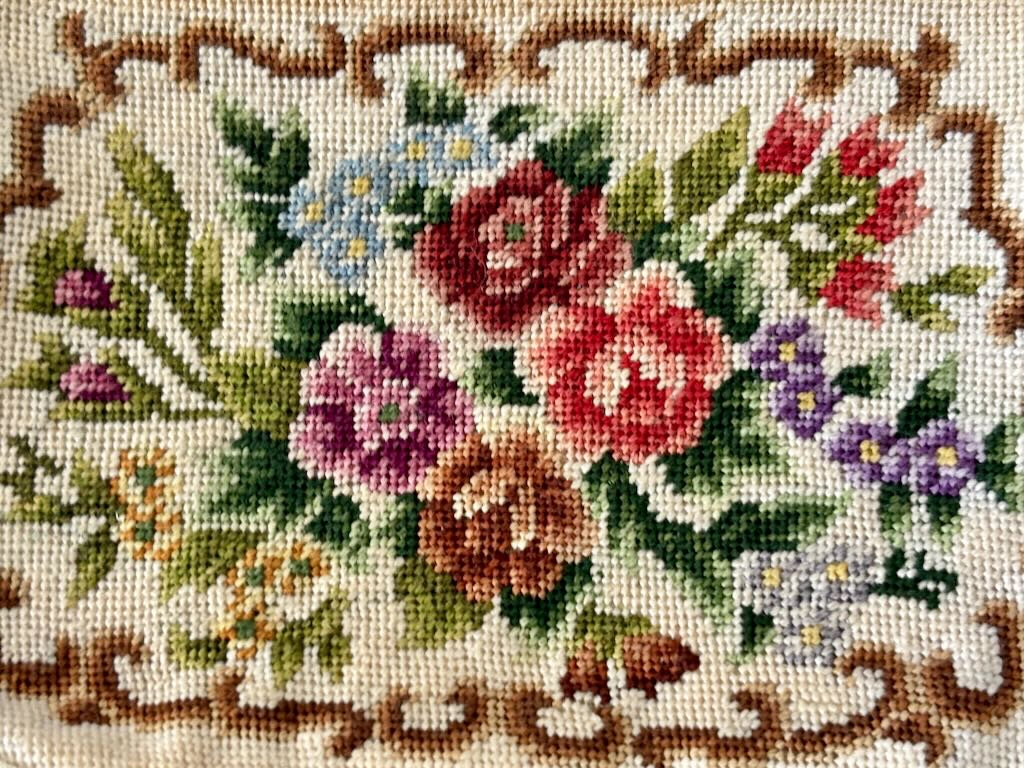
Flowers became one of the most enduring subjects in petit point embroidery. Roses offered particular advantages. Their overlapping petals allowed embroiderers to demonstrate subtle changes in color, while leaves and smaller flowers created contrasting shapes around them. A bouquet could contain pink, crimson, burgundy, cream, blue, violet, yellow and numerous shades of green. On very fine work, several shades within a single petal create the illusion of curvature and light. Yet flowers represent only part of the tradition.
Historic petit point also depicts biblical stories, classical subjects, courtly figures, pastoral scenes, birds, animals, buildings, ruins and landscapes. Needleworkers translated paintings and engravings into grids of tiny stitches much as later image-making technologies constructed pictures from pixels. That comparison helps explain the importance of stitch density. The smaller the “pixel,” the more detail the embroiderer can describe.
Petit Point Handbags, Spectacle Cases and Vanity Accessories
The migration of petit point from interiors to personal accessories represents one of the most fascinating chapters in its history. Large embroidered furnishings demanded enormous areas of stitching. Smaller accessories allowed makers to concentrate the same decorative richness into portable objects.
During the late nineteenth and early twentieth centuries, increasingly elaborate handbags offered ideal surfaces for pictorial needlework. Decorative metal frames completed the effect. Some included engraved, chased, enameled or jewel-like details. As fashions changed, petit point appeared on an expanding range of personal objects. Spectacle cases, coin purses, compacts, mirrors and other accessories brought fine needlework into everyday life. These pieces varied enormously in quality.
Some were extraordinary luxury objects requiring extremely fine embroidery. Others were attractive commercial accessories produced for a much broader market. Both belong to the history of petit point, but collectors should not assume that the name alone indicates a particular stitch count, age, nationality or level of workmanship.
How to Recognize Fine Petit Point
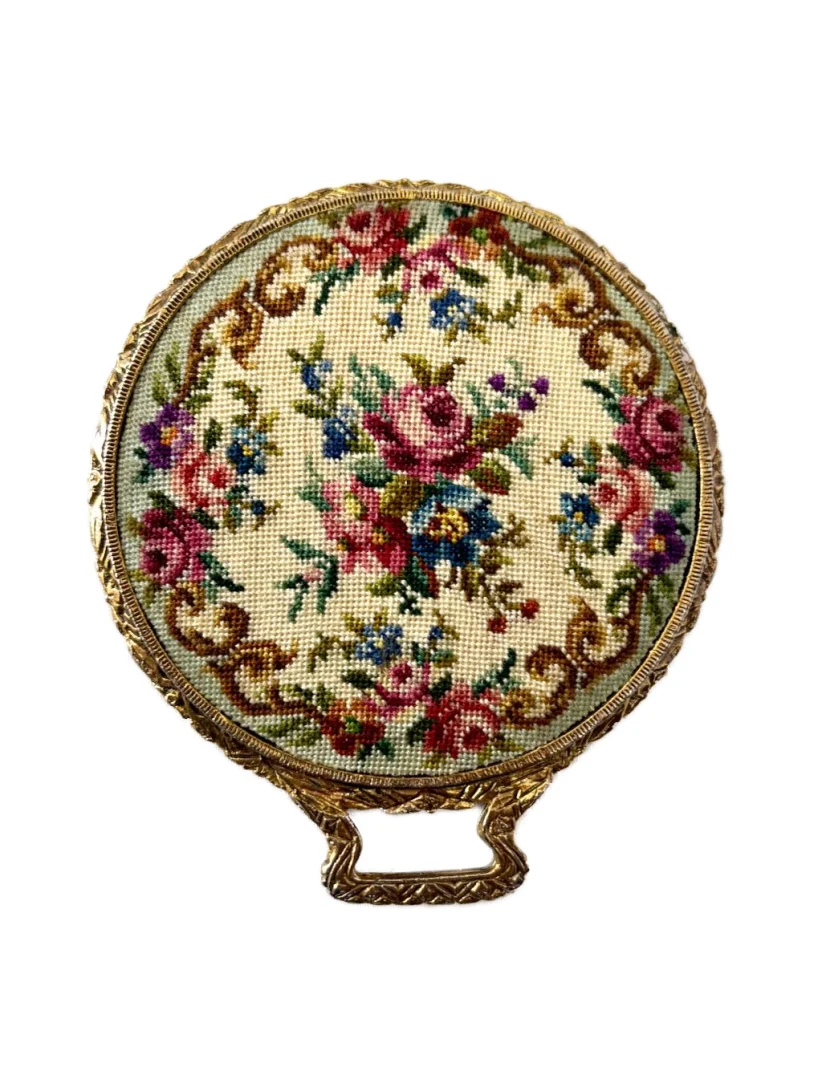
Fine petit point embroidery rewards close examination. First, look at the ground and stitch scale. Very fine work packs many tiny, regular stitches into a small area. Individual stitches should maintain consistent direction and tension. On exceptionally fine pieces, the image dominates from a normal viewing distance and the stitches become apparent only on close inspection.
Next, examine color transitions. Skilled work rarely depends on a single pink for a rose or one green for a leaf. Multiple shades create volume, highlights and shadows. More sophisticated pictorial work uses color to model faces, clothing, architecture and distant landscapes. Curves provide another clue. Coarse work often creates noticeably stepped outlines because each stitch occupies a relatively large part of the design. Finer work allows smoother contours.
The ground also matters. Extremely fine Viennese work traditionally uses very fine silk gauze. Other petit point can appear on linen, cotton canvas and other suitable grounds. Finally, consider the entire object. A beautifully embroidered panel does not exist in isolation. The quality of the frame, clasp, lining, backing and assembly contributes to the finished piece. However, none of these characteristics alone proves nationality.
Stitch Count and Quality
Stitch count provides useful information because greater density allows greater detail. Yet it should not become the only measure of quality. A technically fine ground cannot compensate for poor tension, crude color choices or careless finishing. Conversely, a beautifully composed floral piece on a somewhat coarser ground may display excellent craftsmanship.
The finest Viennese work demonstrates what happens when several qualities come together: exceptionally fine gauze, tiny consistent stitches, sophisticated color selection, accomplished design and meticulous finishing. That combination, rather than an Austrian label by itself, explains the prestige attached to exceptional Wiener Petit Point.
Identifying Antique and Vintage Petit Point
Identifying the origin of an unmarked petit point accessory can prove surprisingly difficult. Begin with marks. Examine the metal frame, clasp, hinges, interior fittings and other hardware. Country-of-origin marks such as Austria, Germany or West Germany can provide important evidence. A manufacturer’s name or trademark can narrow the identification further.
Labels also matter. However, textile and paper labels often disappear through wear, cleaning or previous repairs. Next, examine construction. Determine whether the embroidery covers the entire object or appears only as a panel. Look at the lining material, frame construction, backing and method of attachment.
Design can provide clues, but it requires caution. Rococo figures do not automatically mean France. A rose bouquet does not establish Vienna. Black grounds appear in more than one country.
Provenance can therefore become particularly important. A reliable family history recording where and approximately when an object was purchased adds useful evidence, especially when no manufacturer’s mark survives. Nevertheless, place of purchase and place of manufacture are not necessarily the same. For that reason, careful descriptions distinguish between marked origin, documented provenance, and stylistic attribution.
Dating Petit Point Accessories
Construction and markings can also help establish approximate dates. For example, a piece marked “West Germany” necessarily belongs to the historical period when that national designation applied, providing a useful chronological framework. Changes in handbag shape, clasp design, lining materials and metalwork can help narrow the period further.
However, older-looking designs require particular caution. Twentieth-century Viennese makers deliberately continued using eighteenth-century and Rococo-inspired imagery. Therefore, a pastoral scene that appears stylistically eighteenth century may actually have been embroidered much later. Petit point often celebrates historical design rather than following contemporary visual fashion. That quality forms part of its charm, but it can also mislead an inexperienced eye.
Caring for Antique and Vintage Petit Point
Age makes fine petit point vulnerable. Silk can weaken. Colors can fade. Metal frames can tarnish or corrode. Linings can split, while adhesives and other materials hidden within a frame can deteriorate. Moisture presents a particular danger because a small accessory combines several materials that may react differently. Water can cause dyes to migrate, create tidelines, move accumulated dirt through fibers, affect silk and interact with metal or old adhesives.
Therefore, avoid washing an antique petit point accessory simply because its surface appears dirty. Aggressive metal polishing can cause similar problems. Polish can enter the embroidery, stain threads or become trapped along the frame. Excessive manipulation can also stress fragile stitching where the textile joins the hardware.
For valuable or particularly fragile pieces, a professional textile conservator offers the safest approach. For ordinary storage, protect the object from strong light, excessive humidity, dust and crushing. Acid-free tissue can help support the shape of a purse or case without placing unnecessary pressure on the embroidery.
Why Viennese Petit Point Remains Exceptional
The broader European history makes Vienna’s achievement more interesting, not less. France contributed to the development and dissemination of fine canvas embroidery and courtly imagery. Britain produced accomplished petit point and tent-stitch work over several centuries. Hungary incorporated petit point into aristocratic interiors and decorative objects. Italy produced fine embroidered accessories. Germany contributed both to the nineteenth-century expansion of counted canvas work and to later fashion accessories. Designs and engravings from the Low Countries influenced embroiderers far beyond their place of origin.
Vienna absorbed this larger European vocabulary and pushed one branch of the craft toward extraordinary miniaturization. At the highest levels of Viennese petit point, hundreds of stitches can occupy a square centimeter. Silk threads and extremely fine gauze allow subtle gradations that transform stitches into imagery. A handbag can require months of concentrated labor.
Yet the tradition survived precisely because artisans adapted it to objects people could carry and use. A grand embroidered wall hanging belonged to an interior. A petit point purse, spectacle case or compact placed the same fascination with color and miniature imagery into the hand.
Petit Point as a Living Decorative Art
Petit point occupies an unusual position between embroidery, painting and the decorative arts. Its materials appear modest: ground, thread and a seemingly simple diagonal stitch. Its complexity emerges through accumulation. Hundreds and eventually thousands of carefully positioned stitches turn those basic materials into roses, landscapes, architecture and human figures.
The surviving objects also record changing European life. Aristocratic needlework became fashionable domestic embroidery. Large furnishings gave way to intimate personal accessories. Historic designs entered twentieth-century fashion. Specialist workshops preserved techniques that industrial production could never reproduce in quite the same way.
Most remarkably, the Viennese tradition remains alive. Artisans still create hand-embroidered petit point in Vienna today, continuing techniques associated with workshops established nearly a century ago. For collectors, that long history makes petit point much more than an attractive floral embroidery. Each piece belongs somewhere within a complex European story of needlework, fashion, craftsmanship and cultural exchange. The smallest stitches can tell a surprisingly large story.