


Description
Vintage Golden Seal Petit Point Purse
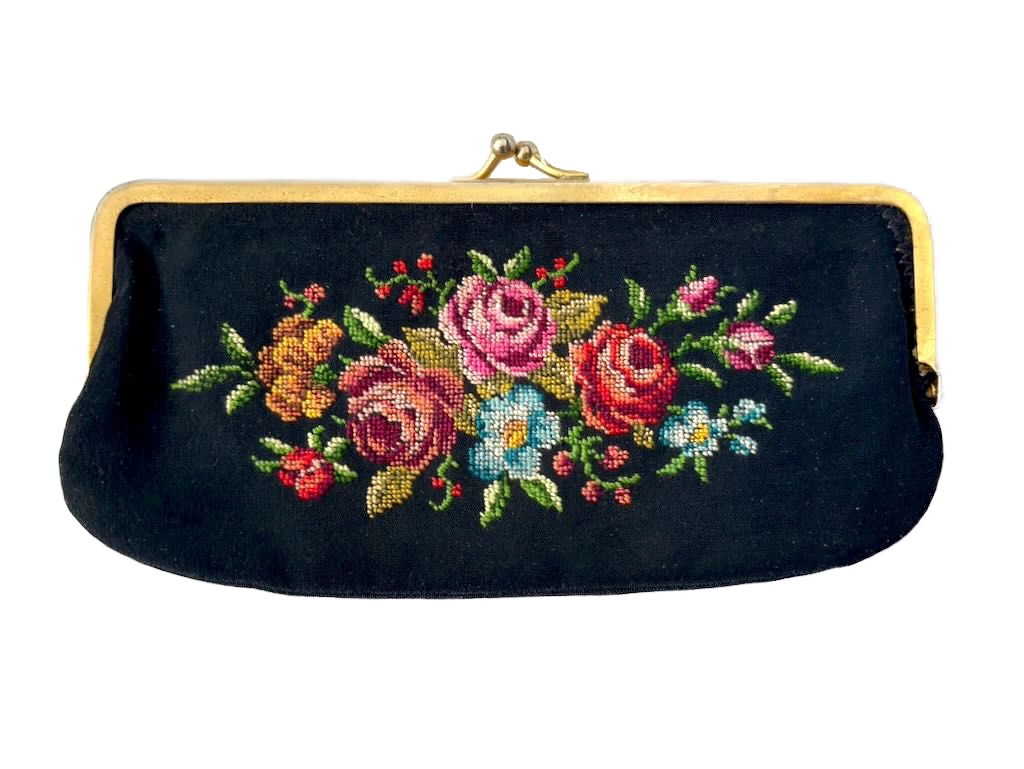
This vintage Golden Seal petit point purse combines colorful floral needlework with a dramatic black ground, gold-tone metal frame and lustrous gold-colored satin interior. Marked Golden Seal and West Germany, it provides a documented example of the petit point accessories produced in postwar Germany during the mid-20th century.
The purse has a slender rectangular form with softly curved lower corners. A concentrated bouquet of roses and smaller flowers spreads across the front, while the surrounding black fabric allows the embroidery to stand out with unusual clarity.
Floral Petit Point on a Black Ground
The embroidery features large pink, rose and red blossoms accompanied by smaller blue flowers, buds, leaves and golden-brown foliage. Numerous shades within the larger roses create highlights and shadows, giving the petals considerably more dimension than a simple flat floral pattern.
The black ground is particularly effective. Rather than covering the entire surface with embroidery, the maker allowed the dark fabric to become part of the composition. The flowers consequently appear almost suspended against the background.
Seen at close range, the individual stitches remain clearly visible. From a normal viewing distance, however, those small areas of color merge into recognizable petals, leaves and blossoms—one of the characteristic visual effects of petit point embroidery.
Golden Seal West Germany
Unlike many surviving vintage petit point accessories whose origins remain uncertain, this purse carries a Golden Seal West Germany mark. That marking securely places its production in West Germany and provides useful evidence when identifying similar mid-century embroidered accessories.
Golden Seal appears on a variety of surviving West German personal accessories decorated with petit point, including purses, mirrors, compacts and small cases. The surviving objects demonstrate that petit point remained commercially fashionable well into the postwar period rather than disappearing with the elaborate embroidered handbags of earlier generations.
The West German attribution is especially useful because floral petit point accessories were produced and sold across several European countries. Roses, dark grounds and gold-tone frames alone cannot reliably establish national origin; a surviving manufacturer’s or country mark provides much stronger evidence.
Gold-Tone Frame and Satin Interior
A simple gold-tone metal frame borders the top of the purse and terminates in a small ball clasp. Its restrained design keeps attention on the embroidery while providing a warm visual contrast with the black exterior.
Opening the purse reveals a gold-colored satin lining. The interior remains notably clean and attractive for its age, retaining much of its original sheen.
There is slight localized damage to the black exterior fabric near the metal frame. It is relatively inconspicuous in normal viewing and does not detract significantly from the embroidered floral panel, which remains intact.
A Mid-Century European Fashion Accessory
By the mid-20th century, petit point had moved far beyond the large furnishings and pictorial needlework associated with earlier European embroidery. Makers adapted the technique to handbags, spectacle cases, mirrors, compacts and other accessories that could carry miniature areas of elaborate needlework.
This Golden Seal purse illustrates that transition particularly well. Its streamlined form belongs to the postwar era, while its densely shaded roses continue a much older European tradition of creating remarkably detailed pictures from tiny individual stitches.
For a broader look at the technique, European traditions and the exceptional refinement achieved by Viennese workshops, see Petit Point: The Remarkable Art of Miniature Embroidery.