

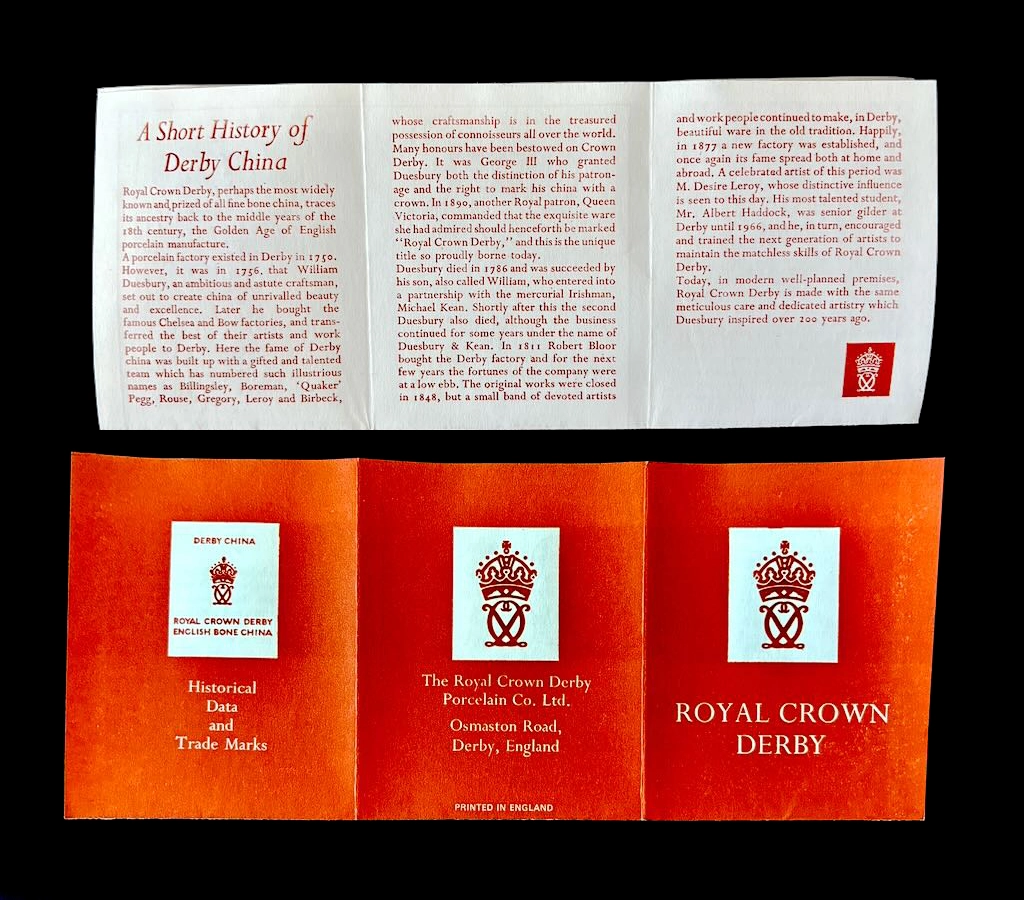
Royal Crown Derby occupies an extraordinary place in the history of English porcelain. From its origins in 18th-century Derby to the fine bone china still produced in the city today, the company has built a reputation for richly decorated tableware, elaborate gilding and an unusual continuity of skilled English craftsmanship.
Its history spans more than 275 years and several distinct businesses, factories and generations of artists. Along the way, Derby porcelain has reflected changing European tastes, absorbed influences from France, Japan and China, served royal households and fashionable dining rooms, and produced some of the most recognizable patterns in British ceramics. Today, Royal Crown Derby remains particularly associated with fine bone china made in England. Yet the story behind that familiar crowned backstamp is considerably more complicated—and more interesting—than the history of a single factory.
The Beginnings of Derby Porcelain
The history of Royal Crown Derby traditionally begins in 1750, when Andrew Planché established a china works in Derby. Planché was an accomplished modeller whose early porcelain figures helped establish Derby as an important center of English porcelain production. A decisive development followed when William Duesbury, a talented porcelain decorator, became involved in the enterprise. With financial backing from local businessman John Heath, the business developed into the Derby porcelain manufactory associated with Nottingham Road.
Duesbury proved particularly important because he combined artistic judgment with considerable commercial ambition. Rather than simply producing another provincial English porcelain, he developed Derby into a serious competitor in the rapidly expanding luxury ceramics market. Porcelain had become one of the great status materials of 18th-century Europe. Meissen, Sèvres and other Continental factories produced elaborate objects for aristocratic households, while English manufacturers competed to develop their own distinctive porcelain traditions. Derby became one of the most successful.
William Duesbury and the Expansion of Derby
Under Duesbury, Derby attracted talented painters, modellers and decorators. The factory produced figures, ornamental objects and increasingly sophisticated tableware. Duesbury also expanded through acquisition. Most significantly, he acquired the celebrated Chelsea porcelain factory, bringing its artistic traditions and skilled workers into the Derby enterprise. For a period, porcelain combining these influences became known to collectors as Chelsea-Derby.
Derby’s growing reputation also reached London. A showroom gave the factory direct access to fashionable customers and helped establish Derby porcelain beyond its Midlands origins.
Royal patronage followed. In 1775, King George III granted permission for a crown to appear in the Derby mark. The crown subsequently became one of the most recognizable elements associated with Derby porcelain. It was an early indication of a relationship with royalty that would become central to the company’s identity.
The Duesbury Legacy
When William Duesbury died in 1786, his son William Duesbury II inherited the business. The younger Duesbury continued to develop the factory’s artistic reputation and employed accomplished painters and decorators. Derby porcelain from this broad period can display remarkable variety. Botanical painting, landscapes, figures, elaborate borders, rich grounds and gilding all appeared on the factory’s wares.
The company also responded readily to changing fashions. European Neoclassicism influenced shapes and ornament, while growing Western enthusiasm for Asian porcelain encouraged Derby decorators to explore designs inspired by Japanese and Chinese ceramics. Those influences would eventually contribute to one of Royal Crown Derby’s most enduring specialties: its richly colored interpretations of Imari porcelain.
Robert Bloor and Nineteenth-Century Derby
The business entered another important phase under Robert Bloor, whose name became closely associated with Derby porcelain during the early 19th century. Bloor-era wares often demonstrate the highly decorative character that collectors continue to associate with Derby. Rich colors, gilding and Japan-inspired patterns suited contemporary demand for visually impressive ceramics. However, the original Derby works eventually declined. The Nottingham Road factory closed in 1848, apparently bringing the original Derby enterprise to an end.
The skills associated with Derby porcelain did not disappear. A small group of former workers established another operation at King Street in Derby, continuing aspects of the old factory’s tradition. The King Street works survived independently for decades and produced porcelain using inherited skills, forms and decorative traditions.
This creates an important distinction for collectors. “Derby,” “Crown Derby” and “Royal Crown Derby” do not describe one uninterrupted corporate entity operating under a single name. Several strands of Derby porcelain history overlap, and factory marks can therefore become essential when identifying an individual piece. We will explore those distinctions more fully in our separate article on Royal Crown Derby marks and dating.
A New Factory at Osmaston Road
The foundation of the company recognizable as modern Royal Crown Derby came during the second half of the 19th century. A new enterprise began production at Osmaston Road in Derby in the 1870s under the name Derby Crown Porcelain Company. The Osmaston works established a new center for Derby porcelain and ultimately became the home of Royal Crown Derby. The factory combined respect for Derby’s earlier decorative heritage with the ambitions of a Victorian luxury manufacturer.
Fine tableware, ornamental porcelain, intricate painting and extensive gilding became increasingly important. At the same time, the company developed designs that drew upon historical European and Asian sources while transforming them into unmistakably Derby creations. The Osmaston Road site remains associated with Royal Crown Derby today.
From Crown Derby to Royal Crown Derby
Another defining moment came in 1890. Queen Victoria granted the company permission to use the word “Royal”, after which the business became known as the Royal Crown Derby Porcelain Company.
The distinction between “Crown” and “Royal” therefore has historical significance. Earlier Crown Derby wares predate the Royal designation, while pieces bearing Royal Crown Derby marks belong to the period beginning in the late 19th century. The crowned monogram that developed through subsequent backstamps became one of the best-known British ceramic marks. Royal recognition coincided with a particularly ambitious period of decoration at the factory.
Désiré Leroy and the Art of Decoration
Among the notable artists associated with Royal Crown Derby was the French-born decorator Désiré Leroy, who arrived at the factory around the time it received its Royal title. Leroy became associated with exceptionally elaborate painted, gilded and jewelled porcelain. His work represented an approach in which porcelain could become almost as much a vehicle for decorative art as a functional ceramic object. Raised gilding, intricate borders, richly painted panels and jewel-like enamel effects transformed some Royal Crown Derby pieces into objects intended primarily to demonstrate artistic and technical virtuosity.
Other artists and decorators contributed to the factory’s reputation as well. Royal Crown Derby’s own historical literature particularly remembers figures such as Albert Haddock, who became an important gilder and helped pass specialized skills to subsequent generations. This continuity of knowledge—from experienced craftspeople to younger decorators—became one of the defining characteristics of Derby production.
Royal Crown Derby and the Influence of Imari
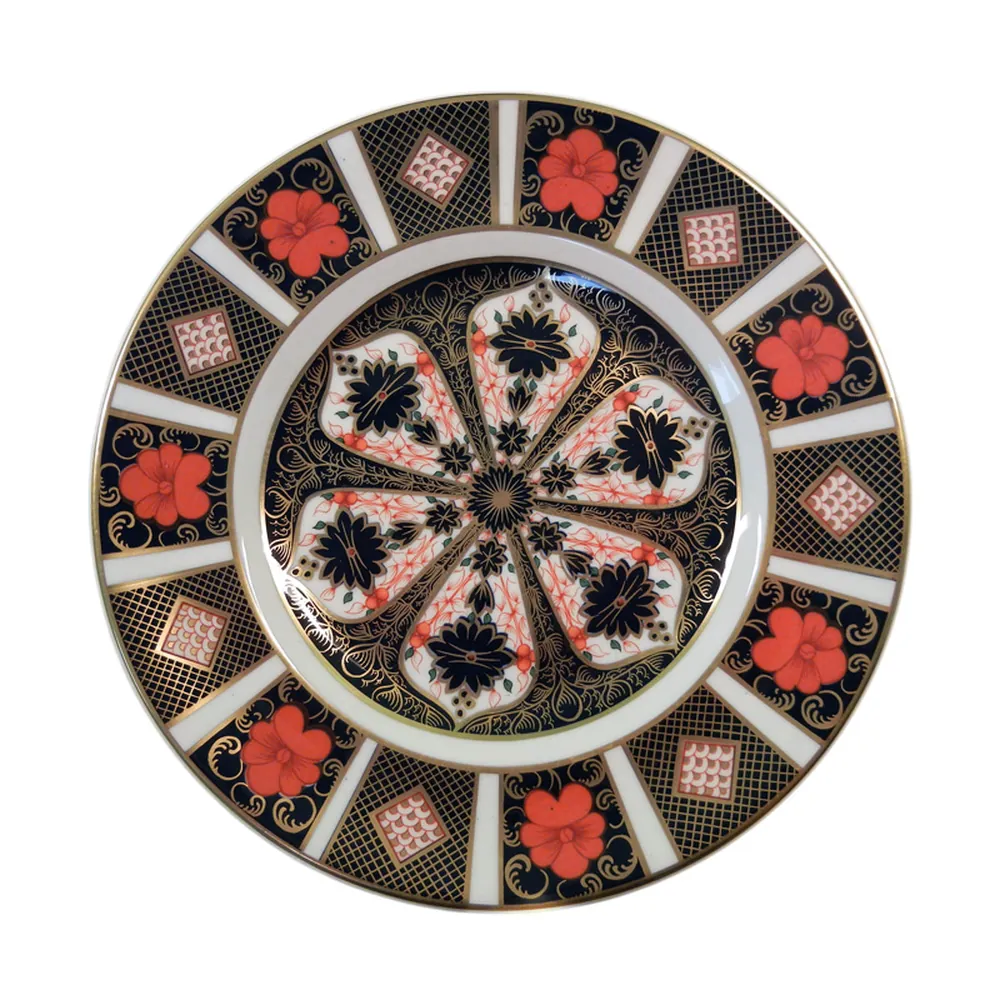
Few decorative traditions are as closely associated with Royal Crown Derby as Imari. Original Japanese Imari porcelain reached Europe in significant quantities during the 17th and 18th centuries. Its dramatic combinations of cobalt blue, iron red, white and gilding strongly influenced European ceramic manufacturers. Derby did not simply reproduce Japanese porcelain. Its artists gradually developed highly elaborate interpretations that combined Japanese-inspired color and ornament with European forms, dense patterning and extensive gilding.
One design became particularly celebrated: Old Imari pattern 1128. The pattern appears in Royal Crown Derby’s historic pattern books and remains part of the company’s production today. Its survival demonstrates how successfully Derby transformed an imported decorative influence into part of its own visual identity. Royal Crown Derby also produced numerous other Japan and Imari-derived designs, including patterns now avidly collected in their own right.
The larger story extends far beyond Derby. Japanese Imari influenced manufacturers throughout Europe and eventually became an international decorative language. We explore that broader history in our article Imari Porcelain: The Remarkable Journey of Japan’s Most Influential Pattern.
Flowers, Birds and the Other Side of Royal Crown Derby
Imari may be one of the company’s most recognizable traditions, but Royal Crown Derby has never been limited to it. Flowers have remained especially important throughout Derby’s history. Early botanical painters helped establish the factory’s reputation, while later patterns translated the English flower garden into increasingly delicate tableware.
Floral designs could range from carefully observed individual specimens to exuberant bouquets scattered across white porcelain. Birds also became recurring subjects. Patterns such as Aves developed another recognizable branch of the Derby aesthetic, combining naturalistic subjects with ornamental borders and gilding.
Royal Crown Derby’s continuing Royal Antoinette pattern demonstrates another side of the tradition. Delicate flowers, scrolling ornament and gilded detail create a very different impression from the saturated colors and geometric richness of Old Imari, yet both belong convincingly within the same decorative heritage.
This range helps explain Royal Crown Derby’s longevity. Rather than depending upon one visual formula, generations of designers repeatedly reinterpreted the company’s established vocabulary.
Derby Posies and the Informal Floral Tradition
One of Royal Crown Derby’s best-known 20th-century floral designs is Derby Posies. Unlike the visual opulence of Old Imari, Derby Posies relies on small, colorful floral arrangements scattered against a light ground. The effect is intimate and informal, making the pattern particularly suitable for tea wares, smaller table pieces and decorative accessories.
Its popularity also illustrates an important change in the market for English china. Fine porcelain no longer belonged exclusively to grand formal dining services. Attractive china increasingly entered everyday domestic life through tea sets, serving pieces, gifts and personal accessories.
Royal Crown Derby adapted accordingly.
Derby Posies appeared on an exceptionally broad range of objects, including the bone-china-handled cutlery produced by Royal Crown Derby during the 20th century. Surviving boxed sets include salad servers, dessert and fruit cutlery and other specialized utensils whose porcelain handles carry the familiar floral decoration. These pieces form an interesting bridge between traditional porcelain manufacture and the changing rituals of the modern dining table.
Bone China Handled Cutlery and Unusual Royal Crown Derby Wares
Collectors encountering Royal Crown Derby for the first time often think primarily of plates, cups, saucers and ornamental porcelain. The company’s historical production was considerably broader. Vintage Royal Crown Derby bone china handled cutlery combined decorated porcelain handles with metal utensils, allowing a table service to extend its china pattern beyond conventional ceramic pieces.
Original Royal Crown Derby literature supplied with such sets specifically describes them as “bone china handled cutlery.” The manufacturer’s care instructions recommended washing the pieces by hand in lukewarm water to protect the material binding the metal component to the handle.
Surviving unused sets in their original fitted boxes provide a particularly evocative glimpse of mid-20th-century entertaining. Salad servers, fruit or dessert knives and forks could coordinate with the china on the table while also serving as presentation-quality gifts.
They also demonstrate something easily overlooked when studying historic manufacturers: innovation does not always require abandoning tradition. Royal Crown Derby could adapt its established floral decoration and bone china craftsmanship to new objects while retaining an immediately recognizable identity.
Fine Bone China and the Importance of Craftsmanship
Royal Crown Derby today describes every piece of its fine bone china as designed, handcrafted and decorated in Derbyshire. Fine bone china combines delicacy of appearance with considerable strength. Its white body provides an ideal surface for the elaborate colors, fine detail and metallic decoration for which Royal Crown Derby became known.
Yet the ceramic body is only the beginning. A piece moves through numerous stages before completion. Forming, firing, glazing, decorating and additional firings transform the initial material into finished china. Decoration may involve carefully applied designs as well as hand-painted details and gilding. Royal Crown Derby continues to use 22-carat gold and platinum on many of its collections.
Gilding requires particular skill because a decorator must control the placement and consistency of the precious-metal preparation before firing reveals the finished metallic surface. Borders, handles and complex ornamental elements demand considerable precision.
The survival of these specialized skills is important to understanding Royal Crown Derby. The value of fine porcelain lies not simply in the raw ceramic material but in the accumulated design knowledge and craftsmanship required to transform it.
Royal Crown Derby and the Titanic
One of the most fascinating episodes in Royal Crown Derby history connects the factory with RMS Titanic. On January 31, 1911, Royal Crown Derby received a commission to supply china for the ship’s first-class dining service. Correspondence with Stonier & Co., the glass and china retailer involved in the order, survives in the Royal Crown Derby Museum.
Titanic represented the height of Edwardian luxury. Its first-class interiors and dining arrangements were intended to rival prestigious hotels, making fine tableware an integral part of the experience rather than a minor practical detail. Royal Crown Derby’s participation places the company within that larger world of British luxury manufacturing immediately before the First World War. Remarkably, the historic Titanic design remains associated with Royal Crown Derby today. The company continues to produce a Titanic collection inspired by that celebrated service.
Royal Patronage and Prestigious Commissions
Royal connections have accompanied Derby porcelain for much of its history. The crown incorporated into the Derby mark following the honor granted by George III and the later “Royal” designation authorized during Queen Victoria’s reign gave those associations visible expression on the porcelain itself.
Royal Crown Derby states that it has supplied every British monarch since George III. Royal visits and presentations continued through the 20th century, including a Royal Pinxton Rose dinner service presented to Queen Elizabeth II. Prestigious commissions have not been limited to royalty.
Fine porcelain historically occupied an important place in hotels, ocean liners, diplomatic settings and wealthy private households. Royal Crown Derby continues to work with private and hospitality clients and offers bespoke tableware today. The clientele has changed with society, but the underlying idea remains remarkably familiar: porcelain can communicate identity, ceremony and hospitality as effectively as it performs a practical function.
Royal Crown Derby in the Twentieth Century
The 20th century presented English porcelain manufacturers with enormous challenges. Two world wars altered labor, materials and markets. Formal dining habits changed. International competition expanded, and later generations became less likely to purchase enormous matching dinner services of the type once associated with marriage and household establishment. Royal Crown Derby nevertheless continued to develop new markets and products.
Its decorative vocabulary expanded, while familiar patterns remained available. Tableware continued alongside ornamental and gift objects, and pieces such as porcelain-handled cutlery brought Derby decoration into new categories. Another particularly successful development came with collectible porcelain figures and paperweights. These small sculptural objects opened Royal Crown Derby to collectors who might never assemble a traditional dinner service.
At the same time, older patterns remained an important part of the company’s identity. That combination of continuity and adaptation has allowed a plate based on a historic Derby design to coexist with contemporary tableware and collectible objects carrying the same crowned marque.
Changing Ownership and a Continuing Derby Identity
Royal Crown Derby’s corporate history changed considerably during the later 20th and early 21st centuries. Like many British ceramic manufacturers, it spent periods within larger corporate structures before returning to greater independence. In the early 21st century, further ownership changes connected Royal Crown Derby with Steelite International, a major British tableware manufacturer with extensive hospitality experience.
Royal Crown Derby records Steelite’s acquisition as taking place in 2012, led by Kevin Oakes. The company credits that period with expanding its presence in international hospitality. Kevin Oakes subsequently acquired Royal Crown Derby privately, and Christopher Oakes became Managing Director in 2017. Despite those changes in ownership and market strategy, Derby itself has remained central to the brand.
Royal Crown Derby Today
Royal Crown Derby continues to manufacture in England. The company states that 100 percent of its products are made in England, with its fine bone china designed, handcrafted and decorated in Derbyshire. That continuity is unusual in an industry transformed by globalization.
Today’s collections range from restrained contemporary designs to patterns deeply rooted in the company’s past. Old Imari, Royal Antoinette, Aves and Titanic coexist with newer tableware, bespoke commissions, home décor and collectible objects. The company also serves private residences, retailers, hotels and restaurants internationally. This combination makes modern Royal Crown Derby difficult to classify simply as either a heritage manufacturer or a contemporary luxury company. It is both.

Royal Crown Derby Marks and Dating
For collectors, the underside of a Royal Crown Derby piece can be nearly as interesting as its decoration. Derby marks evolved substantially over more than two centuries. Early marks differ greatly from later Crown Derby and Royal Crown Derby backstamps, while King Street and Osmaston Road production introduce further distinctions.
Pattern numbers can provide additional information, but they should not automatically be confused with date marks. Likewise, painted symbols, Roman numerals, decorators’ marks and factory identifiers can serve different purposes. Royal Crown Derby itself maintains an unusually extensive historical record of its backstamps and dating systems.
Because this subject deserves more than a simplified chart, we examine it separately in Royal Crown Derby Marks and Dating, including early Derby marks, the transition to Crown Derby and Royal Crown Derby, year cyphers, Roman numeral date codes and the difference between pattern numbers and dating information.
Collecting Royal Crown Derby
Collectors approach Royal Crown Derby from many directions. Some concentrate on 18th- or 19th-century Derby porcelain. Others pursue individual artists, particular shapes, floral patterns, Imari designs, paperweights or discontinued table services. Still others simply acquire individual pieces whose decoration appeals to them. Condition remains important, particularly on heavily gilded porcelain. Wear to gold, scratches, staining, cracks, chips and restoration can all affect desirability. However, age alone does not determine significance or value.
Marks deserve careful examination, but decoration, shape, craftsmanship, condition and documented pattern information should be considered together. Original boxes and factory literature can add another dimension, especially for later vintage objects. They preserve evidence about how Royal Crown Derby described, sold and cared for its own products at the time.
More Than 275 Years of Derby Porcelain
The history of Royal Crown Derby is ultimately a story of continuity through change. The business associated with the name has changed factories, owners, markets and artistic directions. The world in which Andrew Planché and William Duesbury worked bears little resemblance to the international luxury market Royal Crown Derby serves today.
Yet certain ideas have endured. Porcelain should be beautifully made. Decoration should matter. Skilled hands should remain visible in the finished object. Historical designs can be preserved without preventing new ones from emerging.
That continuity explains why an 18th-century Derby figure, a richly gilded Victorian vase, an Old Imari plate, a floral bone-china-handled serving set and a contemporary Royal Crown Derby dinner service can appear dramatically different while remaining connected by a recognizable tradition. For collectors, that long history offers more than famous patterns or royal associations. Each Royal Crown Derby piece belongs to a continuing story of English porcelain making—one that began in Derby in the 18th century and remains alive there today.