

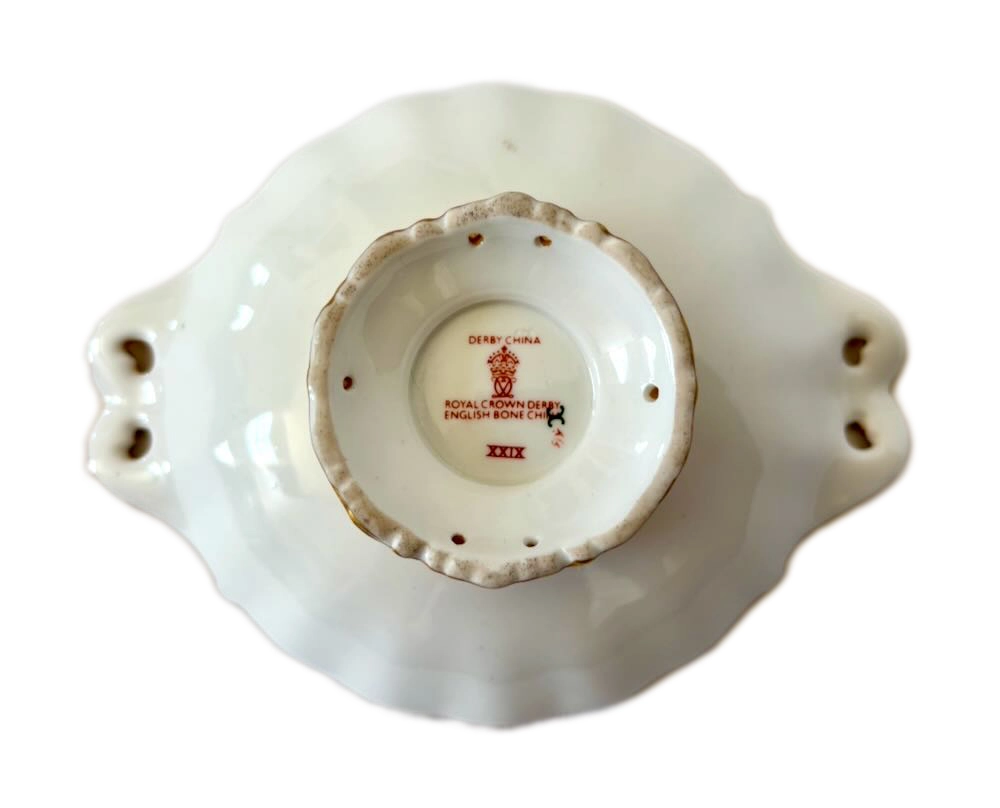
Royal Crown Derby marks can reveal a surprising amount about a piece of English porcelain. Turn over a plate, cup, vase or decorative object and the marks on its base may identify the factory, establish a period of manufacture, reveal the pattern and, in many cases, identify the year in which it was made.
Reading those marks correctly, however, requires more than recognizing the familiar Royal Crown Derby name or crown. Derby porcelain has been produced through a long and sometimes complicated succession of factories, proprietors and trademarks. The marks changed accordingly.
A backstamp and a date mark are also not necessarily the same thing. A pattern number serves another purpose entirely. Painted numbers, impressed marks and decorators’ marks can add still more information. For collectors, learning to separate these different clues provides one of the most useful tools for identifying and dating Royal Crown Derby porcelain.
Understanding Royal Crown Derby Marks
Collectors often use the term “backstamp” for almost anything found beneath a piece of porcelain. In reality, several different types of marks may appear together, and each can tell a different part of the story. The principal factory mark identifies the manufacturer or factory and generally establishes a broad period. A separate date mark may identify the year of manufacture. A pattern number identifies the decoration rather than the date, while other painted, impressed or incised marks can relate to production or decoration. This distinction becomes particularly important with Royal Crown Derby because the company eventually developed a remarkably systematic method of dating its wares.
From 1880 through 1937, individual symbols identified particular years. Beginning in 1938, Royal Crown Derby changed to a Roman-numeral system. Before looking for an exact year, however, it helps to establish which chapter of Derby production the principal factory mark represents.
Nottingham Road Factory Marks, 1761–1848
The earliest Derby porcelain predates the familiar Royal Crown Derby name by more than a century. Marks associated with the Nottingham Road factory therefore differ considerably from the crowned trademarks found on later wares. Royal Crown Derby records Nottingham Road trademarks beginning in 1761. One of the earliest documented examples is a rebus for Richard Holdship that decorated transfer-printed wares from approximately 1761 to 1769. During the later eighteenth century, Derby used incised marks followed by a succession of Chelsea-Derby marks.
The Chelsea connection is particularly significant. William Duesbury acquired the Chelsea porcelain factory in 1770, and the intertwined histories of Chelsea and Derby produced several related marks. Chelsea used some of these marks, while Derby used others. Collectors should therefore interpret a Chelsea-Derby mark within this historical context rather than treat it as a variation of the much later Royal Crown Derby trademark.
The Duesbury Period Marks
One of the best-known early Derby marks developed during the Duesbury period. Royal Crown Derby dates the principal form to approximately 1784–1825. These early marks were not mechanically identical from one piece to another. Their execution and color can provide additional clues. The factory records indicate that blue and puce were used until 1806, after which red became the standard color.
The character of the mark also changed. Artists carefully drew earlier examples, but after about 1820, they rendered the marks with increasingly loose execution. For an early Derby piece, therefore, the color and execution of the mark can provide useful evidence alongside its basic design.
Robert Bloor Marks, c. 1825–1848
Robert Bloor’s period at Derby introduced another important group of marks. Printed Gothic-style Bloor marks appeared from approximately 1825. They provided a more consistent alternative to some of the increasingly loosely drawn marks of the preceding period.
Collectors may also encounter less obvious Derby marks on pieces from this era. Bloor figures could carry distinctive figure marks, while some late Bloor pieces display a pseudo-Meissen mark. Derby also used a pseudo-Sèvres mark on Sèvres-style copies from approximately 1830 to 1848.
These are particularly good examples of why a mark should never be interpreted in isolation. A mark resembling that of another European porcelain factory does not automatically mean that factory made the object. Its context, porcelain body, decoration and other markings must also agree with the attribution.
King Street Factory Marks, 1848–1935
The closing of the original Nottingham Road works in 1848 did not end porcelain production associated with the Derby tradition. Production continued at King Street, and the marks associated with this factory form a distinct sequence extending from 1848 until 1935.
Early King Street marks include those of Locker & Co., approximately 1848–1859, followed by Stephenson Sharp & Co. from approximately 1859–1861. Later marks relate to Stevenson & Hancock and Sampson Hancock, with documented examples appearing in blue, red and puce. During the twentieth century, King Street marks also included those associated with William Larcombe, Larcombe & Paget and Paget.
This becomes especially important when dating later nineteenth- and early twentieth-century Derby porcelain because King Street and Osmaston Road production overlapped. Collectors therefore cannot attribute a Derby piece from this period to a particular operation based solely on its approximate age. They must examine the actual mark to determine its origin.
Osmaston Road and the Derby Crown Mark
The marks most collectors now associate with Royal Crown Derby emerged at the Osmaston Road factory. The first important phase, known as the Derby Crown period, lasted from approximately 1877 to 1890. During this period, the company used a mark incorporating the crown and Derby monogram, which later evolved into the familiar Royal Crown Derby identity.
The date is significant because the company had not yet received permission to use the word “Royal.” Queen Victoria granted the company permission to use the title Royal in 1890. Consequently, collectors can use the distinction between a Derby Crown mark and a Royal Crown Derby mark as an important historical dividing line when examining nineteenth-century porcelain.
Royal Crown Derby Marks from 1891
Royal Crown Derby marks introduced after the granting of the Royal title developed through several recognizable forms. On examples dating approximately 1891–1921, the word England appears vertically to the right of the principal stamp. From approximately 1921–1964, Made in England appears horizontally beneath the stamp.
These apparently minor differences can provide valuable dating evidence. When examining a mark, it is therefore important to look beyond the crown and central monogram. The position and wording of the country designation can help distinguish one period from another.
The Wartime Royal Crown Derby Mark
The Second World War produced another useful identifying mark. From approximately 1940–1945, Royal Crown Derby used a dark green wartime mark. This mark usually appears without the normal year code and was also used on undecorated utility wares.
The absence of a year mark on such a piece should therefore not automatically cause concern. Historical circumstances affected both production and marking practices. In this instance, identifying the correct wartime backstamp may provide a more reliable dating range than searching for an individual year symbol that was never applied.
Royal Crown Derby Marks, c. 1952–1975
A principal Royal Crown Derby backstamp used from approximately 1952–1975 is especially relevant to collectors of postwar and mid-century pieces. Royal Crown Derby produced far more than conventional dinner services during this period. Table accessories, decorative wares and bone china handled cutlery all formed part of its twentieth-century output.
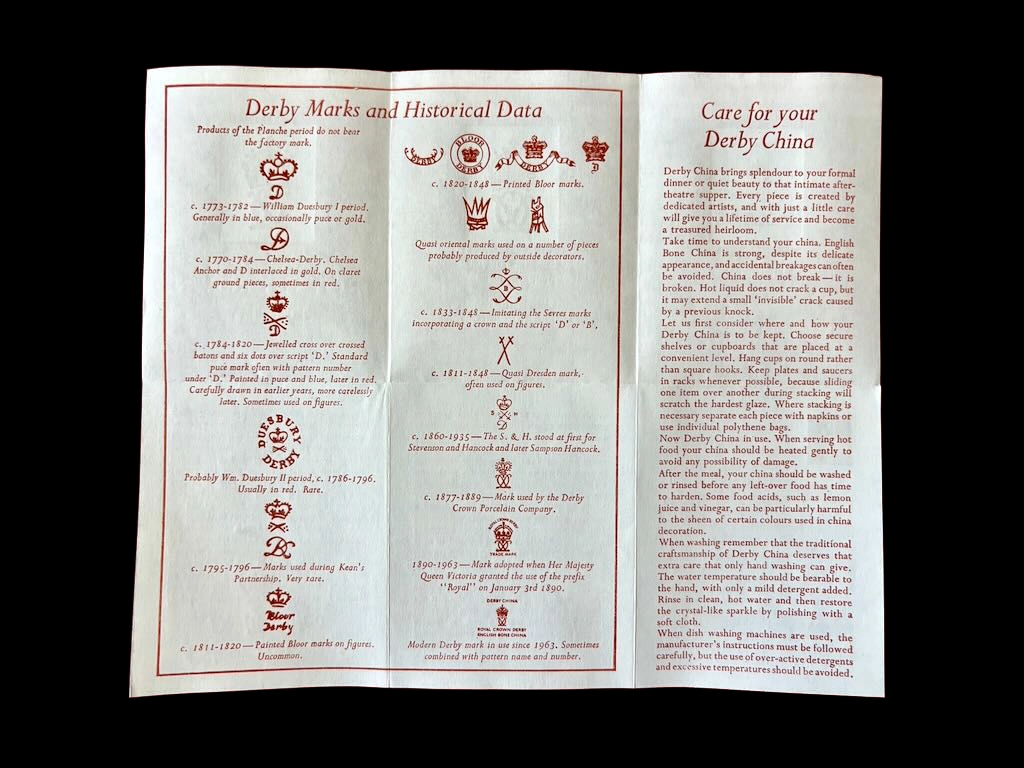
Original Royal Crown Derby literature preserved with early-1970s bone china handled cutlery in the Bernardi Family Collection provides an interesting period reference. Its panel titled “Derby Marks and Historical Data” illustrates selected historic Derby marks and culminates with what the company then described as its modern mark. The same literature also demonstrates an important principle for collectors: the factory mark, pattern identification and other production information can appear together, but they do not necessarily perform the same function.
Royal Crown Derby Marks from c. 1976
Around 1976, Royal Crown Derby introduced another principal backstamp and continued using it into the early twenty-first century. As with earlier marks, this backstamp establishes an initial dating range but does not necessarily identify the precise year.
The separate Royal Crown Derby year-identification system can provide greater precision. When a piece carries an identifiable year mark, collectors can often narrow the broad period indicated by the backstamp to a particular year of manufacture. Collectors should therefore read the factory mark and date mark together, since each provides different but complementary information.
Royal Crown Derby Year Identification Marks, 1880–1937
Royal Crown Derby introduced a particularly useful system in 1880. Instead of relying solely upon changing factory backstamps, the factory used a separate symbol to identify the year of manufacture. A different symbol represented each year through 1937.
The earliest marks begin with comparatively simple linear forms. Over succeeding decades, the system progresses through crescents, circles, diamonds, crosses, triangles and increasingly complex geometric devices before reaching the distinctive marks of the 1920s and 1930s. These small symbols can easily be overlooked beside a larger factory backstamp, yet they may provide the most precise dating information on the entire piece.

When using the chart, compare the complete symbol rather than relying upon its general shape. Several marks developed incrementally from the preceding year’s design, sometimes through the addition of a line, dot or other small element. A partial or poorly printed mark should therefore be interpreted cautiously.
Roman Numeral Date Marks from 1938
Royal Crown Derby changed its dating system again in 1938, replacing the annual graphic symbols with Roman numerals.
The sequence begins simply:
1938 = I
1939 = II
1940 = III
1941 = IV
The system then continues sequentially, with the Roman numeral increasing by one for each succeeding year. This makes twentieth-century Royal Crown Derby comparatively straightforward to date once the system is understood. For example, XV identifies 1952, XXV identifies 1962, XXXV identifies 1972, XLV identifies 1982 and LV identifies 1992. There is, however, an important complication involving X and V.
Those characters had already appeared as individual date marks during the earlier graphic system. X identifies 1902, while V identifies 1905. In those earlier applications they are accompanied by England. Under the later Roman-numeral system, V corresponds to 1942 and X to 1947. These later examples are accompanied by Made in England. The wording surrounding the mark therefore prevents an apparently simple V or X from causing a piece to be misdated by several decades.
The Special Royal Crown Derby Mark for 2000
The year 2000 provides an exception to the normal Roman-numeral sequence. Royal Crown Derby created a special date mark composed of two interlaced M forms for the millennium. This distinctive device makes a 2000 piece particularly easy to recognize when the special mark survives clearly.
Collectors may encounter references to MM when discussing the numerical progression, since MM is the conventional Roman numeral for 2000. For identification purposes, however, Royal Crown Derby specifically documents the special interlaced-M device as its date mark for that year. This is another reason to compare an actual mark visually rather than trying to date a piece from a transcribed description alone.
Backstamp, Date Mark and Pattern Number Are Not the Same
One of the most common mistakes in identifying Royal Crown Derby is assuming that every number beneath a piece represents a date. It does not. The factory backstamp identifies the manufacturer and generally establishes a period. The year mark identifies the year of manufacture where the appropriate dating system was used. A pattern number identifies the decoration.
These pieces of information can appear close together on the same object, which makes it easy to confuse their functions. A famous example is 1128, the pattern number associated with Royal Crown Derby Old Imari. The number identifies the pattern. It does not mean 1128 is a production date, date code or model year. Other Royal Crown Derby patterns likewise carry identifying numbers that should be recorded exactly as they appear rather than interpreted as dates.
Why Royal Crown Derby Pattern Numbers Matter
Pattern numbers remain extremely useful even though they serve a different purpose from date marks. Royal Crown Derby produced numerous decorations over its long history, including closely related designs that can appear similar at first glance. A documented pattern number can provide much stronger identification than a seller’s descriptive name.
This becomes especially important with Imari-style wares. The word “Imari” describes a broad decorative tradition and does not by itself establish a particular Royal Crown Derby pattern. A pattern number can help make that distinction.
At the same time, a pattern number should not be used to establish the manufacturing date of an individual object. Successful patterns could remain in production for long periods, and Royal Crown Derby has continued or revived designs rooted deeply in its historical pattern archive. Identify the pattern and date the object as two separate tasks.
Painted, Incised and Other Royal Crown Derby Marks
Not everything beneath a piece will necessarily belong to the main factory dating system. Collectors may encounter painted numbers, handwritten marks, impressed characters, incised marks and other workshop notations. Earlier Derby production can be particularly complicated because methods of manufacture and marking evolved over generations. These secondary marks deserve to be recorded, but they should not be assigned a meaning without evidence.
A good photograph of the underside should therefore include all visible markings rather than cropping tightly around the principal crown or factory stamp. What initially appears to be an insignificant dot, line or symbol may prove useful once the main backstamp has been identified. The same principle applies when preparing an antique for sale. Photographing the complete underside gives a prospective collector far more information than showing only an enlarged trademark.
Do Not Date Royal Crown Derby by Decoration Alone
The appearance of a pattern can suggest a period, but style alone should not override the evidence provided by marks. An elaborate Imari pattern may appear unmistakably Victorian yet have been manufactured many decades later. A delicate floral design can look Edwardian while belonging to postwar production.
This is particularly important with Royal Crown Derby because continuity forms such an important part of the company’s design tradition. Historic patterns and decorative approaches survived beyond the periods in which they originated. The safest procedure is therefore to identify the factory mark first, look for a year mark, identify the pattern where possible, and then consider style and form as supporting evidence.
How to Date Royal Crown Derby Porcelain
When examining an unfamiliar Royal Crown Derby piece, begin with the entire underside. Use clear, even lighting and take a photograph sharp enough to reveal small symbols as well as the principal backstamp. First identify the broad factory tradition. Is the mark associated with Nottingham Road, King Street or Osmaston Road? If it belongs to the later Royal Crown Derby sequence, compare its wording and configuration with the known backstamp periods.
Next look for the year mark. For Osmaston Road pieces dating from 1880 through 1937, compare any small geometric symbol with the annual date-mark chart. From 1938 onward, look for the Roman-numeral date code, remembering the special millennium mark used for 2000. Only after that should you interpret pattern numbers and other markings.
Finally, consider the piece itself. Shape, porcelain body, decoration, construction and documented pattern should make sense alongside the date suggested by the marks. Dating works best when several independent clues agree.
When an Exact Date Is Not Possible
Not every Royal Crown Derby piece can be assigned confidently to a particular year. Marks may be worn, incomplete or obscured by decoration. A stamp may have transferred imperfectly. Some periods used marks that establish a range rather than an exact date, while wartime production may lack the year code normally expected on other pieces. Older pieces present additional complications because early marks were sometimes painted or incised by hand rather than applied with the consistency expected from a modern trademark.
When the evidence establishes only a period, use that period. A carefully supported date such as c. 1952–1975 is preferable to assigning an exact year that the object itself cannot substantiate. Precision is valuable only when the evidence supports it.
Period Royal Crown Derby Literature and Modern Research
Original factory literature provides a particularly interesting companion to the marks found on surviving porcelain. The early-1970s Royal Crown Derby leaflet preserved in the Bernardi Family Collection presents a condensed history of Derby marks intended for customers of the period. It does not attempt to illustrate every annual date symbol or every variation produced during more than two centuries.
Today’s Royal Crown Derby historic backstamp archive is considerably more extensive. It documents Nottingham Road, King Street and Osmaston Road marks alongside the year-identification system. Used together, the two sources provide different perspectives. Period literature shows how Royal Crown Derby presented its heritage to contemporary customers, while the modern archive gives collectors a broader reference for identifying surviving pieces.
Reading the Story Beneath Royal Crown Derby Porcelain
Royal Crown Derby marks are more than trademarks. Collectively, they record changes in ownership, factories, manufacturing practices and methods of identifying porcelain across more than two centuries.
An eighteenth-century Chelsea-Derby mark belongs to a very different chapter from a Robert Bloor mark. King Street and Osmaston Road marks can identify different strands of Derby production during overlapping periods. Later factory backstamps establish increasingly recognizable production eras, while the year marks introduced in 1880 can sometimes narrow decades of possible manufacture to a single year. The most reliable identification comes from reading these clues together.
Start with the factory mark. Find the year mark if one is present. Record the pattern number separately. Examine any additional painted or impressed marks. Then compare those findings with the form and decoration of the object itself. Turn a piece of Royal Crown Derby over, and what initially appears to be a collection of crowns, letters, symbols and numbers can become a remarkably concise record of where—and often when—it was made.