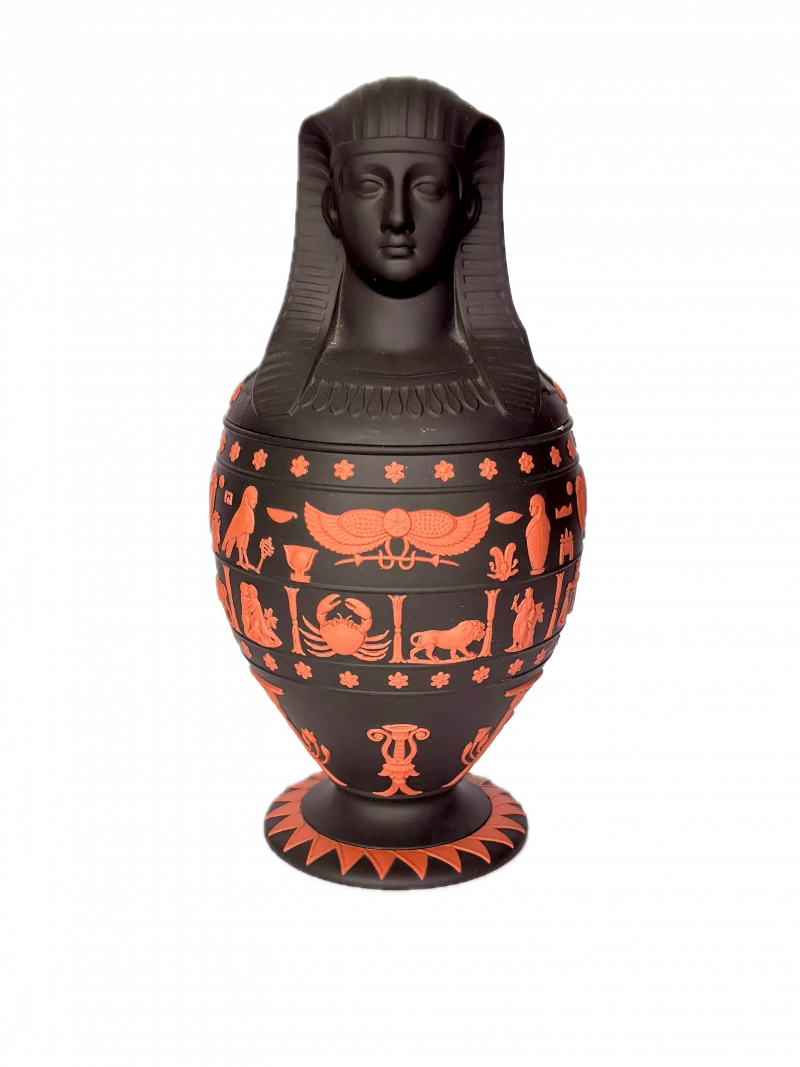

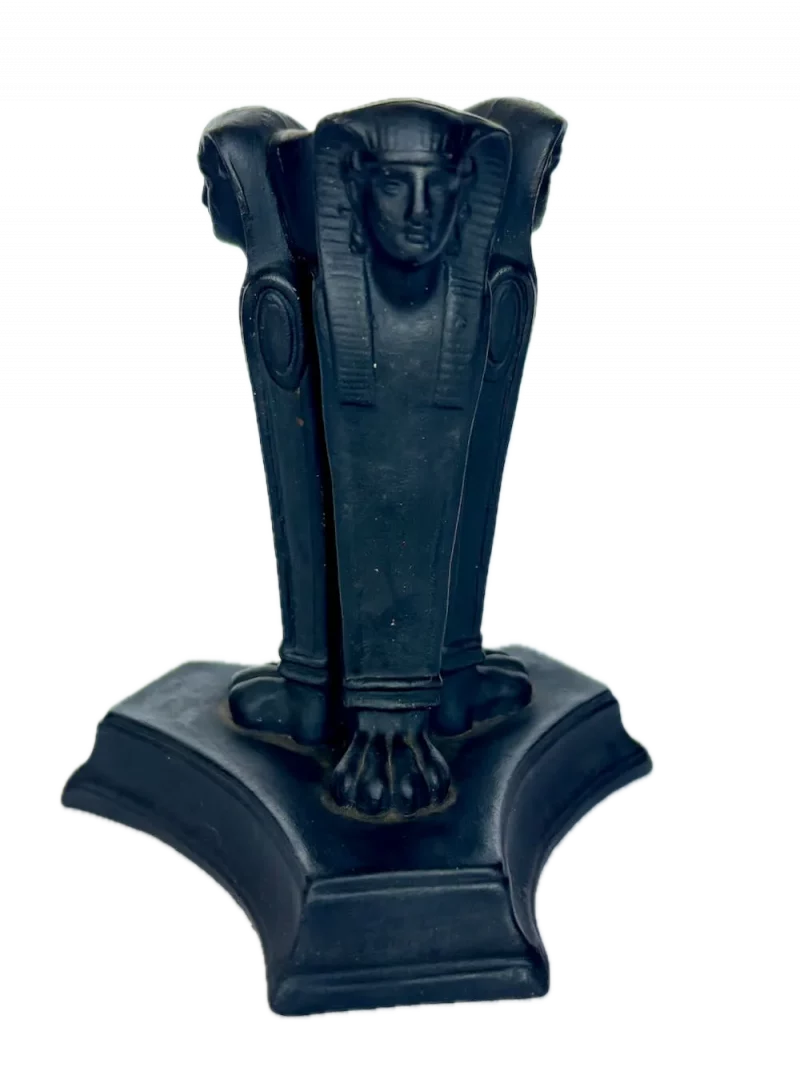
What Makes Jasperware and Black Basalt Different
Jasperware vs black basalt often appears straightforward at first glance, but the difference becomes much more interesting the closer you look. Wedgwood produced many types of ceramics, yet these two stand apart for both their appearance and their purpose. One uses a colored body with applied white relief decoration, while the other presents a deep, uniform matte black surface that emphasizes form over ornament.
These are not simply different finishes. Wedgwood developed each as a distinct ceramic body with its own materials, techniques, and artistic intent. When you understand these differences, you can identify a piece with greater confidence and see how makers produced it, how it aged over time, and why collectors value it today.
Understanding the Core Difference
The simplest way to think about jasperware and basalt is this:
- Jasperware is a colored, fine stoneware designed for applied decoration
- Black basalt is a dense, iron-rich stoneware designed for sculptural form
That difference shapes everything—from how each material behaves during production to how it holds up over time.
Jasperware relies on contrast. The colored body works with applied white reliefs, often depicting classical scenes, to create its distinctive look. Black basalt, by contrast, emphasizes form and surface. Wedgwood designed it to resemble ancient bronzes and carved stone, building the decoration into the form itself rather than applying it afterward.
Material and Composition
The differences begin at the material level. Jasperware uses a refined stoneware body colored throughout with metal oxides. Barium plays a key role, giving the surface its smooth, matte finish and, in early examples, a subtle translucency along the edges of the relief.
Black basalt, despite its name, has no connection to volcanic stone. Wedgwood made it from clay mixed with iron oxide and other materials, which fire to a deep, uniform black. This process produces a dense, fine-grained body with an almost stone-like appearance.
These differences in composition allow jasperware to support delicate applied decoration, while basalt holds sharp edges and lends itself to strong sculptural forms.
Surface and Finish
Both materials are unglazed, but they behave very differently.
Jasperware has a soft, matte “biscuit” finish. The surface feels almost velvety, particularly on earlier pieces. The contrast between the colored ground and the white relief creates its signature look.
Black basalt has a more solid, compact feel. The surface ranges from matte to slightly satin, and in some cases it was polished or engine-turned to create a refined, almost metallic appearance.
Where jasperware invites close inspection of detail, basalt emphasizes silhouette and proportion.
Decoration and Technique
This is where the visual difference becomes most apparent.
Jasperware relies on sprigging, a process where makers apply molded white reliefs onto the colored body. Artists such as John Flaxman originally modeled these designs, and craftsmen reproduced them using molds. Skilled workers then applied each sprig by hand, which creates the delicate transitions between the relief and the surface seen in early pieces.
Black basalt, on the other hand, does not use applied decoration in the same way. Instead, detail is created through:
- molding
- carving
- turning on a lathe
- incised or engine-turned patterns
Because there are no applied elements, basalt pieces tend to have fewer structural weak points. This has implications for both durability and long-term condition.
How Each Material Is Shaped
From a maker’s perspective, these materials behave very differently.
Black basalt is relatively forgiving. It can be thrown, molded, and turned with precision, and it holds sharp edges well. This makes it ideal for:
- vases with crisp profiles
- busts and sculptural forms
- teawares with thin, elegant walls
Jasperware is far more demanding. The body itself requires careful handling, and the addition of sprigs introduces another level of complexity. Each applied relief must bond perfectly to the surface without trapping air or separating during firing.
This is why early jasperware is so highly regarded. It represents not only artistic design but also exceptional technical skill.
Durability and Longevity
Both materials are durable, but they age differently.
Black basalt is one of Wedgwood’s toughest ceramic bodies. Its density makes it resistant to chipping, scratching, and general wear. Even pieces that have been handled extensively often retain sharp detail.
Jasperware is strong, but its surface and decoration introduce vulnerabilities. The matte finish can show scuffs, particularly on lighter colors, and the applied reliefs can chip if knocked or mishandled.
Earlier jasperware, especially thinly sprigged examples, can be surprisingly delicate despite its age. Later pieces tend to be more robust, though often at the expense of refinement.
Dating Differences Between Jasperware and Basalt
Because these materials evolved differently, they also offer different clues for dating.
Jasperware is often dated through:
- relief thickness
- translucency
- body color (dip vs solid)
- quality of sprigging
Black basalt is more often dated through:
- sharpness of form
- surface finish (matte vs polished)
- turning marks and detailing
- overall refinement of modeling
Marks can assist in both cases, but the physical characteristics of the material remain the most reliable indicators.
Quick Comparison Table
| Feature | Jasperware | Black Basalt |
|---|---|---|
| Body | Barium-based, colored stoneware | Iron-rich, naturally black stoneware |
| Surface | Matte, soft “biscuit” finish | Dense, matte to satin finish |
| Decoration | White applied relief (sprigging) | Molded, carved, or turned |
| Strength | Durable but reliefs can chip | Extremely durable and dense |
| Aesthetic | Neoclassical, cameo-like | Classical, sculptural, bronze-like |
| Dating clues | Relief, translucency, body color | Form, surface, and finish |
Why Wedgwood Developed Both
These materials reflect two different artistic ambitions.
Black basalt was introduced earlier, in the late 1760s, as part of Wedgwood’s fascination with classical antiquity. It was intended to evoke ancient Etruscan and Roman wares, particularly dark bronzes and carved stone.
Jasperware followed shortly after, in the 1770s, as a more refined and technically ambitious material. It was designed to capture the look of carved cameos and classical reliefs, combining color and sculpture in a way that had not been achieved before.
Rather than replacing basalt, jasperware expanded Wedgwood’s range. The two materials continued to be produced alongside each other, each serving a different aesthetic purpose.
How Collectors View Jasperware vs Basalt
From a collector’s perspective, the two materials occupy different spaces.
Jasperware tends to attract attention for its decoration. Early pieces with thin, translucent reliefs are particularly desirable, as they represent the highest level of craftsmanship.
Black basalt appeals to those who appreciate form and restraint. Its strength and durability also make it appealing for collectors who prefer objects that can withstand handling and display.
Neither is inherently more valuable than the other. Value depends on period, condition, rarity, and quality of execution. A finely modeled basalt vase from the 18th century can be just as significant as a delicately sprigged jasperware plaque.
A Practical Way to Tell Them Apart
In most cases, distinguishing between jasperware and basalt is straightforward once you know what to look for.
Start with the color. Jasperware is typically colored—most often blue, green, or lilac—with contrasting white decoration. Basalt is uniformly black throughout.
Then look at the decoration. Applied white relief immediately indicates jasperware. If the detail is carved, molded, or incised into the body itself, you are looking at basalt.
Finally, consider the overall feel. Jasperware tends to feel lighter and softer in surface texture, while basalt feels denser and more solid, almost like stone. Once you’ve handled both, the difference becomes instinctive.
This distinction is clearly defined in the original Wedgwood Egyptian Collection brochure (1978), which separates hand-gilded black basalt pieces from the Jasper Collection in terra cotta on black or primrose jasper.
Final Thoughts
Jasperware and black basalt represent two of Wedgwood’s most important innovations, each capturing a different aspect of classical design.
One relies on contrast and delicate craftsmanship. The other emphasizes form, strength, and material presence.
Understanding the difference between them does more than help with identification. It gives you a clearer sense of how Wedgwood worked, what it was trying to achieve, and why these objects continue to appeal to collectors today.