
Description
Antique Persian Dah-Yek-Duzi Embroidery on Ruby-Red Silk
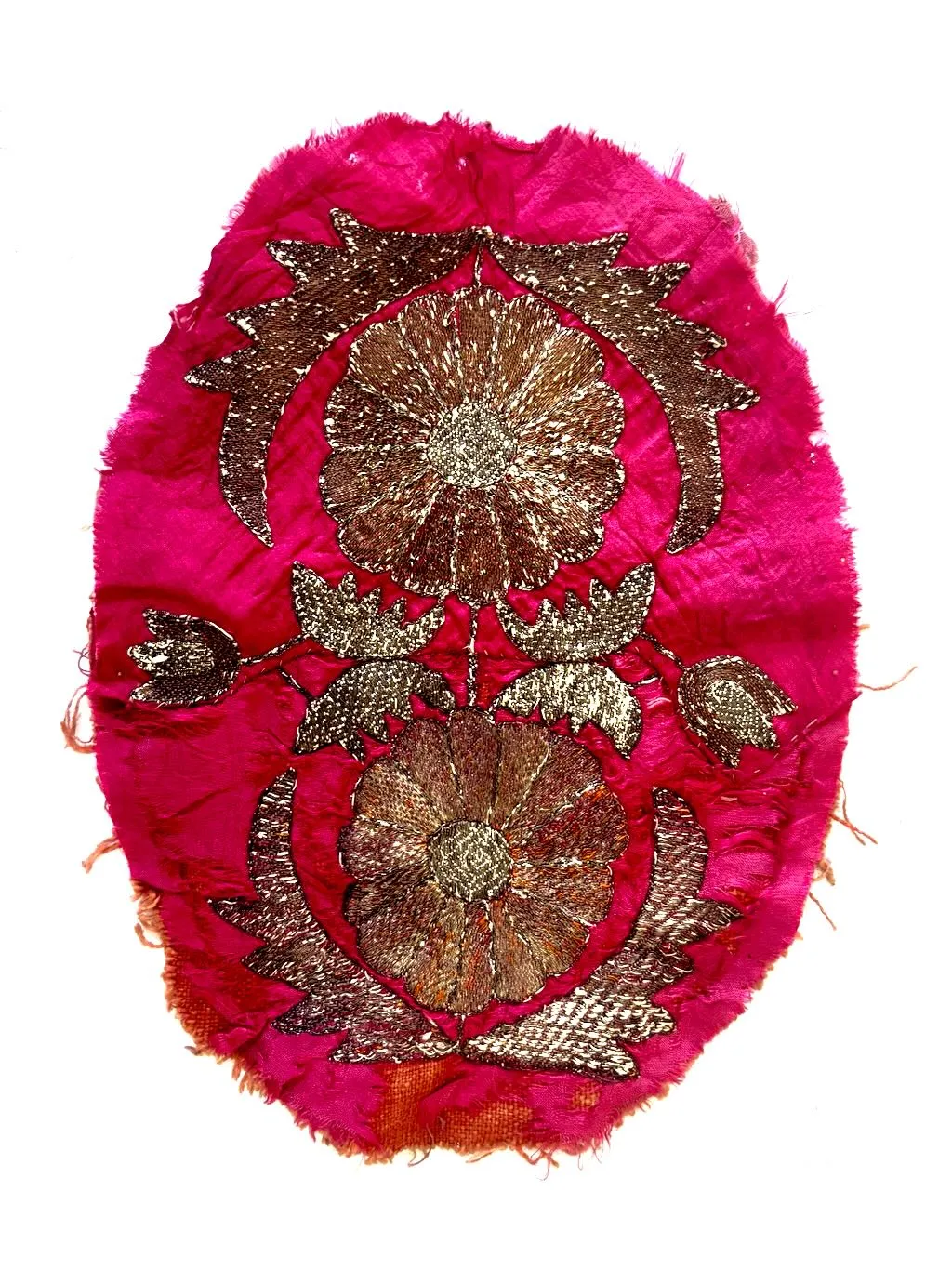
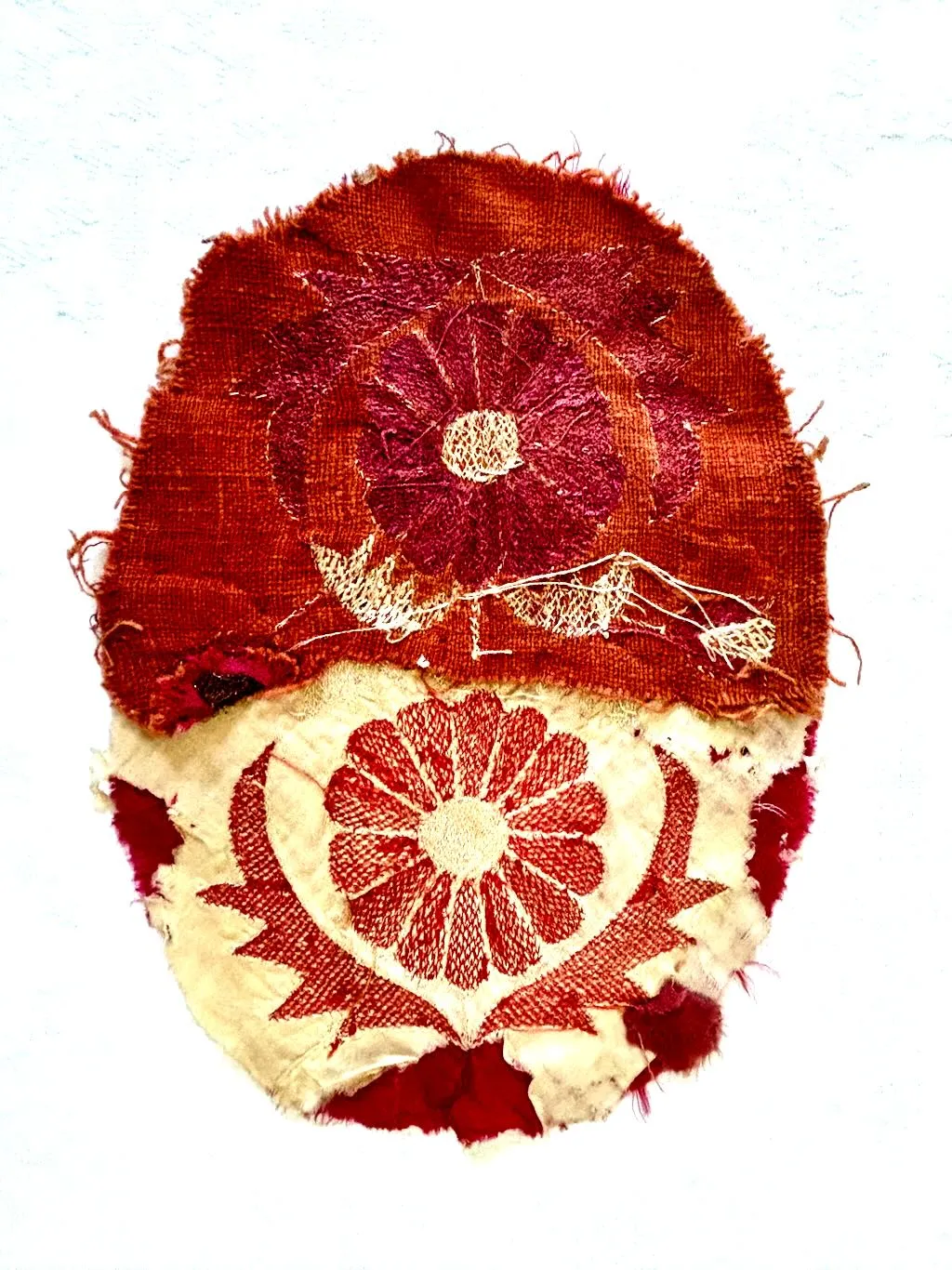
This exquisite small fragment preserves an unusually detailed example of traditional Persian Dah-Yek-Duzi metallic-thread embroidery. Measuring approximately 8.5 × 6 inches (21.6 × 15.2 cm), the irregular oval textile combines densely worked silver-toned metallic embroidery with a rich ruby-red likely silk ground.
Two stylized floral sprays dominate the composition. Large blossoms rise among curving leaves, smaller buds, and dramatic serrated forms. Dark outlines sharply define the individual motifs against the red ground. Meanwhile, the metallic surfaces catch and reflect light, giving the embroidery a sculptural quality that changes as the textile moves.
Despite its modest size, the fragment contains an extraordinary amount of fine handwork. It can stand alone as a collectible study of historic Persian embroidery or offer inspiration for a carefully considered decorative application.
For more information about this distinctive Persian embroidery technique, see our article “Dah-Yek-Duzi: How to Identify this Persian Laid Metal Embroidery.”
The Distinctive Dah-Yek-Duzi Technique
Dah-Yek-Duzi belongs to Persia’s historic tradition of elaborate metal-thread embroidery. Rather than repeatedly pulling the metallic elements through the delicate textile ground, the embroiderer lays them across the surface and secures them with small couching stitches.
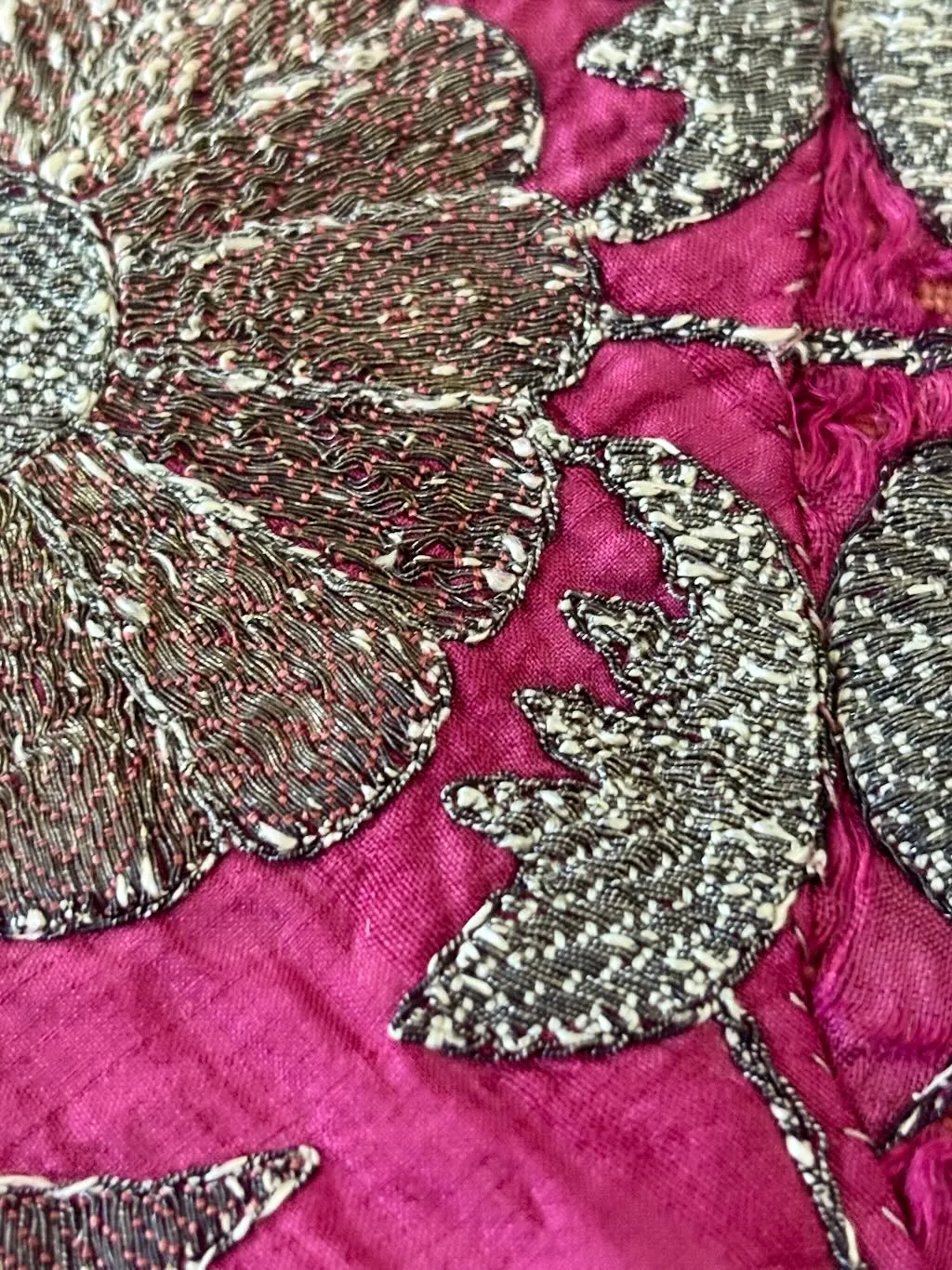
The detailed close-up photograph reveals this construction particularly well. Rows of silver-toned metallic thread form the flowers and leaves, while regularly spaced stitches hold the metal securely against the textile. The embroiderer also changed the direction of the laid threads to follow the contours of individual petals and leaves.
This careful manipulation of the metallic thread creates texture as well as pattern. Light moves differently across each area, giving the floral motifs a subtle relief and shimmer. Dark outlining further separates the forms and intensifies their definition against the ruby-red ground.
The metallic material feels distinctly metal to the touch. However, its precise composition has not been tested. Therefore, we describe it conservatively as silver-toned metallic thread rather than claiming pure silver.
An Intriguing Two-Part Construction
Close examination reveals an especially interesting aspect of this fragment. It consists of two separately embroidered textile sections that were carefully hand-sewn together.
The reverse shows different-colored foundation fabrics behind the two sections. More importantly, part of the embroidery on the underlying section continues beneath the overlapping upper piece. This concealed embroidery demonstrates that both sections carried embroidery before they were joined.
Although the two sections have different reverse foundations, the embroidery remains remarkably consistent. The metallic work, dark outlining, floral vocabulary, scale, and overall workmanship relate closely across the join. As a result, the front reads as a cohesive floral composition rather than two unrelated fragments.
Who joined the sections, when they were joined, and whether the joining formed part of the textile’s original construction remain unknown. However, the surviving overlap offers a fascinating glimpse into the physical history of the piece.
Persian Floral Metal-Thread Embroidery
The flowing floral design gives this fragment a very different character from the strongly geometric Baluchi embroidery traditions of southeastern Iran. Here, curving stems, flowers, buds, and leaves dominate the composition.
Dah-Yek-Duzi and related Persian metal-thread techniques have long been associated with luxury textiles and skilled urban embroidery traditions. Historic centers connected with this type of work include Isfahan, Kashan, Qazvin, and Tehran.
Without documentation, we cannot attribute this fragment to one particular city or workshop. However, to the best of our knowledge, its technique, floral vocabulary, metallic embroidery, and silk-like ground appear stylistically consistent with historic Persian Dah-Yek-Duzi traditions associated with these centers.
The fragment may also date to the Qajar period, possibly the 19th to early 20th century, based on its materials, technique, and floral style. We present this as a stylistic assessment rather than a documented date.
A Surviving Antique Embroidery Fragment
The fragment was acquired from an antique shop in Iran, probably during the 1960s, when it was already considered an old textile. Its earlier history remains unknown.
Its irregular oval shape suggests that it may once have belonged to a larger textile. However, without the original object, we cannot determine whether it came from a garment, furnishing, ceremonial textile, or another embroidered piece.
What survives is substantial enough to appreciate independently. The two principal flowers and surrounding leaves create a balanced composition, while the dense metallic embroidery provides an excellent study of the technique.
For a textile collector, preserving the fragment intact allows both the embroidery and its unusual construction to remain accessible. It could also be archivally mounted and framed as a small example of Persian textile art.
Alternatively, a designer might carefully incorporate it as an appliqué into a decorative cushion, garment, wall textile, or other project. Any such use should respect the age and delicacy of the original materials.
A Small Textile with Exceptional Detail
This fragment rewards close examination. From a distance, the silver-toned flowers create a bold contrast against the ruby-red ground. At closer range, the individual metallic elements, couching stitches, outlines, and subtle changes in direction become visible.
The reverse adds another dimension. Rather than hiding the construction, it reveals the different foundations, hand stitching, and overlapping join. Together, the front, reverse, and macro photographs document both the beauty of the finished embroidery and the methods behind it.
Although only approximately 8.5 inches long, this antique fragment preserves an impressive concentration of Persian needlework. Its rich color, shimmering metallic surface, floral design, and visible hand construction make it an appealing study piece for collectors of Persian textiles, antique embroidery, and historic metal-thread needlework.