
Dah-Yek-Duzi is one of the lesser-known forms of Persian embroidery, yet it represents an important chapter in Iran’s rich textile heritage. Historical sources describe the technique as a form of laid metal-thread embroidery practiced in several important Iranian textile centers, including Kashan, Isfahan, and Qazvin. Unlike many embroidery traditions that rely on decorative stitches worked directly through the fabric, Dah-Yek-Duzi uses metallic threads laid across the surface and secured with carefully placed couching stitches.
The resulting embroidery creates richly textured designs that shimmer under changing light. Floral motifs, botehs, and geometric patterns combine with gold and silver-colored threads to produce luxurious decorative objects that were valued for both their beauty and craftsmanship.
Although Dah-Yek-Duzi is not as widely known today as Pateh-Duzi or Sermeh-Duzi, surviving examples demonstrate the remarkable skill of Persian embroiderers and their mastery of metal-thread techniques.
What Is Dah-Yek-Duzi?
Historical textile surveys identify Dah-Yek-Duzi as a form of laid work embroidery. The technique employs one or more metallic threads that are arranged on the surface of the fabric rather than repeatedly passing through it.
Once the metallic threads are positioned, embroiderers secure them with small couching stitches placed at regular intervals. These stitches hold the metal thread in place while allowing the decorative surface to remain visible.
This method offers several advantages. First, it preserves the brilliance of the metallic thread because most of the thread remains exposed. Second, it allows artisans to create large decorative patterns without repeatedly piercing heavy metal threads through the fabric. Finally, the technique produces raised surfaces that enhance both texture and visual impact.
As a result, Dah-Yek-Duzi became particularly suitable for luxury textiles and ceremonial objects where decorative effect was highly valued.
The Materials Used in Dah-Yek-Duzi
The beauty of Dah-Yek-Duzi depends largely on the materials chosen by the embroiderer. Historical descriptions indicate that artisans employed a combination of metallic threads and rich textile foundations.
Common materials included:
- Gold thread
- Silver-gilt metal thread
- Metal strips wound around cotton cores
- Metal strips wound around silk cores
- Silk thread
- Cotton thread
- Velvet foundation fabrics
- Cotton backing fabrics
Dark green and purple velvet appear frequently in historical examples. These deep colors provided an ideal background for metallic embroidery and enhanced the reflective qualities of the thread.
In addition, some pieces incorporated coarse cotton backings treated with wax. This treatment increased stiffness and helped support the weight of the embroidery. Such details reveal the practical considerations involved in producing durable decorative textiles.
Dah-Yek-Duzi in Kashan, Isfahan, and Qazvin
Several important Iranian cities became associated with Dah-Yek-Duzi production. Historical sources specifically identify Kashan as a center where the technique continued into the early twentieth century.
Kashan had long been famous for its textile industries. The city produced luxury fabrics, velvets, carpets, and embroidered works that were traded throughout Iran and beyond. Within this environment, Dah-Yek-Duzi developed as part of a broader tradition of decorative textile arts.
The technique was also practiced in Isfahan during the late nineteenth century. As one of Iran’s most celebrated artistic centers, Isfahan supported numerous workshops specializing in textiles, metalwork, painting, and other decorative arts. Dah-Yek-Duzi formed part of this vibrant artistic culture.
Historical accounts also record examples from Qazvin. Although less information survives regarding production there, the evidence demonstrates that the technique was not restricted to a single region. Instead, Dah-Yek-Duzi appears to have been practiced across multiple urban centers known for skilled craftsmanship.
Decorative Motifs in Dah-Yek-Duzi
Like many Persian decorative arts, Dah-Yek-Duzi employed a relatively small group of recurring motifs. Historical descriptions specifically mention floral designs, botehs, and geometric figures.
Floral patterns occupied an important place in Persian art for centuries. Embroiderers adapted these designs to metal-thread work, creating stylized blossoms, leaves, and decorative arrangements that complemented the reflective qualities of the metallic thread.
Boteh motifs also appear in Dah-Yek-Duzi. This distinctive curved design later became known internationally as the paisley motif. Throughout Persian art, the boteh served as one of the most enduring decorative elements and appeared in textiles, carpets, manuscripts, and embroidery.
Geometric figures provided balance and structure within many compositions. Repeated forms, borders, and symmetrical arrangements helped organize the overall design while emphasizing the precision of the embroidery.
Together, these motifs created decorative objects that reflected broader trends within Persian artistic traditions.
Traditional Uses of Dah-Yek-Duzi
Historical sources provide valuable information about the objects decorated with Dah-Yek-Duzi embroidery. Among the most distinctive were embroidered gift covers and circular covers used when breaking pieces from traditional sugar cones.
These objects occupied an important place within Persian social and ceremonial life. Their decoration reflected both the significance of the occasion and the status of the owner.
In addition to sugar covers, Dah-Yek-Duzi appeared on a variety of decorative objects, including:
- Gift covers
- Decorative pouches
- Ceremonial textiles
- Household furnishings
- Ornamental accessories
Because the technique required costly materials and considerable skill, it was generally reserved for objects intended to be displayed, presented, or used on special occasions.
How Dah-Yek-Duzi Differs from Golabatoon-Duzi
Dah-Yek-Duzi is sometimes associated with Golabatoon-Duzi because both traditions employ metallic thread. However, historical descriptions indicate that the techniques are fundamentally different.
Dah-Yek-Duzi is a laid-work embroidery. Metallic threads are arranged on the surface and secured with couching stitches. The visual effect comes from the exposed metallic thread and the patterns created by the couching.
Golabatoon-Duzi, by contrast, traditionally uses metallic-wrapped thread worked with a hooked needle known as a ghollab. The hooked needle produces chain-like embroidery structures that differ significantly from laid work.
Although both belong to the wider family of Persian metal-thread embroidery, they represent separate technical traditions. Understanding this distinction helps clarify the remarkable diversity of Iranian embroidery techniques.
Dah-Yek-Duzi Examples from the Bernardi Family Collection
The Bernardi Family Collection contains examples that illustrate the decorative qualities associated with Dah-Yek-Duzi.
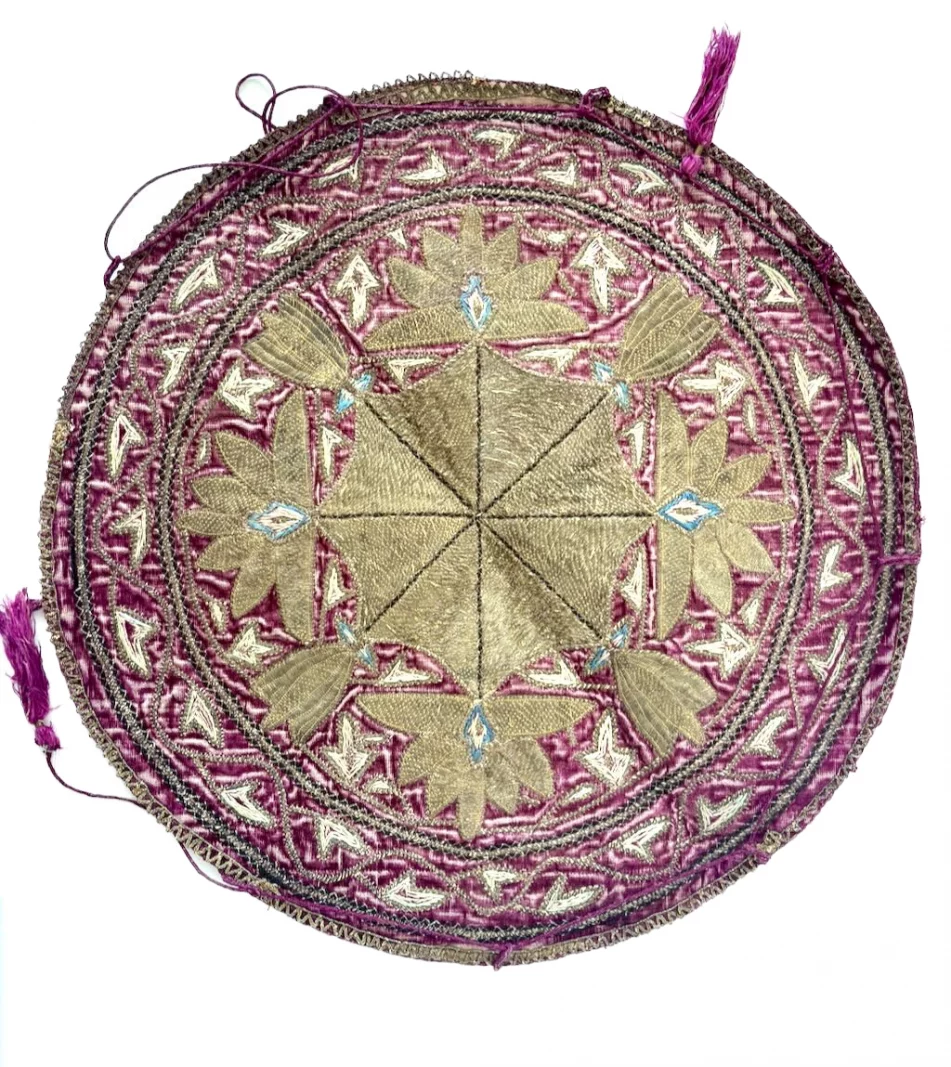
One example is a circular embroidered cover decorated with metallic thread. Historical sources specifically identify similar circular covers as objects used during the breaking of traditional sugar cones. The embroidery combines metallic thread with decorative motifs that demonstrate the elegance of the technique.
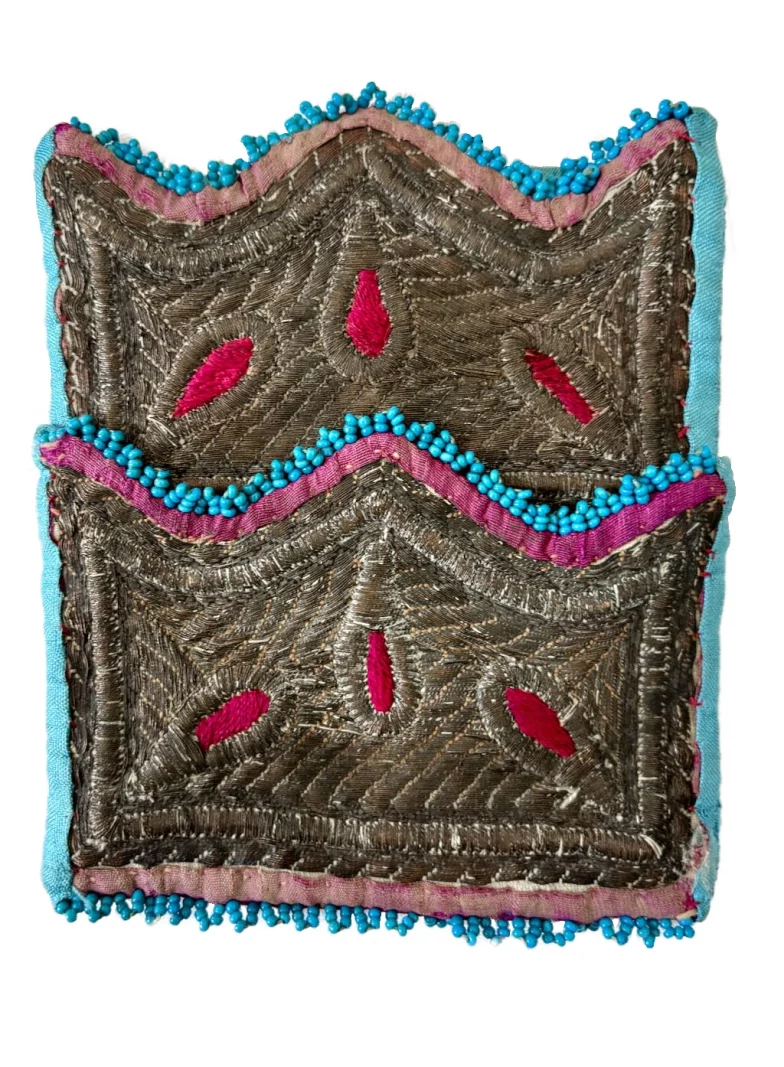
A second example is a richly embroidered pouch decorated with metallic thread ornament. Such objects illustrate the application of Dah-Yek-Duzi beyond ceremonial covers and demonstrate the versatility of the technique.
Together, these textiles provide valuable insight into a tradition that survives today primarily through museum collections and preserved historical examples.
The Significance of Dah-Yek-Duzi Today
Although Dah-Yek-Duzi is less familiar than many other forms of Persian embroidery, it remains an important part of Iran’s textile heritage. The technique demonstrates how Persian artisans adapted metal-thread embroidery to create objects of exceptional beauty and refinement.
Furthermore, surviving examples help document regional craftsmanship in cities such as Kashan, Isfahan, and Qazvin. They also reveal the close relationship between embroidery, textile production, and decorative arts within Persian culture.
As museums, collectors, and researchers continue to document historic textiles, Dah-Yek-Duzi offers valuable evidence of the technical sophistication achieved by generations of Iranian embroiders.
Conclusion
Dah-Yek-Duzi represents a distinctive tradition within the broader history of Persian embroidery. By laying metallic threads across the surface of the fabric and securing them with carefully placed couching stitches, artisans created richly textured designs that combined beauty, craftsmanship, and technical skill.
Practiced in important textile centers such as Kashan, Isfahan, and Qazvin, the technique adorned sugar covers, gift covers, pouches, and other decorative objects. Floral motifs, botehs, and geometric designs enhanced the brilliance of gold and silver-colored threads, producing textiles that reflected the artistic achievements of Persian embroidery.
Today, surviving examples continue to preserve the legacy of this remarkable metal-thread tradition and provide an important link to Iran’s rich textile heritage.