

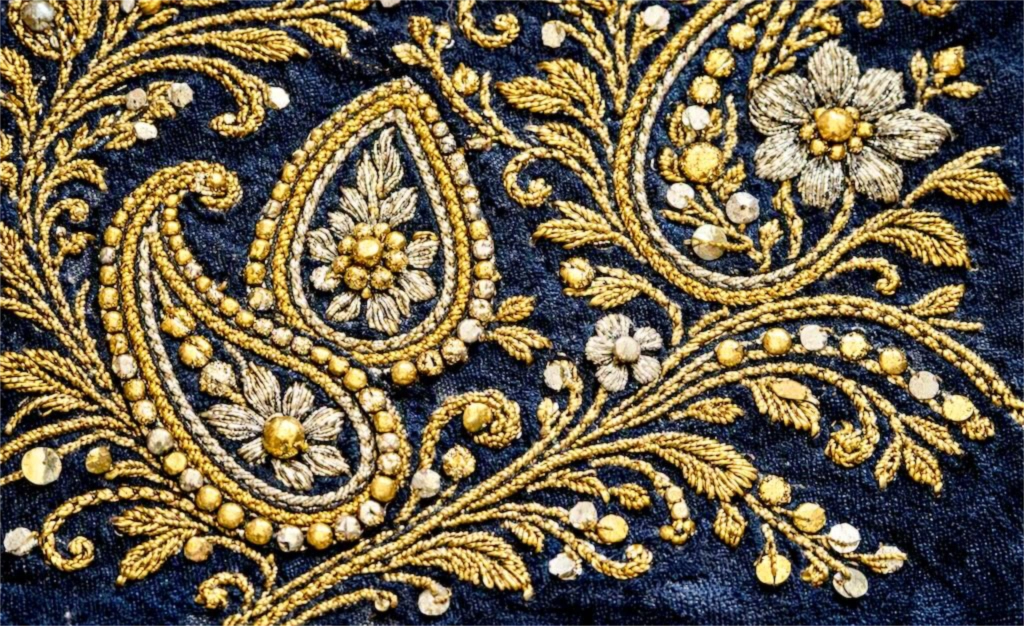
The Art of Persian Gold Embroidery Golabatoon-Duzi
Golabatoon-Duzi (گلابتوندوزی) is one of the most distinctive embroidery traditions of Iran. Practiced primarily in the southern coastal province of Hormozgan, this remarkable craft transforms fabric into shimmering works of art through the use of metallic gold and silver threads. For generations, women in the ports and towns along the Persian Gulf have embellished garments, household textiles, and ceremonial objects with intricate patterns that reflect both regional identity and the broader artistic heritage of Persia.
Unlike many forms of embroidery that rely on silk or cotton thread, Golabatoon-Duzi derives its visual impact from metallic-wrapped yarns that catch and reflect light. The resulting designs possess a luxurious appearance that has long been associated with celebration, status, and beauty. Although the craft shares certain characteristics with other Persian metal-thread traditions, particularly Sermeh-Duzi and Zardozi, it developed its own techniques, tools, motifs, and cultural identity in southern Iran.
Today, Golabatoon-Duzi remains one of the most recognizable traditional crafts of Hormozgan Province and continues to play an important role in preserving the region’s artistic heritage.
The Historical Origins of Golabatoon-Duzi
The exact origins of Golabatoon-Duzi remain difficult to establish with certainty. Like many traditional textile arts, the craft developed gradually over centuries, and surviving embroidered textiles rarely provide a complete historical record.
Iranian cultural heritage sources associate the broader tradition of gold and silver embroidery with ancient Persian civilization. Decorative textiles embellished with precious metals were known during the Achaemenid, Parthian, and Sasanian periods, and Persian rulers valued luxurious fabrics throughout antiquity. While direct evidence linking modern Golabatoon-Duzi to these early traditions remains limited, the craft clearly belongs to a long lineage of Iranian metal-thread embroidery.
The strongest historical evidence places Golabatoon-Duzi within the flourishing textile culture of southern Iran during the Safavid era (1501–1736). By this period, Bandar Abbas and other ports along the Persian Gulf had become important commercial centers connecting Persia with India, Arabia, East Africa, and Europe. The exchange of luxury goods encouraged the development of specialized textile arts, including metallic embroidery.
Historical accounts suggest that artisans refined the craft during the Safavid period, producing increasingly sophisticated decorative work for clothing and ceremonial textiles. Over time, Golabatoon-Duzi became deeply rooted in the daily lives of women throughout Hormozgan and neighboring coastal regions.
Today, the World Crafts Council recognizes Hormozgan as one of the principal centers of this traditional embroidery, reflecting the region’s enduring importance in preserving the craft.
What Does Golabatoon Mean?
The name Golabatoon refers to the metallic thread itself. Traditionally, these threads consisted of a silk or cotton core wrapped with a thin strip of precious metal. Modern examples typically use metallic foil-wrapped yarns that replicate the appearance of gold or silver while remaining affordable and practical.
The embroidery is known by several regional names, including:
- Goldouzi
- Kam-Douzi
- Kamandouzi
- Boroodari-Douzi
- Zardouzi
These names often reflect local terminology or particular variations of the craft. The terms Kam and Kaman refer to the circular wooden frame used to stretch the fabric during embroidery.
How Golabatoon-Duzi Is Created
One of the most distinctive aspects of Golabatoon-Duzi is its specialized technique. Unlike conventional embroidery that relies on a standard sewing needle, artisans traditionally employ a hooked needle known as a Ghollab.
The fabric is stretched tightly over a wooden hoop called a Kaman, creating a firm surface that allows precise manipulation of the metallic thread. Using the hook, the embroiderer draws loops of thread through the fabric, producing continuous flowing lines and intricate decorative forms. This method bears similarities to tambour embroidery and chain-stitch techniques found elsewhere in the world, yet it has evolved its own regional character in southern Iran.
Materials Used in Golabatoon-Duzi
Traditional artisans carefully select materials that enhance the brilliance of the metallic embroidery. Common ground fabrics include:
- Crepe
- Velvet
- Satin
- Heavy cotton cloth
These strong colors provide dramatic contrast against gold and silver thread. Preferred fabric colors often include:
- Black
- Crimson red
- Turquoise
- Green
- Yellow
- Orange
In addition to metallic embroidery threads, artisans may incorporate:
- Sequins
- Glass beads
- Decorative metallic elements
These additions create extra texture and reflectivity, particularly on ceremonial garments and festive clothing.
Traditional Motifs in Golabatoon-Duzi
The decorative vocabulary of Golabatoon-Duzi draws from the wider Persian artistic tradition. Many motifs also appear in Persian carpets, manuscript illumination, tile-work, and architectural decoration.
Eslimi Motifs
Eslimi patterns consist of flowing arabesque scrolls and intertwined vegetal forms. Their graceful curves create rhythmic movement across the embroidered surface and remain among the most popular designs in Persian decorative arts.
Khatayi Motifs
Khatayi designs feature stylized floral forms inspired by blossoms, leaves, and garden imagery. They frequently appear alongside Eslimi patterns to create balanced and harmonious compositions.
Boteh Jegheh
The famous Persian boteh, often called paisley in the West, occupies a central place in Golabatoon-Duzi. This elegant curved motif appears in countless Persian textiles and has become one of the most recognizable symbols of Iranian design.
Moharamati and Sotooni Patterns
These columnar and striped arrangements divide surfaces into orderly sections. They provide structure and rhythm while allowing artisans to showcase repeating decorative motifs.
Bazoobandi Designs
Band-like decorative elements inspired by traditional armbands create geometric borders and framing devices that organize larger compositions.
Golabatoon-Duzi and Traditional Clothing
The strongest association between Golabatoon-Duzi and everyday life appears in the traditional dress of southern Iran. Women in Hormozgan have long decorated garments with elaborate metallic embroidery. The technique commonly appears on:
- Trouser cuffs
- Sleeves
- Collars
- Bridal garments
- Tunics
- Head coverings
These embroidered elements often indicate celebration, social status, and regional identity. Wedding attire and festive clothing frequently feature the most elaborate examples. The embroidery also appears on household textiles, including decorative covers, cushion panels, wall hangings, and religious objects.
The Relationship Between Golabatoon-Duzi and Sermeh-Duzi
Because both traditions employ metallic materials, Golabatoon-Duzi and Sermeh-Duzi are sometimes confused. However, they differ significantly in technique and appearance. Sermeh-Duzi typically uses small sections of coiled metal wire that are stitched onto fabric. These metal coils create raised, dimensional surfaces with a sculptural quality. Golabatoon-Duzi, by contrast, employs flexible metallic-wrapped thread worked directly into the fabric using a hooked needle. The resulting embroidery generally appears flatter and more fluid, producing elegant lines that resemble metallic drawing across the textile surface. While both belong to the broader family of Persian metal-thread embroidery, each developed its own technical vocabulary and regional traditions.
Related Embroidery Traditions of Hormozgan
Golabatoon-Duzi often appears alongside several related embroidery techniques practiced throughout southern Iran. One of the closest is Khos-Duzi, which uses narrow metallic strips to create highly reflective decorative surfaces. Another is Kam-Duzi, which combines sequins and metallic thread to produce richly textured embellishment. Artisans frequently combine these techniques on a single garment, creating dazzling ensembles that showcase the full range of southern Iranian needlework.
Golabatoon-Duzi Beyond Iran
The beauty of Persian embroidery has occasionally attracted international attention. During the twentieth century, Iranian decorative arts influenced fashion designers working far beyond the country’s borders.
One notable example involves garments created for Empress Farah Pahlavi by the House of Dior. Designers including Yves Saint Laurent and Marc Bohan incorporated Persian motifs and metallic embroidery into couture creations associated with important royal ceremonies. The famous 1967 coronation robe featured elaborate gold embroidery based on traditional Persian boteh motifs, demonstrating the continuing appeal of Persian decorative traditions on the international stage. Although these couture garments cannot automatically be classified as Golabatoon-Duzi, they illustrate the enduring influence of Persian embroidery and design on global fashion.
The Preservation of Golabatoon-Duzi Today
Despite modernization and changing fashions, Golabatoon-Duzi remains an important part of the cultural identity of Hormozgan Province. Many women continue to learn the craft from older family members, preserving techniques that have been transmitted through generations.
Cultural organizations, heritage programs, and local artisans actively promote the embroidery as both a traditional art form and a source of economic opportunity. Workshops, exhibitions, and educational initiatives help ensure that younger generations remain connected to this unique aspect of Iran’s artistic heritage. The recognition of Hormozgan by the World Crafts Council further highlights the international importance of preserving the region’s embroidery traditions.
Conclusion
Golabatoon-Duzi stands among the most beautiful and distinctive forms of Persian embroidery. Rooted in the coastal culture of Hormozgan, it combines metallic threads, specialized hook techniques, and classical Persian motifs to create textiles of remarkable elegance. While connected to the broader history of Iranian gold embroidery, the craft possesses a unique regional identity shaped by centuries of artistic practice along the Persian Gulf.
From embroidered garments and ceremonial textiles to modern decorative works, Golabatoon-Duzi continues to embody the creativity, skill, and cultural memory of southern Iran. Its shimmering surfaces not only celebrate beauty and craftsmanship but also preserve a living connection to one of the oldest textile traditions in the Persian world.