

Description
Antique Qajar Dah-Yek-Duzi Persian Sugar Cover
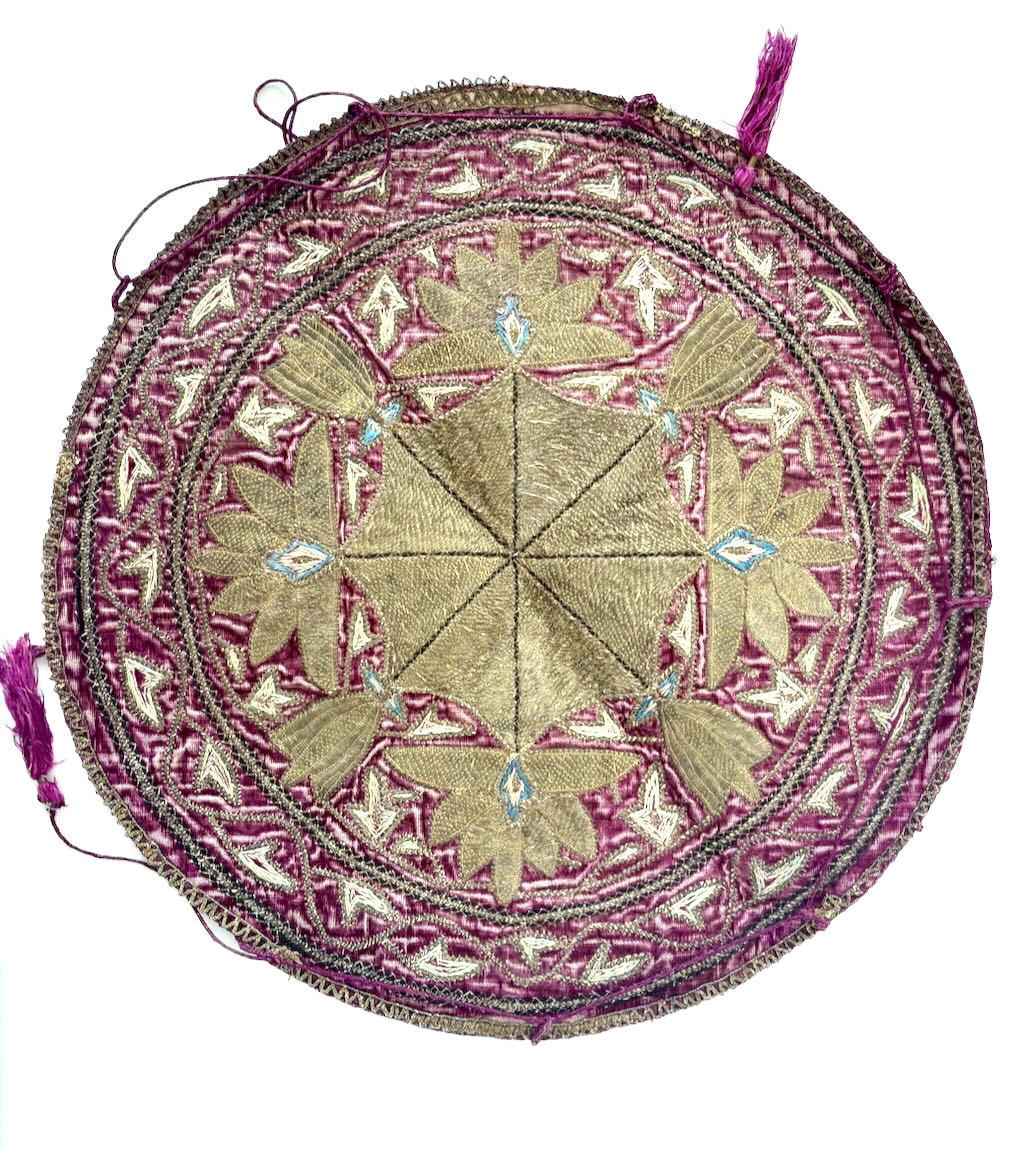
This Qajar Dah-Yek-Duzi sugar cover or sugar container is a remarkable surviving example of traditional Persian textile art created for an everyday purpose. Dating to approximately the late 19th to early 20th century, the circular textile combines richly colored velvet with extensive metallic Golabatoon-thread embroidery, a textile lining and its surviving original gathering cord.
When opened, the piece lies approximately flat as a large decorated circle. A cord around the circumference allows the textile to gather inward, transforming it into a pouch used to hold pieces broken from traditional Persian sugar cones, or kaleh qand. This practical construction allowed an exceptionally decorative textile to serve as a functional household object.
The elaborate surface creates an immediate visual impression. A large geometric medallion dominates the center, surrounded by concentric arrangements of stylized flowers, leaves and geometric forms. Metallic embroidery outlines and fills much of the composition, while vivid blue, green, red, purple and cream accents emerge against the aged velvet ground.
The Persian Art of Dah-Yek-Duzi
Dah-Yek-Duzi (ده یک دوزی) is a distinctive Persian embroidery technique traditionally worked with metallic Golabatoon thread. Its name relates to the repeated stitching method used to build the dense, raised decoration characteristic of the technique.
The metallic thread gives Dah-Yek-Duzi its particularly rich surface. Rather than relying simply on color, the embroidery responds to changing light, allowing individual elements of the design to appear brighter or darker as the textile moves.
Historical examples include decorative and functional textiles, among them circular covers associated with traditional Persian sugar. This example preserves that relationship between elaborate needlework and domestic life particularly well: a highly ornamented textile could open into a broad circular surface and then gather into a practical container.
A Persian Sugar Cover and Drawstring Pouch
Traditional Persian sugar commonly came in hard conical loaves known as kaleh qand. Pieces had to be broken from the cone for serving and household use.
This textile was designed to accommodate that broken sugar. When fully opened, its circular form provides access to the contents. Pulling the original cord gathers the perimeter, drawing the decorated surface upward and creating a pouch that could contain the sugar pieces.
The construction helps explain the unusual circular format. The elaborate central design becomes fully visible when the cover lies open, while the surrounding embroidery folds into a richly decorated pouch when gathered.
The approximately 44 cm diameter is also noteworthy. A closely comparable Iranian Dah-Yek-Duzi example documented by an Iranian antiques specialist measures the same 44 cm diameter, providing a useful comparison for the scale of this type of work.
Qajar Design and Golabatoon Embroidery
The composition reflects the Persian preference for combining strong geometric organization with abundant vegetal ornament. An eight-part central arrangement establishes the symmetry, while successive borders expand outward through repeated floral and geometric elements.
Golabatoon thread provides much of the visual structure. Its aged metallic surface now has a subdued patina that contrasts beautifully with the surviving colored embroidery and velvet. The workmanship remains remarkably legible despite the object’s considerable age.
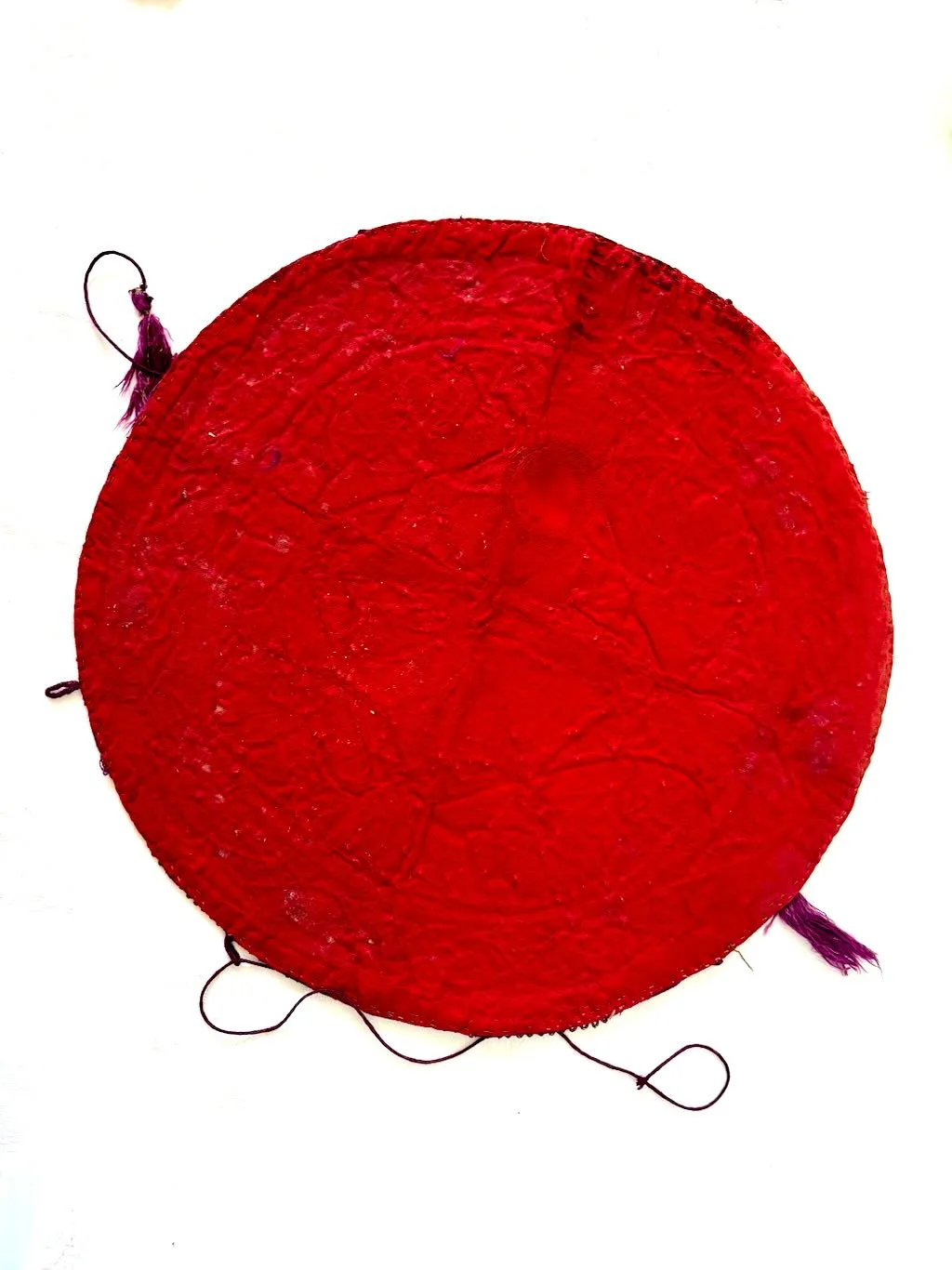
The reverse reveals another side of its construction. A red textile lining protects the back of the embroidered surface, while the surviving cord and perimeter elements demonstrate how the flat textile transformed into a functional container.
Condition
The sugar cover remains in good antique condition considering its age, materials and original functional use.
The Dah-Yek-Duzi embroidery remains intact, retaining extensive metallic-thread decoration and colored embroidered details. The velvet shows expected aging and wear, including areas where the surface has changed with time. Portions of the original cord around the circumference have been lost or deteriorated, although enough survives to document the original drawstring construction.
The red textile lining remains intact.
The piece has not been restored to our knowledge. The aged metallic surfaces, textile wear and surviving original cord contribute to its character as an authentic antique textile rather than a later reproduction.
Provenance and Collecting Interest
This Qajar Persian sugar cover was acquired from an antique dealer in Tehran during the 1970s and has remained in the Bernardi Family Collection since that time.
Its appeal extends beyond embroidery alone. The piece preserves evidence of a traditional Persian domestic practice while demonstrating the extraordinary amount of skilled handwork that could be invested in a functional household textile.
For collectors of Persian textiles, Qajar decorative arts, historic embroidery and Iranian material culture, it offers an unusual combination of documented function, specialized technique and elaborate ornament.
Related Research
For a detailed examination of this specialized Persian embroidery tradition, including its materials, construction and historical uses, see our Dah-Yek-Duzi: Persian Metallic-Thread Embroidery research article. This particular sugar cover also appears in that research as an example from the collection.
For another example of historic Persian textile craftsmanship in the collection, see our Antique Qajar Persian Termeh Embroidered Man’s Hat.
For additional background on Dah-Yek-Duzi as an Iranian handicraft tradition, the Tehran Times has documented the technique, its materials and its historical association with several Iranian centers of needlework. Iranian Handicrafts: Dah-Yek-Duzi — Tehran Times
Authenticity
This is an antique Persian textile showing wear consistent with age and original use. The Qajar-period dating reflects its materials, technique, construction, provenance and comparison with documented Persian Dah-Yek-Duzi work.