


Description
Antique Qajar Persian Termeh Hat with Calligraphy
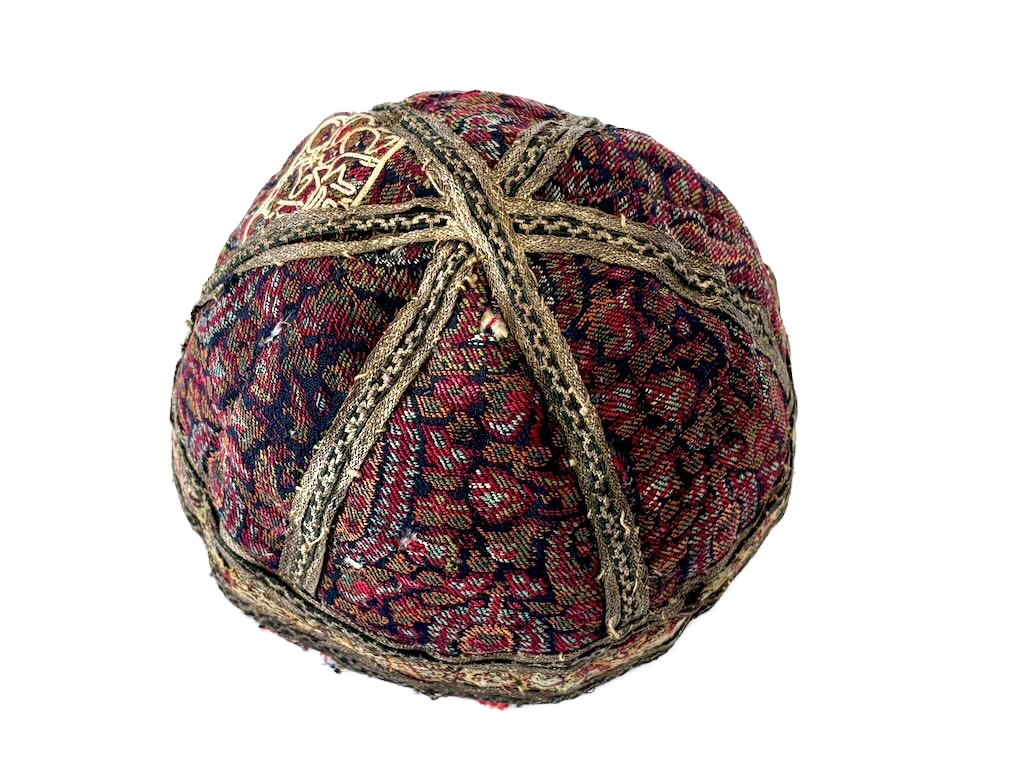
This Qajar Persian termeh hat combines one of Iran’s celebrated luxury textiles with elaborate applied decoration and an intriguing hand-embroidered Persian inscription. Likely dating from the 19th to early 20th century, the man’s cap has survived with its richly patterned textile, structured construction and extensive decorative braid.
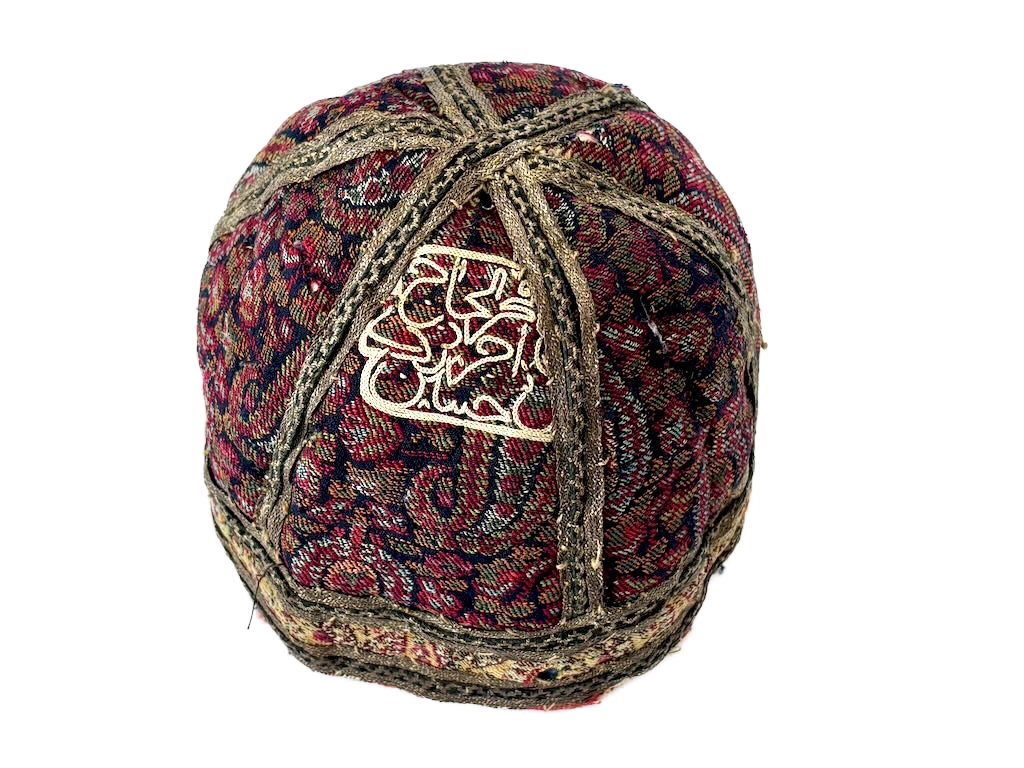
The maker formed the rounded cap from individual panels of densely patterned termeh. Deep red, blue, green, ochre and lighter accents create small boteh and floral forms across the surface. Raised bands of aged metallic-toned braid divide the panels and converge across the crown, giving the hat an architectural structure. Additional bands encircle its lower edge.
A light layer of padding between the termeh exterior and textile lining gives the cap body and helps preserve its distinctive rounded form.
Embroidered Persian Calligraphy
One panel carries an especially unusual feature: an inscription worked in pale chain embroidery directly over the patterned termeh. The flowing letters form a compact calligraphic composition rather than a simple decorative border.
The highly stylized inscription remains difficult to decipher with certainty. Consultation with Persian speakers suggests that elements may be read as Fakhr al-Hajj and Ali/Hajji Yazdi. The inscription appears more likely to identify or honor a person associated with the hat than to function simply as ornament.
Our research uncovered an intriguing historical parallel. Hajji Mirza Ali Aqa Yazdi, better known by his Sufi name Bahar Ali Shah Yazdi, was a Qajar-era Persian Sufi figure associated with the Khaksar/Jalali tradition. Historical material records Fakhr al-Hajj among the honorifics associated with him.
The apparent correspondence between the embroidered words and his documented name and title raises the possibility that this hat was made for, dedicated to, or otherwise associated with Bahar Ali Shah Yazdi or his circle. However, no surviving documentation accompanies the hat that can establish this identification. We therefore present the connection as a research attribution rather than confirmed provenance.
Qajar Termeh and the Art of the Hat
Termeh ranks among the most recognizable historic luxury textiles of Persia, particularly associated with weaving centers such as Yazd and Kerman. Its tightly woven surfaces often incorporate boteh, floral and scrolling motifs in complex combinations of colors.
Here, the textile does more than cover the cap. The maker carefully arranged shaped sections of patterned termeh beneath an elaborate framework of decorative braid. The resulting surface changes continuously as the hat turns, while the radiating bands emphasize its three-dimensional form.
The embroidered inscription adds another level of interest. Persian textiles could carry inscriptions relating to makers, owners, patrons, dedications and religious subjects. Consequently, the inscription on this cap deserves to remain part of its historical interpretation even while its complete reading remains unresolved.
Condition
The hat remains in good antique condition considering its age and textile construction. The termeh retains strong color and extensive pattern detail, while much of the applied braid and embroidered calligraphy remains intact.
There is a localized hole and textile loss where the underlying lining or padding shows through. Smaller areas show age-related wear, loose fibers and deterioration to portions of the decorative trim. These characteristics are visible in the photographs and form part of the object’s antique condition.
The hat has not been restored to our knowledge. Its surviving wear provides useful evidence of its layered construction and considerable age.
Provenance and Collecting Interest
This Qajar Persian termeh hat was acquired from an antique dealer in Tehran during the 1960s and has remained in the same family collection since that time.
Its combination of antique termeh, padded and lined construction, elaborate applied decoration and embroidered Persian calligraphy makes it an unusual surviving example of Persian men’s headwear. The still-unresolved inscription provides an additional avenue for research, particularly given its possible relationship to a documented Qajar-era Yazdi Sufi figure.
For collectors of Persian textiles, Qajar decorative arts, historic costume and Islamic calligraphy, the hat offers both visual richness and an unusually compelling historical question.
Related Research
For more information about historic Persian embroidery and textile traditions, see our Persian Embroidery: History, Techniques and Regional Traditions article. [I would link your existing embroidery hub here.]
For a related piece of historic Persian embroidered headwear, see our Antique Mamqan Embroidered Man’s Hat.
For an authoritative museum comparison demonstrating the use of Persian inscriptions on historic embroidered textiles, the Victoria and Albert Museum preserves a Persian silk-embroidered textile dated 1793 with an inscription recording a dedication connected with Hajji Zaki Yazdi and Imam Husayn. V&A Museum Persian embroidered textile
Authenticity
This is an antique textile object showing wear consistent with age and use. Dating and attribution reflect the object’s materials, construction, provenance and current research. The possible association with Bahar Ali Shah Yazdi remains an attribution and is not presented as a documented historical provenance.