
Description
Egyptian Revival Gilt Bronze Clock Mount with Horus, Canopic Jar & Rare Turtle Motif
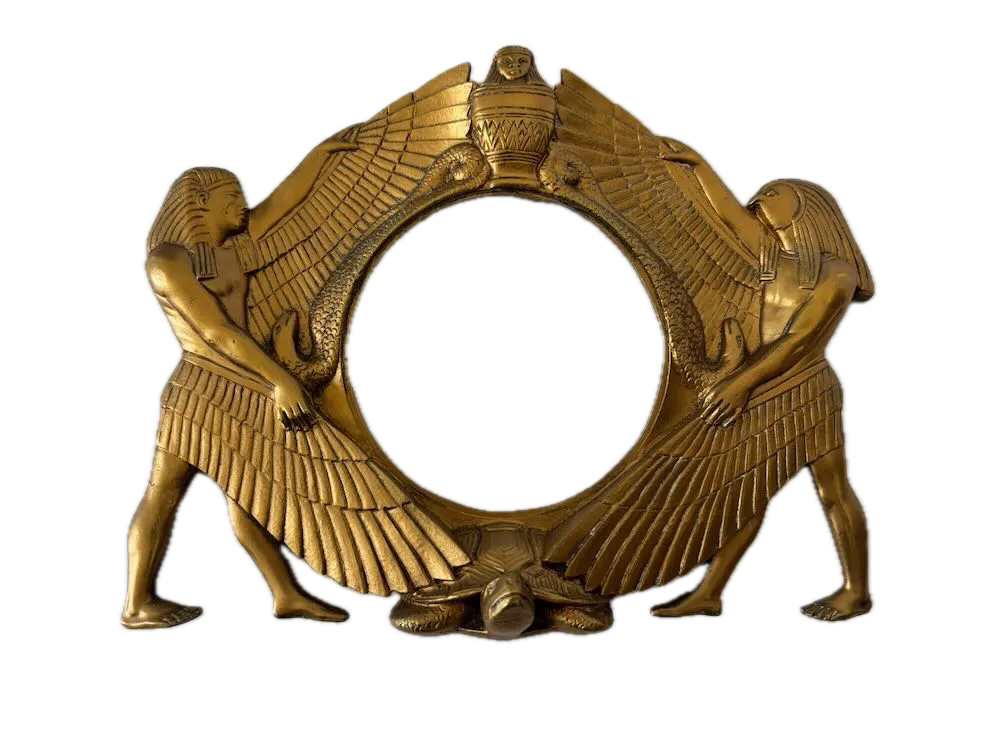
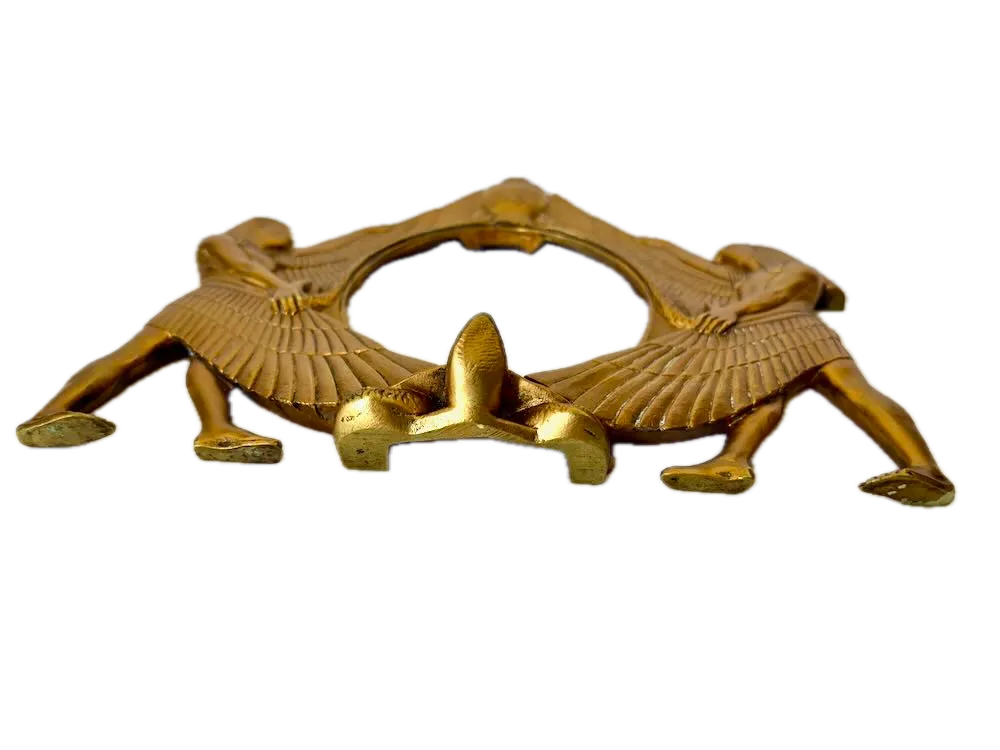
This is a striking Egyptian Revival gilt bronze clock mount, originally made as a decorative surround—most likely for a mantel clock dial or architectural clock case. Pieces like this were designed to be seen from the front only, and this one still carries that presence even detached from its original setting.
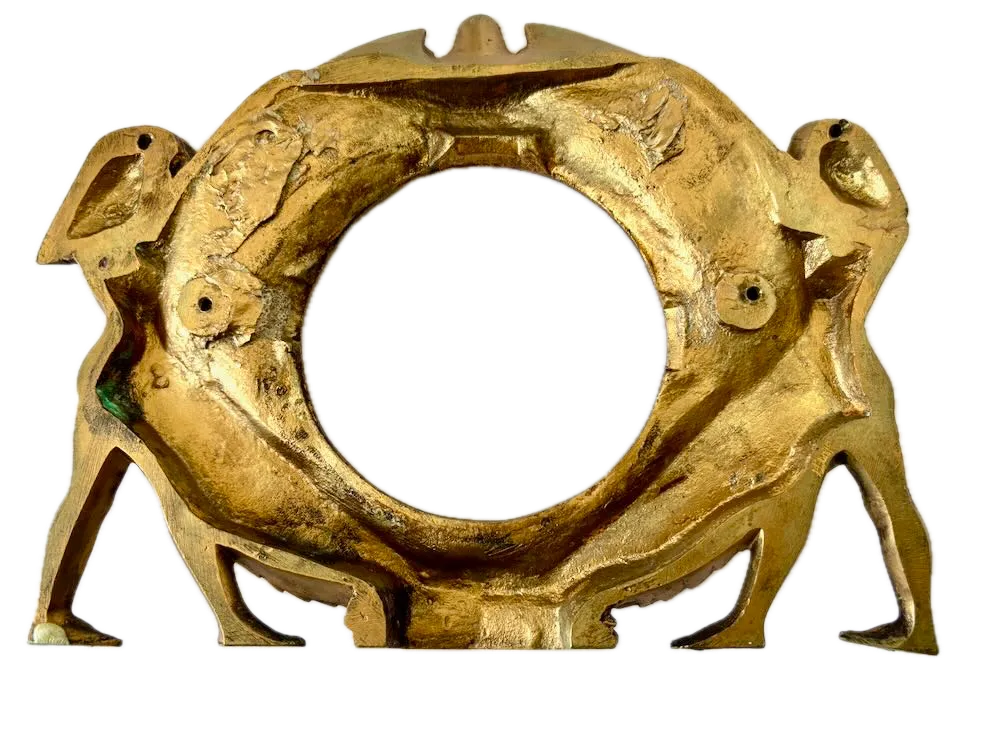
The weight alone tells you this is not a lightweight decorative casting. At approximately 759 grams, it has the density and feel you expect from a substantial bronze element rather than a later reproduction. The reverse is rough and unfinished, exactly as it should be, with original mounting holes still visible—clear evidence that it was once fixed to a larger structure.
What makes this piece particularly compelling is not just its form, but its iconography.
A Composition Rooted in Egyptian Symbolism
The design centers around a circular opening, which would have framed a clock dial, medallion, or similar element. Surrounding it is a carefully balanced arrangement of figures that feels more intentional than purely decorative.
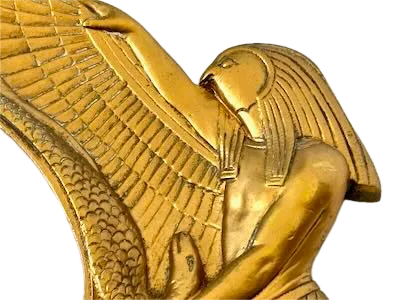
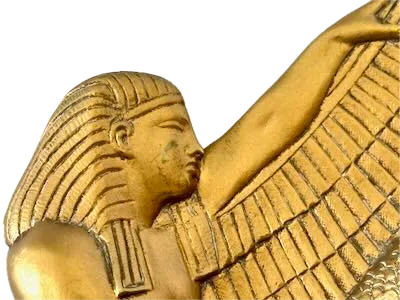
On either side are two male figures. One is falcon-headed, strongly associated with Horus or Ra-Horus, while the other appears in human form, both rendered in an Egyptianizing style. Their symmetry suggests guardianship, enclosing and protecting whatever once occupied the central opening.
At the top sits a form that closely resembles a human-headed canopic jar. In ancient Egyptian tradition, these vessels were used to safeguard the organs of the deceased, each protected by one of the Sons of Horus. While the figures here do not correspond exactly to those canonical forms, the combination of human and falcon-headed figures suggests a broader reference to protective deities within that tradition.
Two serpents curve around the circular aperture, forming a visual boundary. In Egyptian symbolism, serpents carried a dual meaning. The rearing cobra, or uraeus, represented royal authority and divine protection, while other serpent forms embodied opposing or chaotic forces. Their placement here reinforces the idea of containment and defense, enclosing the central space.
At the base, however, the composition takes a more unusual turn.
The Unusual Turtle Motif
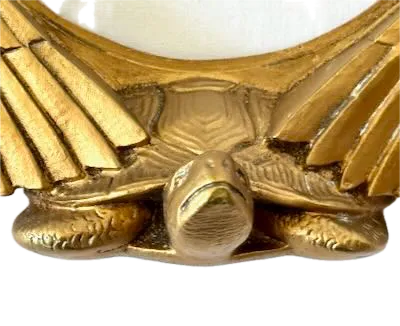
Instead of the more familiar scarab—commonly used in Egyptian Revival design—a turtle-like figure anchors the lower portion of the mount. The domed shell, head, and proportions read clearly as a turtle rather than a beetle.
This is a rare choice. In ancient Egyptian belief, the turtle held an ambiguous role. It was sometimes associated with forces opposed to the sun god Ra and linked to the underworld, yet it could also serve an apotropaic function, its presence acting as a form of protection. Placed at the lowest point of the composition, it suggests something restrained or held beneath the protective structure above.
Taken together, the arrangement reads as more than decorative. It suggests a layered composition—protective forces above and around, enclosing the center, with a subdued or opposing element below. Whether this reflects a specific narrative or a creative interpretation by a 19th-century designer, it gives the piece a depth not commonly found in standard Egyptian Revival ornament.
Form, Craftsmanship, and Attribution
The casting shows good detail, particularly in the figures and surface modeling. The gilt surface retains a warm tone with natural variation, and there is some green oxidation visible on the reverse—consistent with age and the underlying bronze.
There are no visible maker’s marks, which is not unusual for this type of mount. While Egyptian Revival pieces of this quality are often associated with French production in the late 19th century, especially during the height of Egyptomania, it would be more accurate to describe this as likely continental European, late 19th to early 20th century, rather than assign a definitive origin.
What can be said with confidence is that this is a functional architectural element, not a decorative imitation. The scale, weight, and construction all point to it having been part of a larger, more elaborate object—most likely a mantel clock or similar display piece.
A Decorative Object in Its Own Right
Even separated from its original purpose, this mount works beautifully as a standalone decorative object. It has strong visual presence and can easily be repurposed as a frame for a plaque, medallion, or artwork—as it has been used before.
It sits comfortably between architectural fragment and sculptural object, which is exactly the kind of crossover that makes Egyptian Revival pieces so appealing today.