


Description
Vintage Wedgwood Blue Jasperware Cupid Sharpening Arrows Dish
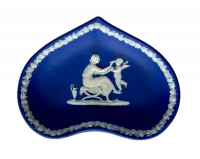
This Wedgwood Blue Jasperware Cupid Sharpening Arrows Dish features a charming neoclassical composition of Cupid, the Roman god of love, kneeling as he prepares his arrows. The finely modeled white figure contrasts beautifully with the characteristic matte blue Jasperware ground, while an elaborate blue-on-blue arabesque border completes the design.
Measuring approximately 4 3/8 inches in diameter, this vintage English dish captures the elegance of Wedgwood’s celebrated Jasperware tradition. Its distinctive combination of white figural relief and monochromatic arabesque ornament creates a particularly refined example of the company’s enduring neoclassical style.
Cupid Sharpening His Arrows: The Mythological Subject
In Roman mythology, Cupid, known as Eros in Greek mythology, personifies love, attraction and desire. Artists frequently depicted him as a winged child or youthful figure carrying a bow and arrows, whose power could inspire irresistible affection.
According to classical mythology, Cupid possessed arrows capable of influencing the emotions of gods and mortals alike. His golden arrows inspired love, while arrows associated with aversion could produce the opposite effect. These attributes made Cupid one of the most recognizable figures in European art.
The central relief depicts Cupid Sharpening His Arrows, a subject that emphasizes the preparation of love’s instruments rather than their use. Cupid kneels beside a small work surface, concentrating on his task, while his wings and drapery create a graceful composition.
The scene captures an appealing contrast between Cupid’s youthful innocence and the extraordinary power traditionally associated with his arrows. This combination of charm and classical symbolism made the subject especially suitable for neoclassical decorative art.
Classical Origins of the Cupid Design
The figure of Cupid preparing his weapons has a long artistic history, extending from ancient Greek and Roman sculpture through Renaissance painting and eighteenth-century neoclassical decoration.
Ancient sculptors frequently portrayed Eros engaged in everyday activities, including preparing or handling his bow. One celebrated example, traditionally associated with the Greek sculptor Lysippos, depicts Eros stringing his bow. The original Greek sculpture has not survived, although Roman copies preserve its composition.
Later European artists continued to explore related subjects. During the Renaissance, Parmigianino created his celebrated painting Cupid Making His Bow, demonstrating the enduring appeal of the youthful god preparing his weapons.
Wedgwood’s relief belongs to this broader artistic tradition. Its compact composition transforms the classical subject into a delicate decorative image suitable for Jasperware dishes, plaques, medallions and other small ornamental objects.
Josiah Wedgwood and Neoclassical Jasperware
Josiah Wedgwood founded his pottery business in Staffordshire, England, in 1759. Through technical innovation, artistic experimentation and a remarkable understanding of contemporary taste, he established one of the most influential ceramic manufacturers in Europe.
During the second half of the eighteenth century, European interest in ancient Greece and Rome inspired a major revival of classical forms and ornament. Wedgwood embraced this movement, collaborating with talented artists and modelers to translate ancient sculpture, engraved gemstones and classical reliefs into ceramic decoration.
Among these collaborators was John Flaxman, whose elegant neoclassical designs became closely associated with Wedgwood’s artistic achievements.
Wedgwood introduced Jasperware in the 1770s, developing an unglazed stoneware that provided an exceptionally effective background for finely modeled white relief. The resulting contrast resembled ancient carved cameos and became one of the company’s most recognizable decorative innovations.
Although the present dish dates from a much later period, it continues this historic tradition of classical imagery and sculptural ceramic ornament.
Blue-on-Blue Arabesque Border
One of the most distinctive features of this Wedgwood dish is its elaborate blue-on-blue arabesque border. Unlike traditional Jasperware decoration, which frequently uses contrasting white relief, this example reserves the white ornament for the central figure of Cupid.
The surrounding border features a continuous arrangement of stylized floral medallions, intertwining scrolls and gracefully curving foliage. These elements reflect the arabesque tradition, an ornamental style characterized by rhythmic repetition, flowing lines and intricate arrangements of stylized plant forms.
Because the arabesque decoration shares the same blue color as the Jasperware ground, its sculptural details emerge through subtle variations of light and shadow. This creates a sophisticated monochromatic effect that contrasts beautifully with the crisp white figure of Cupid.
The combination of a restrained arabesque border and a prominent classical figure gives this small dish a particularly harmonious composition. Rather than competing with the central relief, the intricate ornament frames and emphasizes Cupid, demonstrating Wedgwood’s skill in balancing decorative richness with neoclassical elegance.
Wedgwood’s Enduring Cupid Motifs
Cupid became a recurring subject in Wedgwood’s neoclassical designs, appearing in numerous compositions inspired by classical mythology and European decorative traditions.
Scenes depicting Cupid sharpening arrows, stringing his bow, carrying flowers or participating in playful activities offered artists a wide range of expressive possibilities. Their compact forms made them particularly suitable for the small-scale relief decoration associated with Jasperware.
Historic Wedgwood examples of Cupid Sharpening His Arrows appear in museum collections, including the Birmingham Museum of Art and the Victoria and Albert Museum.
The continued use of these classical subjects reflects one of Wedgwood’s most remarkable achievements: the preservation of eighteenth-century decorative traditions through successive generations of ceramic production.
Wedgwood Made in England Backstamp
The underside carries the impressed WEDGWOOD® / MADE IN ENGLAND mark, confirming its English manufacture.
The style of the mark is consistent with later twentieth-century Wedgwood production. Although an exact manufacturing date has not been established, the dish represents the company’s longstanding practice of reproducing classical decorative subjects.
This distinction is important when considering vintage Jasperware. While the inspiration for a design may reach back to classical antiquity or eighteenth-century neoclassicism, the individual ceramic object may have been manufactured considerably later.
Condition and Decorative Appeal
This vintage Wedgwood Jasperware dish remains in good vintage condition. Its matte blue surface and contrasting white Cupid relief retain their attractive appearance, while the intricate blue-on-blue arabesque border provides additional decorative interest.
Minor signs of age and handling are visible, particularly on the underside. Please examine the photographs for a closer view of the condition and impressed manufacturer’s mark.
With its classical Cupid subject, unusual monochromatic arabesque border and recognizable Wedgwood craftsmanship, this small decorative dish makes an appealing addition to a collection of English Jasperware.
Its compact dimensions also make it suitable for display in a cabinet, on a shelf or alongside other Wedgwood pieces featuring classical mythology.