

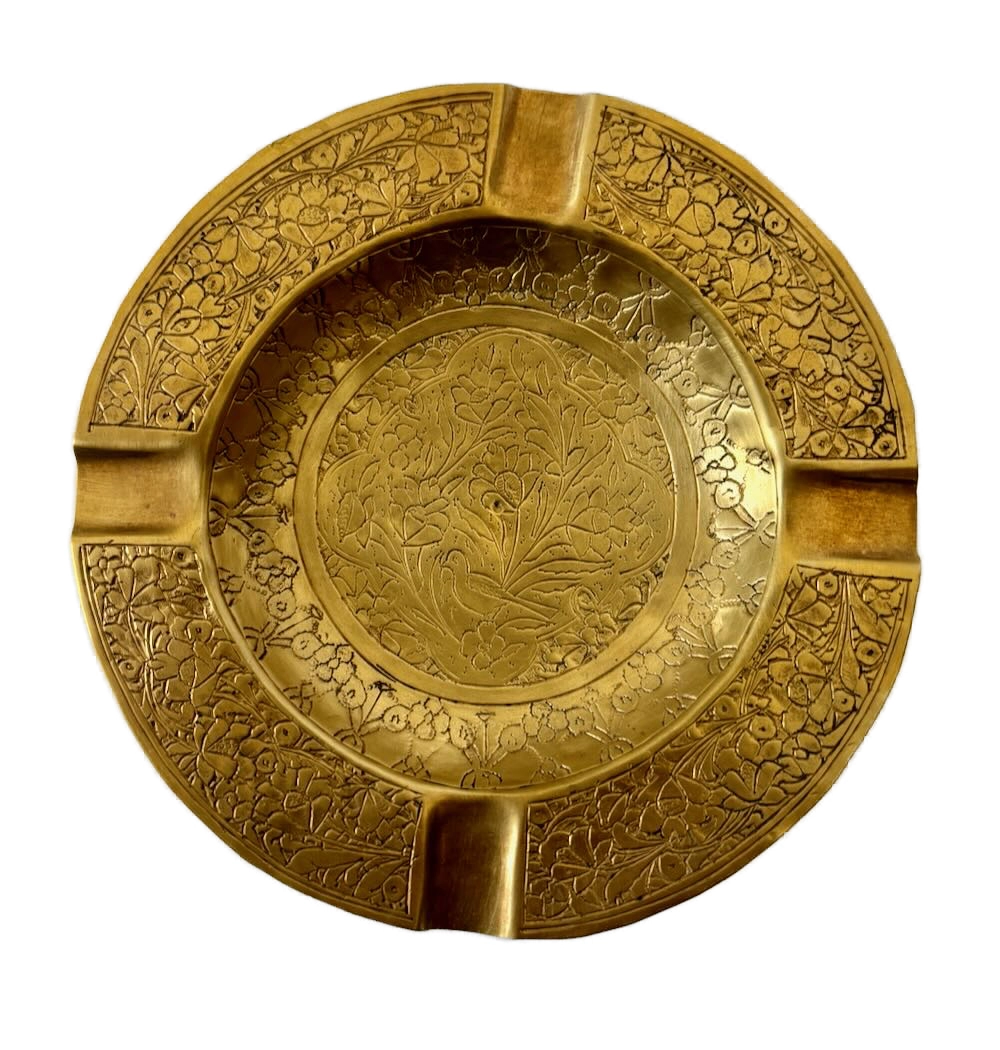
Few motifs appear more frequently in Persian decorative arts than the timeless pairing of flowers and birds. Whether engraved into silver trays, painted onto lacquer boxes, woven into carpets, or carved into metal vessels, these delicate scenes carry far more meaning than simple ornament. In Persian art, flowers and birds became poetry made visible.
Among these motifs, none became more beloved than Gol-o-Bolbol — literally “The Rose and the Nightingale.”
For centuries, Persian artists returned to this theme again and again. A single bird beside a flowering rose could express longing, beauty, devotion, love, spirituality, and the fleeting nature of life itself. The imagery moved naturally between literature, painting, architecture, textiles, and metalwork, becoming one of the defining visual languages of Persian culture.
Today, the motif remains deeply connected to traditional arts such as Ghalamzani, the ancient Persian art of hand engraving on metal.
Poetry at the Heart of Persian Ornament
To understand Gol-o-Bolbol, it helps to understand how closely Persian art and Persian poetry developed together. Unlike many decorative traditions where ornament serves mainly as embellishment, Persian ornament often carries emotional and literary meaning. Poets, painters, calligraphers, metalworkers, and carpet designers frequently drew inspiration from the same symbolic vocabulary.
The rose represented beauty, perfection, and divine creation. The nightingale, enchanted by the rose, became a symbol of longing and devotion. In Persian poetry, the bird sings endlessly to the flower it can never fully possess.
The theme appears repeatedly in the works of poets such as:
- Hafez
- Saadi
- Rumi
- Attar
Over time, the imagery moved beyond literature and entered nearly every Persian decorative art form.
From Poetry to Metalwork
Persian metalworkers adapted Gol-o-Bolbol beautifully because the flowing vines, petals, and curved bird forms translated naturally into engraved linework.
Traditional Ghalamzani artists used fine chisels to carve the designs into silver, copper, or brass surfaces by hand. The engraved grooves were often darkened afterward, allowing the delicate patterns to stand out with remarkable clarity.
On older Persian trays and vessels, the motif rarely appears isolated. Instead, birds and flowers intertwine with:
- scrolling arabesques
- cypress leaves
- palmettes
- geometric borders
- dense floral backgrounds
The result feels alive rather than rigid. The decoration flows continuously across the surface, almost like visual music.
Many antique Persian trays reveal this layered complexity especially well. At first glance, viewers notice the overall symmetry. Then slowly, smaller details emerge: hidden birds, tiny blossoms, curling leaves, and repeating floral rhythms engraved with astonishing precision.
The Gol-o-Bolbol Motif Beyond Metalwork
Although strongly associated with Persian engraving, Gol-o-Bolbol also flourished across many other art forms.
During the Safavid and Qajar periods especially, artists used the motif extensively in:
- lacquer painting
- manuscript illumination
- carpets and textiles
- ceramic tiles
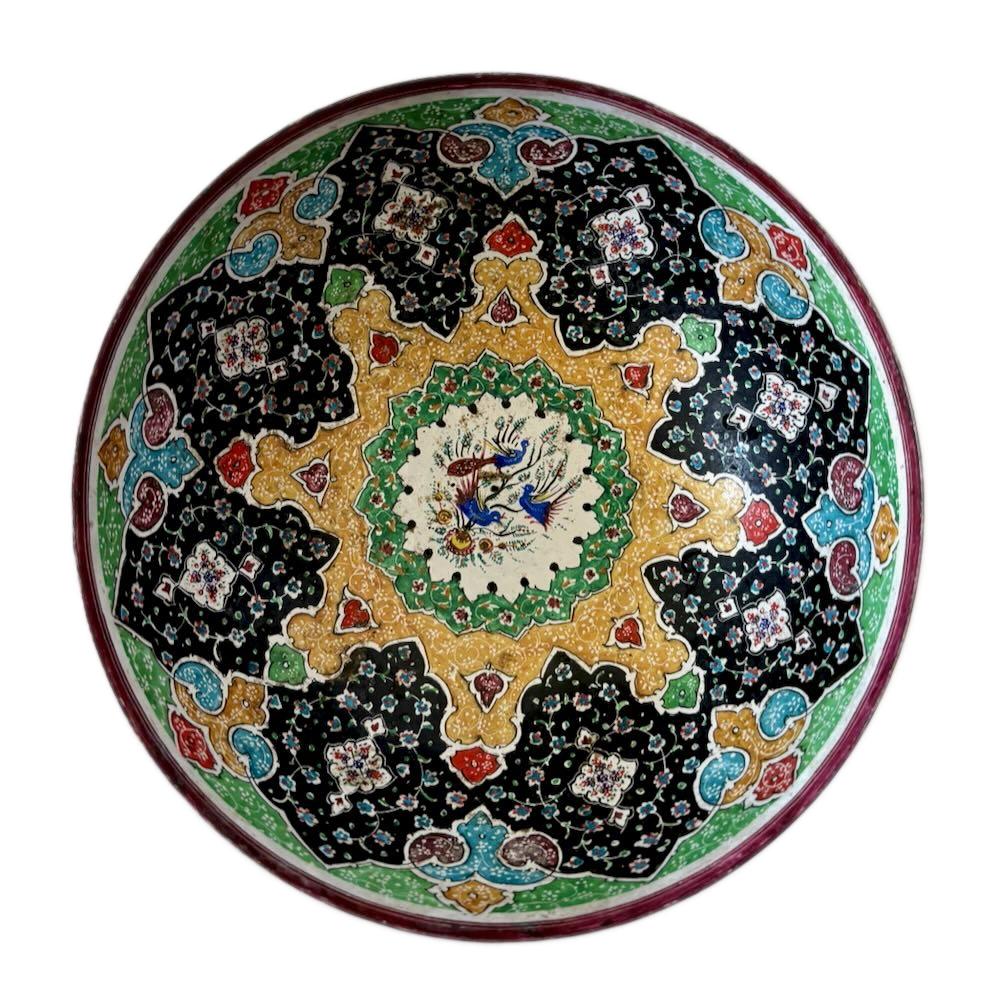
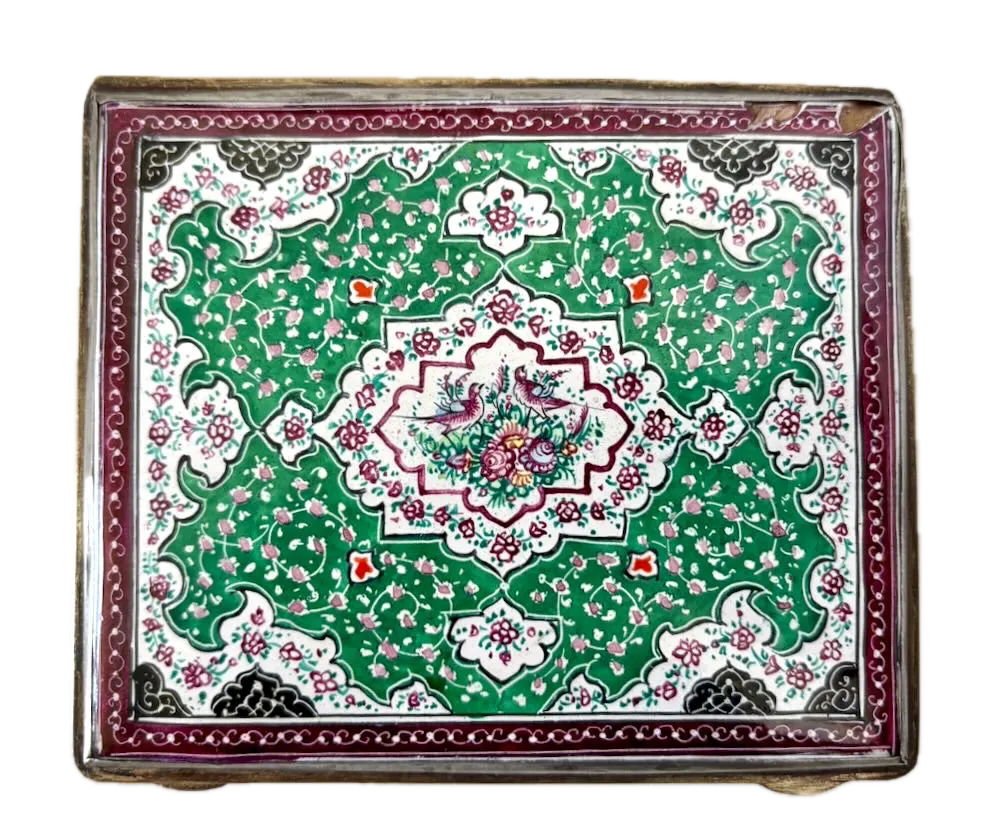
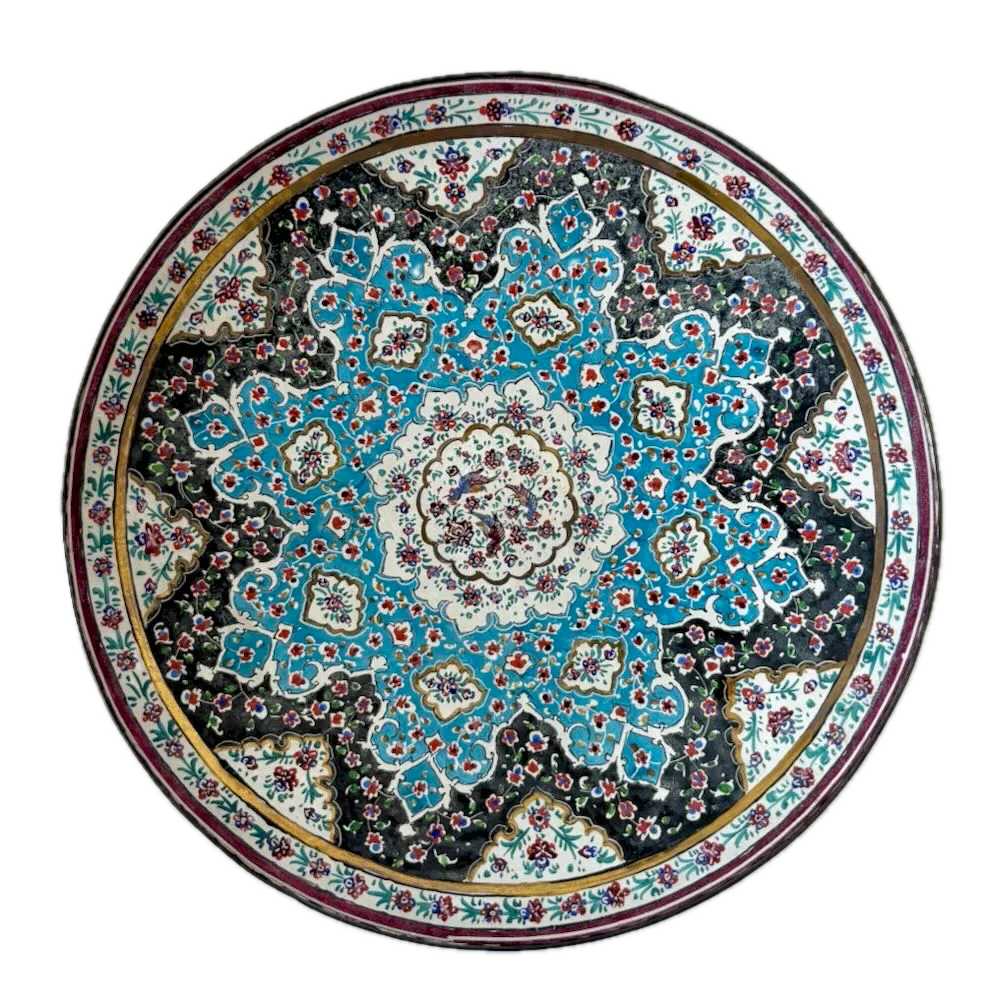
- enamelwork
- wood carving
- architectural decoration
Some of the most elaborate examples appear in Persian lacquer pen boxes and mirror cases from the 18th and 19th centuries. These objects often combine rich floral painting with delicate birds hidden among branches and blossoms.
Persian carpets also embraced the motif. In many classical rugs, birds appear quietly within floral gardens, creating symbolic landscapes inspired by paradise imagery and Persian poetry.
Why the Motif Endured
Gol-o-Bolbol survived for centuries because it balanced elegance with emotion. The imagery works on several levels at once. Even viewers unfamiliar with Persian poetry still respond instinctively to the beauty of birds among flowers. Yet beneath the surface lies a far deeper cultural and literary tradition.
The motif also adapts easily across materials and artistic styles. A master engraver in Isfahan could interpret it through dense silver engraving, while a ceramic artist might reduce the same idea to a few graceful painted lines. That flexibility allowed the motif to evolve without losing its identity. Even today, contemporary Persian artisans continue to reinterpret Gol-o-Bolbol in traditional workshops throughout Iran.
Reading the Details in Antique Persian Metalwork
Collectors often notice Persian engraving first for its extraordinary detail, but understanding the motifs adds another layer of appreciation. In older hand-engraved objects, Gol-o-Bolbol scenes usually reveal themselves gradually. Birds may hide among floral scrolls or appear integrated into highly symmetrical compositions. The finest pieces reward slow viewing because every section contains new details.
Several characteristics often distinguish older hand-worked examples from modern machine-made decoration:
- variation in engraving depth
- subtle asymmetry
- hand-darkened grooves
- layered textures created by different chisels
- natural flow in the floral forms
These details give authentic Persian metalwork its warmth and individuality. No two fully hand-engraved pieces ever look completely identical.
Persian Decorative Arts and the Language of Beauty
One reason Persian decorative arts remain so compelling is their refusal to separate beauty from meaning. A tray, bowl, or engraved vessel was never simply functional. Ornament carried memory, poetry, symbolism, spirituality, and craftsmanship together within a single object. Gol-o-Bolbol embodies that tradition perfectly.
What first appears to be a decorative bird beside a flower slowly reveals itself as part of a much older artistic language — one shaped by poetry, gardens, music, craftsmanship, and centuries of Persian cultural history.
Even now, the motif continues to speak quietly across time through engraved silver, carved brass, painted lacquer, woven silk, and hand-worked copper surfaces created by generations of Persian artisans.