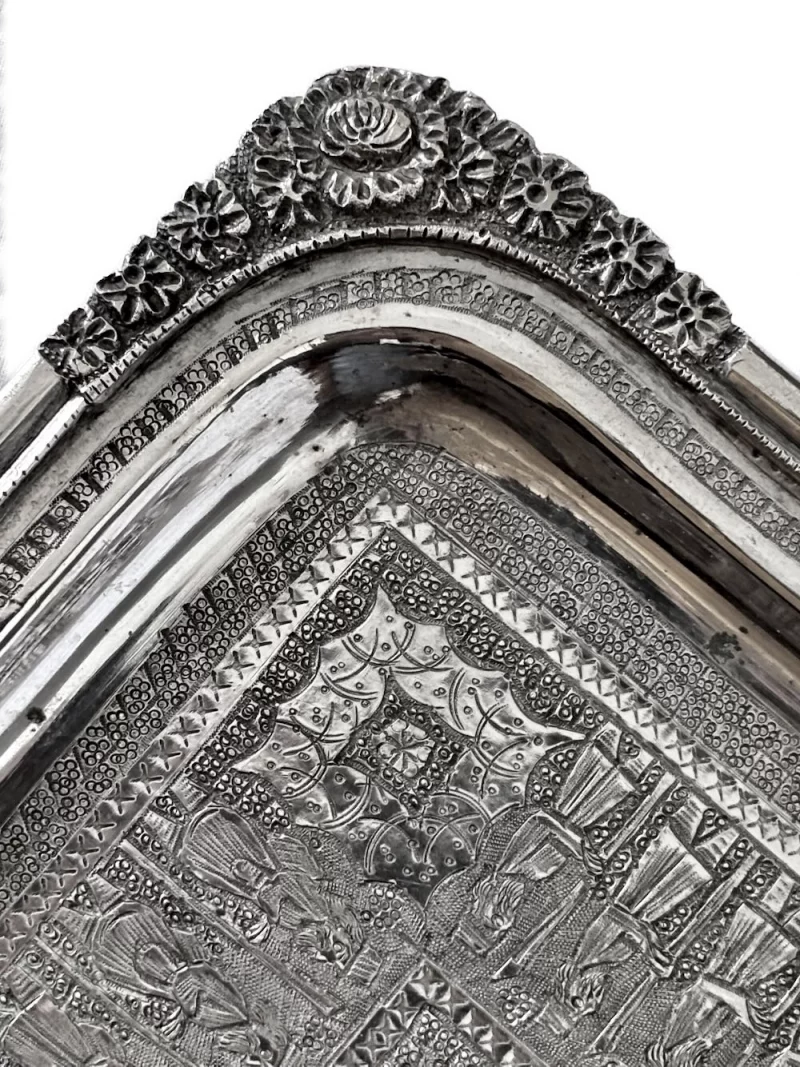

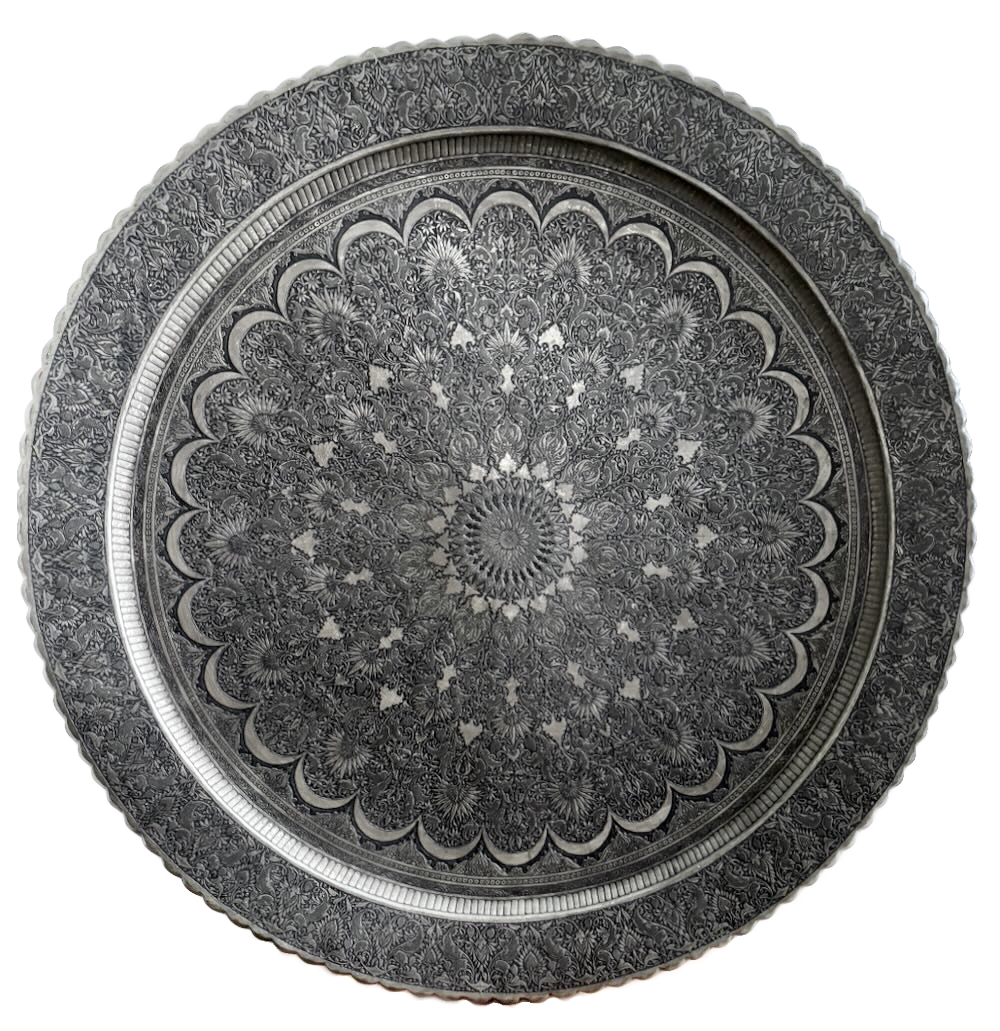
Persian Ghalamzani — also written Qalamzani, Ghalam zani, or Qalam zani — is one of the oldest and most visually captivating metalworking traditions in Iranian decorative arts. At first glance, antique Ghalamzani objects immediately stand apart from ordinary engraved brass or copper wares. Light moves differently across their surfaces. The carved lines create shadows and texture, while dense floral ornament seems to emerge gradually from the metal rather than simply sitting on top of it.
Even relatively small objects can feel surprisingly rich and complex. A simple ashtray, tray, bowl, or vase may contain hundreds of individually engraved lines cut slowly by hand using tiny chisels and hammers. The result is decorative, but also deeply tactile and sculptural.
For centuries, Persian artisans used Ghalamzani to decorate trays, mirror frames, incense burners, boxes, ewers, bowls, hookah components, and ceremonial vessels with intricate floral arabesques, birds, calligraphy, hunting scenes, and poetic symbolism. Today, antique examples remain highly collectible not only because of their craftsmanship, but because they preserve an entire visual language rooted in Persian history, literature, and design.
The Meaning Behind the Name
The word “Ghalamzani” roughly translates to “engraving with the pen,” though the “pen” refers to the steel chisels used by the engraver rather than an ink instrument. Different spellings appear in English because Persian words can be transliterated in multiple ways, so collectors may encounter Ghalamzani, Qalamzani, or Ghalam zani used interchangeably.
Unlike repoussé work, where metal is hammered outward from the reverse side to create raised relief, Ghalamzani primarily involves carving and engraving directly into the metal surface itself. The engraved line becomes the defining feature of the work. Fine grooves, textures, and recesses catch shadow and create visual depth across the surface.
Some Persian metalwork combines engraving with chasing or light relief work, which occasionally causes confusion between techniques. However, authentic Ghalamzani is fundamentally about the hand-cut line and the rhythm created through repeated engraving.
An Art Form with Ancient Roots
Persian metalworking traditions extend back thousands of years. Archaeological discoveries from the Achaemenid Empire already reveal extraordinary sophistication in the production of gold and silver ceremonial vessels, rhytons, bowls, and decorative objects. Over centuries, engraving techniques evolved through the Sassanian, Seljuk, Safavid, and Qajar periods, gradually developing into the refined decorative vocabulary now associated with Persian engraved metalwork.
The Safavid dynasty, particularly between the 16th and 18th centuries, marked a major turning point for Persian decorative arts. When Shah Abbas I established Isfahan as the capital, the city became one of the artistic centers of the Islamic world. Architecture, tile-work, miniature painting, textiles, calligraphy, lacquerwork, and metal arts flourished simultaneously.
That creative environment shaped the ornamental language still visible in Persian Ghalamzani today. Scrolling vines, floral arabesques, geometric rhythm, birds among flowers, and elegant repeating borders all reflect the broader visual culture of Safavid Persia.
Why Isfahan Became the Center of Ghalamzani
Although engraved metalwork was produced throughout Persia, Isfahan eventually became the city most closely associated with Ghalamzani craftsmanship. The city’s traditional bazaars supported generations of highly specialized artisans, many of whom inherited techniques and workshop traditions through family lines.
Even today, Isfahan remains the primary center for Persian hand-engraved metalwork.
Part of the city’s influence came from royal patronage during the Safavid period, but architecture also played an important role. The same visual sensibility seen in Isfahan’s mosques and palaces appears repeatedly in Persian engraved metal. Floral scrolls resemble tilework ornament. Repeating borders echo architectural geometry. Dense engraved surfaces reflect the Persian preference for layered decoration and rhythmic pattern.
The connection between architecture and portable decorative arts is impossible to ignore once it becomes familiar.
How Persian Ghalamzani Is Made
Traditional Ghalamzani is remarkably labor intensive. The process begins by stabilizing the reverse side of the metal, often using a mixture of bitumen and gypsum. This support absorbs hammer shock and prevents the metal from collapsing while the engraver works.
The artisan either sketches the design directly onto the metal or transfers it from paper. Using specialized chisels of different shapes and widths, the engraver slowly cuts lines into the surface through repeated hammer strikes. Some chisels outline forms, while others create textures, shading, or recessed backgrounds.
The process is slow, repetitive, and physically demanding. On finely worked pieces, nearly every visible surface may be engraved.
Once the carving is complete, the grooves are often darkened with charcoal or blackening compounds. This dark contrast helps emphasize the engraved lines and creates the rich visual depth collectors associate with older Persian metalwork.
Those darkened engraved grooves remain one of the easiest ways to distinguish authentic hand-worked examples from later machine-made imitations.

Image source: Tehran Times / Mehr News Agency (CC BY 4.0).
The Beauty of the Hand-Carved Surface
One of the reasons antique Ghalamzani feels so visually alive is the subtle irregularity created by hand engraving. Machine-etched decoration tends to appear mechanically flat and uniform. Hand engraving, by contrast, produces tiny variations in depth, pressure, spacing, and texture.
Under changing light, the surface shifts constantly. Some lines deepen into shadow while others catch highlights. Floral ornament emerges gradually rather than appearing printed or stamped.
Collectors often describe older Persian engraved metalwork as having warmth and movement that modern reproductions struggle to replicate. Much of that quality comes directly from the engraved surface itself.
Even signs of age contribute to the effect. Oxidation inside the engraved grooves, softened brass tones, and gentle surface wear all enhance the sense of depth and history.
Gol-o-Bolbol and Persian Symbolism
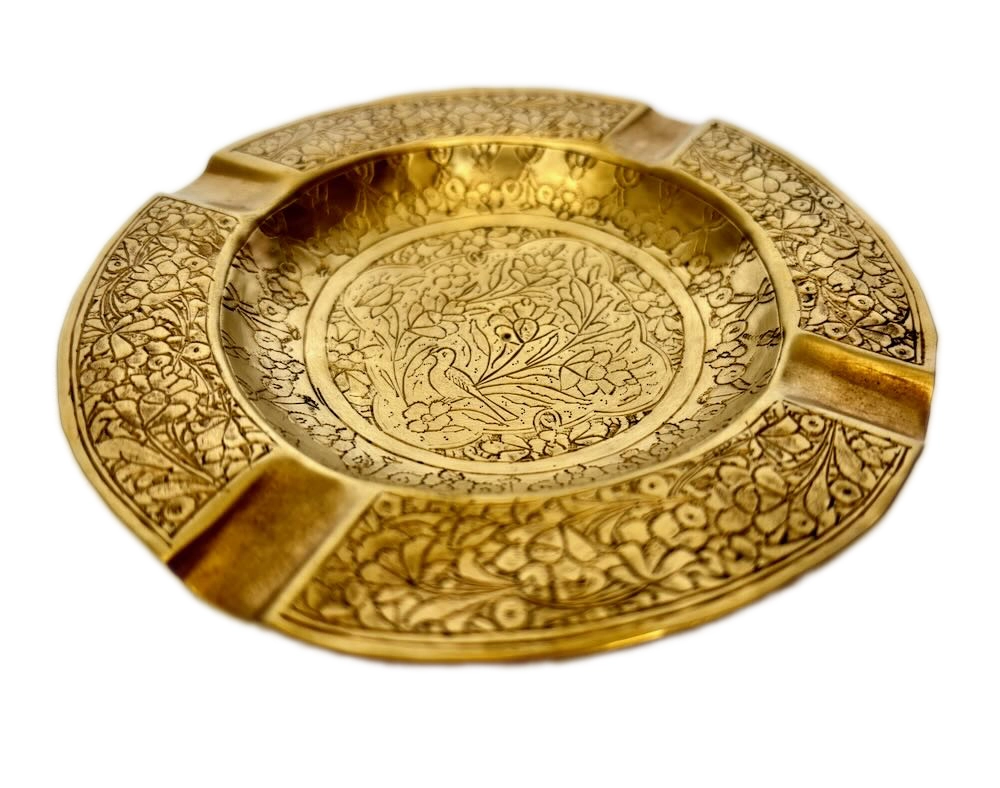
Among the most beloved motifs in Persian decorative arts is the Gol-o-Bolbol theme — the Rose and Nightingale. The motif appears throughout Persian poetry, textiles, miniature painting, lacquerwork, ceramics, and metal engraving.
In Persian symbolism, the rose represents beauty and perfection, while the nightingale symbolizes longing, devotion, and poetic desire. Together they became enduring metaphors in Persian literature, particularly in the poetry of Hafez and Saadi.
These poetic ideas naturally migrated into decorative arts. Birds among flowering branches became one of the defining visual themes of Persian ornament, appearing on engraved trays, bowls, ashtrays, mirror cases, pen boxes, and enamelwork.
The motif also appears prominently in Persian Minakari enamelwork, where birds and flowers similarly evoke paradise gardens, beauty, and lyricism.
Once recognized, Gol-o-Bolbol becomes one of the easiest motifs to identify across Persian decorative traditions.
Materials Used in Persian Engraved Metalwork
Persian artisans engraved many different metals over the centuries, though brass, copper, silver, and bronze became especially associated with decorative production.
Copper was widely used because it was relatively soft and easy to engrave deeply. Brass developed warm golden patinas over time and became particularly popular during the late Qajar and Pahlavi periods. Silver examples were generally more luxurious and often reserved for ceremonial or high-status objects.
The choice of metal changes not only the appearance of the piece, but also the visual character of the engraving itself. Deeply engraved brass tends to emphasize contrast and warmth, while copper produces softer tonal variation.
Even today, many collectors are drawn as much to the aging surfaces and patina as to the engraving itself.
Antique Versus Modern Ghalamzani
Persian Ghalamzani is still actively practiced in Iran today, especially in Isfahan, where contemporary artisans continue producing remarkable hand-engraved work using traditional methods.
However, antique pieces often possess qualities difficult to reproduce consistently in modern commercial production. Older examples typically show:
- denser engraving
- softer patina
- more balanced ornament
- deeper hand-cut grooves
- subtle irregularities
- and greater variation across the surface
Modern tourist-market pieces sometimes imitate Ghalamzani using acid etching or repetitive stamped decoration rather than genuine hand engraving. While decorative, they lack the sculptural depth and individuality associated with older artisan work.
Collectors frequently examine the underside, groove depth, oxidation, wear patterns, and overall compositional quality when evaluating authenticity.
Why Persian Ghalamzani Remains Collectible
Part of the enduring appeal of Persian Ghalamzani lies in the balance between craftsmanship and accessibility. Compared to museum-level Islamic metalwork or major European silver, many antique Persian engraved objects remain relatively attainable for collectors.
At the same time, the labor involved in their production can be extraordinary. Even modest decorative pieces may represent many hours of detailed hand engraving.
These objects also adapt naturally to modern interiors. Antique Persian ashtrays become jewelry trays. Engraved bowls serve as decorative centerpieces. Small engraved boxes work beautifully on desks, bookshelves, or cabinets.
Yet beyond decoration, Ghalamzani preserves something deeper: a continuity of Persian artistic culture that stretches across centuries. The engraved flowers, birds, arabesques, and rhythmic patterns visible on these objects connect architecture, poetry, literature, craftsmanship, and everyday life into a single decorative tradition.
That combination of beauty, symbolism, craftsmanship, and history continues to make Persian Ghalamzani one of the most fascinating areas of Middle Eastern decorative arts.