





Description
Vintage Wedgwood Lilac Jasperware Ulysses Tray
This Vintage Wedgwood Lilac Jasperware Ulysses Chariot Tray features an elegant neoclassical composition depicting Ulysses Staying the Chariot of Victory. The dramatic white relief stands out against a soft lilac ground, while a delicate garland of leaves and buds follows the rectangular rim.
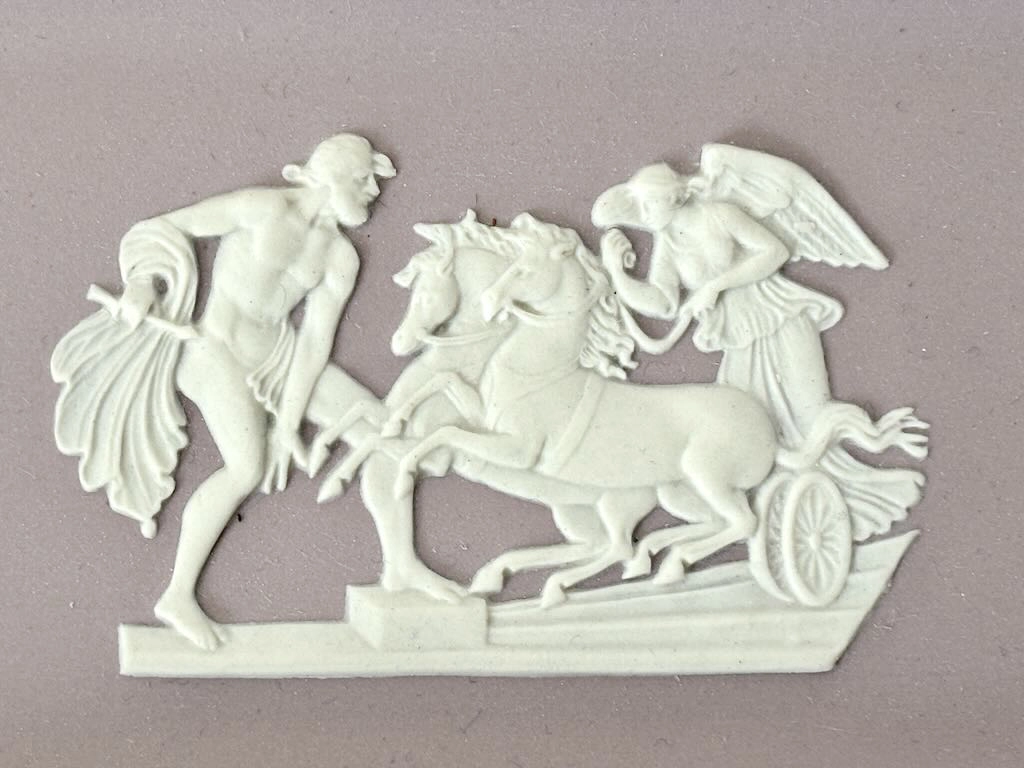
The central scene portrays the Greek hero Ulysses, also known as Odysseus, confronting a pair of horses drawing a chariot driven by the winged goddess of Victory. The figures convey remarkable movement and energy, contrasting beautifully with the tray’s restrained geometric shape and muted color.
Measuring approximately 6 1/4 by 3 1/4 inches, the tray combines an established Wedgwood classical design with a less commonly encountered Jasperware color. Its distinctive subject, carefully modeled relief and graceful proportions make it an appealing example of vintage English decorative ceramics.
Ulysses Staying the Chariot of Victory
The central composition, Ulysses Staying the Chariot of Victory, belongs to the rich tradition of classical subjects that Josiah Wedgwood incorporated into his decorative ceramics during the eighteenth century.
The scene features a male figure standing before two spirited horses, their bodies and raised legs conveying movement and tension. Behind them, a winged female figure drives a small chariot, holding the reins as the horses advance.
The male figure represents Ulysses, the Roman name for Odysseus, the legendary Greek hero celebrated in Homer’s Odyssey and Iliad. The winged charioteer represents Victory, known as Nike in Greek mythology and Victoria in Roman tradition.
Ulysses appears to interrupt or restrain the advancing horses, creating a dynamic interaction between the figures. The title uses the older meaning of staying, referring to stopping or checking forward movement.
The composition is also documented under the alternative historical title Ulysses Stopping the Chariot of Victory. Both titles describe the same classical subject and reflect terminology found in historical collections of Wedgwood ceramics.
The subject’s appeal lies in its dramatic arrangement. Ulysses leans toward the horses while holding flowing drapery, the animals press forward, and Victory bends toward the reins. Together, the figures form a compact but remarkably expressive sculptural composition.
William Hackwood and Wedgwood’s Classical Reliefs
The historical design of Ulysses Staying the Chariot of Victory has been associated with William Hackwood (1753–1839), an important modeler and sculptor who worked for Josiah Wedgwood.
Hackwood joined Wedgwood’s pottery as a young apprentice and became one of the company’s accomplished modelers. His work contributed significantly to the development of the finely detailed classical reliefs that helped establish Wedgwood’s artistic reputation.
During the late eighteenth century, Wedgwood employed skilled artists and modelers to translate classical sculpture, engraved gems and historical compositions into decorative ceramic forms. These designs appeared on plaques, medallions, vases and other ornamental objects.
The Ulysses composition dates to this early period of Wedgwood’s neoclassical production, although the present rectangular tray represents a later manufacture of the historical design.
Its carefully modeled figures demonstrate why these classical compositions remained popular long after their original introduction. The relief captures movement, anatomy and flowing drapery within a relatively small decorative space.
Ulysses and the Classical World
Ulysses, or Odysseus, occupies an important place in ancient Greek mythology. As king of Ithaca, he became renowned for his intelligence, resourcefulness and participation in the Trojan War.
Homer’s Odyssey recounts his long journey home following the fall of Troy, while the Iliad presents him as an influential Greek warrior and strategist.
In European art, Ulysses frequently represented courage, perseverance, ingenuity and the ability to overcome extraordinary challenges. His adventures inspired painters, sculptors and decorative artists throughout the Renaissance and Neoclassical periods.
The goddess Victory also became an enduring subject of classical art. Artists traditionally portrayed Nike or Victoria as a winged female figure, sometimes carrying a wreath or palm branch and sometimes accompanying a victorious hero.
In the Wedgwood relief, the interaction between Ulysses and the winged charioteer creates a striking classical composition. Rather than a static portrait, the scene presents a moment of action, combining mythological imagery with the graceful sculptural language of antiquity.
Josiah Wedgwood and the Neoclassical Revival
Josiah Wedgwood (1730–1795) founded his pottery business in Staffordshire, England, in 1759. Through experimentation, technical innovation and artistic collaboration, he transformed English pottery and established one of the most influential ceramic manufacturers of the eighteenth century.
Wedgwood developed a particular interest in the art of ancient Greece and Rome. His classical designs reflected the growing European enthusiasm for antiquity, encouraged by archaeological discoveries and the popularity of Neoclassical architecture and sculpture.
He collaborated with leading artists and skilled modelers, including John Flaxman and William Hackwood, to create ceramic decorations inspired by ancient reliefs, engraved gemstones and mythological subjects.
These designs became central to Wedgwood’s artistic identity. Classical figures, chariots, goddesses, ornamental wreaths and architectural motifs appeared throughout the company’s decorative collections.
The Ulysses relief reflects this tradition, combining a recognizable classical subject with the refined sculptural modeling that made Wedgwood ceramics internationally admired.
The Development of Wedgwood Jasperware
Among Josiah Wedgwood’s most celebrated achievements was the development of Jasperware during the 1770s.
This distinctive unglazed stoneware provided a smooth, matte surface ideally suited to finely modeled relief decoration. Wedgwood frequently applied contrasting white ornaments to colored grounds, creating a visual effect reminiscent of ancient carved cameos.
The technique allowed the company to reproduce detailed classical compositions on a wide variety of decorative objects. Figures, mythological scenes, floral garlands and architectural ornaments became particularly effective subjects for Jasperware reliefs.
Wedgwood produced Jasperware in several colors, including blue, green, black, yellow and lilac. Although pale blue became the company’s most recognizable shade, the other colors offered collectors a wider range of decorative possibilities.
The present tray demonstrates the continuing appeal of this historic technique. Its raised white classical composition contrasts beautifully with the matte lilac ground, emphasizing the sculptural character of the figures and surrounding ornament.
The Distinctive Appeal of Lilac Jasperware
The tray’s lilac ground provides a particularly attractive alternative to Wedgwood’s familiar blue Jasperware.
Its muted lavender-purple tone creates a soft background for the brilliant white relief, allowing the details of the figures, horses and chariot to remain clearly visible.
Lilac Jasperware appears less frequently than blue among vintage Wedgwood decorative pieces, making it an appealing variation for collectors interested in the company’s different colors and forms.
The restrained color also complements the classical subject. Rather than competing with the intricate relief, the lilac ground enhances its sculptural detail and gives the composition an elegant, understated appearance.
Rectangular Form and Decorative Garland
The tray has a shallow rectangular form with chamfered corners and a gently raised rim. Its elongated proportions provide an effective setting for the horizontal chariot composition.
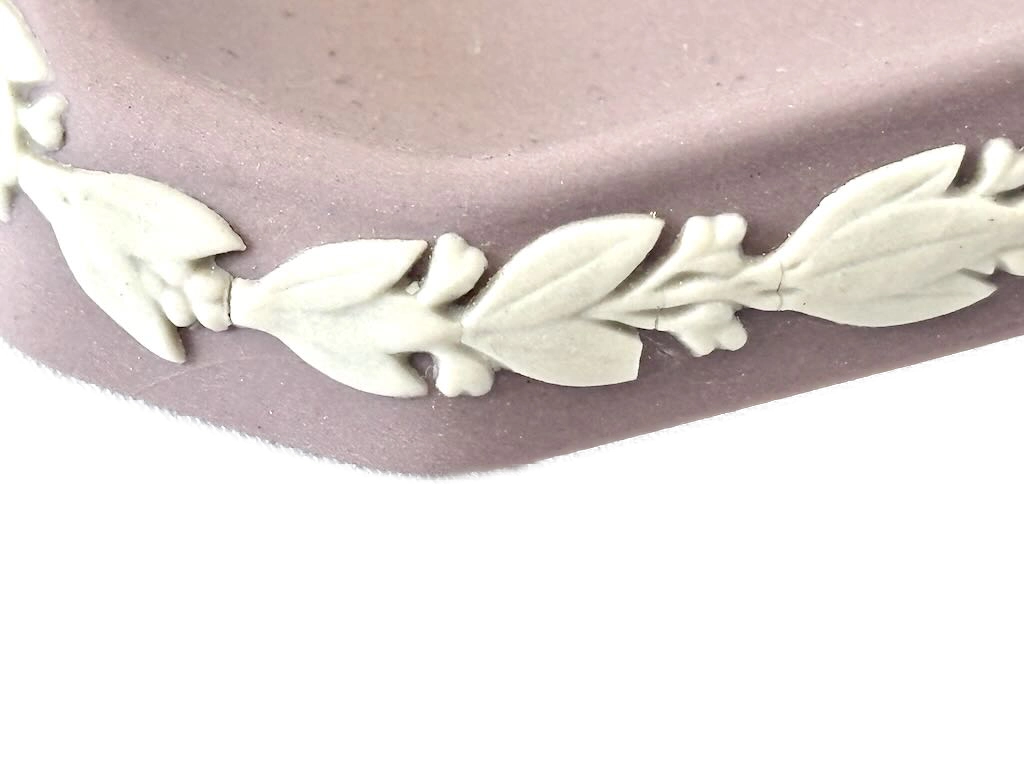
A continuous white garland decorates the outer edge, following the rectangular outline and wrapping around the corners. The ornament consists of stylized pointed leaves, small buds and connecting stems arranged in a repeating botanical pattern.
The delicate garland provides a decorative frame without overwhelming the central scene. Its regular rhythm contrasts with the movement of the horses and figures, bringing visual balance to the composition.
Botanical garlands were an important feature of classical and neoclassical decorative art. Artists frequently used leaves, flowers and intertwined stems to frame mythological scenes, architectural ornaments and sculptural medallions.
On this tray, the garland creates a harmonious transition between the lilac ground and the raised white central relief.
Wedgwood Made in England Backstamp
The underside bears the WEDGWOOD / MADE IN ENGLAND mark, together with additional impressed markings.
These markings identify the tray as an English Wedgwood product. The piece belongs to the company’s later vintage Jasperware production, although its exact manufacturing date has not been established.
The central relief, however, derives from Wedgwood’s much earlier neoclassical design tradition. Historical examples of Ulysses Staying the Chariot of Victory appear in museum collections, demonstrating the longevity of the composition.
The contrast between the eighteenth-century artistic inspiration and the later ceramic manufacture reflects one of Wedgwood’s enduring strengths: the preservation and reinterpretation of classical designs across generations.
Vintage Condition and Collectible Appeal
This vintage Wedgwood tray remains in good overall condition, with age-related imperfections affecting portions of the applied white garland.
Several sections of the raised botanical decoration show visible cracks, and one leaf has a small chip. The cracked sections remain firmly attached. These imperfections are localized to the decorative relief and are shown in the accompanying close-up photographs.
The lilac Jasperware body and central classical composition present attractively. Please examine all photographs carefully, particularly the detailed views of the garland, as they form an important part of the condition description.
Despite these imperfections, the tray retains considerable decorative appeal. Its less commonly encountered lilac color, rectangular form and historically documented classical subject make it an interesting addition to a collection of Wedgwood Jasperware.
It would display beautifully alongside other Wedgwood pieces or as an individual decorative object, particularly for collectors interested in Greek and Roman mythology, classical relief sculpture and the history of English ceramics.