

Understanding Wedgwood Jasperware and Why It Matters
Wedgwood jasperware remains one of the most recognizable and collected ceramics ever produced. Most people know it for its soft matte finish and white relief decoration, often in pale blue. Yet that familiar look only tells part of the story.
Jasperware represents a major technical and artistic breakthrough. It allowed Wedgwood to create finely detailed relief designs in a durable stoneware body, combining classical inspiration with industrial precision. Over time, the material evolved, production methods changed, and new variations appeared. As a result, not all jasperware carries the same quality, age, or value.
For collectors, understanding those differences makes a significant impact. It helps you identify earlier pieces, recognize later production, and avoid common mistakes when buying or selling. Wedgwood’s work is widely recognized in major museum collections, including the Victoria and Albert Museum.
What Defines Jasperware
Jasperware is a fine stoneware that Wedgwood colors throughout using metal oxides. The surface remains unglazed, giving it a soft, matte appearance often described as “biscuit.” White relief decoration is then applied to the surface, creating the contrast that defines the material.
That contrast drives the entire aesthetic. The colored body provides depth, while the white relief supplies detail and narrative. Together, they create the cameo-like effect that made jasperware famous.
The most common color is pale blue, but Wedgwood produced many others, including green, lilac, black, yellow, and more unusual variations. Some colors appear far less frequently, which makes them more desirable to collectors.
How to Date Wedgwood Jasperware
Dating jasperware requires more than checking the mark on the base. The most reliable approach combines visual observation with construction details.
Start by looking at the interior of the piece. Early examples often use dip jasper, where the exterior carries the color but the interior remains white. Later pieces tend to use solid jasper, where the color runs throughout the body.
Next, examine the relief decoration. Thin, crisp edges usually point to earlier production. Thicker, more rounded reliefs often indicate later manufacturing, where durability and efficiency became priorities.
Translucency also plays a role. Early reliefs can show a slight glow at the edges due to their thinness and material composition. Later pieces lose this effect as sprigs become thicker and more opaque.
Finally, observe how the relief meets the body. Early sprigging blends seamlessly into the surface. Later application often appears more defined, with clearer edges.
Each of these details reinforces the others. When you evaluate them together, you can place a piece within a realistic time range with much greater confidence.
Dating Wedgwood by Marks
Marks provide another important layer of information, but they work best when combined with physical observation.
The simple impressed “WEDGWOOD” mark appears from the 18th century onward, which means it does not by itself confirm a precise date. However, additional elements help narrow things down.
The presence of “ENGLAND” indicates production after 1891, when export regulations required country of origin marks. “MADE IN ENGLAND” appears later and generally points to 20th-century production.
Some pieces include letter or number codes that correspond to production dates. These systems can help refine dating further, but they do not appear consistently on all jasperware.
Use marks to confirm what you already suspect from the material and construction. They should support your conclusion, not replace it.
Jasperware vs Black Basalt
Many collectors confuse black jasperware with black basalt. While they may appear similar at first glance, they differ completely in composition and purpose.
Jasperware relies on contrast. The colored body supports applied white relief decoration, which creates the visual effect. Black basalt, by contrast, uses a dense, iron-rich body that fires to a uniform black. It emphasizes form, shape, and surface rather than applied decoration.
This difference affects everything. Jasperware allows for delicate narrative scenes and symbolic imagery. Black basalt excels in sculptural forms, architectural shapes, and incised or molded detail.
Understanding the distinction helps you identify pieces correctly and avoid mislabeling, which can affect both value and credibility.
How Jasperware Has Evolved Over Time
Jasperware did not remain static. It changed significantly from its early development in the late 18th century to modern production.
Early pieces show exceptional craftsmanship. Reliefs appear thin, crisp, and often slightly translucent. The material itself feels refined and carefully controlled.
As production expanded during the 19th century, reliefs became slightly thicker. By the late Victorian period, mass production introduced more uniformity and reduced some of the fine detail seen in earlier work.
During the 20th century, mechanization and changing market demands led to further changes. Reliefs became more consistent, surfaces more standardized, and the overall aesthetic shifted toward bold contrast rather than delicate translucency.
Modern jasperware still follows the same basic principles, but it reflects contemporary production methods rather than the experimental craftsmanship of the early years.
Wedgwood Egyptian Revival and Jasperware
Egyptian Revival introduces a different dimension to jasperware collecting. While jasperware often features Greco-Roman themes, Egyptian motifs appear during specific periods of renewed interest in ancient Egypt.
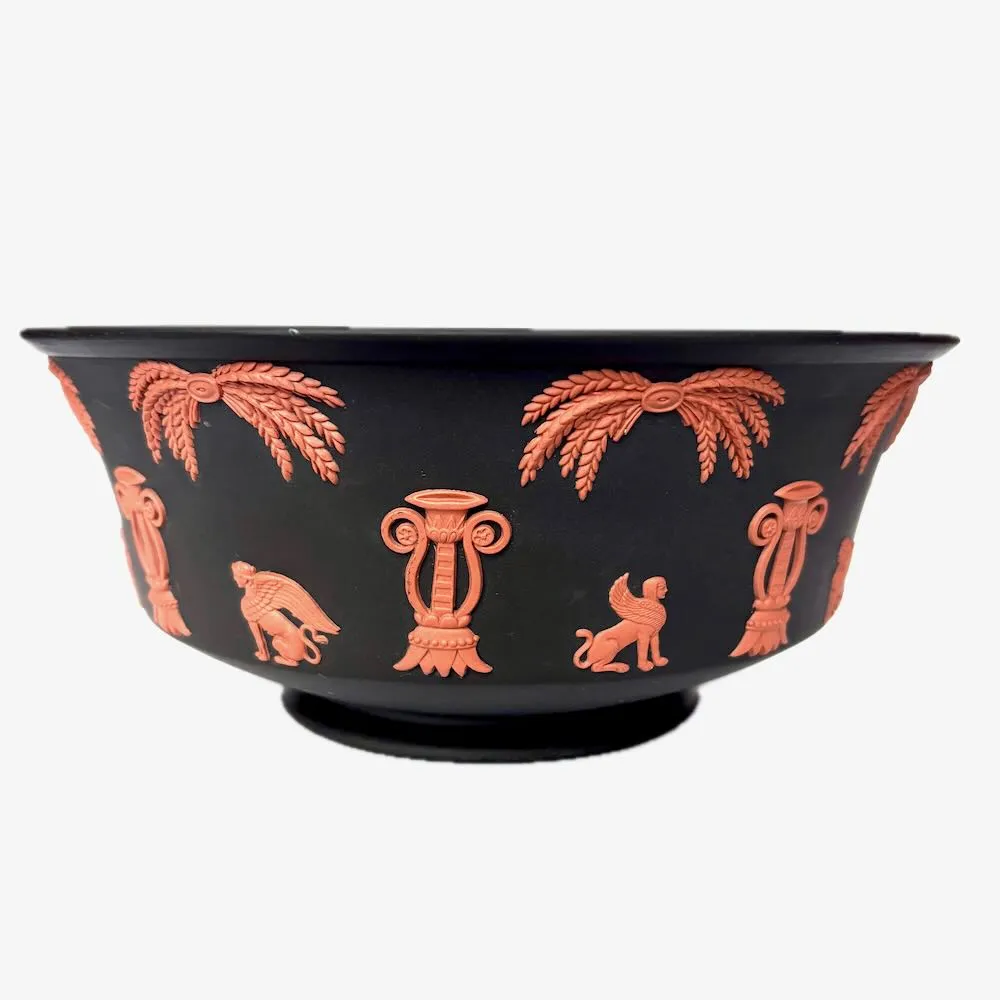
Early 19th-century Egyptian pieces often combine black basalt and rosso antico, but jasperware still plays a role in symbolic decoration. Later, in the 1970s, Wedgwood revisited Egyptian themes through a dedicated collection that included jasperware in black, terracotta, and other color combinations.
These pieces tend to focus on display and collectibility. Plaques, canopic jars, and sculptural forms replace the functional wares seen in earlier periods. Limited editions and presentation details also become part of the appeal.
Understanding these differences helps you place Egyptian-themed jasperware within the broader Wedgwood timeline.
A Practical Approach to Collecting
When evaluating any piece of jasperware, a structured approach helps you avoid common mistakes.
Start with the body and color. Determine whether the piece uses dip or solid jasper and note the color variation. Then examine the relief for thickness, crispness, and detail. Check for any translucency at the edges, and observe how the relief integrates with the surface.
After that, review the mark and any additional codes. Use these to confirm your initial assessment rather than relying on them alone.
This process allows you to move quickly from observation to conclusion. With experience, it becomes second nature.
Why Jasperware Remains So Collectible
Jasperware continues to attract collectors because it combines design, history, and technical achievement in a single material. It reflects both artistic ambition and industrial innovation, which makes it unique among ceramics.
The variety of colors, forms, and themes also keeps the category engaging. From classical scenes to Egyptian Revival pieces, jasperware offers a wide range of styles without losing its identity.
Finally, the differences between early and later production create opportunities. Collectors who understand those differences can identify higher-quality pieces, make better buying decisions, and build more meaningful collections.
Final Thoughts
Wedgwood jasperware rewards close attention. At a glance, many pieces look similar. A closer look reveals differences in craftsmanship, material, and production that can significantly affect both age and value.
By learning how to evaluate relief, color, construction, and marks together, you gain a much clearer understanding of what you are looking at. That knowledge allows you to move beyond surface appearance and engage with the material in a more informed way.
For collectors and sellers alike, that makes all the difference.
Related Wedgwood Guides:
- How to Date Wedgwood Jasperware
- How to Identify Wedgwood Marks
- Jasperware vs Black Basalt
- How Wedgwood Jasperware Has Evolved Over Time
- Wedgwood Egyptian Revival Guide
- How to Clean and Care for Wedgwood Jasperware