

Wedgwood Egyptian Revival
The Enduring Appeal of Egyptian Revival at Wedgwood
Wedgwood Egyptian Revival wares stand apart from almost everything else the company produced. Most collectors expect blue jasperware with classical white reliefs. Egyptian pieces break that expectation immediately. They feel darker, more dramatic, and often more sculptural.
That difference is not accidental. Wedgwood did not simply decorate existing forms with Egyptian motifs. The company developed entire design approaches around them, using black basalt, rosso antico, jasperware, and gilding to capture the mood of ancient Egypt. Each wave of production reflects a specific moment in history when fascination with Egypt surged across Europe and later the world.
Understanding those waves gives you a powerful advantage. It allows you to identify pieces more accurately, place them in context, and recognize why certain forms and materials appear when they do.
Why Egyptian Design Fit Wedgwood So Well
Wedgwood already operated at the intersection of design, experimentation, and marketing. Josiah Wedgwood built the company on innovation, constantly refining ceramic bodies and searching for new ways to appeal to changing tastes.
Egyptian design arrived at exactly the right time. The company already had the technical tools needed to interpret it:
- Black basalt provided a dense, matte black body with a monumental, almost architectural presence
- Rosso antico introduced a rich terracotta red that echoed archaeological materials
- Jasperware allowed for crisp, controlled relief decoration that could translate symbolic imagery
These materials did more than support decoration. They carried meaning. Black basalt suggested age and permanence. Rosso antico evoked excavation and antiquity. Jasperware offered precision and clarity. When Wedgwood combined them with Egyptian motifs, the result felt authentic rather than decorative.
The First Wave: Early 19th-Century Egyptomania
The first true Egyptian Revival at Wedgwood emerged in the early 19th century, roughly between 1800 and 1815. This period followed the surge of interest in Egypt sparked by Napoleon’s campaign and the growing fascination with ancient monuments and artifacts.
Wedgwood responded with confidence. Instead of producing small novelty items, the company created a full range of wares that incorporated Egyptian imagery into functional and decorative objects.
You see this clearly in the forms produced during this period:
- Teapots and sugar bowls with crocodile finials
- Vases with hieroglyphic-style bands and architectural structure
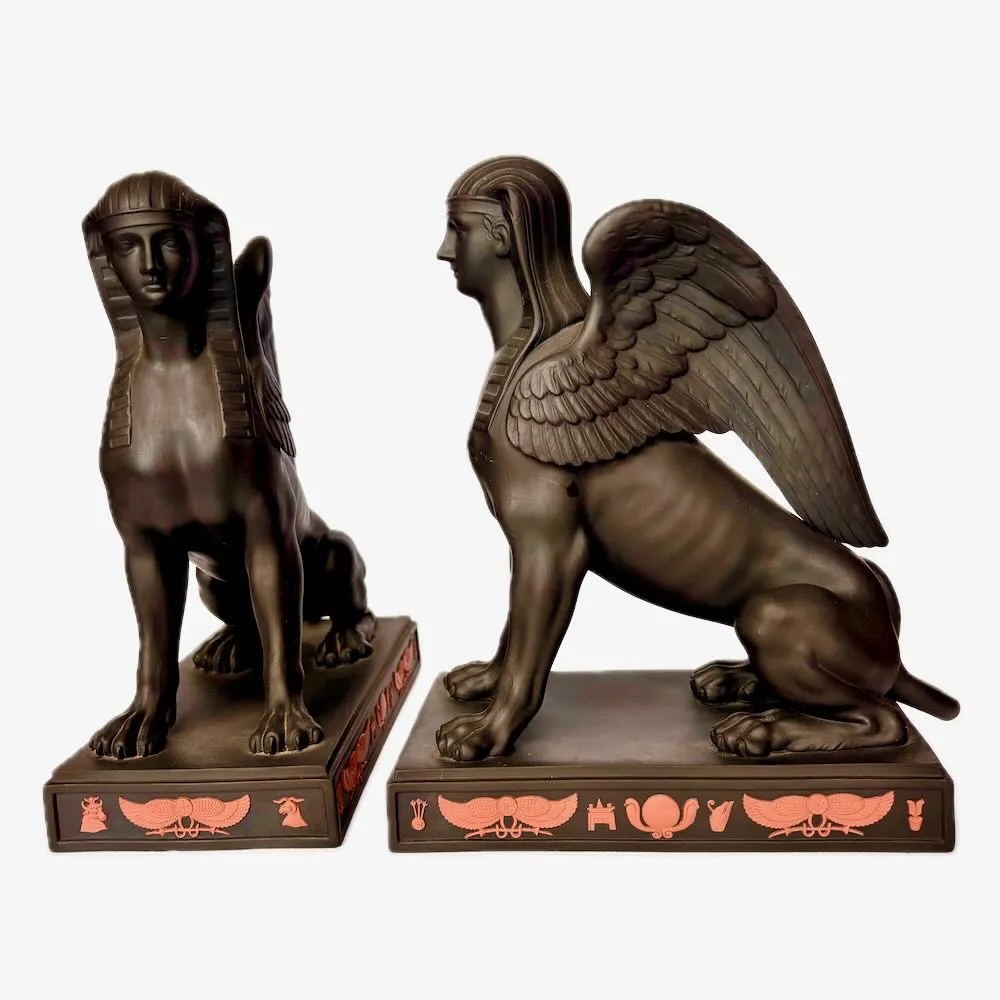
- Tripod and monopodia forms supported by sphinx figures
- Ornamental pieces combining classical symmetry with Egyptian symbolism
These designs did not abandon neoclassicism. Instead, they blended Egyptian elements into the existing design language of the Regency period. The result feels balanced rather than exotic for its own sake.
Materials That Defined the Early Egyptian Revival
The early 19th-century pieces rely heavily on contrast. That contrast comes from both color and texture.
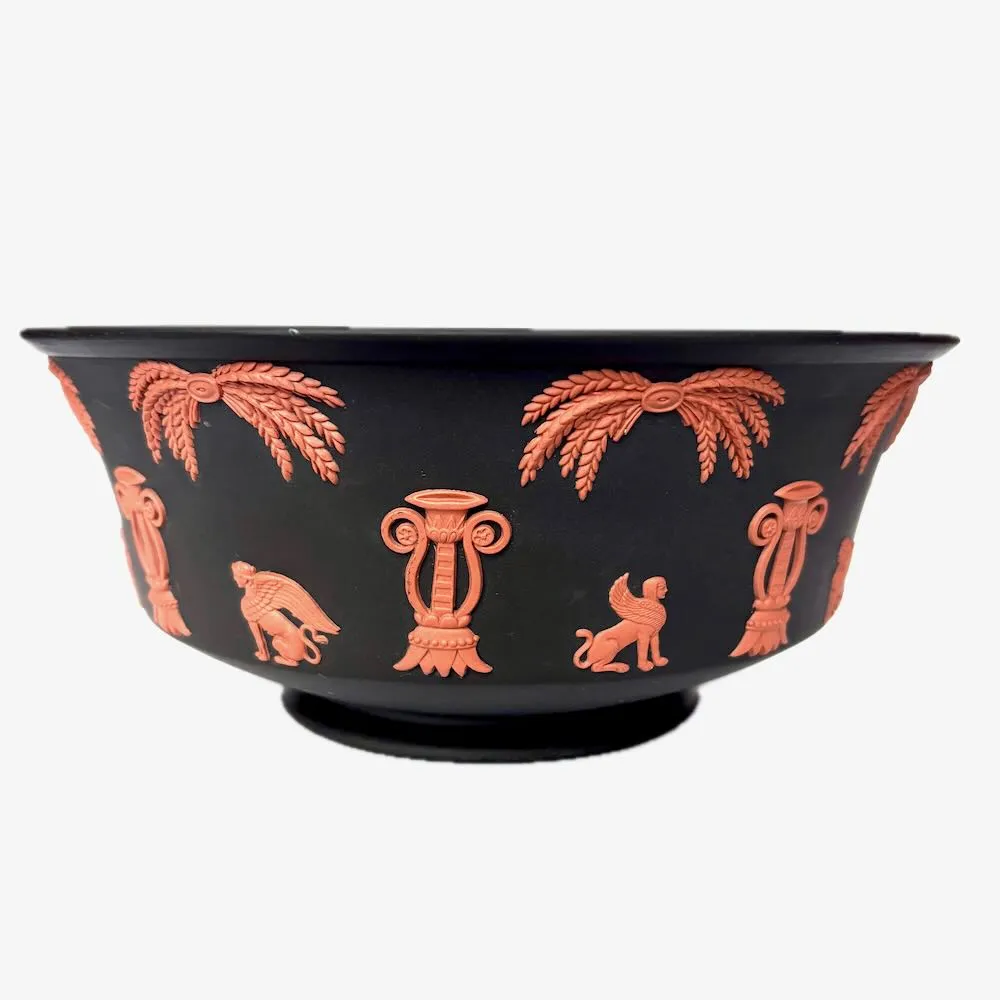
Rosso antico and black basalt work together to create a striking visual effect. The red body draws attention, while the black ornament adds depth and definition. This combination appears again and again in Egyptian-themed wares from this period.
Black basalt also stands on its own. Its matte surface and fine-grained density give sculptural forms a sense of weight and permanence. Sphinx figures, animal forms, and architectural supports benefit from that material because it emphasizes shape rather than surface decoration.
Jasperware plays a smaller role in this early wave, but it still contributes where symbolic detail matters. Relief decoration allows for controlled repetition of motifs such as borders, figures, and stylized hieroglyphic elements.
What Makes Early Egyptian Pieces Distinctive
When you handle an early Egyptian Revival piece, several qualities tend to stand out immediately:
- The modeling feels crisp and deliberate
- The forms often combine utility and ornament
- The decoration integrates into the structure rather than sitting on top of it
- The materials carry strong visual contrast
A teapot might include a crocodile finial, but the overall shape remains refined. A candlestick might rest on sphinx figures, yet the proportions still follow classical design principles.
This balance explains why these pieces continue to appeal to collectors. They feel imaginative, but they never lose discipline.
The 1920s Moment: Influence Without a Defined Campaign
The discovery of Tutankhamun’s tomb in 1922 triggered another wave of fascination with ancient Egypt. Egyptian motifs appeared across architecture, fashion, and decorative arts.
Wedgwood operated within that broader cultural environment, but the company did not produce a clearly defined Egyptian campaign during this period in the same way it did earlier or later. Instead, Egyptian influence blended into the wider design landscape of the time.
This distinction matters. It prevents over-attribution. Not every Egyptian-style Wedgwood piece belongs to a formal production wave. Some reflect general design trends rather than a focused program.
The Second Major Wave: The 1970s Egyptian Collection
The next significant moment arrived in the late 1970s. Renewed global interest in ancient Egypt—driven by major exhibitions and cultural attention—created the conditions for a new Wedgwood response.
This time, the company approached the subject differently.
Instead of integrating Egyptian motifs into everyday wares, Wedgwood created a defined Egyptian Collection aimed at collectors. The focus shifted from functional objects to display pieces and limited editions.
You see that shift clearly in the types of objects produced:
- Canopic jars with symbolic decoration
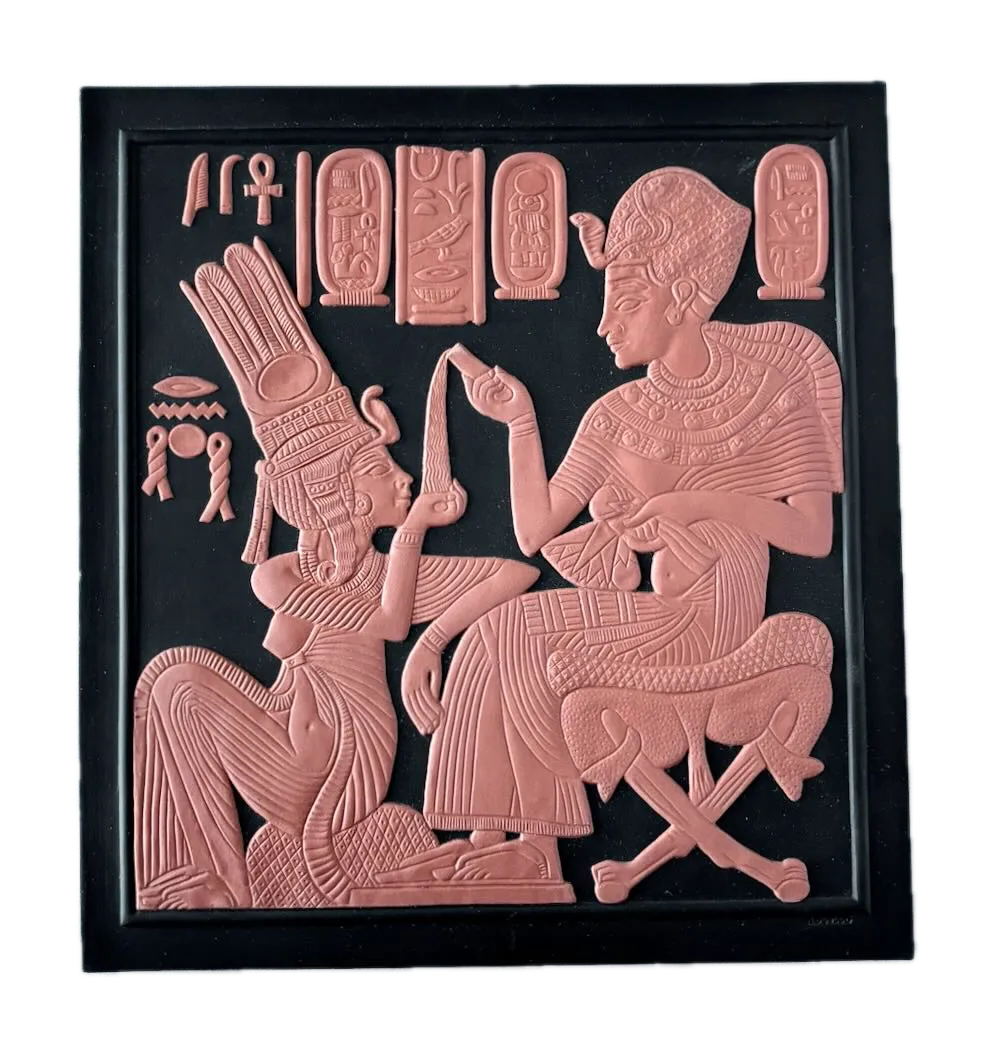
- Plaques featuring Egyptian figures and scenes
- Sphinx figures in black basalt
- Trinket boxes, pendants, and decorative items
- Jasperware pieces in black, terracotta, and primrose colorways
These pieces emphasize presentation. They often include strong contrasts, controlled relief decoration, and, in some cases, gilded accents. A primary source for the 1970s revival is the original Wedgwood Egyptian Collection brochure (1978), which outlines the materials, forms, and structure of the series.
How the 1970s Pieces Differ from Early Work
The differences between early 19th-century Egyptian Revival and the 1970s collection become clear once you compare them directly.
Early pieces feel integrated into their time. They serve practical purposes while carrying decorative meaning. Materials such as rosso antico and black basalt support the design in a subtle but powerful way.
The 1970s pieces take a more direct approach. They highlight contrast, symbolism, and collectibility. Reliefs appear thicker and more uniform. Forms shift toward display rather than use. Limited editions, certificates, and presentation become part of the appeal.
Neither approach is better. They simply reflect different goals.
A Practical Way to Identify the Period
When you pick up a Wedgwood Egyptian piece, you can narrow down its period quickly by focusing on a few key observations.
Start with the material:
- Rosso antico combined with black basalt usually points to early 19th-century production
- Black basalt with gilding or strong terracotta contrast often suggests later production
- Jasperware with Egyptian motifs tends to align more with the 20th-century revival
Then consider the form:
- Functional wares such as teapots and sugar bowls typically belong to the earlier wave
- Plaques, pendants, and commemorative-style objects fit more naturally into the 1970s collection
Finally, look at the overall feel of the piece. Early work shows more variation and hand-driven detail. Later pieces tend toward consistency and uniformity.
Each of these observations reinforces the others. Together, they allow you to place a piece within a realistic timeframe without relying on marks alone.
Why Collectors Value Egyptian Revival Wedgwood
Egyptian Revival pieces attract collectors for several reasons.
First, the visual impact is immediate. Sphinxes, hieroglyphic bands, and symbolic figures create a stronger presence than many classical designs. These pieces stand out in a collection.
Second, the materials offer something different from standard Wedgwood production. Black basalt and rosso antico provide depth and contrast that blue jasperware does not.
Third, the subject connects to a broader cultural story. Egyptian Revival ties Wedgwood to moments of discovery, exploration, and global fascination. That historical connection adds another layer of interest.
Finally, the 1970s collection introduces the appeal of limited production and presentation. Boxes, certificates, and edition numbers create a different type of collectibility that continues to attract buyers.
Final Thoughts
Wedgwood’s Egyptian Revival wares show how effectively the company responded to changing cultural interests. The early 19th-century pieces capture the excitement of first encounters with ancient Egypt, expressed through bold materials and refined forms. The 1970s collection reflects a later moment, when history itself became something to collect and display.
For collectors, this makes Egyptian Revival one of the most rewarding areas to study. It combines strong visual identity, material innovation, and historical depth. Once you understand the two major waves and the materials behind them, identifying and appreciating these pieces becomes far more intuitive.
See Wedgwood Egyptian items for Sale in our Antique Store