

This original Wedgwood brochure for the Egyptian Collection offers a rare primary source view of how the company presented the series at the time of its release. Many modern descriptions rely on secondary market interpretations, but this document uses Wedgwood’s own language, structure, and categorization of the collection.
Most importantly, it clearly distinguishes between hand-gilded black basalt pieces and the Jasper Collection in terra cotta on black or primrose jasper—a distinction that collectors and sellers often misunderstand or describe incorrectly in contemporary listings.
Presented below is a faithful transcription of the original brochure, accompanied by images of the document for reference.
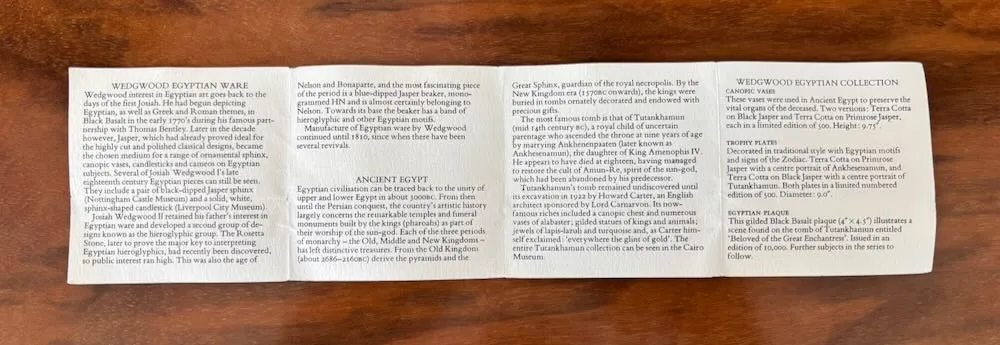
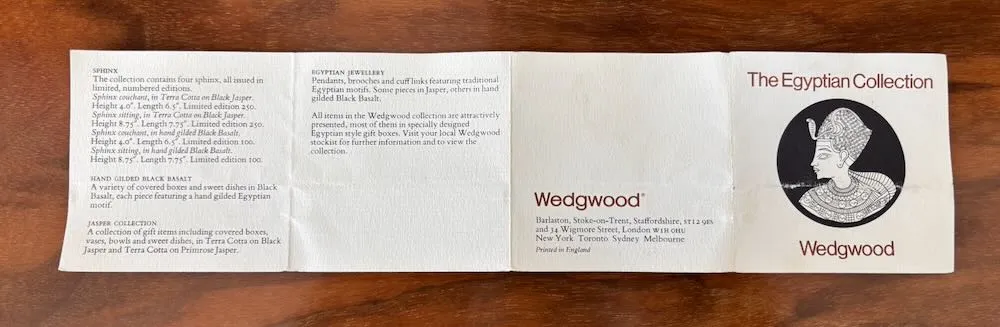
Wedgwood introduced the Egyptian Collection in 1978 during a renewed global fascination with ancient Egypt. This brochure outlines the structure of the collection, including its material distinctions, limited editions, and thematic groupings.
WEDGWOOD EGYPTIAN COLLECTION
Wegwood Egyptian Ware
Wedgwood interest in Egyptian art goes back to the days of the first Josiah. He had begun depicting Egyptian, as well as Greek and Roman themes, in Black Basalt in the early 1770s during his famous friendship with Thomas Bentley. Later in the decade however, Jasper, which had already proved ideal for the highly cut and polished classical designs, became the chosen medium for a range of ornamental sphinx, canopic vases, candlesticks and cameos on Egyptian subjects. Several of Josiah Wedgwood I’s late eighteenth century Egyptian pieces can still be seen. They include a pair of black-dipped Jasper sphinx (Nottingham Castle Museum) and a solid white, sphinx-shaped candlestick (Liverpool City Museum).
Josiah Wedgwood II retained his father’s interest in Egyptian ware and developed a second group of designs known as the hieroglyphic group. The Rosetta Stone, later to prove the major key to interpreting Egyptian hieroglyphics, had recently been discovered, so public interest ran high. This was also the age of Nelson and Bonaparte, and the most fascinating piece of the period is a blue-dipped Jasper beaker, monogrammed HN and is almost certainly belonging to Nelson. Towards its base the beaker has a band of hieroglyphics and other Egyptian motifs.
Manufacture of Egyptian ware by Wedgwood continued until 1810, since when there have been several revivals.
Ancient Egypt
Egyptian civilization can be traced back to the unity of upper and lower Egypt in about 3000 BC. From then until the Persian conquest, the country’s artistic history largely concerns the remarkable temples and funeral monuments built by the kings (pharaohs) as part of their worship of the sun-god. Each of the three periods of monrarchy – the Old, Middle and New Kingdoms – has left distinctive treasures. From the Old Kingdom (about 2686–2160 BC) derive the pyramids and the Great Sphinx, guardian of the royal necropolis. By the New Kingdom era (1570 BC onwards), the king were buried in tombs ornately decorated and endowed with precious gifts.
The most famous tomb is that of Tutankhamun (mid 14th century BC), a royal child of uncertain parentage who ascended the throne at nine years of age by marryingAnkhenenpaaten (later known as Ankhesenamun), the daughter of King Amenophis IV. He appears to have died at eighteen, having managed to restore the cult of Amun-Re, spirit if the sun-god which had been abandoned by his predecessor.
Tutankhamun’s tomb remained undiscovered until its excavation in 1922 by Howard Carter, and English architect sponsored by Lord Cranarvon. It now famous riches included a canpic chest and numerous vases of alabaster; gilded statues of kings and animals; jewels of lapis-lazuli and turquoise and, as Carter himself exclaimed: ‘ everywhere the glint of gold’. The entire Tutankhamun collection can be seen in the Cairo Museum.
Wedgwood Egyptian Collection
Canopic Vases
These vases were used in Ancient Egypt to preserve the vital organs of the deceased. Two version: Terra Cotta on Black Jasper and Terra Cotta on Primrose Jasper each in a limited edition of 500. Height: 9.75″.
Trophy Plates
Decorated in traditional style with Egyptian motifs and signs of the Zodiac. Terra Cotta on Primrose Jasper with a centre portrait of Ankhesenamun, and Terra Cotta on Black Jasper with centre portrait of Tutankhamun. Both Plates in a limited numbered edition of 500. Diameter: 9.0″.
Egyptian Plaque
This gilded Black Basalt plaque (4” × 4.5”) illustrates a scene found on the tomb of Tutankhamun entitled “Beloved of the Great Enchantress.” Issued in an edition of 10,000. Further subjects in the series to follow.
Sphinx
The collection contains four sphinx, all issued in limited, numbered editions.
- Sphinx couchant, in Terra Cotta on Black Jasper, Height 4.0”, Length 6.5”. Limited edition 250.
- Sphinx sitting, in Terra Cotta on Black Jasper, Height 8.75”, Length 7.75”. Limited edition 250.
- Sphinx couchant, in hand gilded Black Basalt, Height 4.0”, Length 6.5”. Limited edition 100.
- Sphinx sitting, in hand gilded Black Basalt, Height 8.75”, Length 7.75”. Limited edition 100.
Hand Gilded Black Basalt
A variety of covered boxes and sweet dishes in Black Basalt, each piece featuring a hand gilded Egyptian motif.
Jasper Collection
A collection of gift items including covered boxes, vases, bowls and sweet dishes, in Terra Cotta on Black Jasper and Terra Cotta on Primrose Jasper.
Egyptian Jewelry
Pendants, brooches and cuff links featuring traditional Egyptian motifs. Some pieces in Jasper, others in hand gilded Black Basalt.
All items in the Wedgwood collections are attractively presented, most of them in specially designed Egyptian style gift boxes. Visit your local Wedgwood stockist for further information and to view the collection.
WEDGWOOD
Barlaston, Stoke-on-Trent, Staffordshire ST12 9ES
and 34 Wigmore Street, London W1H 0HU
New York • Toronto • Sydney • Melbourne
Printed in England
Closing Insights: Understanding the Wedgwood Egyptian Collection
This original Wedgwood brochure offers more than period marketing. It gives a clear framework for understanding how Wedgwood conceived and categorized the Egyptian Collection.
One of the most important takeaways is the intentional distinction between materials. Wedgwood separates the collection into two principal groups: hand-gilded pieces in black basalt and the Jasper Collection in terra cotta relief on black or primrose jasper. Collectors and sellers often misunderstand or misidentify these categories in modern listings. This makes the distinction especially important.
The brochure also shows that Wedgwood structured the collection carefully. It did not assemble it loosely. The company organized items into defined categories. These include covered boxes, plaques, sphinx figures, jewelry, and tableware. Wedgwood issued many of these pieces in limited, numbered editions. This structure reinforces the idea that Wedgwood designed the Egyptian Collection as a coordinated series. It reflects both artistic intent and collectible value.
Wedgwood also connects the designs directly to documented Egyptian sources. Many draw from imagery found in the tomb of Tutankhamun. The company did not rely on generic “Egyptian-style” decoration. Instead, it used specific historical references. It then translated them through its established ceramic traditions in basalt and jasper.
For today’s collector, this document provides a valuable reference point. It clarifies materials and confirms original design intent. It also preserves context that often disappears over time. When collectors study it alongside surviving pieces, they can better distinguish between accurate descriptions and assumptions. This leads to a more confident and informed approach to collecting Wedgwood’s Egyptian revival works.