
Description
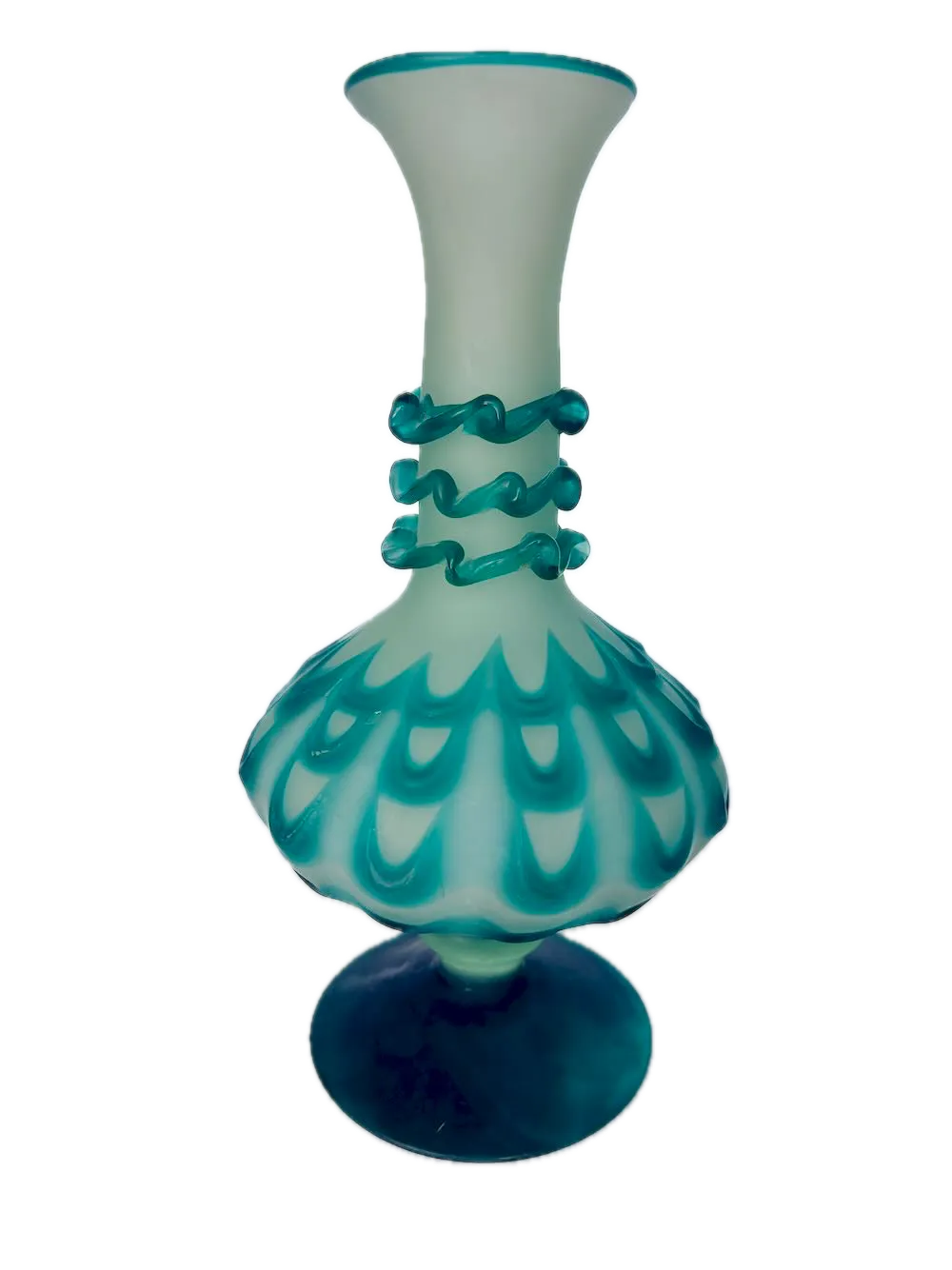
Persian Acid-Etched Glass Vase with Rigaree Neck, Hand-Blown Teal Green Form, 30 cm, 20th Century Revival of Classical Techniques
This is a substantial Persian hand-blown acid-etched glass vase, acquired in Tehran, and rooted in a long tradition of glassmaking that extends back centuries. Pieces like this were not designed as decorative novelties. They reflect a continuation of workshop practices that persisted well into the 20th century, where artisans worked with inherited techniques rather than reinventing them.
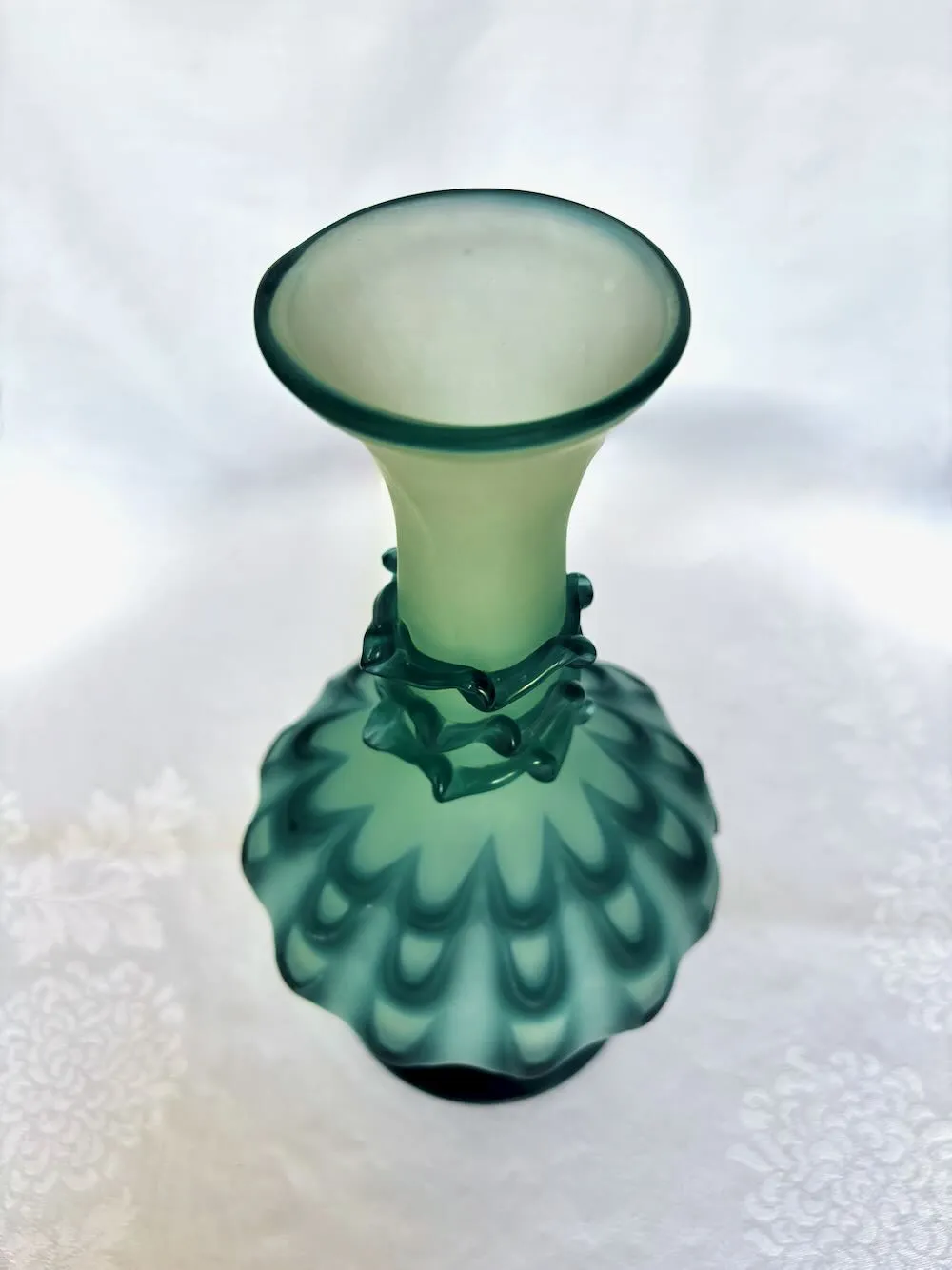
The form immediately establishes its presence. At 30 cm in height, the vase has scale and proportion, with a wide body that rises into a narrower neck finished with applied trailing. The surface carries a soft, satin quality created through acid treatment, diffusing light rather than reflecting it. The result is not brilliance but atmosphere—color held within the glass rather than sitting on its surface.
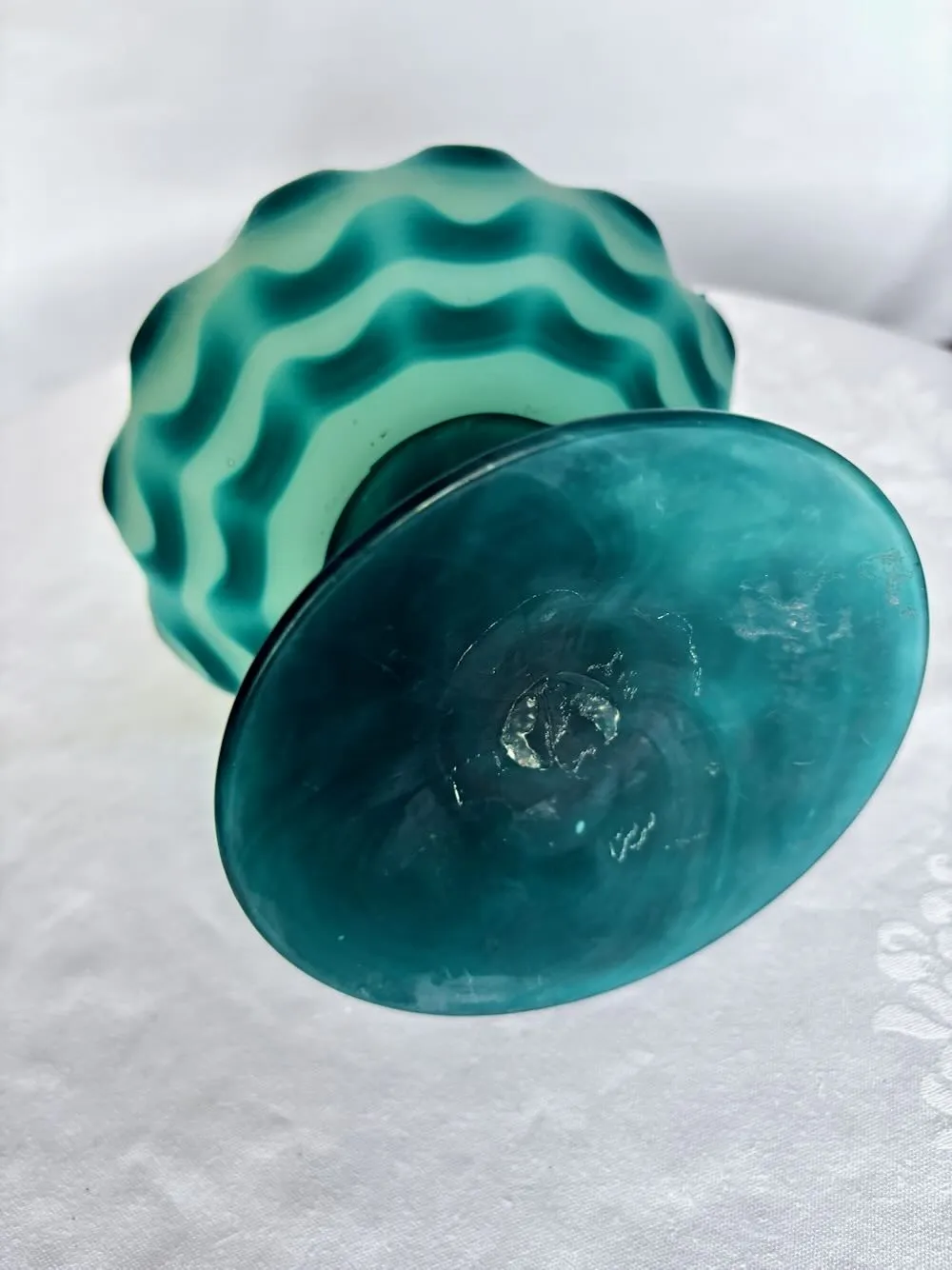
The base shows a pontil mark, clear evidence of hand-blown production. This detail alone separates it from industrial glass. It confirms that the piece was shaped, detached, and finished by hand rather than molded in a factory setting.
Form and Surface
The silhouette is controlled and balanced. The broad lower body provides weight and stability, while the neck narrows just enough to guide the eye upward. Three applied rings encircle the neck—what is often referred to as rigaree—a decorative technique formed by trailing molten glass onto the surface while rotating the vessel.
These rings are not purely ornamental. They signal the hand of the maker. Each line carries slight variation, reinforcing that the piece was formed in motion, not stamped into uniformity.
The surface treatment transforms the character of the glass. Acid-etching removes the sharp reflectivity of polished glass and replaces it with a matte, almost velvety finish. Light disperses across the surface, softening the strong teal tone into something more nuanced and atmospheric.
A Continuity of Persian Glassmaking
Glassmaking in Persia has a long and layered history, evolving from early formed objects into fully developed glassblown vessels by the Parthian period. By the time of the Sasanian era, artisans had refined techniques that balanced form, transparency, and surface treatment—prioritizing control rather than excess.
That philosophy continued. Later Persian glass often favored subtlety over heavy decoration. Instead of relying on elaborate cutting or applied ornament, makers worked with the inherent qualities of glass—its thickness, its color, and the way it interacts with light.
This vase reflects that continuity. The applied trailing, the blown form, and the surface finish all connect to methods that have remained in use across generations. Even in the 20th century, workshops in cities such as Tehran, Shiraz, and elsewhere continued to produce glass using these traditional approaches, often working with recycled material and hand tools rather than industrial systems.
Material and Craft
The glass itself carries a deep teal tone, often associated with Persian glass traditions. Unlike flashed or surface-colored glass, this color is integral to the material. It is present throughout the body, not applied afterward.
The construction follows a traditional sequence. The gather forms at the end of the blowpipe, is expanded into shape, and then worked through rotation, heat, and tool shaping. Additional elements, such as the neck rings, are applied separately and fused into the surface. The pontil attachment and removal complete the process, leaving a visible mark at the base.
Nothing about this process is accidental. Every stage requires timing, control, and experience.
Presence and Use
While originally intended as a functional vessel, the vase operates equally well as a display object. Its scale allows it to stand alone. The surface treatment gives it a quiet presence that changes with light throughout the day.
It does not rely on intricate decoration to hold attention. Instead, it draws interest through form, proportion, and surface.
Condition
The vase is in good vintage condition. The surface retains its consistent satin finish. The form remains clean and intact. Minor variations and irregularities are consistent with hand-blown production and should be understood as part of the making process rather than defects.