

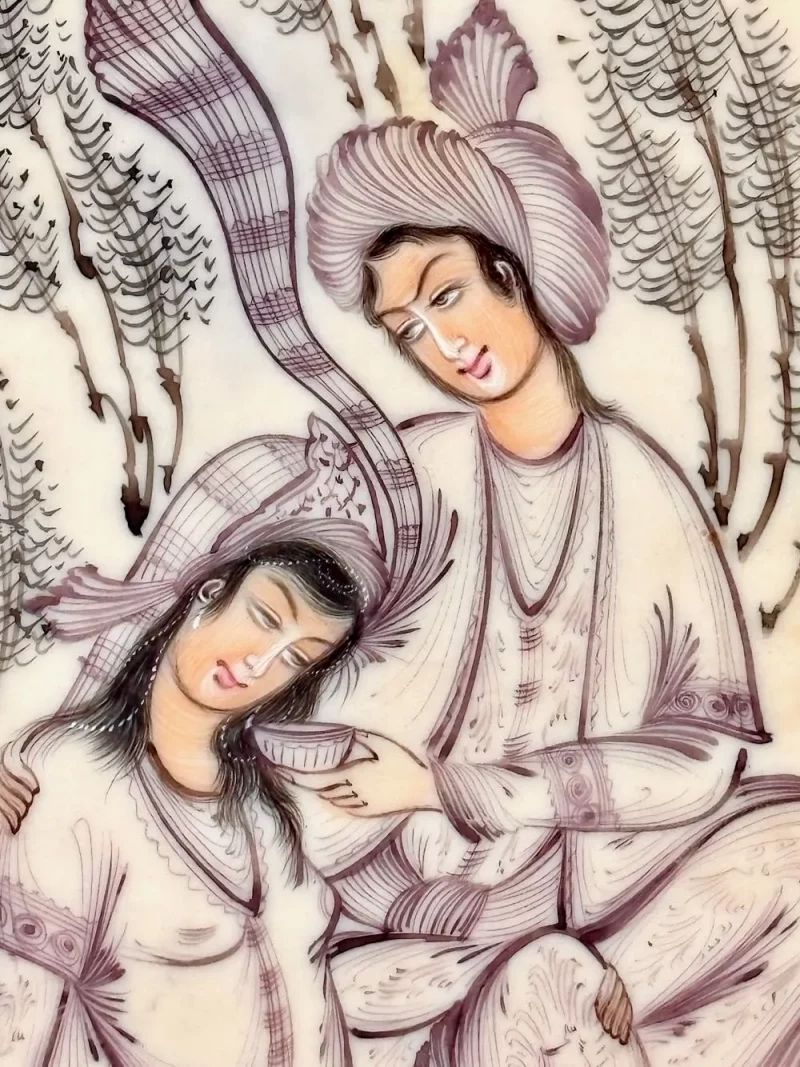
Siyah-Qalam or Qalam-i-siyah and Nim-Rang: Persian miniature painting is often celebrated for its brilliant color, elaborate ornament, and richly detailed storytelling. Yet some of the most refined and poetic Persian paintings rely on restraint rather than abundance. Instead of dense color and gilded backgrounds, these works depend on flowing lines, delicate shading, and carefully controlled highlights. The result feels intimate, lyrical, and deeply expressive.
Among the most elegant examples are paintings created in the traditions known as Siyah-Qalam and Nim-Rang. These techniques allowed Persian artists to create atmosphere, emotion, and extraordinary refinement while using surprisingly little color. Through graceful line work and selective illumination, painters transformed simplicity into sophistication.
Even today, these styles continue to fascinate collectors, historians, and artists because they reveal another side of Persian miniature painting. They demonstrate that Persian art was not only decorative and colorful. It could also be restrained, contemplative, and remarkably modern in appearance.
What Does Siyah-Qalam Mean?
The Persian term Siyah-Qalam literally translates as “black pen” or “black brush.” The name refers to paintings and drawings created primarily through line work rather than full polychrome painting. Artists built forms using ink, fine brush strokes, and subtle tonal variation instead of broad areas of color.
Although the term often refers to monochromatic works, Persian artists rarely relied on harsh black alone. Many painters softened their compositions with deep brown, sepia, aubergine, or plum-colored tones. These warmer shades created a gentler and more poetic effect than stark black ink.
In a traditional Persian miniature, color often defines garments, landscapes, architecture, and decorative details. In Siyah-Qalam painting, however, the line itself becomes the principal artistic language. Artists used contour, shading, and rhythm to create movement, volume, and emotional expression. The effect can feel surprisingly contemporary even centuries later.
Nim-Rang and the Beauty of Restraint
Closely related to Siyah-Qalam is the technique known as Nim-Rang, meaning “half-color.” In these works artists introduced selective touches of color while leaving much of the composition dependent on line and tonal shading. Faces, hands, jewelry, or portions of clothing might receive delicate color application while the surrounding forms remain monochromatic. Gold highlights sometimes appear sparingly to enhance elegance without overwhelming the composition.
This restraint serves an important artistic purpose. By limiting color, Persian painters directed the viewer’s attention toward expression, gesture, and atmosphere. The emotional connection between figures became more important than decorative excess. Many Nim-Rang paintings possess a quiet intimacy rarely found in more densely ornamented court miniatures.
The Influence of the Safavid Masters
The roots of these refined techniques reach deeply into the Safavid period, especially the celebrated Isfahan School of the seventeenth century. During this era Persian artists developed increasingly lyrical and elegant compositions. Instead of crowded battle scenes or highly complex narratives, painters often focused on single figures, lovers, musicians, poets, or contemplative youths.
One of the most influential masters associated with this transformation was Reza Abbasi. His paintings emphasized graceful contour lines, elongated figures, flowing garments, and emotional subtlety. Empty space became as important as ornament. Later Persian artists repeatedly returned to these ideals.
Throughout the late Qajar and Pahlavi periods, many Iranian studios revived Safavid aesthetics in decorative paintings intended for collectors, interiors, and export markets. Mid-century Persian miniature workshops in Tehran and Isfahan frequently created works inspired by Reza Abbasi and earlier Safavid painting traditions. These later paintings preserved the spirit of classical Persian art while adapting it for a modern audience.
Black Paper and the Illusion of Light
Some twentieth-century Persian miniature artists took Siyah-Qalam and Nim-Rang even further by working on black or dark-colored paper. This dramatic surface transformed the visual language of the painting. Instead of building shadows on a pale background, the artist created illumination out of darkness itself. White line work, gold highlights, and soft pastel colors emerged from the black ground almost like candlelight in the night.
This approach created extraordinary visual contrast. It also enhanced the poetic atmosphere already associated with Persian miniature painting. The effect resembles illuminated manuscripts, lacquer painting, and theatrical stage lighting all at once. Delicate details seem to float across the dark surface with remarkable elegance.
These paintings often depict:
- courtly lovers
- musicians
- dancers
- poets
- attendants
- romantic garden scenes
The limited palette encourages viewers to focus on movement, posture, and expression rather than visual spectacle alone.
Why Persian Artists Valued Line So Highly
In Persian miniature painting, line was never simply an outline. It carried emotional and symbolic importance. A skilled artist could communicate softness, movement, youth, nobility, or melancholy through subtle variations in brush pressure and rhythm.
Persian painters trained extensively to master:
- fluid contour drawing
- balanced composition
- proportional harmony
- controlled brush movement
- expressive gesture
Even the folds of garments became opportunities for artistic expression. Because many miniatures were intended for close personal viewing, artists understood that collectors and patrons would examine every detail carefully. Precision mattered enormously. Fine line work demonstrated mastery, discipline, and refinement. This explains why some Persian paintings remain visually powerful despite using very little color. The beauty lies in the confidence and elegance of the drawing itself.
Materials and Technique
Traditional Persian miniature painters used extraordinarily fine brushes, sometimes crafted from very soft animal hair capable of producing incredibly delicate lines. Artists prepared pigments carefully and often mixed their own colors using natural minerals, soot, gold, and plant-based materials.
In Siyah-Qalam works, painters relied heavily on:
- diluted ink washes
- layered contour lines
- tonal shading
- delicate stippling
- selective highlights
In Nim-Rang paintings, color appeared strategically rather than uniformly. Small touches of pink, turquoise, gold, green, or blue created focal points within otherwise restrained compositions. By the twentieth century, artists working in revival studios often combined traditional methods with modern materials and commercial painting surfaces. Nevertheless, the visual language remained strongly connected to earlier Persian artistic traditions.
Persian Miniature Painting Beyond Manuscripts
Many people associate Persian miniatures exclusively with manuscript pages. While manuscripts played a central role historically, Persian miniature painting evolved far beyond books alone.
By the nineteenth and twentieth centuries artists produced:
- framed cabinet pictures
- decorative panels
- lacquer objects
- album paintings
- miniature portraits
- paintings for collectors and tourists
These works preserved the aesthetics of classical Persian painting while adapting them to changing tastes and markets. Siyah-Qalam and Nim-Rang techniques proved especially effective in this context because they translated beautifully into decorative interior art. Their elegant simplicity suited both traditional and modern settings.
Why These Paintings Still Feel Modern
One reason these paintings continue to attract attention today is their remarkable visual balance. Modern viewers often respond strongly to:
- negative space
- restrained palettes
- graphic line work
- minimalism
- elegant composition
Persian artists mastered these ideas centuries before modern design movements popularized them in Europe and America. A refined Siyah-Qalam painting can feel simultaneously ancient and contemporary. Its simplicity allows the eye to rest while still rewarding close examination. This balance between detail and restraint gives the style enduring appeal.
The Lasting Legacy of Siyah-Qalam and Nim-Rang
The traditions of Siyah-Qalam and Nim-Rang reveal the extraordinary versatility of Persian miniature painting. Persian artists did not depend solely on brilliant color or lavish decoration to create beauty. Through line, gesture, and carefully controlled shading, they achieved emotional depth and poetic elegance with remarkable economy. These paintings remind viewers that Persian art has always embraced refinement, subtlety, and intellectual sophistication. Even the quietest compositions carry movement, atmosphere, and emotion.
Today collectors continue to admire these works not only for their craftsmanship but also for their timeless visual language. Whether created during the Safavid period or revived in twentieth-century Iranian studios, they preserve a tradition where line itself becomes poetry.