

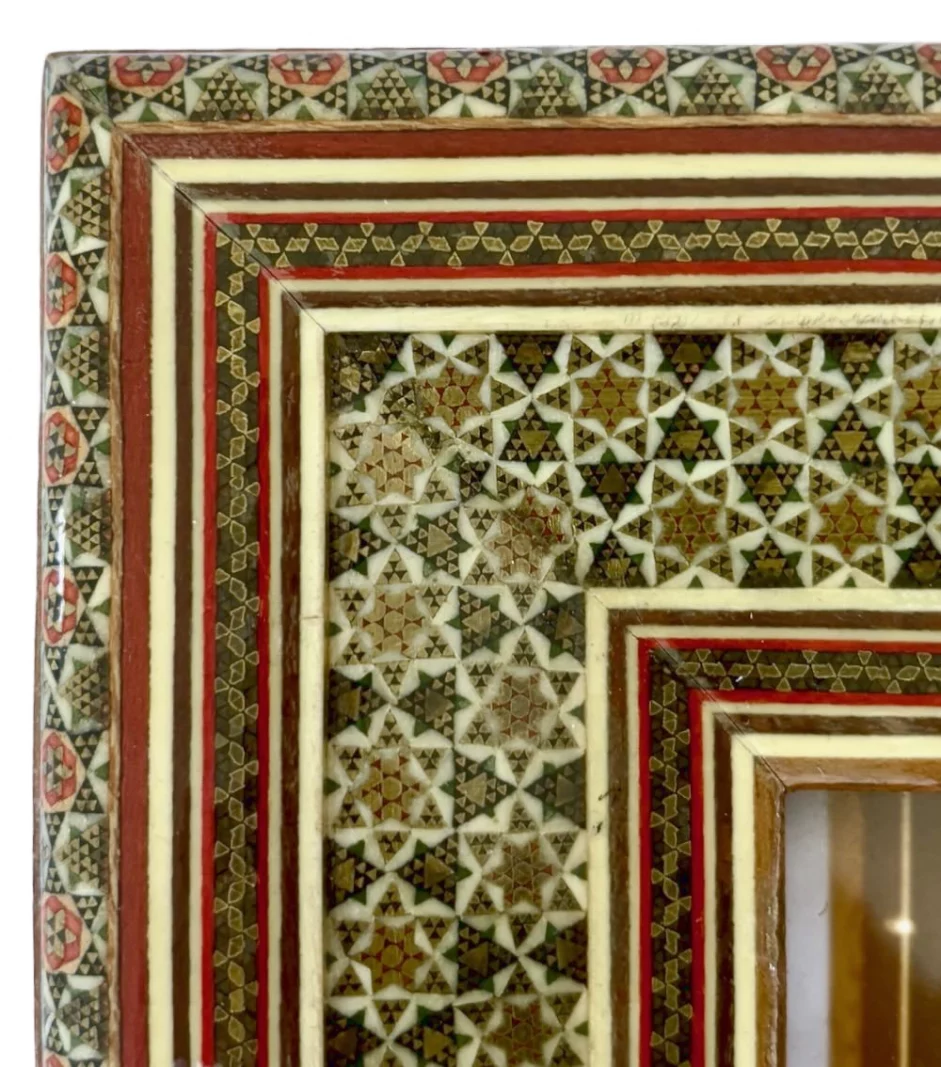
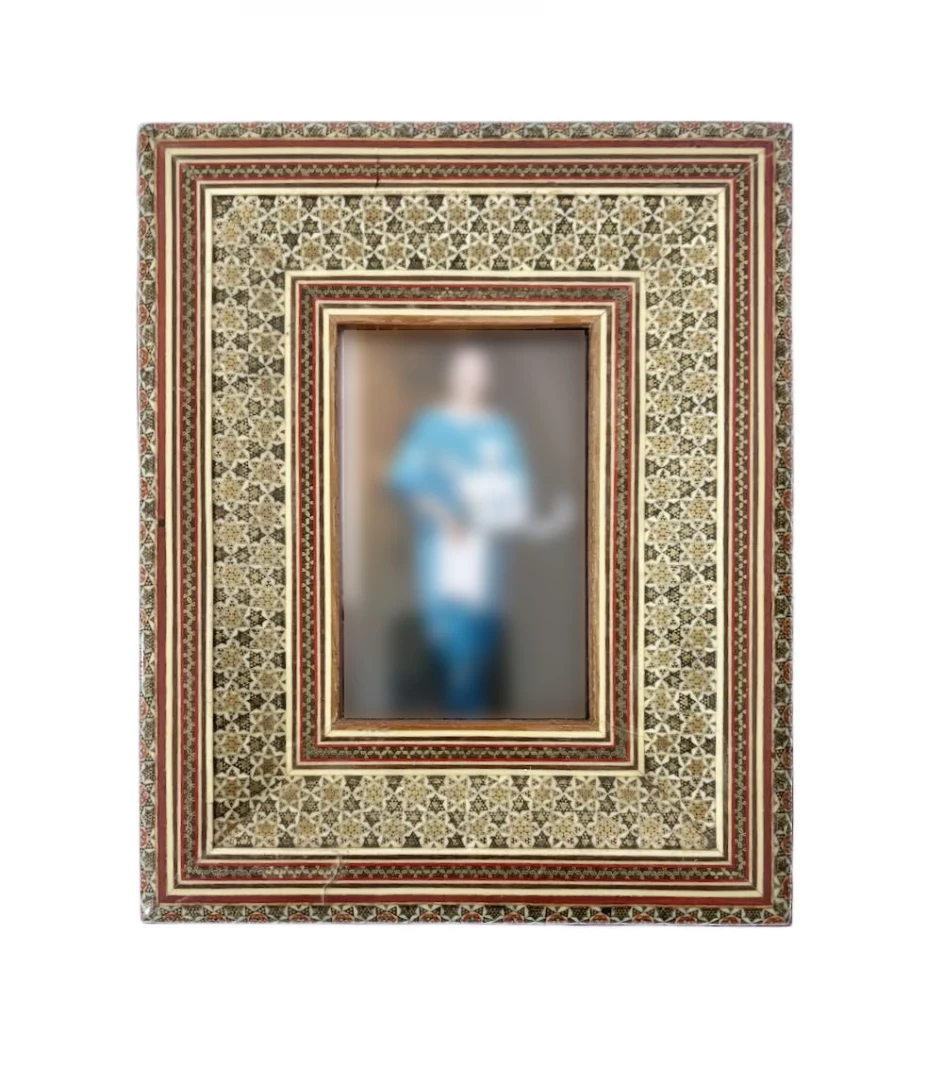
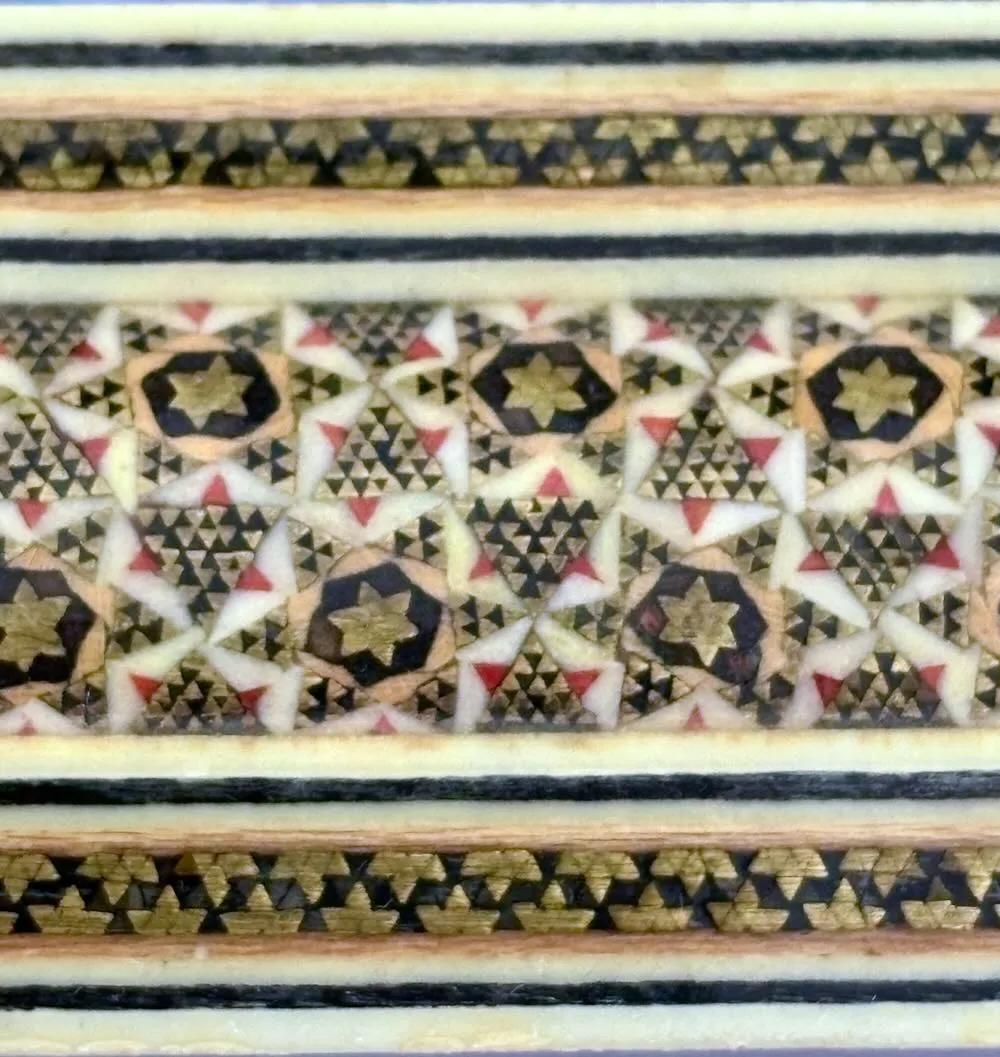
Khatam-kari is one of the most intricate and admired decorative arts of Persia. At first glance, the surface may appear almost printed because the geometric patterns look impossibly precise. However, every star, polygon, and repeating form comes from countless tiny pieces of wood, bone, metal, and ivory carefully assembled by hand. The closer you look, the more astonishing the craftsmanship becomes.
For centuries, Persian artisans transformed simple materials into dazzling geometric surfaces that covered boxes, frames, musical instruments, furniture, palace doors, and even entire rooms. In Iran, people often describe fine khatam-kari as an art of patience because the work demands extraordinary precision, discipline, and mathematical understanding. A single mistake can interrupt the harmony of the entire pattern.
Today, collectors around the world admire antique and vintage khatam-kari for its beauty, complexity, and strong connection to Persian artistic traditions. Although many people casually describe it as marquetry or inlay work, khatam-kari possesses its own distinct identity, history, and technical language.
What Does Khatam-Kari Mean?
The word khatam carries several meanings in Persian culture. In artistic terminology, it refers to the refined geometric mosaic technique itself. The artisan who creates the work is known as a khatam-kar, while the workshop where the pieces are produced is called a khatam-sazi. Some scholars connect the word khatam with perfection or completion. This interpretation feels appropriate because Persian craftsmen long considered khatam-kari the pinnacle of geometric decorative arts. Fine examples reveal astonishing harmony between mathematics, craftsmanship, architecture, and design.
Unlike ordinary marquetry, which often uses larger pieces of veneer arranged into pictorial scenes, khatam-kari depends on microscopic repeating geometric units. Tiny triangles, stars, hexagons, and polygons interlock so precisely that the surface begins to shimmer visually from a distance.
The Origins of Khatam-Kari
The exact origins of khatam-kari remain debated. Some historians connect the technique to Central Asia and China, while others believe Persia developed the most advanced and refined version independently during the medieval period. What scholars generally agree upon is that Persian craftsmen elevated the art to an extraordinary level during the Timurid and Safavid eras.
By the fourteenth and fifteenth centuries, Persian artisans already used highly sophisticated geometric wood decoration in architecture and luxury objects. Cities such as Shiraz and Isfahan became major artistic centers where master craftsmen refined the technique across generations.
Safavid Persia especially encouraged artistic excellence. Royal courts commissioned lavish decorative arts for palaces, mosques, manuscripts, and ceremonial objects. During this period, khatam-kari flourished alongside miniature painting, tilework, calligraphy, and metalwork. The same love of geometry seen in Persian architecture appeared in miniature form within khatam surfaces. Over time, workshops developed family traditions that passed knowledge from master to apprentice through generations. Some renowned khatam families in Shiraz and Isfahan continued these traditions well into the twentieth century.
Why Khatam-Kari Looks So Extraordinary
The visual impact of khatam-kari comes from repetition, symmetry, and scale. Fine examples contain astonishing numbers of tiny components assembled with almost mathematical perfection.
Artisans traditionally used materials such as:
- Ebony and dark hardwoods
- Boxwood and jujube wood
- Camel bone or ivory
- Brass, silver, or gold wire
- Colored woods and dyed materials
- Mother-of-pearl in luxury examples
The artist cuts these materials into thin rods and triangular strips. Next, the pieces are bundled together into geometric units and glued into long composite forms. Afterward, the craftsman slices extremely thin sections from these bundles and applies them to wooden surfaces. This process means the pattern does not simply sit on the surface like paint. Instead, the geometric structure exists within the material itself.
High-quality khatam-kari displays several important characteristics. The surface should feel smooth and even. Patterns should align precisely without gaps or distortion. Tiny geometric units should remain crisp and symmetrical. In general, the finer and smaller the repeating elements become, the more difficult and valuable the work is. Some master craftsmen reportedly incorporated more than 200 miniature pieces within a single square centimeter.
Khatam-Kari in Persian Architecture
Although many collectors encounter khatam-kari on decorative boxes or frames, some of the greatest examples appear in Persian architecture. Palace interiors, doors, furniture, and ceremonial rooms sometimes featured breathtaking khatam surfaces covering entire walls. One of the most famous examples appears in the Marble Palace in Tehran. During the Pahlavi era, master craftsmen from Shiraz created an extraordinary khatam room for Reza Shah. The project required teams of artisans working for years to complete the walls, doors, furniture, and decorative surfaces.
Visitors often describe the room as overwhelming because nearly every surface glitters with geometric detail. Rather than appearing heavy or rigid, the repeating forms create rhythm and movement across the interior. Khatam also appeared in important mosques, royal palaces, and ceremonial buildings. Doors decorated with bone, silver, wood, and geometric mosaics transformed functional architectural elements into works of art.
Shiraz and Isfahan: Great Centers of Khatam
Shiraz and Isfahan became especially important centers for khatam-kari production. Each city contributed to the preservation and refinement of the craft. Shiraz developed a strong reputation for highly detailed geometric work and master family workshops. Many important khatam artists traced their artistic heritage through generations of Shirazi craftsmen.
Isfahan later became one of the leading production centers for decorative arts during the twentieth century. As tourism and collecting increased, artisans produced both museum-quality works and more affordable decorative objects for broader markets. Because of this long production history, collectors today encounter a wide range of quality levels. Some vintage pieces display extraordinary precision and rare materials, while others use coarser geometric patterns and simpler woods intended for decorative export markets.
Antique and Vintage Khatam-Kari
Collectors often notice major differences between antique, vintage, and contemporary khatam-kari. Older works frequently used natural materials such as camel bone, ivory, ebony, silver wire, and dense hardwoods. The surfaces often appear warmer and richer because the materials aged naturally over time.
Mid-century examples from Isfahan became especially popular among travelers and collectors during the 1950s through the 1970s. These pieces commonly included miniature paintings mounted within khatam frames. Scenes of polo players, royal feasts, lovers, hunting parties, musicians, and Persian gardens appeared frequently.
Not every vintage example represents museum-quality craftsmanship. However, even modest authentic pieces still preserve traditional Persian artistic techniques and design language. Slight yellowing, lacquer aging, and wear often add character rather than detract from authenticity. Collectors also encounter differences in geometric density. Fine khatam displays tiny, almost microscopic patterns with remarkable precision. Lower-grade examples use larger geometric forms that appear less refined and more repetitive.
Khatam-Kari and Persian Miniature Painting
Khatam-kari frequently appears alongside Persian miniature painting. Frames, boxes, pen cases, mirror surrounds, and decorative panels often combine the two arts beautifully. This pairing makes perfect artistic sense. Persian miniature painting celebrates flowing line, delicate detail, refined color, and poetic atmosphere. Khatam-kari contributes structure, geometry, rhythm, and visual framing. Together, they create a balance between precision and emotion.
Many mid-century Persian decorative pieces feature miniature paintings mounted within khatam borders. Even when the miniature itself remains relatively simple, the geometric frame elevates the presentation dramatically. Collectors especially appreciate examples where the khatam pattern complements the colors and rhythm of the painting rather than overwhelming it.
The Difference Between Fine and Coarse Khatam
Experienced collectors immediately recognize quality differences in khatam-kari. Fine work appears almost seamless because the geometric units remain tiny and perfectly aligned. The surface feels smooth, elegant, and visually balanced. Coarser work often reveals larger geometric shapes, uneven alignment, wider spacing, or rough lacquer finishes. These examples still possess decorative charm, but they lack the extraordinary refinement of master craftsmanship.
Several factors influence quality:
- Size of the geometric units
- Precision of alignment
- Smoothness of the surface
- Quality of materials
- Complexity of the pattern
- Consistency of color and symmetry
- Quality of finishing and lacquer
Because fine khatam requires immense labor, high-level examples remain expensive and highly collectible.
Why Collectors Love Khatam-Kari
Khatam-kari appeals to collectors for several reasons. First, the craftsmanship immediately captures attention. Many viewers struggle to believe the patterns were assembled entirely by hand. Second, khatam connects directly to broader Persian artistic traditions. The same geometric sophistication appears in Persian tilework, carpets, architecture, manuscript illumination, and metalwork.
Third, authentic vintage pieces carry historical atmosphere. Small imperfections, aging lacquer, softened surfaces, and worn edges often reveal decades of careful use and preservation. Finally, khatam-kari works beautifully in interiors. Whether displayed as a decorative box, frame, table, or architectural panel, the geometric surfaces create elegance without feeling visually heavy.
The Enduring Legacy of Khatam-Kari
Despite modernization and machine production, traditional khatam-kari still survives in Iran today. Workshops in Isfahan, Shiraz, and Tehran continue producing both traditional and contemporary works. The finest artisans preserve methods passed through generations. Even now, true master-level khatam demands patience, mathematical precision, and extraordinary hand skills that machines cannot fully replicate.
As collectors and historians continue exploring Persian decorative arts, appreciation for khatam-kari keeps growing. What once decorated royal palaces and noble residences now fascinates museums, collectors, designers, and art historians across the world. Khatam-kari represents far more than decoration. It reflects the Persian love of geometry, harmony, craftsmanship, and beauty transformed into physical form through patience and extraordinary artistic discipline.