
Description
Early Persian Scholarly Gathering Miniature on Bone c. 1920–1935
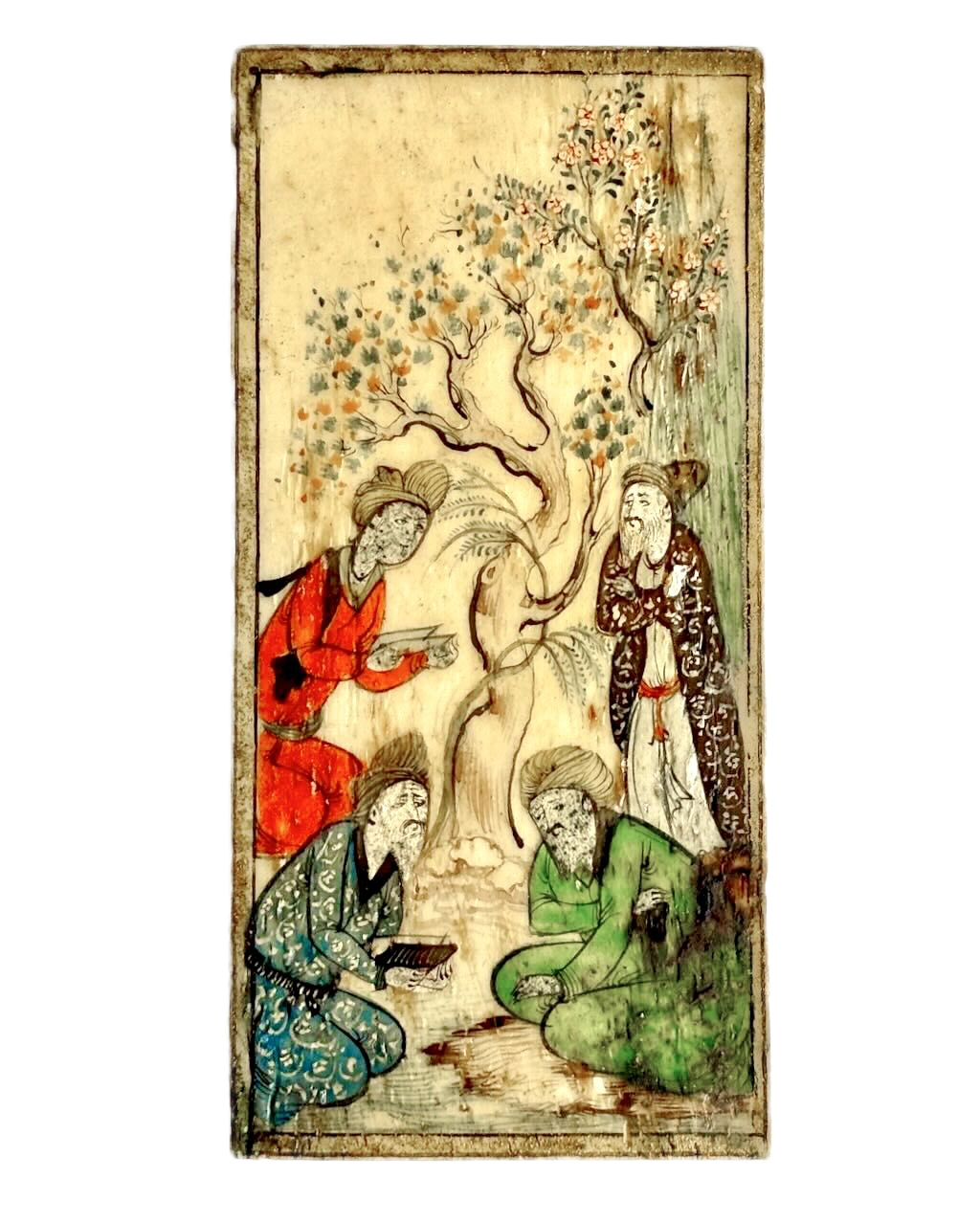
Persian miniature painting is celebrated for its ability to tell stories within remarkably small compositions. While royal hunts and court ceremonies remain among its best-known subjects, Persian artists also devoted considerable attention to scholarship, poetry, philosophy, and the exchange of ideas. This beautifully painted miniature depicts four distinguished figures gathered beneath flowering trees, creating a peaceful scene that reflects the enduring importance of learning within Persian culture.
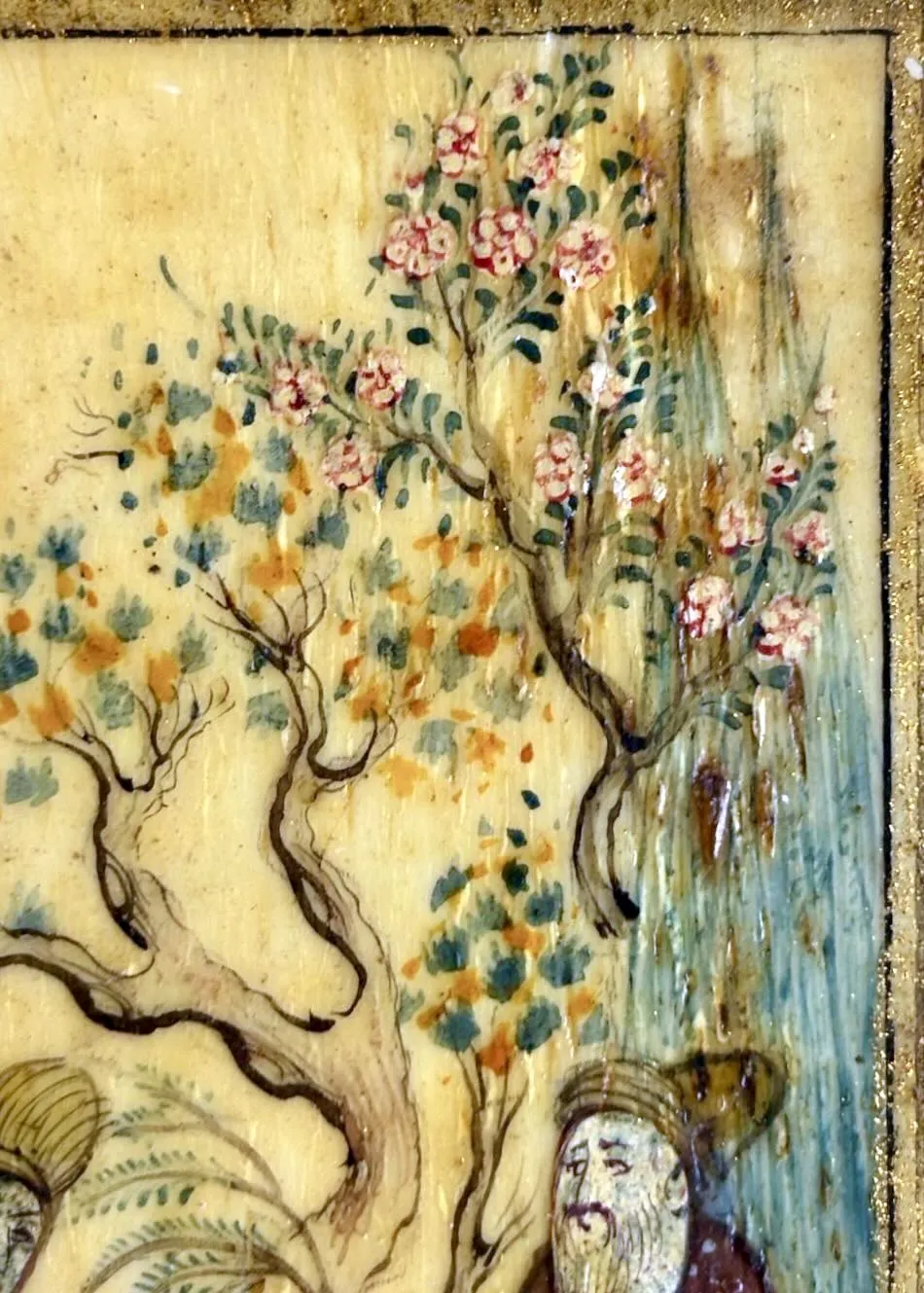
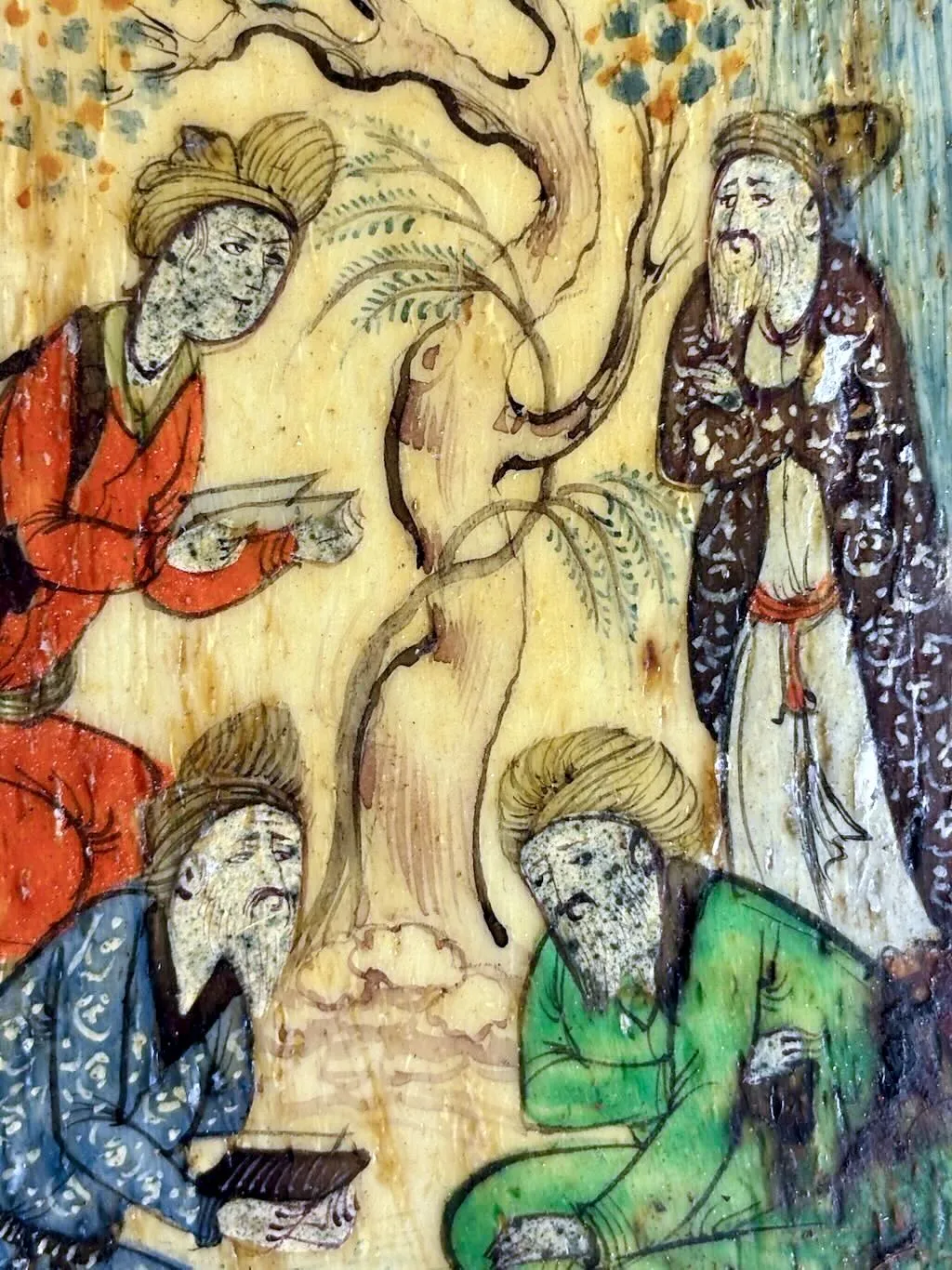
Painted by hand on a carefully prepared natural bone panel, the composition immediately conveys a sense of quiet dignity. One figure studies an open manuscript while another appears to present or discuss a written work. Two elder companions complete the gathering, their gestures suggesting thoughtful conversation rather than formal ceremony.
Instead of portraying a specific historical event, the artist created an idealized vision of intellectual life, inviting the viewer to imagine the discussion taking place beneath the blossoms.
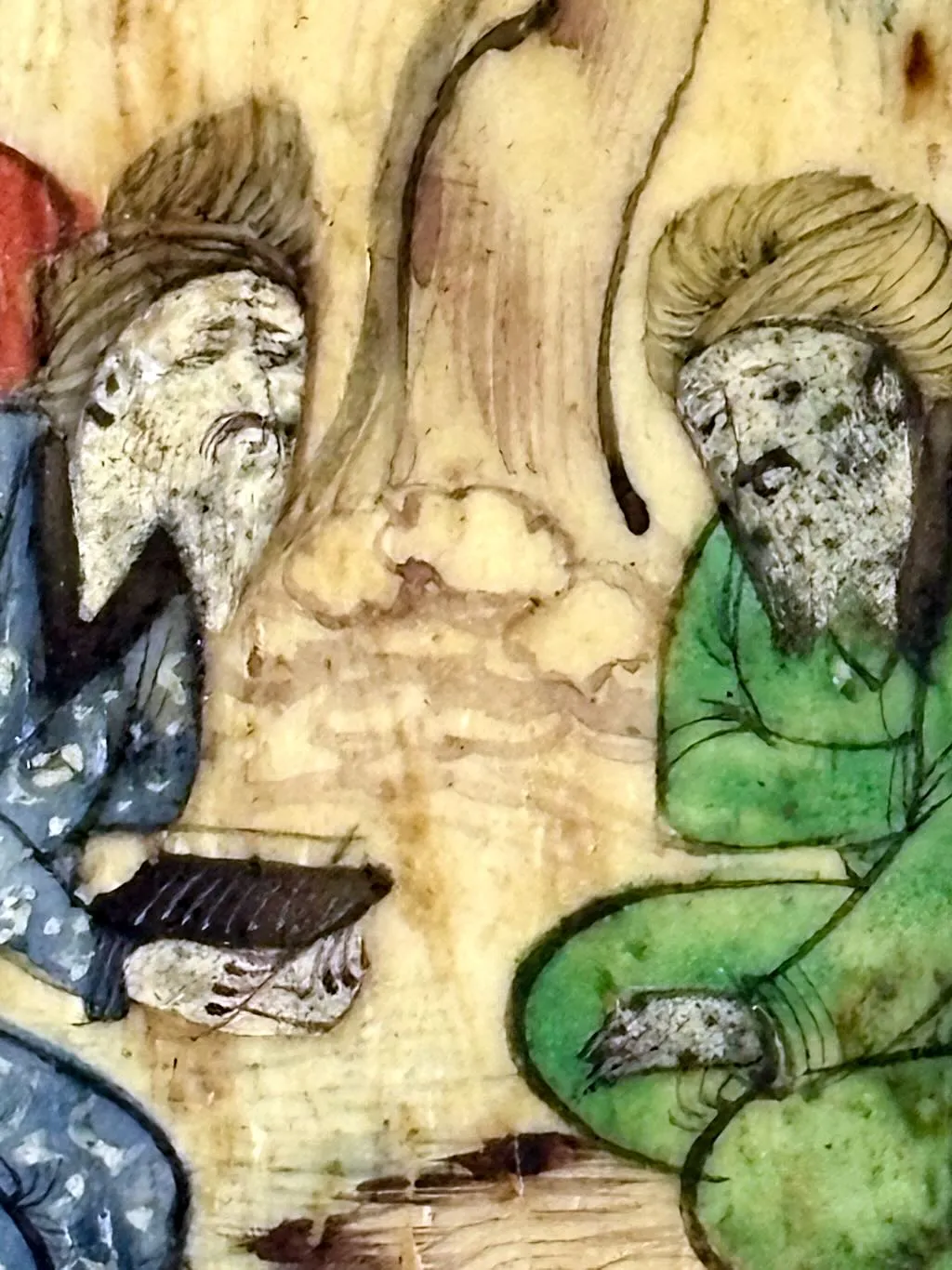
Although modest in size, the miniature demonstrates remarkable artistic control. Every figure possesses an individual expression, while the robes display graceful folds and carefully balanced colors. Rich crimson, emerald green, deep blue, and warm earth tones contrast beautifully against the naturally aged surface of the bone. Fine brushwork defines each face, garment, and tree branch, rewarding close examination and revealing new details with every viewing.
The Persian Tradition of Learning and Conversation
Persian civilization has long celebrated scholars, poets, philosophers, and teachers. Throughout history, gatherings devoted to literature and learning formed an important part of courtly and intellectual life. Miniature painters frequently illustrated these moments, emphasizing thoughtful conversation rather than dramatic action.
Books, manuscripts, and scholarly discussion appear throughout Persian art because they symbolize the pursuit of knowledge and wisdom. Rather than simply documenting historical events, artists created idealized scenes that reflected the cultural values of education, reflection, and respectful dialogue. This miniature belongs to that long artistic tradition, presenting knowledge as something to be shared within the beauty of a carefully imagined garden.
A Composition Designed for Reflection
Unlike the hunting and Chogan miniatures from the same collection, this painting relies on balance and harmony rather than movement. The artist arranged the figures in the lower portion of the composition while allowing flowering trees to occupy the upper half. As a result, the viewer’s eye moves naturally upward through the branches before returning to the scholars below.
The flowering trees do more than decorate the scene. They create a visual canopy over the gathering and reinforce the peaceful atmosphere that defines the composition. Their graceful branches soften the strong vertical format while adding rhythm and balance throughout the painting.
The landscape itself remains intentionally restrained. Instead of competing with the figures, it provides an elegant setting that supports the narrative without overwhelming it. This careful balance between people and nature represents one of the defining qualities of Persian miniature painting.
Hand-Painted on Natural Bone
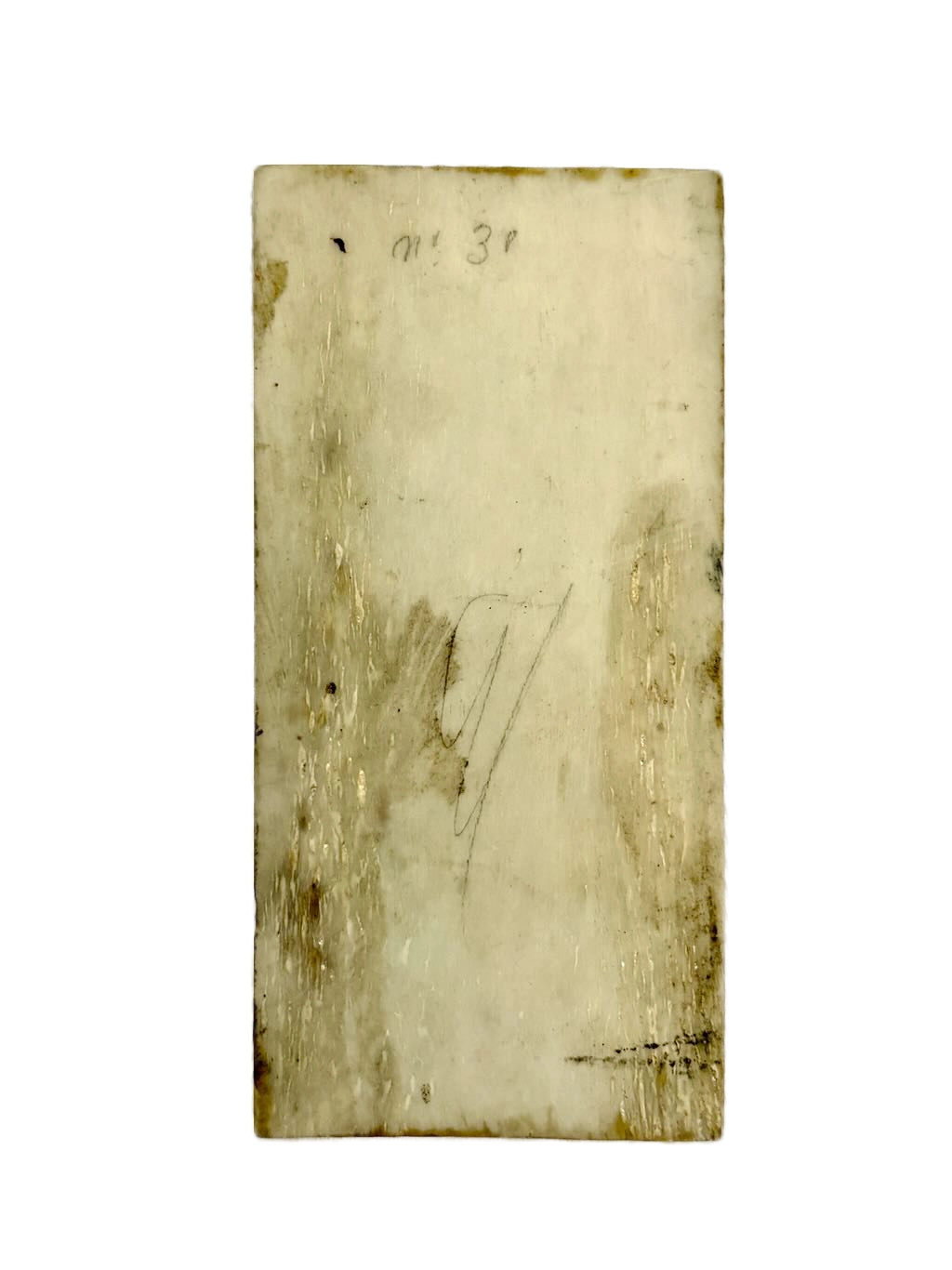
The artist selected polished natural bone as the painting surface, a traditional material valued for its smooth texture and durability. Its subtle warmth complements the colors of the painting while allowing exceptionally fine brushwork to remain crisp and clearly defined.
Over time the bone has developed an attractive cream-colored patina that enhances the miniature’s character without distracting from the artwork itself. A hand-painted gold border surrounds the composition, providing an elegant transition between the painting and the natural surface of the panel.
Collectors increasingly distinguish early Persian miniatures painted on natural materials from the larger number of later examples executed on synthetic ivorine. While both have their place within the history of Persian decorative arts, early bone miniatures retain a distinctive warmth and individuality that collectors continue to appreciate.
Readers interested in the traditional materials used by Persian miniature artists may also enjoy our companion article, Why Master Persian Miniature Artists Selected Bone, Ivory and Mother of Pearl, which explores the characteristics of bone, ivory, mother-of-pearl, and later synthetic substitutes.
Artistic Quality and Workshop Tradition
Although the artist remains unidentified, the quality of the painting reflects the high standards maintained by Persian workshops during the early twentieth century. Delicate facial features, confident line work, balanced proportions, and harmonious color relationships demonstrate an accomplished hand working within an established artistic tradition.
Rather than attempting Western perspective, the artist embraced the decorative qualities that define Persian miniature painting. Every element contributes to the composition without unnecessary detail, allowing the figures, flowering trees, and landscape to exist together in perfect visual harmony.
The miniature also reflects the continuity of Persian artistic traditions. While created during the early twentieth century, its style draws directly from much earlier manuscript painting, preserving subjects and techniques that had inspired Persian artists for centuries.
A Collectible Example of Early Persian Miniature Painting
Authentic Persian miniatures painted on natural bone have become increasingly difficult to find, particularly examples that retain their original painted surfaces and remain in well-preserved condition. Their combination of artistic refinement, traditional materials, and cultural significance continues to attract collectors of Persian art, Islamic art, and miniature painting throughout the world.
This miniature forms part of a small group of early twentieth-century Persian bone miniatures, each depicting a different traditional subject. While every painting stands beautifully on its own, together they illustrate the remarkable diversity of Persian miniature painting, from royal hunting scenes and Chogan matches to literary gatherings such as this one.
Provenance
This miniature comes from the Bernardi Family Collection, assembled through acquisitions made in Iran during the early twentieth century. Preserved within the same family for approximately one hundred years, it represents part of a carefully curated group of Persian miniature paintings selected for their artistic quality, traditional subjects, and enduring craftsmanship.