
Description
Pair of Antique Persian Tribal Embroidery Garment Pieces
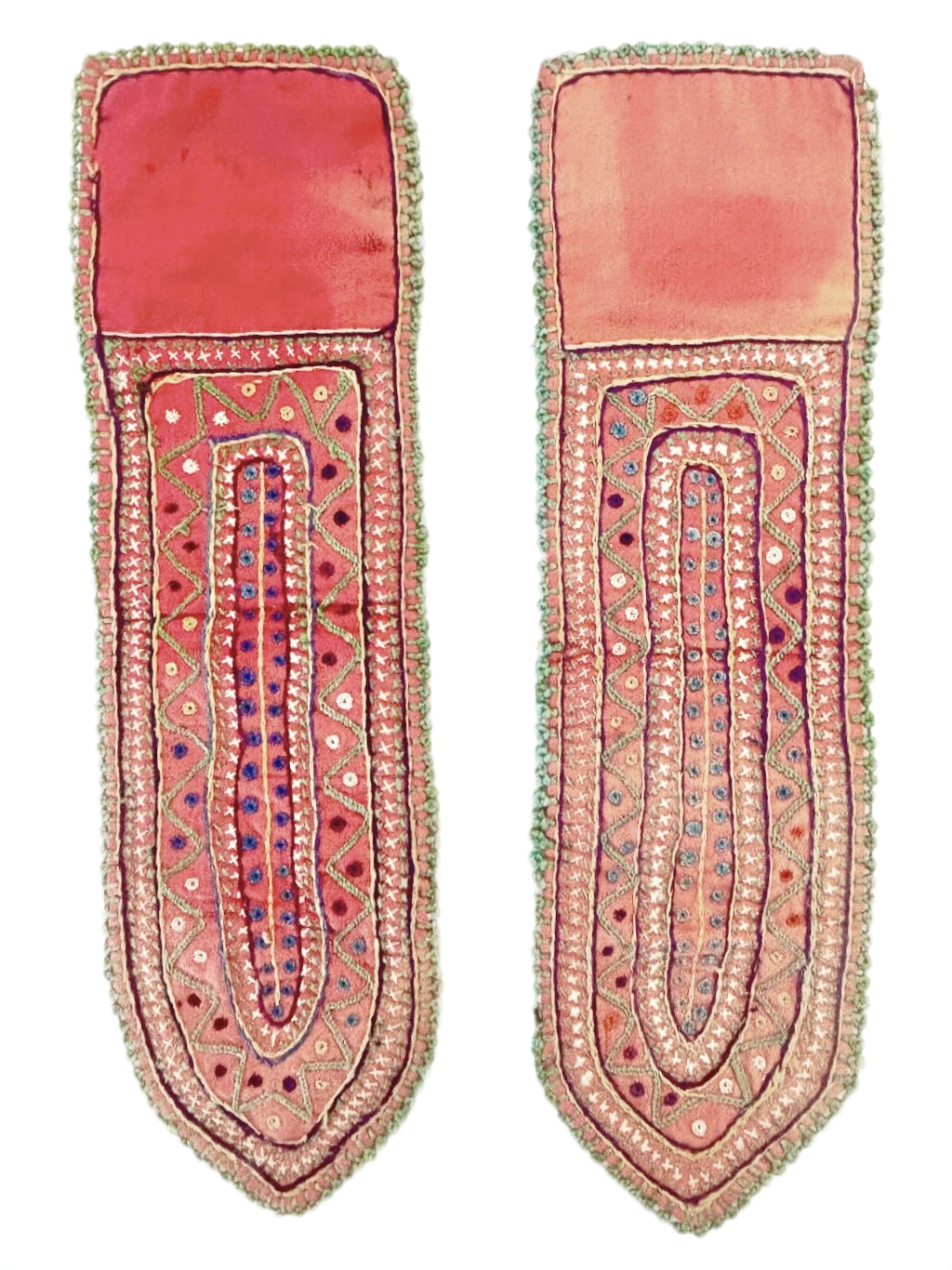
This matched pair of Persian Tribal Embroidery offers a fascinating glimpse into traditional Iranian textile and garment construction. Probably created during the first half of the 20th century, the two hand-embroidered pieces survive together and appear to have been made for corresponding positions on a garment, possibly as wrist or lower-sleeve cuffs.
Each piece measures approximately 11 inches (27.9 cm) long and 3 inches (7.6 cm) wide. The lower approximately 8.25 inches (21 cm) carry the principal embroidered decoration, while an approximately 2.75-inch (7 cm) plain section remains at the upper end.
Their matching dimensions, construction, pointed lower ends, finished perimeter edges, and nearly identical embroidered compositions strongly indicate that the two pieces were intentionally created as a pair.
Persian Tribal Embroidery with Geometric Needlework
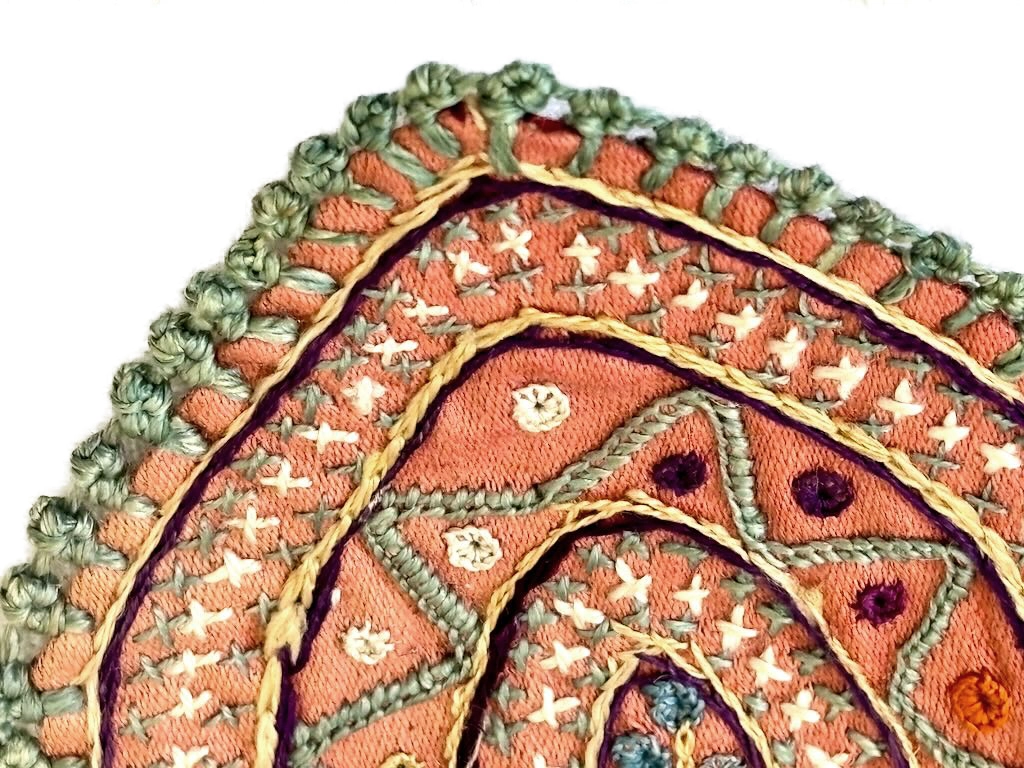
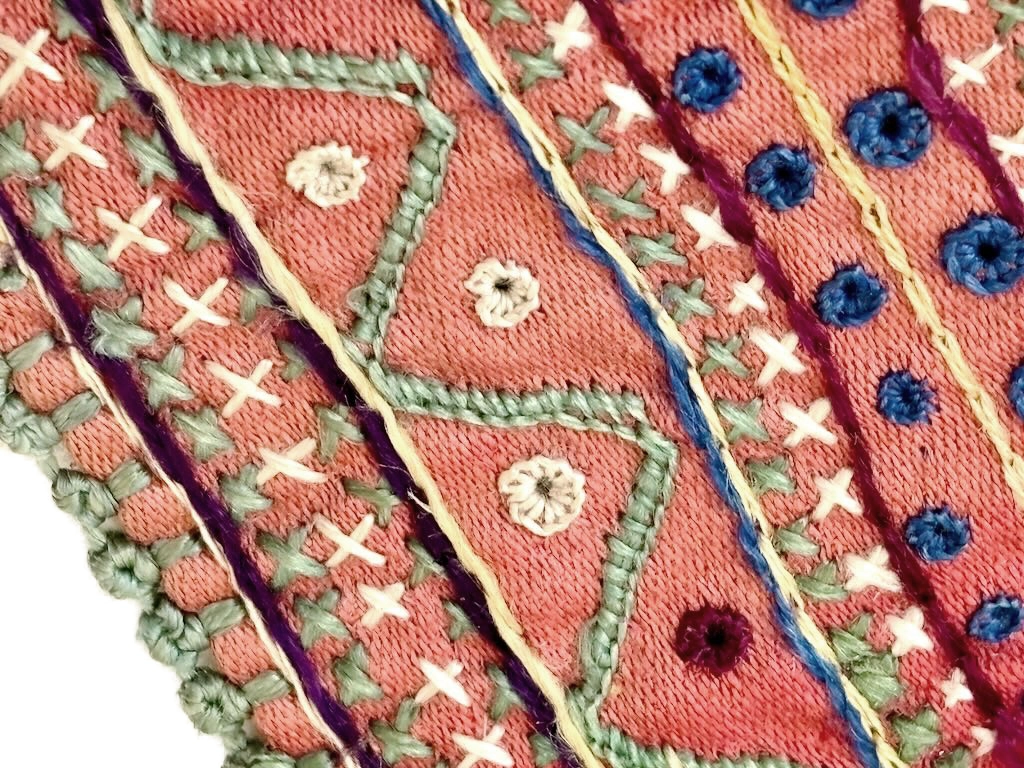
The Persian Tribal Embroidery combines an understated coral-salmon ground with sage green, cream, blue, purple, and yellow threads.
Rather than covering every inch of the textile, the embroiderer organized the decoration into carefully defined bands. A long U-shaped composition follows the pointed form of each piece, creating several nested layers of embroidery.
Repeated zigzag lines divide one band into triangular compartments. Tiny circular rosettes alternate within these spaces in cream, purple, blue, and other colors. A narrow central panel contains orderly rows of small blue embroidered rosettes, while numerous tiny cream cross-shaped stitches form additional borders.
Fine colored lines separate these patterns and emphasize the elongated shape. The result feels both geometric and remarkably delicate.
The two pieces closely correspond without being mechanically identical. Small variations in individual stitches and motifs reveal the character of handmade work.
Possibly Persian Embroidered Garment Cuffs
The original purpose of these antique Persian Tribal Embroidery pieces has not been documented. However, their construction provides useful clues.
Most importantly, they survive as a matched pair. Their narrow proportions and corresponding decoration suggest that they occupied equivalent positions on a traditional garment. Wrist or lower-sleeve cuffs provide a plausible interpretation.
Each piece also has an undecorated section approximately 2.75 inches (7 cm) long. These matching plain areas may have allowed the embroidered pieces to attach to, extend beneath, or overlap another part of the garment.
Unlike a related single embroidered piece from the same collection, this pair does not retain metal fasteners. We therefore cannot determine precisely how they were originally attached or worn.
For this reason, we describe them as possibly garment cuffs rather than assigning a definitive function.
Finished Borders and Layered Construction
A soft sage-green looped edging surrounds each textile and follows the distinctive pointed lower end. Narrow purple and yellow lines provide additional definition between the coral ground and embroidered fields.
These details demonstrate that the pieces were conceived as finished textile components rather than simply rectangular sections of embroidery.
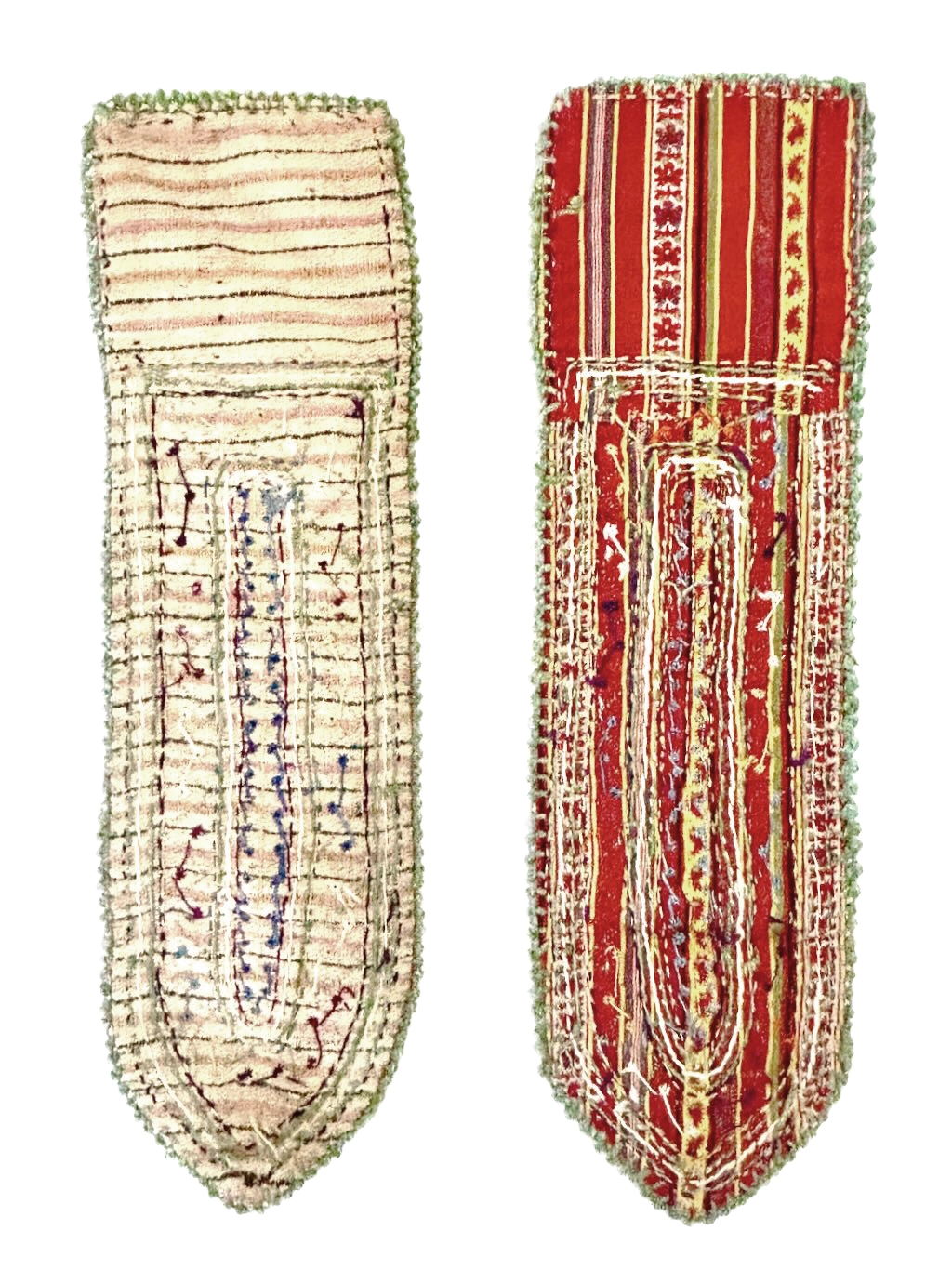
Their backs are particularly revealing. The reverse exposes the considerable network of threads required to create the orderly decoration visible on the front. It also shows the layered construction and provides an unusually direct view of the embroiderer’s working process.
Together, the front and reverse make the pair especially interesting for collectors who appreciate traditional needlework as both decorative art and evidence of historic textile construction.
Dating the Persian Tribal Embroidery
The exact age, maker, and regional or tribal origin remain unknown. However, the documented acquisition history provides an important reference point.
The pair was acquired in Tehran during the 1960s. Their hand construction, materials, decorative vocabulary, and known history suggest that they were probably produced during the first half of the 20th century.
Persia supported numerous regional and tribal embroidery traditions, and geometric motifs often crossed cultural and geographic boundaries. Without documentation linking this pair to a particular community, we do not attribute the work specifically to Baluch, Kurdish, Qashqai, Luri, or another Iranian group.
Instead, antique Persian Tribal Embroidery provides an appropriately broad description while acknowledging that the precise regional tradition remains unidentified.
A Rare Surviving Matched Pair
The survival of both corresponding pieces adds considerably to their interest.
Individual garment fragments often become separated after the original clothing is dismantled or lost. Here, the pair preserves the relationship between two components that were clearly intended to work together.
Their muted antique palette also differs beautifully from the brighter colors often associated with later Iranian embroidery. Subtle variations and fading across the coral ground reveal their age while allowing the blue, cream, purple, yellow, and sage-green needlework to remain clearly visible.
Whether displayed together as textile art or preserved for study, this matched pair offers an appealing example of early Persian hand embroidery and traditional garment ornament.