
Description
Antique Persian Tribal Embroidery with Original Fastener
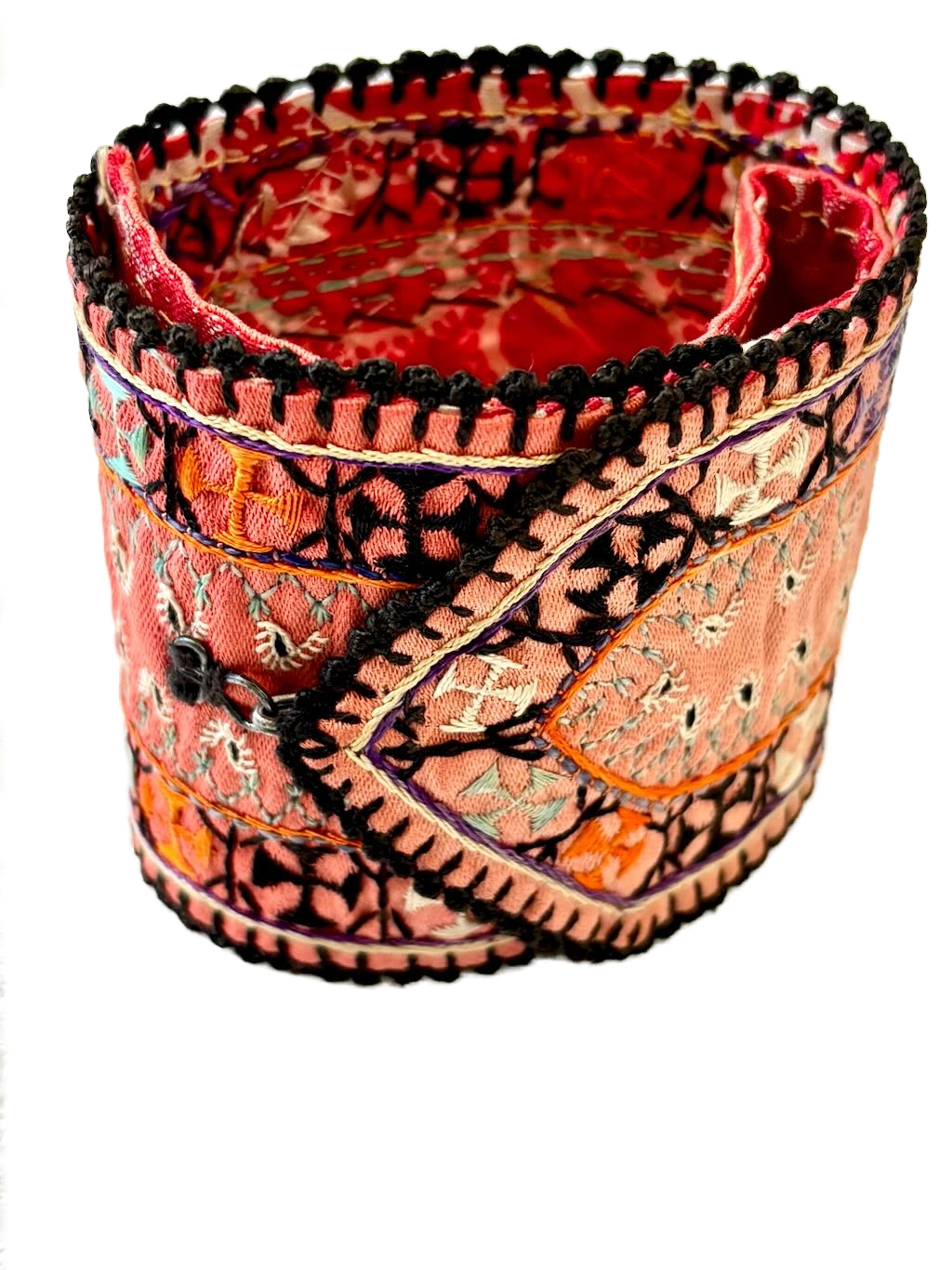
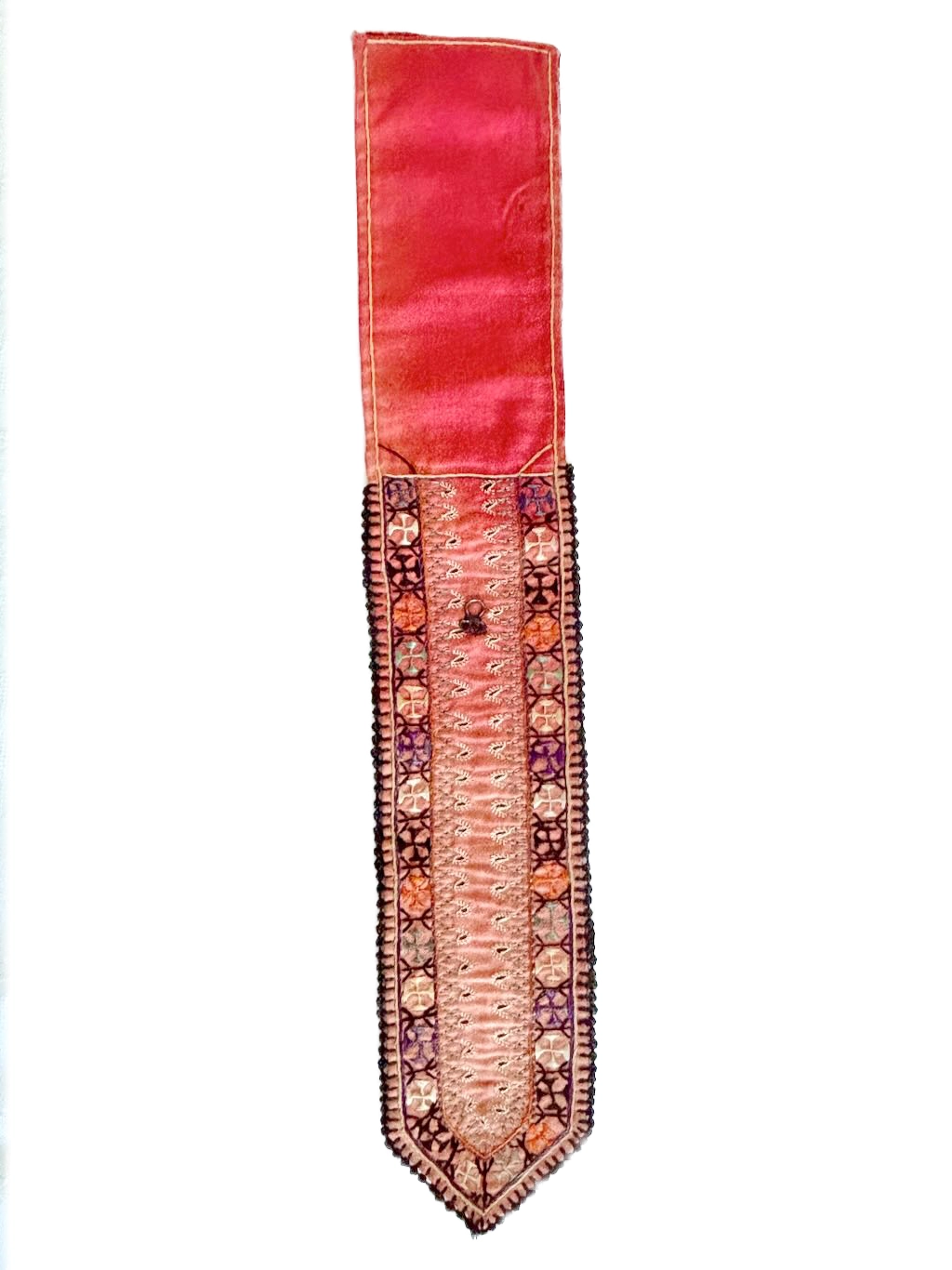
This Persian Tribal Embroidery is a fascinating surviving piece of traditional Iranian textile work, probably created during the first half of the 20th century. Its narrow proportions, concentrated embroidered section, finished borders, and surviving metal fastener suggest that it may once have served as a wrist cuff or lower-sleeve component of a traditional garment.
The piece measures approximately 15.25 inches (38.7 cm) long and 2.75 inches (7 cm) wide. Approximately 9 inches (22.9 cm) carry dense embroidery, while the remaining section consists of plain red fabric.
When curved into a cylindrical form, the textile readily assumes the proportions of a cuff or lower-arm band. The small metal fastener adds further support to this interpretation. However, because the original garment no longer survives with this piece, we describe its function as possible rather than certain.
Persian Tribal Embroidery with Bold Geometric Motifs
The embroidery combines strong geometry with small, highly stylized forms.
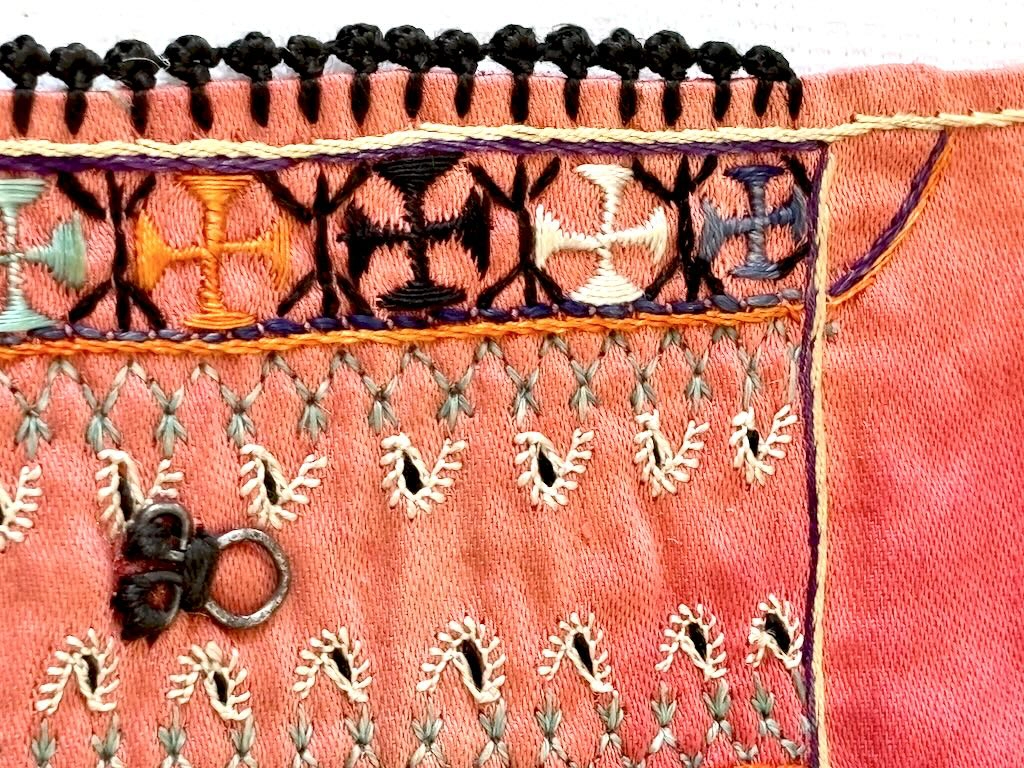
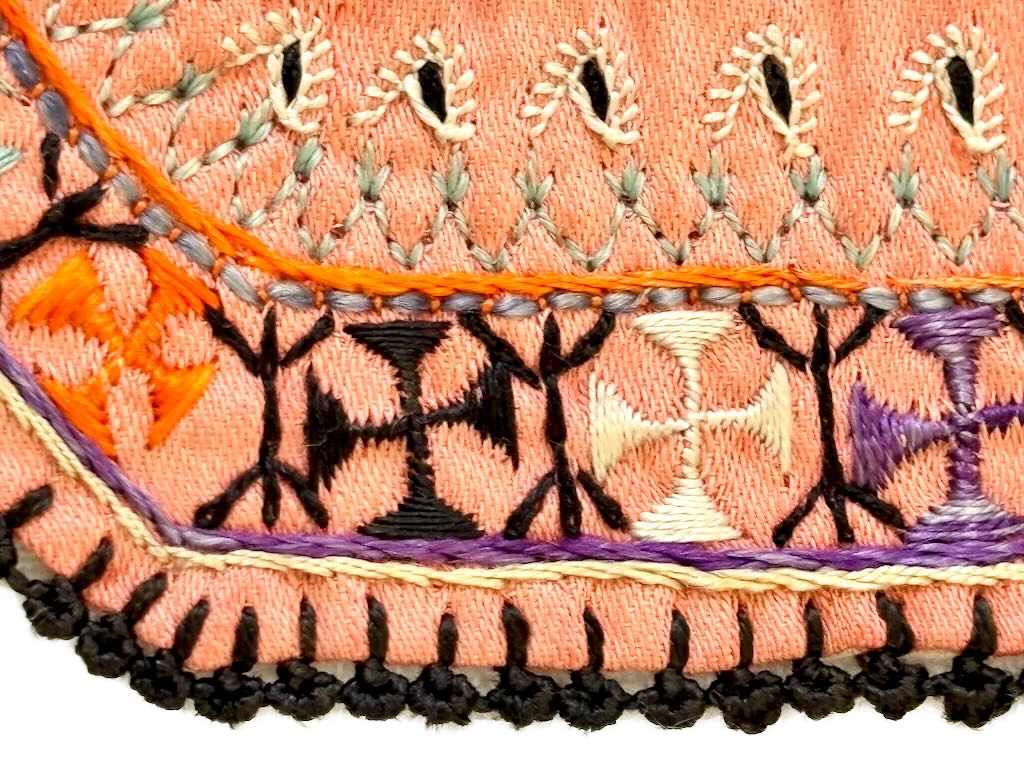
Repeated wheel-like or rosette motifs dominate the outer decorative bands. Black thread defines their structure, while cream, orange, lavender, green, red, and other colors create intricate internal patterns. The resulting contrast gives the relatively small textile considerable visual impact.
Between these geometric borders, the coral-red central field carries rows of tiny stylized motifs. Their forms suggest leaves, sprigs, flowers, or other abstracted natural subjects. Rather than assigning them a specific symbolic meaning, we prefer to appreciate them as part of the broader visual vocabulary of regional Persian embroidery.
The embroiderer carefully balanced these small motifs against the much stronger geometric borders. Consequently, the design remains detailed without becoming visually crowded.
Decorative Edging and Original Construction
The borders deserve close attention.
Dark looped or braided edging frames the embroidered section and creates a strong outline against the red ground. Additional colored stitching and narrow decorative bands separate the central field from the larger geometric motifs.
The surviving metal fastener is particularly interesting because it helps us understand the textile as a functional object rather than simply a loose piece of embroidery.
A plain red fabric section extends beyond the heavily embroidered area. It may once have helped attach the piece to a garment, overlap beneath the decorated section, or perform another structural function. Without the original garment, its exact arrangement remains uncertain.
Possibly an Embroidered Wrist Cuff
Several characteristics suggest that this Persian Tribal Embroidery may represent a wrist cuff or related garment component.
First, its approximately 2.75-inch (7 cm) width suits a decorative band around the wrist or lower forearm. Furthermore, the textile naturally forms a short cylinder when wrapped, while the surviving fastener provides a practical means of securing it.
There is also useful comparative evidence within the collection. Another related embroidered textile survives as a matched pair, which supports the possibility that pieces of this general form originally served as corresponding garment components.
Nevertheless, no intact garment accompanies this particular example. We therefore avoid identifying it definitively as a cuff. It could also have formed part of a sleeve or another element of traditional clothing.
That uncertainty does not diminish its interest. Instead, the surviving construction allows collectors to study how elaborate embroidery could function as an independent component within a larger garment.
The Reverse Shows the Hand Embroidery
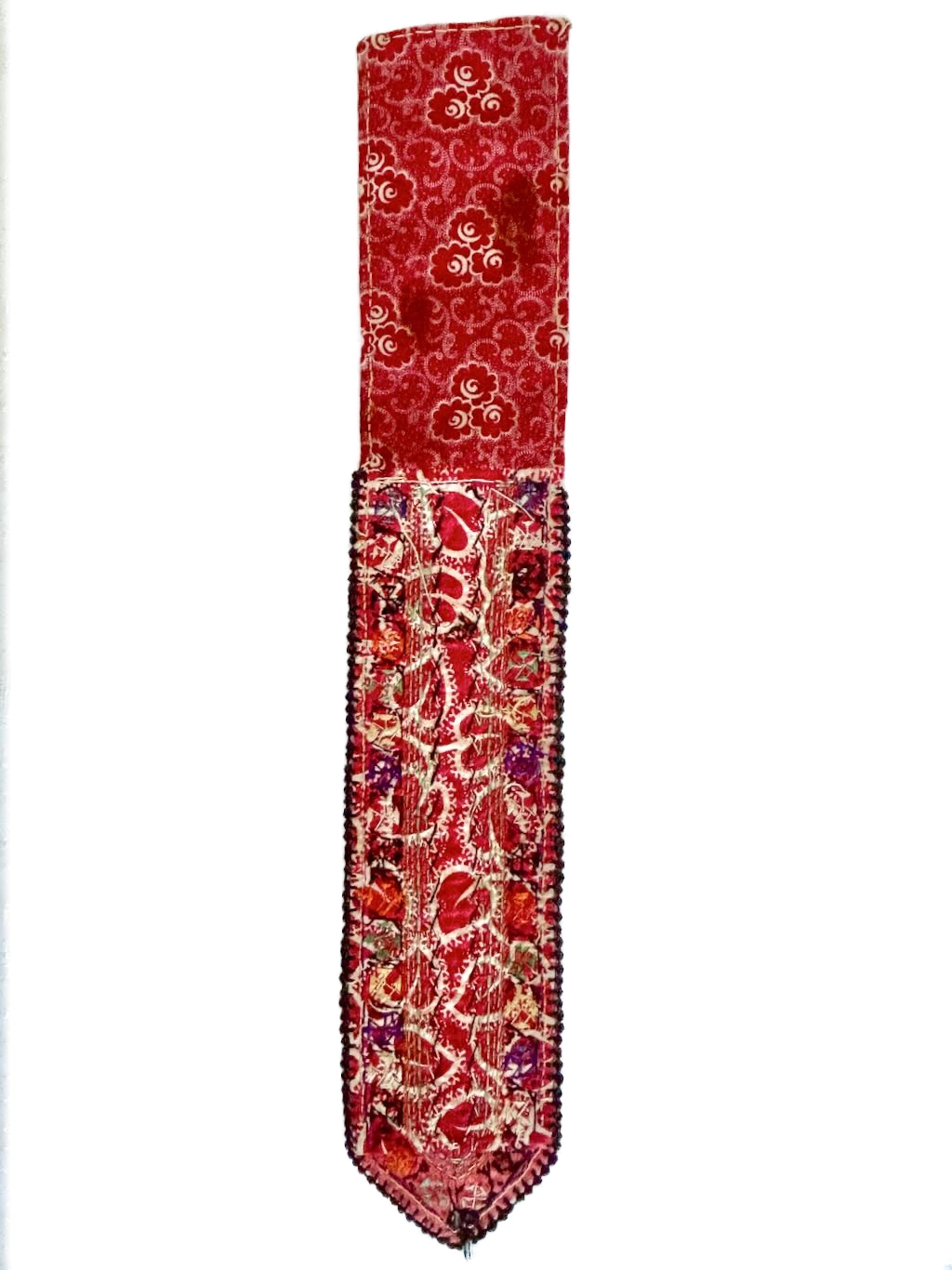
The reverse provides one of the most informative views of the piece.
Rather than concealing the construction beneath a later backing, it reveals the threads and stitching used to build the embroidered surface. The photograph of the reverse therefore provides valuable evidence of the textile’s handmade character.
From the front, black outlines and vivid colors create crisp geometric forms. From the back, the paths of the threads reveal the physical process required to produce them.
For collectors of antique embroidery, this visibility adds considerable interest. The textile can be appreciated not only as a decorative object but also as a small study piece demonstrating traditional needlework and garment construction.
Dating This Persian Tribal Embroidery
The exact creation date and original regional origin remain undocumented. However, the known history provides an important chronological anchor.
The piece was acquired in Tehran during the 1960s and has remained in the same collection since that time. Its materials, hand construction, decorative vocabulary, and acquisition history suggest that it was probably produced during the first half of the 20th century.
We have not assigned the embroidery to a specific Iranian tribal community. Regional embroidery traditions often share colors, geometric structures, and decorative techniques. Without documentary evidence or a securely identified comparable example, a more precise attribution would be speculative.
For that reason, we describe the piece broadly as antique Persian tribal embroidery while preserving the uncertainty surrounding its exact origin and function.
A Small but Fascinating Persian Textile
Although modest in scale, this textile contains an impressive amount of detail.
Its saturated colors, geometric rosettes, tiny stylized motifs, decorative edging, original fastener, and visible reverse make it particularly appealing as a study piece. Moreover, its possible connection with traditional garment construction gives it an ethnographic dimension beyond its decorative qualities.
It could remain preserved as a collectible example of Iranian needlework or be displayed so that its intricate embroidery can be examined closely.
Above all, this antique Persian Tribal Embroidery survives as an evocative fragment of traditional textile culture. Its precise original purpose may no longer be known, but the craftsmanship, construction, and remarkable visual character remain clearly visible.