


Description
Vintage Wedgwood White Jasperware Three Graces Dancing Dis
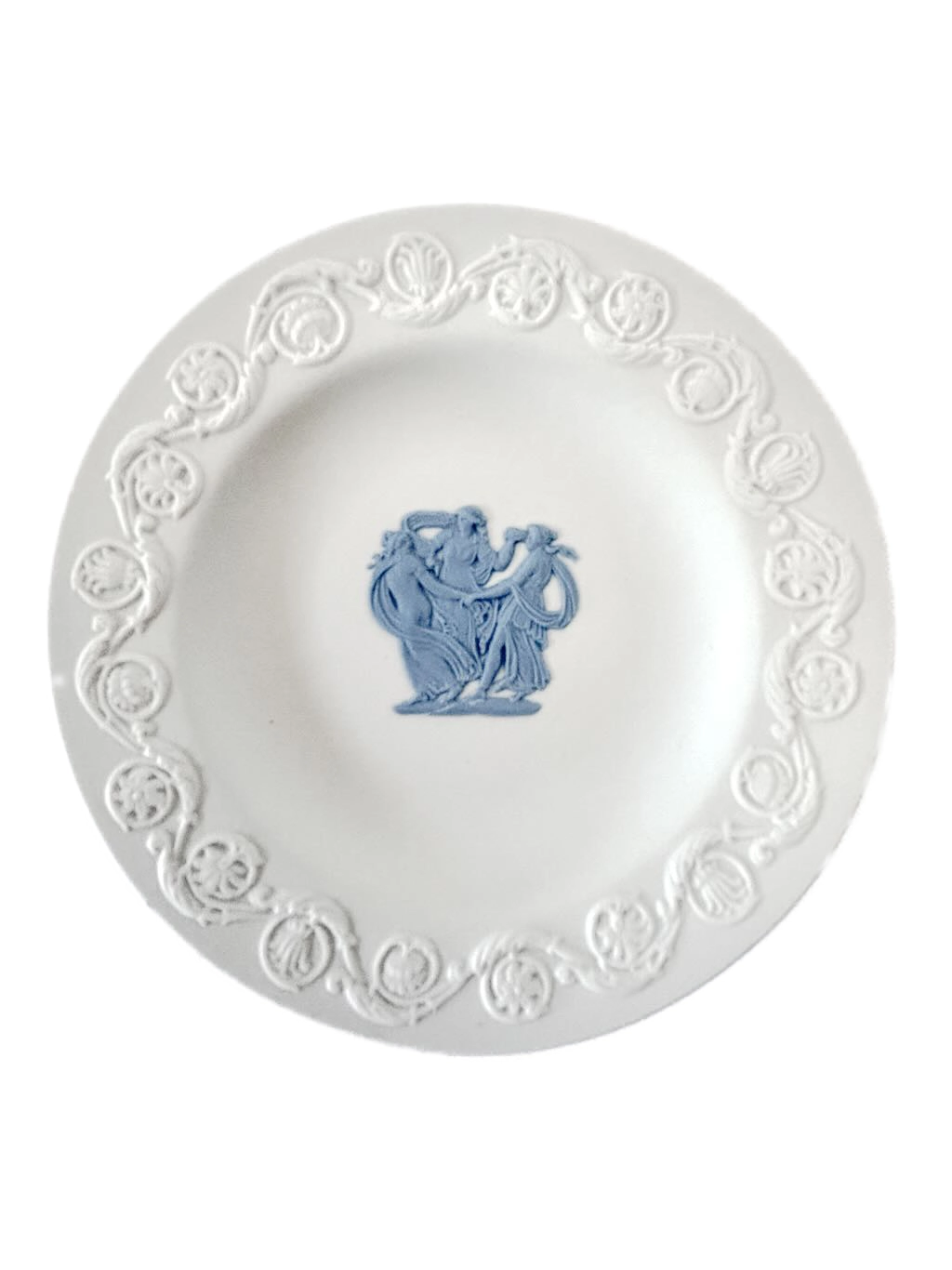
This Wedgwood White Jasperware Three Graces Dancing Dish features an elegant neoclassical composition of three female figures dancing together, rendered in delicate blue applied relief against a soft white Jasperware ground. An elaborate white-on-white arabesque border surrounds the central scene, creating a sophisticated combination of contrasting and monochromatic ornament.
Measuring approximately 4 3/8 inches in diameter, this vintage English dish offers an attractive variation on Wedgwood’s celebrated Jasperware tradition. While the company’s familiar blue Jasperware typically features white classical relief, this example reverses the arrangement, placing blue figures against a white ground.
The result is a particularly graceful decorative piece that combines classical mythology, refined ceramic craftsmanship and the understated elegance of neoclassical design.
The Three Graces Dancing: A Classical Mythological Subject
The Three Graces, known as the Charites in Greek mythology and the Gratiae in Roman tradition, personify beauty, charm, joy and generosity. They frequently appear together in classical literature and art, representing the harmonious relationships that enrich human life.
The three goddesses are traditionally identified as Aglaea, associated with splendor and beauty; Euphrosyne, representing joy and good cheer; and Thalia, associated with flourishing and abundance.
Artists often portrayed the Graces dancing together, their flowing garments and intertwined gestures expressing unity, movement and companionship. Their graceful arrangement became one of the most enduring subjects in European decorative art.
On this Wedgwood dish, the three figures stand close together in a flowing composition. Their draped garments and delicate gestures suggest the rhythmic movement of a classical dance, creating an image of harmony and elegance.
The small scale of the relief adds to its charm, demonstrating how effectively Wedgwood could translate a complex mythological subject into miniature ceramic decoration.
The Three Graces in European Art
The Three Graces have inspired artists for centuries, appearing in ancient sculpture, Renaissance painting and neoclassical decorative arts.
One of the most recognizable classical arrangements depicts three female figures standing together, often with the central figure facing in the opposite direction from her companions. This composition became a celebrated symbol of ideal beauty and harmonious proportion.
During the Renaissance, artists such as Sandro Botticelli and Raphael revisited the subject, adapting classical imagery to reflect contemporary ideals of beauty and humanism.
The theme remained equally popular during the eighteenth century, when European artists and designers increasingly drew inspiration from Greek and Roman antiquity.
For Wedgwood, the Three Graces offered a subject perfectly suited to the company’s neoclassical aesthetic. Their flowing drapery, balanced arrangement and graceful gestures translated naturally into the shallow sculptural relief characteristic of Jasperware.
Historic Wedgwood representations of the Dancing Three Graces appear in museum collections, including the Victoria and Albert Museum in London and the Spencer Museum of Art at the University of Kansas.
Josiah Wedgwood and the Neoclassical Revival
Josiah Wedgwood (1730–1795) founded his pottery business in Staffordshire, England, in 1759. His technical innovations and artistic collaborations transformed English ceramics and helped establish Wedgwood as one of the most influential names in European decorative arts.
During the eighteenth century, archaeological discoveries and renewed interest in ancient Greece and Rome inspired the neoclassical movement. Artists, architects and designers embraced classical proportions, mythological subjects and decorative motifs drawn from antiquity.
Wedgwood became one of the movement’s most successful interpreters. The company collaborated with talented sculptors and modelers, including John Flaxman, to develop ceramic reliefs inspired by ancient sculpture, engraved gemstones and classical decorative art.
Introduced in the 1770s, Jasperware represented one of Wedgwood’s most important achievements. Its distinctive unglazed surface and finely modeled relief decoration allowed the company to reproduce the appearance of classical carved cameos in a durable ceramic medium.
Although the present dish belongs to a much later period of production, its decoration continues the artistic traditions established during Wedgwood’s eighteenth-century neoclassical development.
White Jasperware with Blue Classical Relief
One of the most appealing characteristics of this dish is its unusual blue-on-white Jasperware decoration.
While pale blue Jasperware with white relief remains Wedgwood’s most recognizable combination, the company also produced white Jasperware decorated with contrasting colored reliefs.
Here, the white ceramic ground provides a restrained background for the blue figures of the Three Graces. The contrasting relief emphasizes the delicate modeling of their garments, gestures and intertwined forms.
The blue decoration gives the central composition a cameo-like appearance, while the surrounding white surface creates a sense of openness and refinement.
This reversal of Wedgwood’s familiar color arrangement makes the dish particularly attractive when displayed alongside traditional blue Jasperware pieces.
White-on-White Arabesque Border
An elaborate white-on-white arabesque border encircles the central composition. The raised decoration features a continuous arrangement of stylized floral medallions, scrolling foliage and gracefully intertwining ornamental forms.
Arabesque ornament has a long history in European decorative art. Its flowing curves, repeated motifs and stylized botanical elements became particularly popular in Renaissance and neoclassical design.
On this Wedgwood dish, the arabesque decoration shares the same white color as the ceramic ground. Rather than relying on contrasting colors, the ornament emerges through subtle changes in light and shadow across the raised surface.
This monochromatic treatment gives the border a delicate sculptural quality. It also allows the blue Three Graces relief to remain the principal focus of the composition.
The combination of blue figural decoration and white arabesque ornament creates a harmonious balance between classical imagery and decorative restraint.
Wedgwood’s Enduring Three Graces Motif
The Three Graces became a recurring subject in neoclassical decorative art because of their associations with beauty, friendship and harmony.
Their graceful arrangement suited a variety of artistic forms, from large sculptural compositions to small cameos, medallions and ceramic plaques.
Wedgwood’s use of the Three Graces reflects the company’s longstanding practice of adapting celebrated classical subjects for decorative objects intended for the home.
The continued reproduction of such motifs also demonstrates the remarkable longevity of Wedgwood’s artistic heritage. Designs inspired by antiquity remained relevant to successive generations of collectors, even as ceramic production techniques and decorative fashions evolved.
Wedgwood Made in England Backstamp
The underside carries the impressed WEDGWOOD® / MADE IN ENGLAND mark, identifying the manufacturer and confirming English production.
The style of the mark is consistent with later twentieth-century Wedgwood manufacture. Although an exact production date has not been established, the dish represents a vintage interpretation of a classical decorative subject.
As with many Wedgwood Jasperware pieces, the age of the design tradition should not be confused with the manufacturing date of the individual object.
Condition and Decorative Appeal
This vintage Wedgwood Jasperware dish remains in good condition, with no observed chips or cracks. The blue relief of the Three Graces presents attractively against the white ground, while the surrounding arabesque border retains its delicate decorative appearance.
Minor signs of age and handling are consistent with its vintage character. Please examine the photographs for details of the condition and the impressed Wedgwood mark.
With its graceful mythological subject, unusual blue-on-white decoration and elegant monochromatic arabesque border, this small dish makes an appealing addition to a collection of English Jasperware.
Its compact dimensions make it suitable for display in a cabinet, on a shelf or alongside other Wedgwood pieces featuring classical mythology and neoclassical ornament.