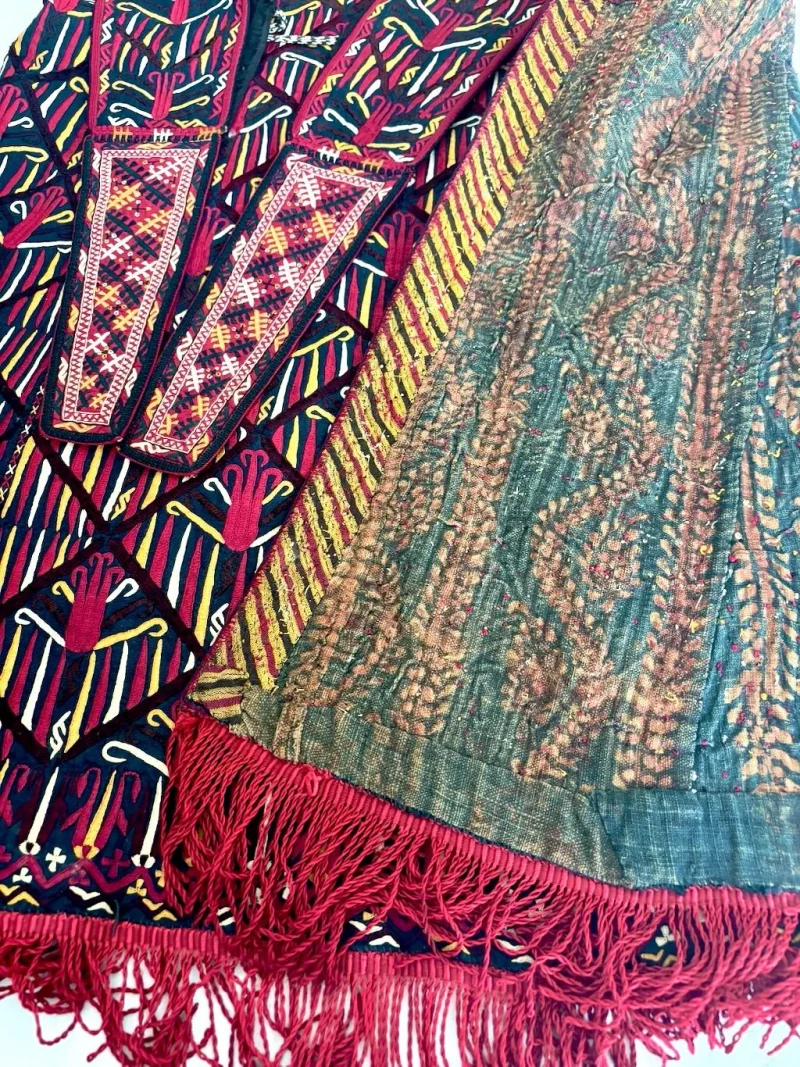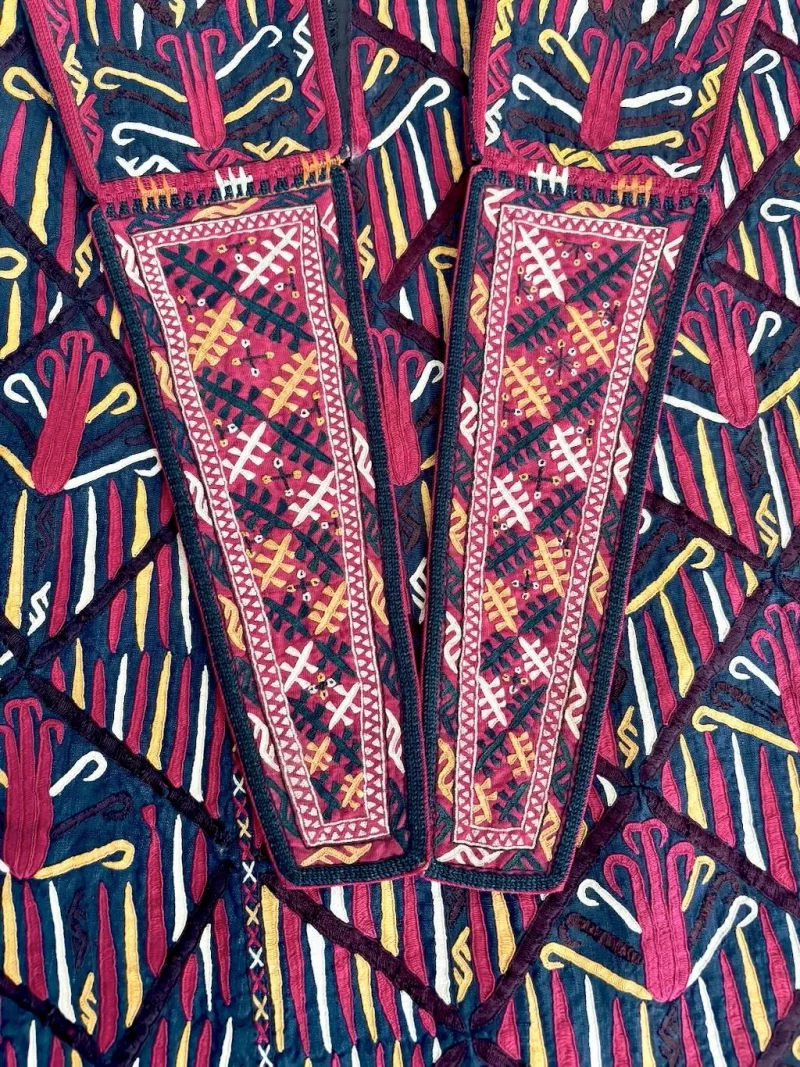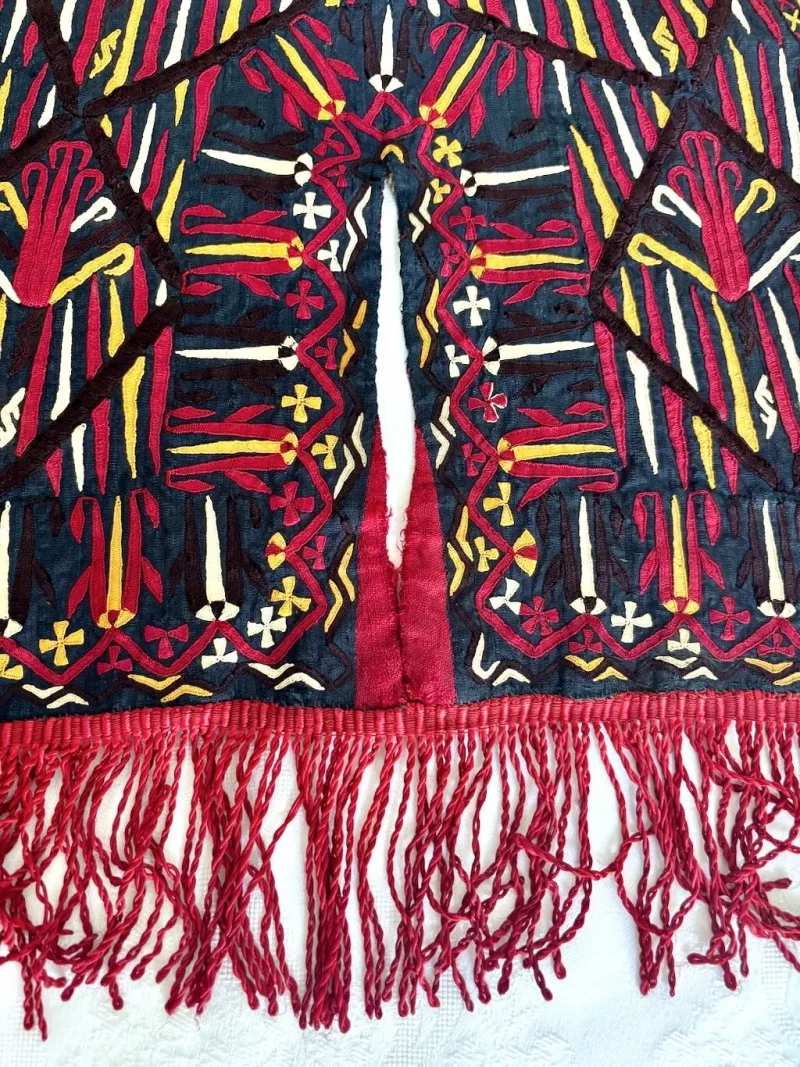

Few traditional garments capture the history, artistry, and identity of a people as completely as the Tekke Turkmen chyrpy. At first glance, its long decorative sleeves and richly embroidered surface suggest an elegant robe. However, the chyrpy served a very different purpose. Tekke women draped it gracefully over the head and shoulders as a ceremonial mantle, allowing the elaborate silver jewelry beneath to remain visible while the long ornamental sleeves flowed freely behind them.
For centuries, the chyrpy represented far more than beautiful clothing. It reflected a woman’s place within her community, expressed the remarkable embroidery skills passed from mother to daughter, and preserved traditions that stretched back to some of the earliest civilizations of Central Asia. Although production gradually disappeared during the early twentieth century, surviving examples continue to inspire collectors, museums, and textile historians throughout the world.
Today, authentic nineteenth-century chyrpy occupy important places in the collections of institutions including the Metropolitan Museum of Art in New York, the Museum of Fine Arts, Houston, the Victoria and Albert Museum in London, the Cleveland Museum of Art, the Powerhouse Museum in Sydney, and the Museum of Anthropology at the University of British Columbia. Their preservation reflects both their artistic beauty and their cultural importance within Turkmen history.
Who Were the Tekke Turkmen?
The Tekke are one of the principal Turkmen tribes whose history spans the vast steppes and oasis settlements of Central Asia. Their traditional homeland extended across what is now Turkmenistan while also reaching into northeastern Iran, particularly the region known as Turkmen Sahra. Long before modern political borders divided the region, Tekke communities moved seasonally with their herds, carrying with them distinctive artistic traditions that evolved over many centuries.
Life on the Central Asian steppe demanded both practicality and creativity. Women transformed everyday materials into textiles of extraordinary beauty, producing carpets, embroidered garments, ceremonial accessories, and household furnishings that reflected both tribal identity and personal accomplishment. Their work became an important expression of family pride, and every carefully stitched motif carried meaning beyond simple decoration.
During the nineteenth century, the Tekke gained particular recognition for the refinement of their silk embroidery. Their ceremonial garments displayed remarkable technical precision while preserving symbolic designs that had passed through countless generations. Today, collectors often regard these textiles among the finest surviving examples of Central Asian embroidery.
The connection between the Tekke and Iran also helps explain why authentic examples frequently appear in older Iranian collections. Large Turkmen communities have lived in northeastern Iran for centuries, and tribal textiles regularly entered the antique markets of cities such as Tehran during the twentieth century. As a result, many significant chyrpy found their way into private collections long before they attracted widespread international attention.
What Is a Tekke Turkmen Chyrpy?
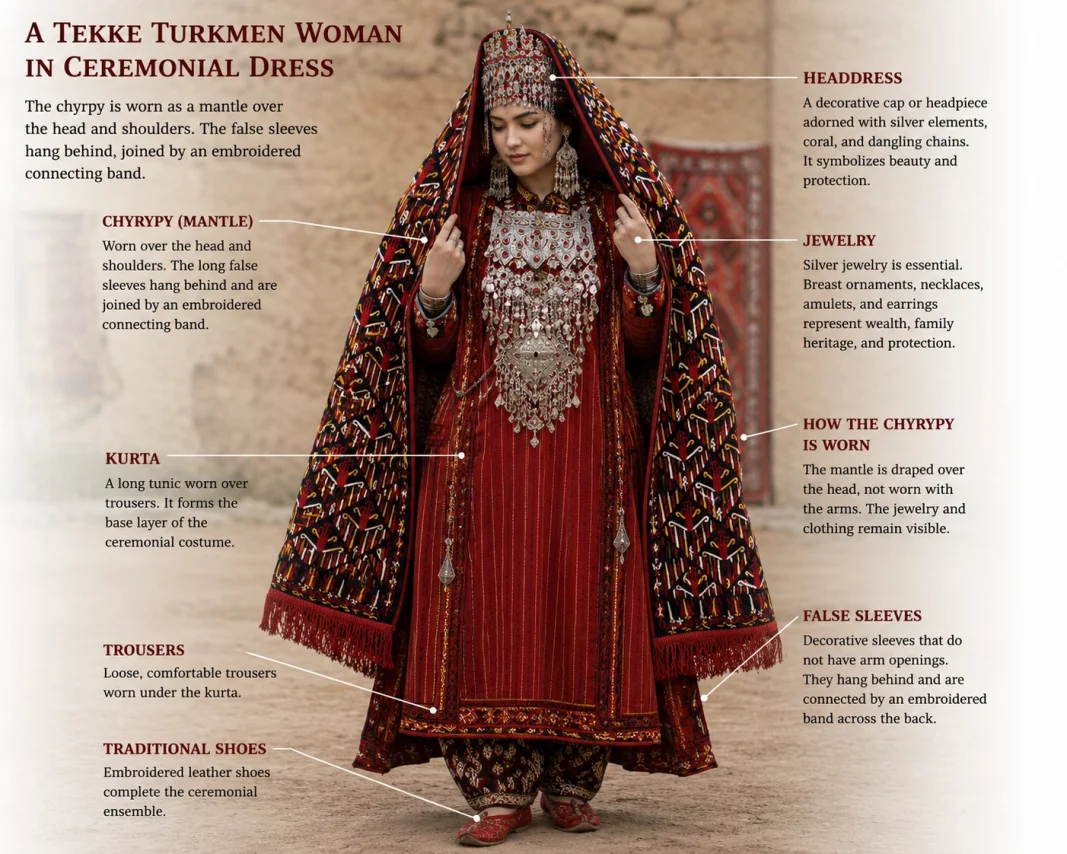
Although many auction houses and antique dealers describe the chyrpy simply as a robe, that definition tells only part of its story. Unlike a conventional coat or cloak, the garment was never intended to be worn through its sleeves. Instead, women carefully draped it over the head and shoulders so that it rested elegantly above the embroidered tunic, or kurta, worn underneath.
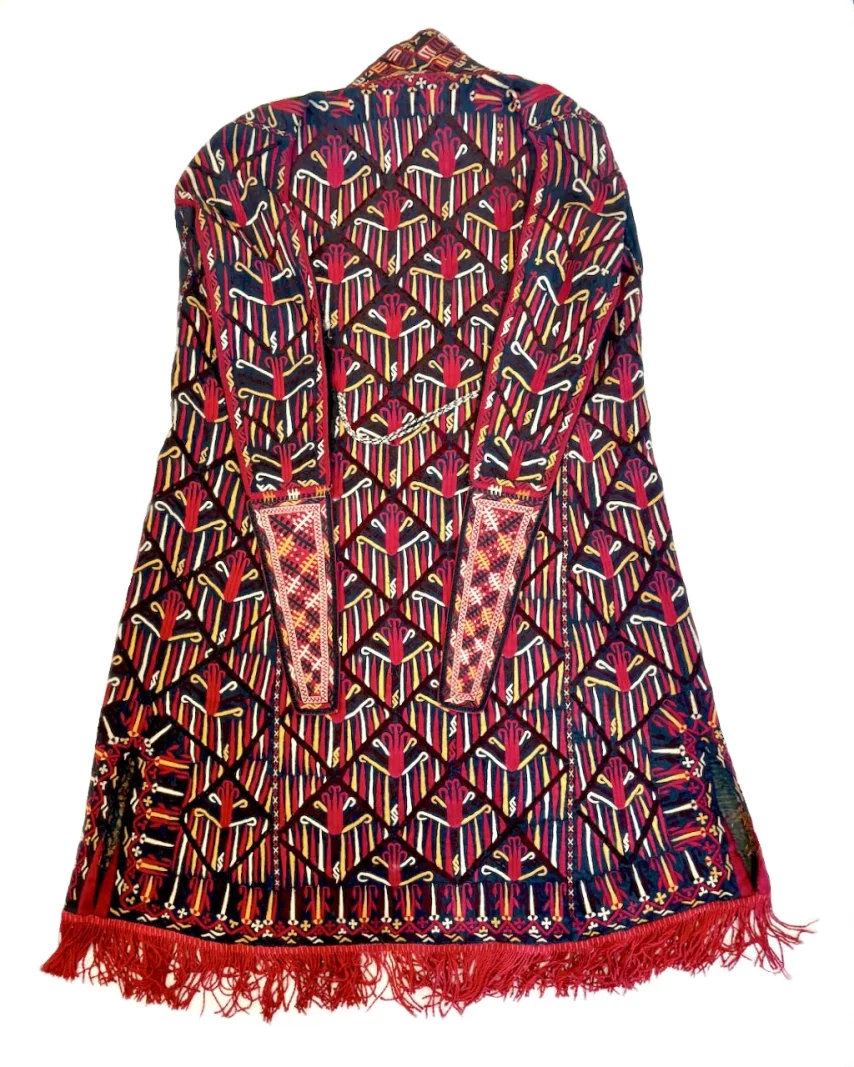
The garment’s most distinctive feature immediately captures attention. Its exceptionally long false sleeves extend far beyond practical use and usually remain joined together by an embroidered connecting band across the back. Rather than serving a functional purpose, these decorative sleeves emphasize movement and create a dramatic silhouette during ceremonial occasions.
Historical photographs from the late nineteenth century, together with museum examples preserved around the world, clearly illustrate this unique style of dress. They show the chyrpy resting lightly over the head while magnificent silver jewelry remains fully visible across the chest. The result creates an appearance unlike any other ceremonial costume in Central Asia.
This unusual method of wearing the garment often surprises modern viewers because it challenges familiar ideas about clothing. Once understood, however, the design reveals itself as both practical and symbolic. The richly embroidered mantle framed the wearer while allowing the elaborate jewelry, itself an important indicator of family wealth and social status, to remain the visual centerpiece of the costume.
A Tradition That Reaches Back Thousands of Years
The distinctive false sleeves of the chyrpy belong to one of the oldest surviving costume traditions in Central Asia. Textile historians have traced similar ceremonial garments to remarkable archaeological discoveries dating back more than two thousand years.
Evidence appears among the famous Pazyryk burials in Siberia, where preserved garments reveal elongated decorative sleeves. Comparable forms also appear in the sculptural reliefs of Persepolis, on objects from the Oxus Treasure, and in terracotta figures discovered at Afrasiab. Although historians cannot fully explain the original purpose of these extraordinary sleeves, the tradition survived through countless generations before eventually finding expression in the Tekke chyrpy of the nineteenth century.
Few ceremonial garments anywhere in the world demonstrate such remarkable continuity between the ancient and modern worlds.
The Colors That Told a Story
The color of a Tekke chyrpy communicated information immediately recognizable within Turkmen society. Rather than serving as a simple decorative choice, the background color reflected the wearer’s age and position within the community.
Young women traditionally wore dark blue, black, or deep green examples. These rich colors accompanied the early years of adulthood and often appear in association with bridal ceremonies and the first years of marriage. As women matured and gained experience within family and community life, they adopted yellow chyrpy, a color associated with wisdom and established social standing.
White examples represented the highest stage of life. Reserved for respected matriarchs, these garments symbolized honor, experience, and the esteem earned through many decades within the tribe.
Museum collections consistently preserve examples representing each of these stages, allowing modern scholars to understand how color formed an essential part of Tekke ceremonial dress. Together they demonstrate that a chyrpy conveyed far more than artistic taste; it quietly communicated personal identity and social status without the need for words.
Kesdi Embroidery and the Art of Tekke Women
The beauty of a Tekke chyrpy extends far beyond its graceful silhouette. Every embroidered motif reflects the patience, skill, and artistic tradition of the women who created it. Long before commercial textiles became available, Turkmen women embroidered ceremonial garments entirely by hand. Their work preserved techniques that families passed from one generation to the next for centuries.
Among the Tekke, embroidery formed an important part of a young woman’s education. Girls learned the craft at an early age by watching their mothers and grandmothers. As their confidence grew, they embroidered increasingly complex patterns for household textiles, clothing, and eventually ceremonial garments. A beautifully embroidered chyrpy demonstrated not only artistic talent but also dedication, discipline, and pride in family traditions.
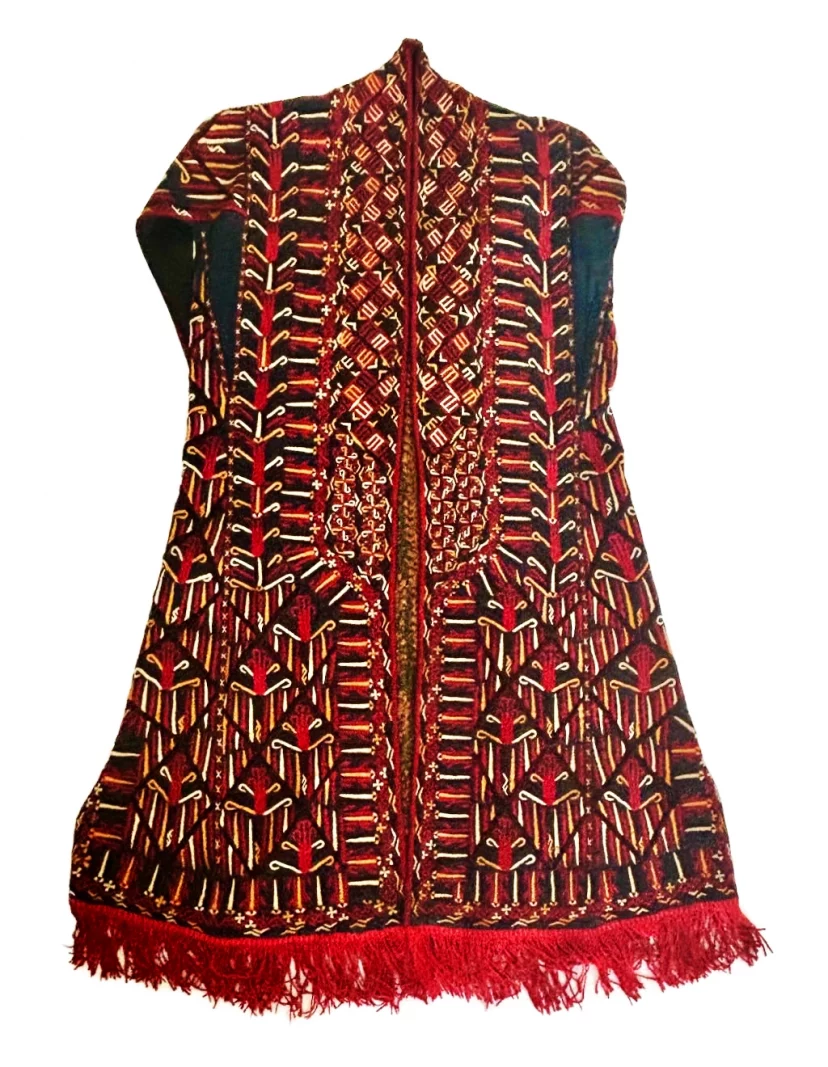
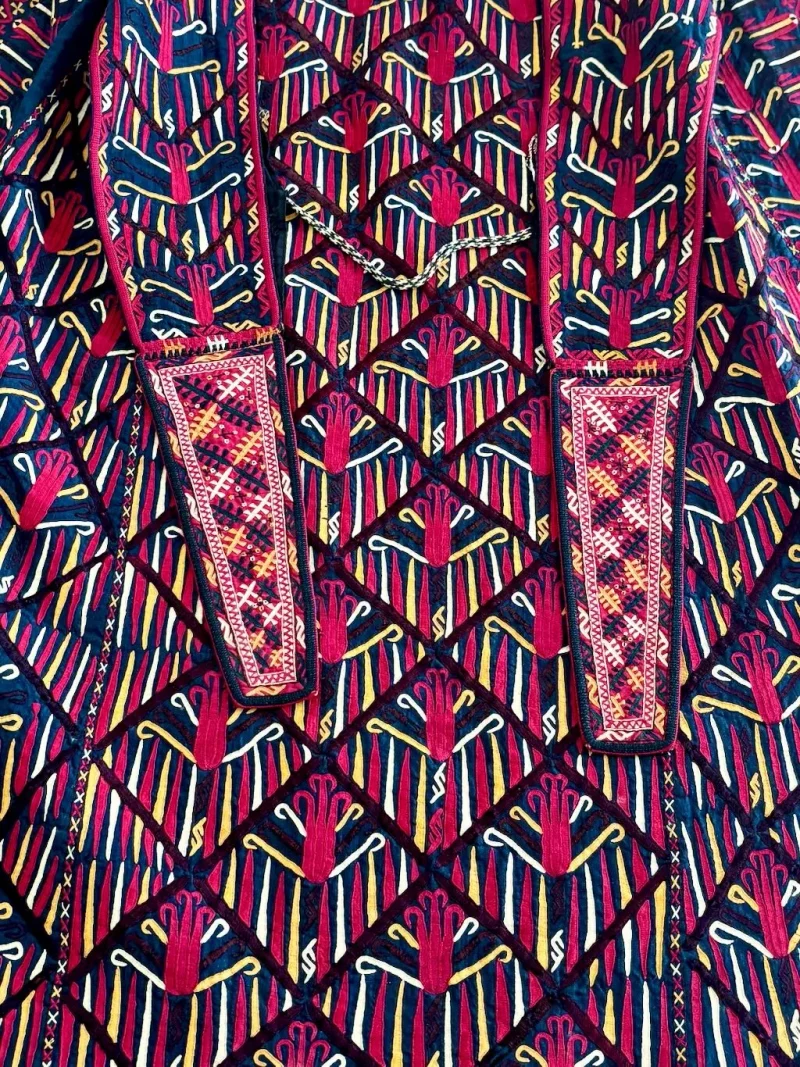
One of the defining features of these mantles is the kesdi embroidery technique. Rather than filling large areas with dense stitching, Tekke women carefully laid brightly colored silk threads across the fabric and secured them with fine couching stitches. This method produced crisp geometric forms and floral motifs while allowing the rich colors of the silk to remain vibrant. The technique also created a subtle raised texture that catches the light and gives the embroidery remarkable depth.
Silk played an essential role in the overall appearance of the mantle. The brilliant reds, yellows, greens, and blues stand out dramatically against the dark ground of garments made for younger women. Even after more than a century, well-preserved examples continue to display the remarkable brilliance that made these ceremonial textiles so admired.
The embroidery itself tells a story of countless hours of careful work. Every motif required precise planning because symmetry was essential to the finished design. Although individual artisans introduced small variations, experienced embroiderers maintained a remarkable consistency that immediately identifies authentic Tekke workmanship. This attention to detail explains why collectors and museums regard surviving nineteenth-century examples as both important ethnographic artifacts and exceptional works of textile art.
The craftsmanship becomes even more impressive when viewed at close range. Tiny stitches remain remarkably even, while each embroidered band follows the garment with precision. The overall effect appears effortless, yet every section reflects hundreds of deliberate decisions made by the embroiderer. Together they transformed a ceremonial mantle into a lasting expression of Tekke artistic identity.
Tulips, Geometry, and the Language of Symbolism
The embroidery decorating a Tekke chyrpy reflects far more than artistic taste. Every carefully placed motif carried meaning that members of the Turkmen community understood immediately. Together, the flowers, geometric forms, and repeated patterns expressed ideas about prosperity, protection, family, and the natural world. While modern viewers often admire these designs for their beauty alone, nineteenth-century Tekke women recognized them as part of a rich visual language that connected generations.
Among all the decorative motifs, the tulip holds a special place. Museum collections and textile scholars consistently identify it as the most common design found on surviving chyrpy. The tulip grew abundantly across the grasslands and mountain foothills of Central Asia, where its brilliant spring blossoms became closely associated with renewal, fertility, and abundance. By incorporating stylized tulips into ceremonial garments, embroiderers celebrated both the beauty of nature and the hope for a prosperous future.
Although each artisan interpreted the flower slightly differently, the tulip rarely appears as a realistic botanical illustration. Instead, Tekke women transformed it into elegant geometric forms that could repeat rhythmically across the surface of the mantle. This stylization created balance and harmony while preserving the symbolic meaning behind the design. The result combines artistic refinement with cultural tradition, allowing the embroidery to remain visually striking even from a distance.
Geometric motifs play an equally important role throughout the composition. Symmetrical arrangements, repeated borders, and carefully ordered bands create a sense of structure that reflects the disciplined craftsmanship of the embroiderer. Rather than filling every available space, the designs establish a deliberate rhythm that guides the eye naturally across the garment. This thoughtful balance gives the chyrpy its unmistakable elegance.
Many scholars also believe that repeated geometric forms carried protective significance. Throughout Central Asia, embroidered garments often combined beauty with symbolism, and decorative motifs were thought to offer blessings, prosperity, or protection for the wearer. While the precise meaning of individual patterns has not always survived, the tradition of using embroidery to express both artistic and spiritual values remained deeply rooted in Turkmen culture.
The symbolism becomes even more meaningful when viewed alongside the mantle’s ceremonial role. A chyrpy accompanied important moments in a woman’s life, m
How a Tekke Woman Wore the Chyrpy
The Tekke Turkmen chyrpy did not function as an ordinary robe or coat. Instead, it formed the final and most visible layer of an elaborate ceremonial costume that reflected a woman’s age, family, and social standing. Understanding how the mantle was worn helps explain its unusual construction and reveals why its decorative sleeves remained an essential feature long after they ceased to serve a practical purpose.
A woman first dressed in her kurta, the traditional long tunic worn over loose trousers. She then added the remarkable silver jewelry that formed one of the most impressive elements of Tekke ceremonial dress. Large breast ornaments, necklaces, amulets, and other silver pieces often covered much of the front of the costume. These ornaments displayed the family’s prosperity while also serving as protective talismans believed to bring health, fertility, and good fortune.
Only after the clothing and jewelry were in place did the woman drape the chyrpy over her head and shoulders. Rather than putting her arms through the sleeves, she allowed the mantle to rest lightly across the upper body like a ceremonial cape. The long false sleeves hung gracefully behind her, joined by an embroidered connecting band that created one of the garment’s most distinctive features.
This method of wearing the chyrpy achieved both practical and artistic goals. It framed the richly embroidered mantle without concealing the magnificent silver jewelry beneath. The brilliant silk embroidery, the polished silver ornaments, and the colorful garments worked together as a unified composition. Every element complemented the others, creating an appearance that immediately identified the wearer as a member of the Tekke community.
Historical photographs from the late nineteenth century, together with surviving museum examples, confirm this elegant style of dress. They show the mantle resting over the head while the jewelry remains fully visible across the chest. Once viewed in this way, the unusual proportions of the chyrpy become easy to understand. The false sleeves no longer appear mysterious or impractical. Instead, they become graceful decorative elements that add movement and dignity to the entire costume.
Although the chyrpy accompanied important celebrations throughout a woman’s life, newly married women often wore it more frequently during the early years of marriage. As time passed, the mantle became increasingly associated with weddings, festivals, and other formal occasions. Because families carefully preserved these ceremonial textiles, many surviving examples remain in remarkably good condition despite their considerable age.
Today, the chyrpy offers more than a glimpse into historic clothing traditions. It demonstrates how textiles, jewelry, and craftsmanship combined to express identity, artistry, and cultural continuity. Each surviving mantle tells the story of the women who embroidered it and the generations who preserved it, allowing modern collectors to appreciate one of Central Asia’s most distinctive ceremonial traditions.
Why Authentic Tekke Chyrpy Have Become So Rare
Authentic nineteenth-century Tekke chyrpy have become increasingly difficult to find. Unlike many traditional textiles that continued into the twentieth century or experienced later revivals, the chyrpy gradually disappeared from everyday life during the early decades of the twentieth century. As social customs changed and Central Asia underwent profound political and cultural transformation, the tradition of producing these ceremonial mantles slowly came to an end.
Unlike carpets, which remained practical household objects, a chyrpy served a highly specific ceremonial purpose. Families treasured these mantles because they represented important milestones in a woman’s life and often preserved them for future generations. Nevertheless, time eventually took its toll. Daily wear, changing fashions, environmental conditions, and the natural aging of textiles caused many examples to disappear. Others were altered, damaged, or simply discarded as their original purpose faded from memory.
As surviving examples became scarcer, museums and private collectors began to recognize both their artistic and historical importance. Today, important nineteenth-century chyrpy reside in the permanent collections of institutions including the Metropolitan Museum of Art in New York, the Museum of Fine Arts, Houston, the Victoria and Albert Museum in London, the Cleveland Museum of Art, the Museum of Anthropology at the University of British Columbia, and the Powerhouse Museum in Sydney. These collections help preserve an important chapter in the textile history of Central Asia while making these remarkable garments available for study by future generations.
Museum collections also reveal the remarkable consistency of Tekke craftsmanship. Although each mantle displays individual artistic choices, they share the same distinctive silhouette, false sleeves, silk kesdi embroidery, and symbolic use of color. Together they illustrate a tradition that remained remarkably faithful to its cultural roots for generations.
Because relatively few examples survive in excellent condition, collectors increasingly appreciate the rarity of authentic nineteenth-century chyrpy. Well-preserved mantles with vibrant silk embroidery, complete decorative elements, and documented provenance rarely appear on the market. When they do, they attract interest not only from textile specialists but also from collectors of tribal art, Islamic art, ethnographic material, and Central Asian history.
Today, every authentic Tekke chyrpy represents more than an antique textile. It preserves the artistic achievements of generations of Turkmen women while offering a tangible connection to a ceremonial tradition that has largely disappeared. Each surviving mantle reminds us that some of the world’s most extraordinary works of textile art were created not for museums, but for the important moments of everyday life.
Collecting Antique Tekke Turkmen Chyrpy Today
Collectors increasingly recognize the Tekke chyrpy as one of Central Asia’s most significant surviving ceremonial textiles. Its appeal extends far beyond its decorative beauty. Every authentic mantle reflects the remarkable embroidery skills of Tekke women, preserves traditions that evolved over centuries, and provides insight into a society where clothing communicated identity, status, and cultural values.
Authenticity remains the first consideration when evaluating a chyrpy. Nineteenth-century examples display hand-woven silk, traditional kesdi embroidery, and the distinctive false sleeves that immediately identify the garment. They also reveal the subtle irregularities expected of entirely handmade work. Small variations in stitch placement, motif spacing, and woven fabric remind us that skilled artisans created each mantle individually rather than through mechanical production.
Condition naturally influences both historical importance and collector interest. Because these ceremonial mantles often remained within families for generations, many examples show careful repairs, minor wear, or sympathetic conservation. Such evidence does not diminish their significance. Instead, it often reflects a garment that people valued and preserved throughout its working life. Collectors generally pay closer attention to the quality of the embroidery, the survival of the original construction, and the overall visual integrity than they do to the absence of every small imperfection.
Provenance can also play an important role. A documented history of ownership helps establish confidence while connecting the textile to the broader story of Central Asian collecting. During the twentieth century, many important tribal textiles entered private collections through established antique dealers in Iran, where centuries of cultural exchange brought together Persian, Turkmen, and Central Asian works of art. When a chyrpy retains a well-documented history, it offers collectors an additional level of confidence that extends beyond the object itself.
Museum collections continue to shape the way collectors evaluate these remarkable textiles. Institutions such as the Metropolitan Museum of Art, the Victoria and Albert Museum, the Museum of Fine Arts, Houston, the Cleveland Museum of Art, the University of British Columbia Museum of Anthropology, and the Powerhouse Museum have preserved outstanding examples for study and exhibition. Their collections provide valuable reference points for construction, embroidery techniques, materials, and ceremonial use, allowing collectors to compare privately owned examples with well-documented museum pieces.
Perhaps the greatest appeal of a nineteenth-century Tekke chyrpy lies in its ability to bridge art, history, and cultural identity. It stands comfortably alongside important tribal carpets, Central Asian jewelry, and Islamic textiles while remaining unlike any of them. The mantle represents a tradition that has largely disappeared, yet it continues to tell the story of the women who embroidered it, the families who treasured it, and the communities that preserved its meaning across generations.
Today, collectors do more than acquire an exceptional textile. They become custodians of a remarkable artistic legacy that continues to inspire scholars, museums, and admirers of Central Asian culture throughout the world.
Conclusion
The Tekke Turkmen chyrpy represents one of the most remarkable surviving textile traditions of Central Asia. Although its elegant silhouette and brilliant silk embroidery immediately capture the eye, its true significance extends much further. Every mantle reflects the artistry of the women who embroidered it, the customs that shaped Turkmen society, and the ceremonial occasions that marked the important milestones of life. Together, these elements transformed a beautifully crafted textile into a powerful expression of identity, family, and tradition.
Today, authentic nineteenth-century examples have become increasingly scarce. Museums around the world continue to preserve outstanding chyrpy because they recognize their importance not only as exceptional works of textile art but also as valuable records of Central Asian cultural history. Their collections ensure that future generations can continue to study the remarkable craftsmanship, symbolism, and ceremonial traditions embodied in these extraordinary mantles.
Private collections also play an important role in preserving this heritage. Carefully documented examples with established provenance provide collectors with an opportunity to become custodians of an artistic tradition that has largely disappeared. Every surviving chyrpy tells its own story through its silk embroidery, carefully chosen colors, and distinctive construction, preserving the creative achievements of the Tekke women who produced them more than a century ago.
The Bernardi Family Collection includes an exceptional late nineteenth-century Tekke Turkmen chyrpy acquired from an antique dealer in Tehran during the 1960s. Its richly embroidered silk decoration, traditional kesdi embroidery, and excellent state of preservation beautifully illustrate many of the characteristics discussed throughout this article. If you would like to see a documented example in greater detail, we invite you to explore our companion listing, where we examine its history, craftsmanship, construction, and provenance.
Whether admired as a masterpiece of textile art, appreciated as an important ethnographic artifact, or collected as part of a broader interest in Central Asian culture, the Tekke chyrpy remains one of the finest surviving expressions of Turkmen artistic tradition. More than a century after many of these remarkable mantles were embroidered, they continue to connect us with the lives, skills, and enduring legacy of the women who created them.