

Description
Mid-Century Persian Siyah-Qalam Miniature Painting on Ivorine Signed Dehghani Iran c. 1950s–1960s
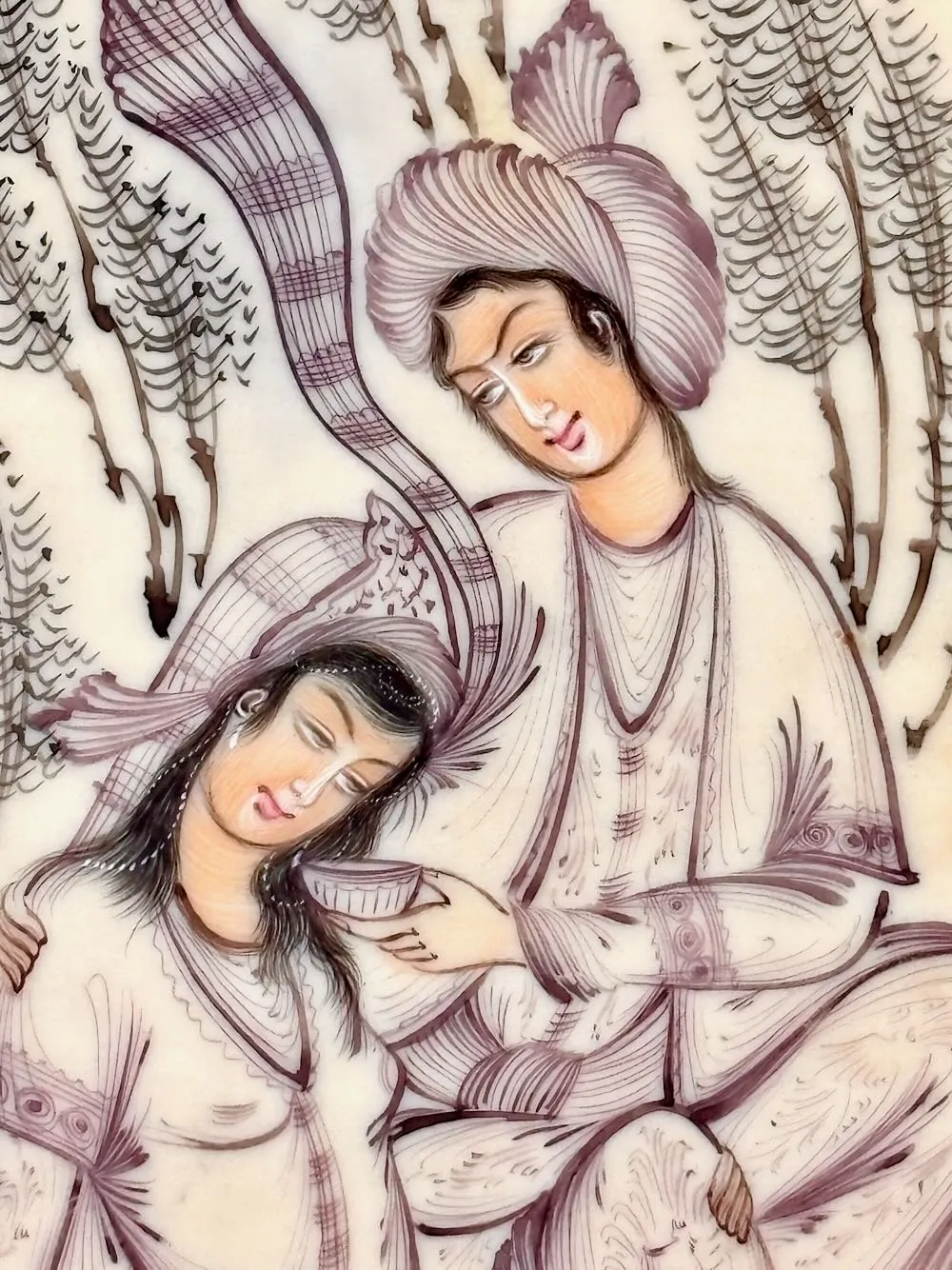
This refined Persian miniature painting captures a romantic couple seated quietly beneath slender stylized trees, rendered in the lyrical Siyah-Qalam tradition that remained deeply admired in Iran throughout the 20th century. Unlike brightly colored commercial miniatures produced primarily for the tourist trade, this work relies on delicate aubergine-toned linework, subtle shading, and emotional restraint to create a far more intimate and poetic atmosphere.
The painting belongs to a long artistic tradition rooted in Persian literature, court culture, and miniature painting ateliers of Isfahan and Tehran. Scenes of lovers in gardens symbolized refinement, beauty, contemplation, and the poetic world celebrated in Persian literature, from Omar Khayyam’s quatrains to the romances of Nezami and the lyrical poetry of Hafez and Saadi.
A Sophisticated Example of Siyah-Qalam Technique
One of the most fascinating aspects of this painting is its restrained palette. The artist intentionally avoided heavy color application and instead focused on extraordinarily fine brushwork using soft plum, sepia, and aubergine tones. This approach relates closely to the Persian Siyah-Qalam tradition, literally meaning “black pen” or “black brush,” where line, rhythm, and shading become more important than strong color.
The faces and hands receive delicate flesh tones while the garments, trees, and flowing fabrics are largely created through linework and transparent washes. Persian artists sometimes referred to this softer selective-color approach as Nim-Rang, or “half-color,” where controlled restraint creates elegance and refinement.
The result is remarkably graceful. The eye moves naturally through the composition, following the flowing scarves, elongated figures, and rhythmic trees behind the couple. The reddish-purple hue visible throughout the linework softens the composition considerably compared to stark black ink and gives the painting an unmistakably romantic atmosphere.
Painted on Ivorine
The painting is likely executed on ivorine, a polished ivory substitute widely used by Iranian miniature artists during the mid-20th century. During the 1940s through the 1970s, many artists in Isfahan and Tehran increasingly adopted ivorine panels because they offered several practical and artistic advantages.
The material provided a smoother and more consistent surface than natural bone while also avoiding the expense and scarcity of ivory. Its slightly luminous surface allowed artists to achieve extraordinarily fine detail and controlled brush movement, particularly important in miniature painting where precision is essential.
The warm undertone and subtle translucency visible in this example strongly support a mid-century ivorine identification. Today, ivorine pieces are often preferred by collectors because they preserve the historical aesthetic of ivory miniatures without the legal complications associated with genuine ivory.
Signature and Artistic Attribution
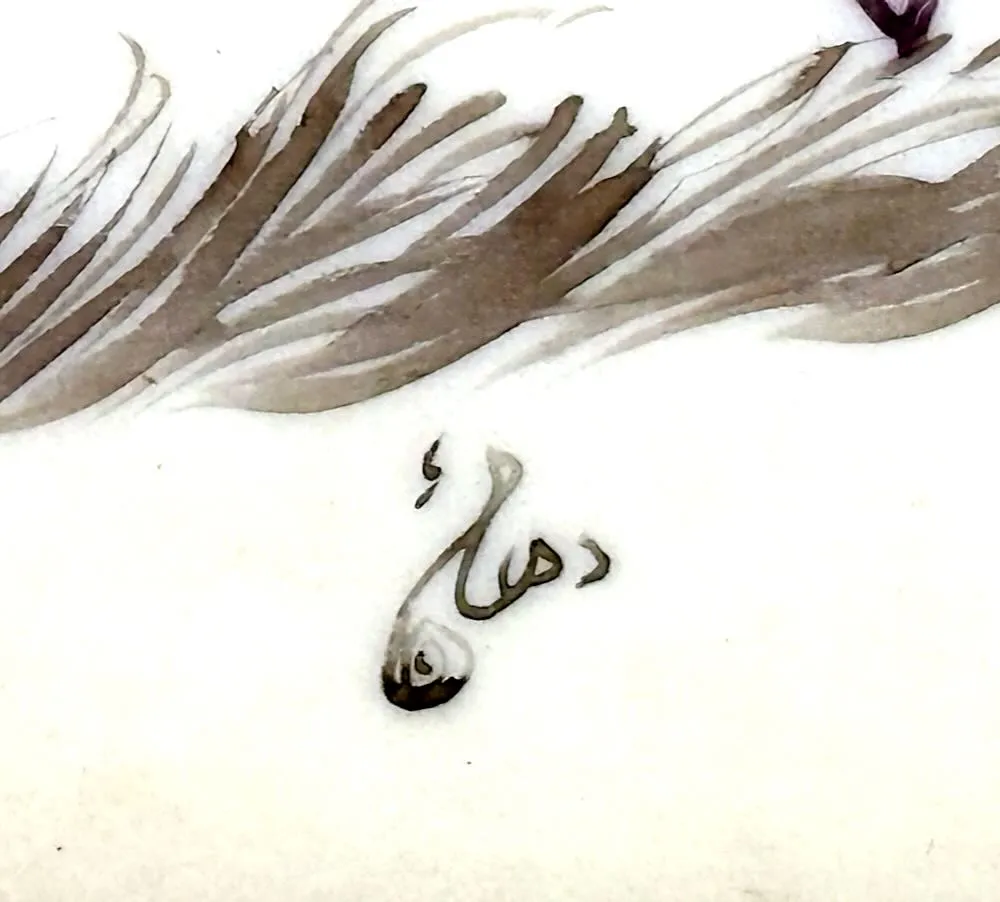
The work appears to be signed in Persian script, likely reading “Dehghani” (دهقانی). While no widely documented master miniature painter by this exact name currently appears in major Western references, this is not unusual within Persian miniature traditions.
Many highly skilled Iranian miniature painters worked within local ateliers, family workshops, and regional artistic communities without becoming internationally catalogued artists. In Persian miniature painting, collectors often evaluate quality, refinement, subject matter, and execution more heavily than celebrity attribution alone.
The confident signature, refined brush control, and balanced composition suggest the hand of an experienced studio artist trained within established Persian miniature traditions rather than an amateur or mass-production workshop.
Original Tehran Framing and Provenance
Equally important is the painting’s untouched period presentation. This miniature was acquired in Iran during the late 1960s and remained part of the Bernardi Family Collection alongside other Persian artworks and decorative objects collected directly in Iran over several decades.
The painting retains its original Tehran framing and mounting. While the backing board shows expected dust accumulation and age from more than half a century of preservation, the painting itself remains in very good vintage condition. The original presentation contributes authenticity and historical character that would be diminished through aggressive restoration or reframing.
Unlike pieces purchased solely as export souvenirs, this miniature formed part of a privately displayed family collection assembled in Iran itself. That context gives the work additional cultural authenticity and historical interest.
The Enduring Appeal of Persian Miniatures
Persian miniature paintings continue to fascinate collectors because they combine extraordinary technical precision with emotional subtlety and poetic atmosphere. Even relatively small works invite prolonged viewing. Tiny details reveal themselves gradually through careful observation: the delicate facial expressions, flowing garments, rhythmic tree forms, and controlled linework all contribute to the composition’s quiet elegance.
This example beautifully reflects the enduring appeal of mid-century Iranian miniature painting — traditional in inspiration yet unmistakably modern in its restraint and sophistication. The soft aubergine linework, intimate composition, and graceful execution create a work that feels both decorative and deeply contemplative.
It is a charming and authentic example of Persian miniature art from a period when Iranian artists continued to reinterpret centuries-old traditions for modern collectors and interiors while preserving the elegance and discipline of classical Persian painting.