

Description
Early Persian Shikar Hunting Scene Hand-Painted on Bone
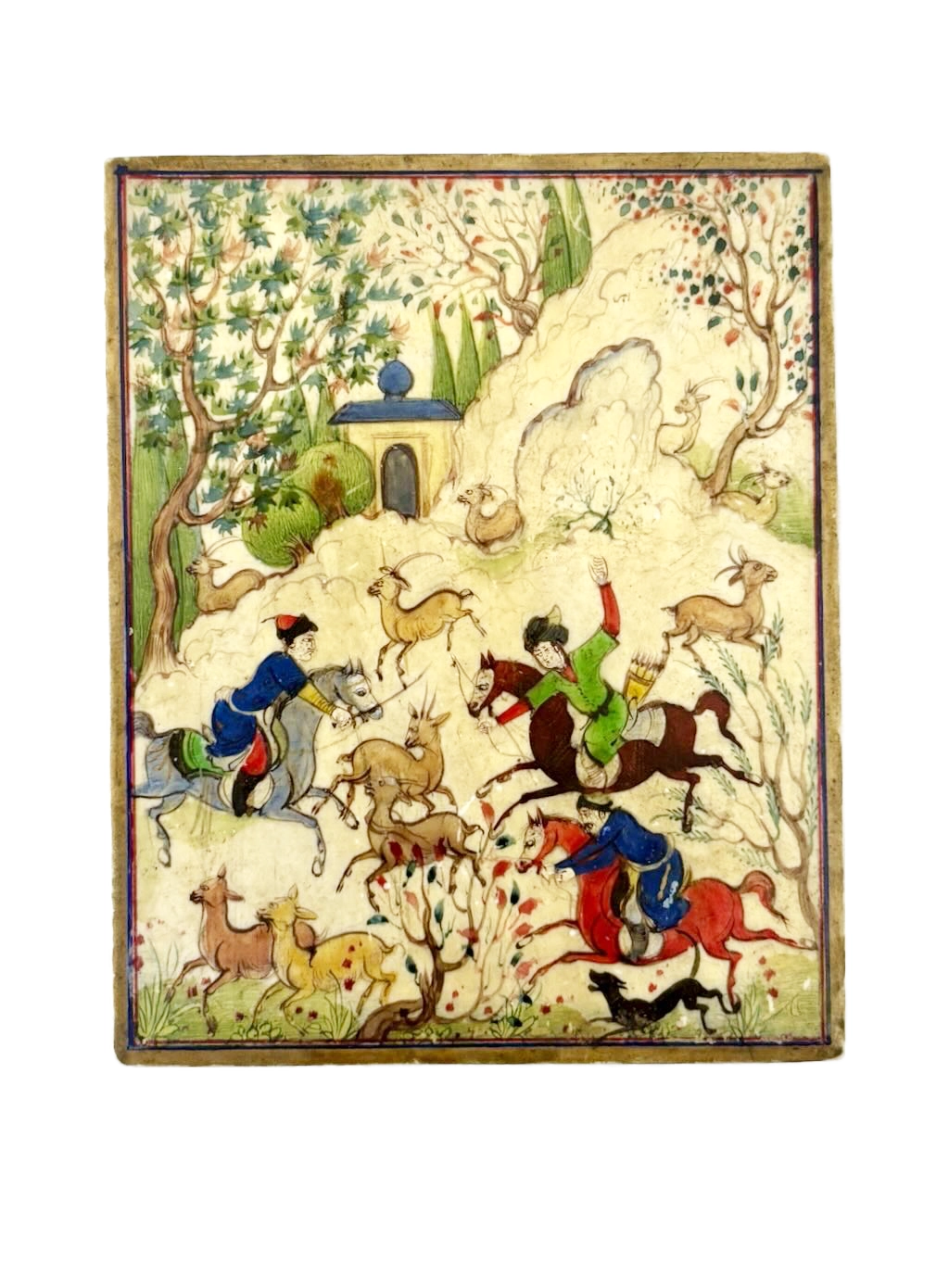
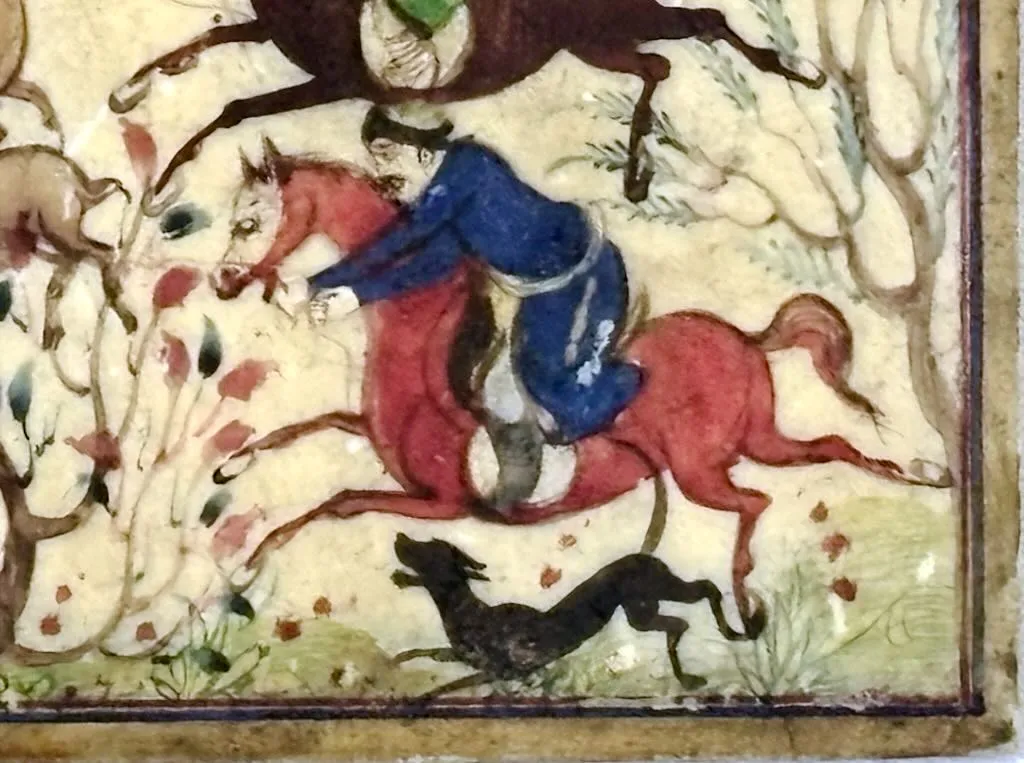
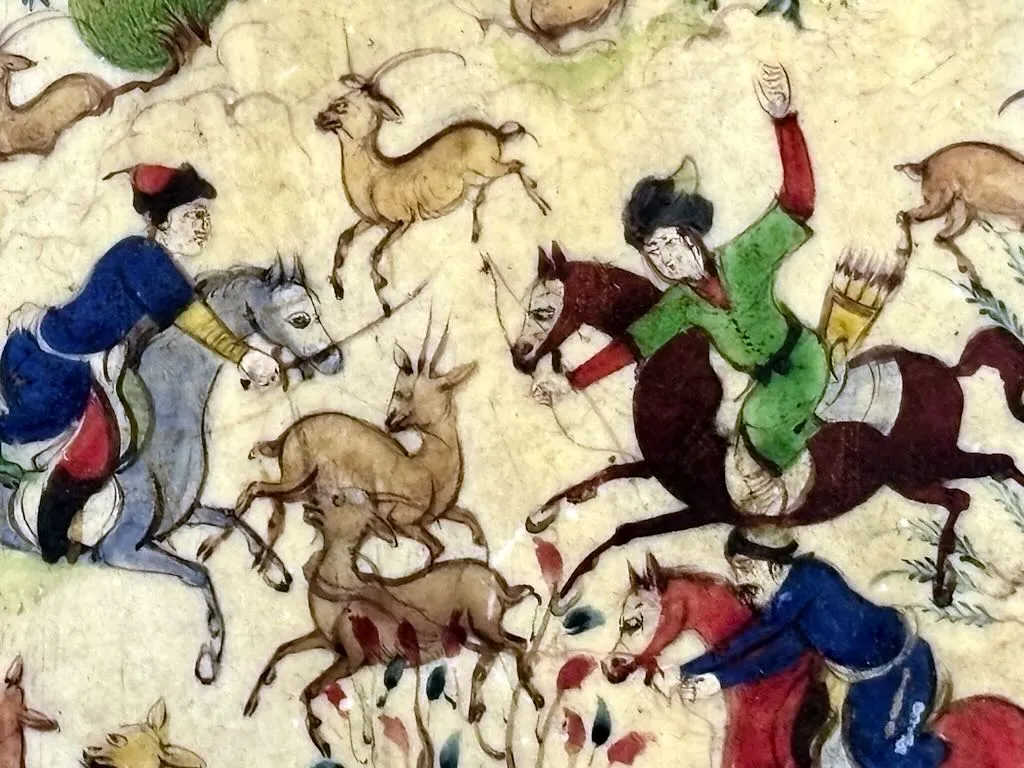
Few subjects capture the energy and elegance of Persian miniature painting as effectively as the traditional Shikar, or hunt. In this early twentieth-century miniature, mounted horsemen pursue gazelles through an imagined Persian landscape while a black hunting dog races beneath the action. Trees, rocky formations, flowering vegetation and a small architectural pavilion complete a composition that combines movement with the highly decorative character associated with Persian painting.
The artist painted the scene directly onto a polished bone panel measuring approximately 2.75 × 3.5 inches (7 × 8.9 cm). Despite its compact dimensions, the composition contains an extraordinary amount of activity. Riders approach from different directions, animals leap through the terrain, and the landscape rises behind them to create a sense of depth. As a result, the eye travels naturally from the energetic hunt in the foreground toward the quieter garden architecture and trees above.
Unlike the long horizontal hunting miniature from the same family collection, this example uses its vertical format to build the scene upward. The artist does not simply compress a panoramic hunt into a smaller space. Instead, the landscape becomes an active part of the composition, separating the riders and animals into different visual levels while still connecting every element into a continuous narrative.
Shikar and the Persian Tradition of the Hunt
The Persian word Shikar refers to hunting, a subject with a long history in Iranian art and literature. Royal hunts appeared in Persian manuscripts, paintings, metalwork, ceramics and textiles for centuries because the subject offered artists much more than an opportunity to portray sport.
Hunting carried associations with kingship, courage, physical skill and horsemanship. Persian rulers often treated the hunt as an extension of courtly and military culture, while artists used hunting scenes to portray the controlled relationship between the rider, the horse and the natural world.
Consequently, Persian miniature painters developed an exceptionally rich visual language around the hunt. Galloping horses, fleeing gazelles, archers, hunting dogs and idealized landscapes could all appear within a single composition. Artists frequently arranged several moments of action at once rather than limiting the scene to a single instant. This approach allowed a small painting to function almost like a visual narrative that unfolds as the viewer studies it.
This miniature continues that tradition. The horsemen do not form a rigid procession. Instead, each rider occupies a different position and angle, creating a lively interaction between figures and animals. The gazelles move through the composition in several directions, while the black dog at the lower edge strengthens the sense of pursuit.
A Landscape Designed Around Movement
The vertical format gives this particular Shikar scene much of its character. The painter places the most energetic action in the lower half, where mounted hunters converge around the animals. Above them, the landscape opens into rocky hills, trees and architecture.
That contrast creates visual rhythm. The densely populated lower area conveys speed and pursuit, while the upper landscape gives the composition space to breathe. Furthermore, the pavilion with its blue-domed roof introduces a small architectural focal point that helps establish the scene as an idealized Persian garden landscape rather than an anonymous wilderness.
The trees also deserve attention. Their stylized foliage and slender forms do not attempt botanical realism. Instead, they organize the composition, frame the architecture and reinforce the decorative quality that distinguishes Persian miniature painting from Western approaches to landscape.
Likewise, the rocky forms rise through the centre of the painting almost like a visual pathway. They separate the riders without isolating them and carry the eye upward through the miniature.
Horses, Gazelles and the Hunting Dog
Animals play an especially important role in this scene. The horses convey considerable movement despite their small scale. Each appears at a different stage of the chase, and the artist alters their posture accordingly. Some stretch forward at speed, while others turn or climb through the landscape.
The gazelles provide another layer of motion. Their slender bodies and extended legs contrast with the heavier forms of the horses and make the quarry appear quick and elusive. Several occupy the rocky upper landscape, while others pass directly through the centre of the hunt.
At the bottom of the miniature, a black hunting dog runs beneath the red horse. Although tiny, this figure provides one of the most engaging details in the entire composition. Its dark silhouette immediately catches the eye and visually anchors the lower edge of the painting.
These small observations matter because Persian miniatures reward close inspection. The overall composition makes an immediate impression, yet the individual gestures, animals and landscape details reveal themselves gradually.
Hand-Painted on Natural Bone
The artist chose polished bone as the painting surface. Bone provided Persian miniature painters with a smooth, firm support capable of accepting very fine brushwork, while its naturally warm tone gave the finished painting a distinctive luminosity.
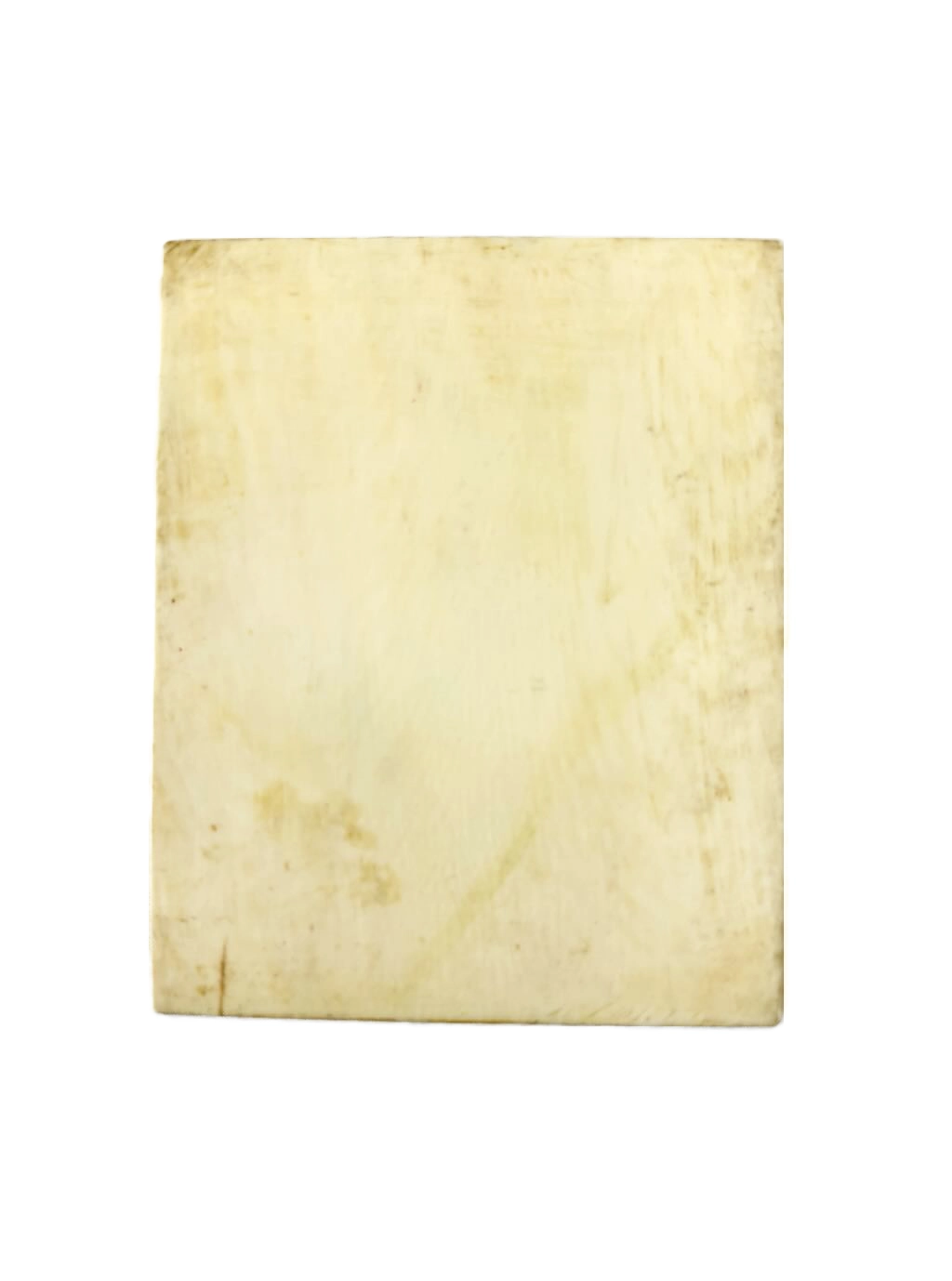
The bone remains visible around and beneath portions of the composition, and age has given the material a warm cream patina. Rather than concealing the substrate, the painter incorporated its tone into the overall colour balance of the work.
A narrow hand-painted gold border surrounds the scene and creates the effect of a miniature manuscript painting presented within its own decorative frame. Because the border forms part of the painted panel itself, the miniature remains visually complete even though it has never received an external frame.
Later twentieth-century Persian miniatures frequently appear on ivorine and other manufactured substitutes. Those materials can support attractive painting, but they have a distinctly different character from natural bone. This earlier panel retains the subtle irregularities, patina and tactile quality associated with an organic support.
For a more detailed discussion of the materials traditionally used for Persian miniature painting, our article Why Master Persian Miniature Artists Selected Bone, Ivory and Mother of Pearl examines bone, ivory, mother-of-pearl and later synthetic alternatives in greater depth.
Early Twentieth-Century Persian Workshop Painting
Although this miniature dates from the early twentieth century, its artist looked back to much older Persian painting traditions. The composition recalls the courtly hunting scenes associated with earlier manuscript painting, yet the artist adapted those conventions to a small independent bone panel intended to function as a complete work of art.
That continuity matters. Persian miniature painting did not simply disappear when royal manuscript production declined. Artists continued to preserve and reinterpret traditional subjects, particularly hunting scenes, courtly gatherings, literary episodes and equestrian subjects.
Works such as this miniature therefore occupy an interesting position. They preserve the visual language of earlier Persian painting while belonging to a later period when artists increasingly created independent decorative panels for collectors and patrons.
The result does not imitate Western painting. Instead, the artist maintains the flattened perspective, stylized landscape, brilliant colour and simultaneous narrative action that give Persian miniature painting its distinctive identity.
Why This Shikar Miniature Stands Apart
Several features make this example particularly engaging. First, the vertical composition differs from the more common elongated hunting panels and allows the landscape to become an integral part of the narrative. Second, the variety of animals gives the scene unusual richness. The horses, gazelles and hunting dog all contribute different forms of movement.
The architecture also adds another dimension. Rather than filling every inch with riders and quarry, the painter allows a quiet pavilion and garden landscape to appear above the hunt. This juxtaposition between courtly architecture and energetic pursuit gives the miniature a more complete sense of place.
Finally, the natural bone support contributes its own visual character. Its warm tone softens the palette while allowing the deep blue, green, red and earth colours to stand out clearly.
The miniature works equally well as an individual object or as part of a collection devoted to Persian painting, equestrian art or Iranian decorative arts. Because several related early bone miniatures from the same family collection depict different traditional subjects, collectors may also choose to build their own grouping while acquiring each work individually.
Condition and Preservation
The miniature remains in very good antique condition for its age. The colours retain considerable strength, and the detailed line work remains clearly visible throughout the composition. Light surface wear and natural patina reflect approximately a century of age and handling without overwhelming the painted scene.
The reverse shows the natural bone surface rather than a later backing, allowing the material itself to remain visible. The panel appears sound, and no obvious cracks or repairs appear in the photographs.
As with all early works painted on natural materials, careful handling and protection from prolonged direct sunlight, excessive humidity and abrupt environmental changes will help preserve both the bone and the painted surface.