


Description
Vintage Fenton Hobnail Milk Glass 3-Horn Epergne
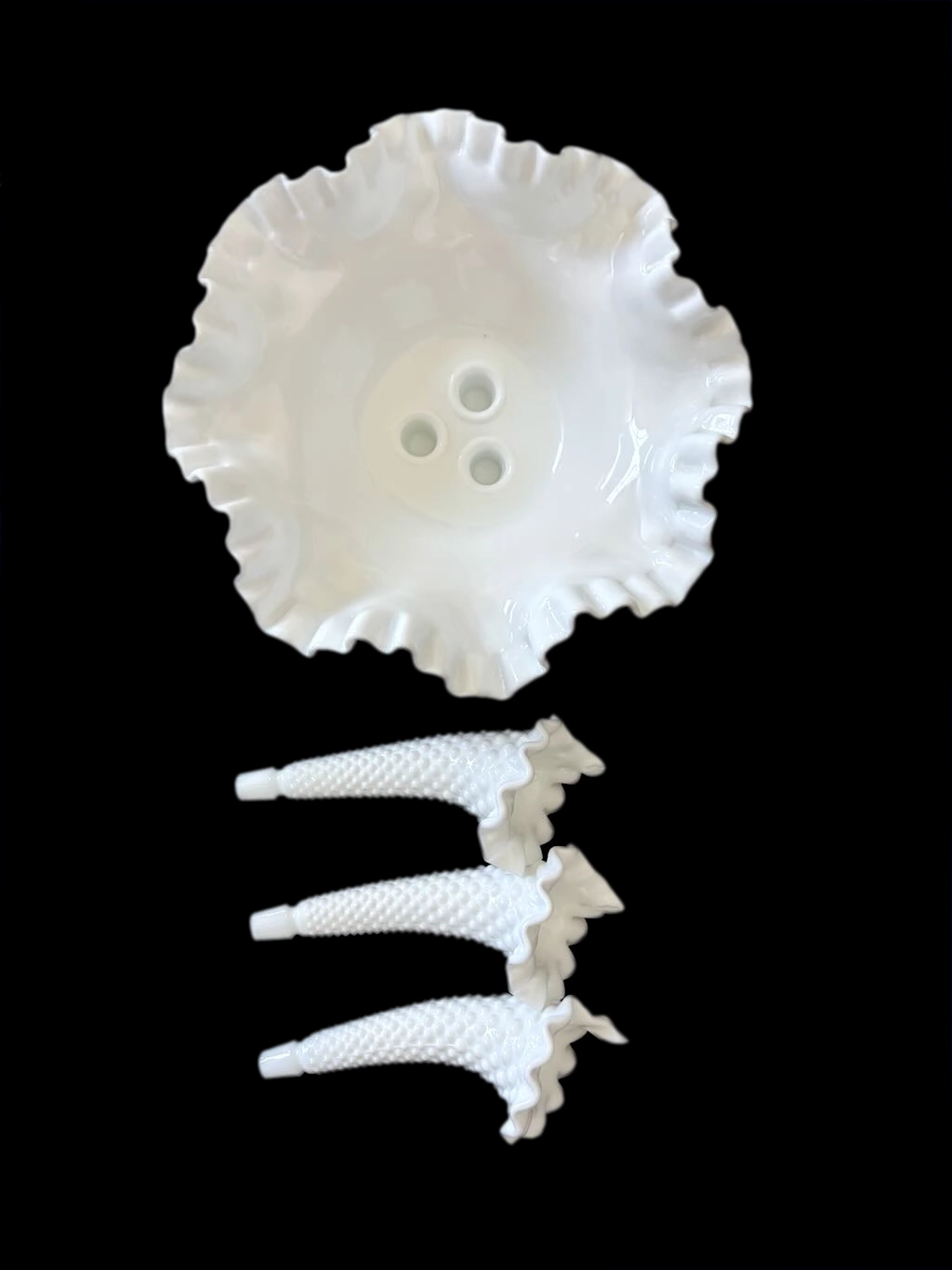
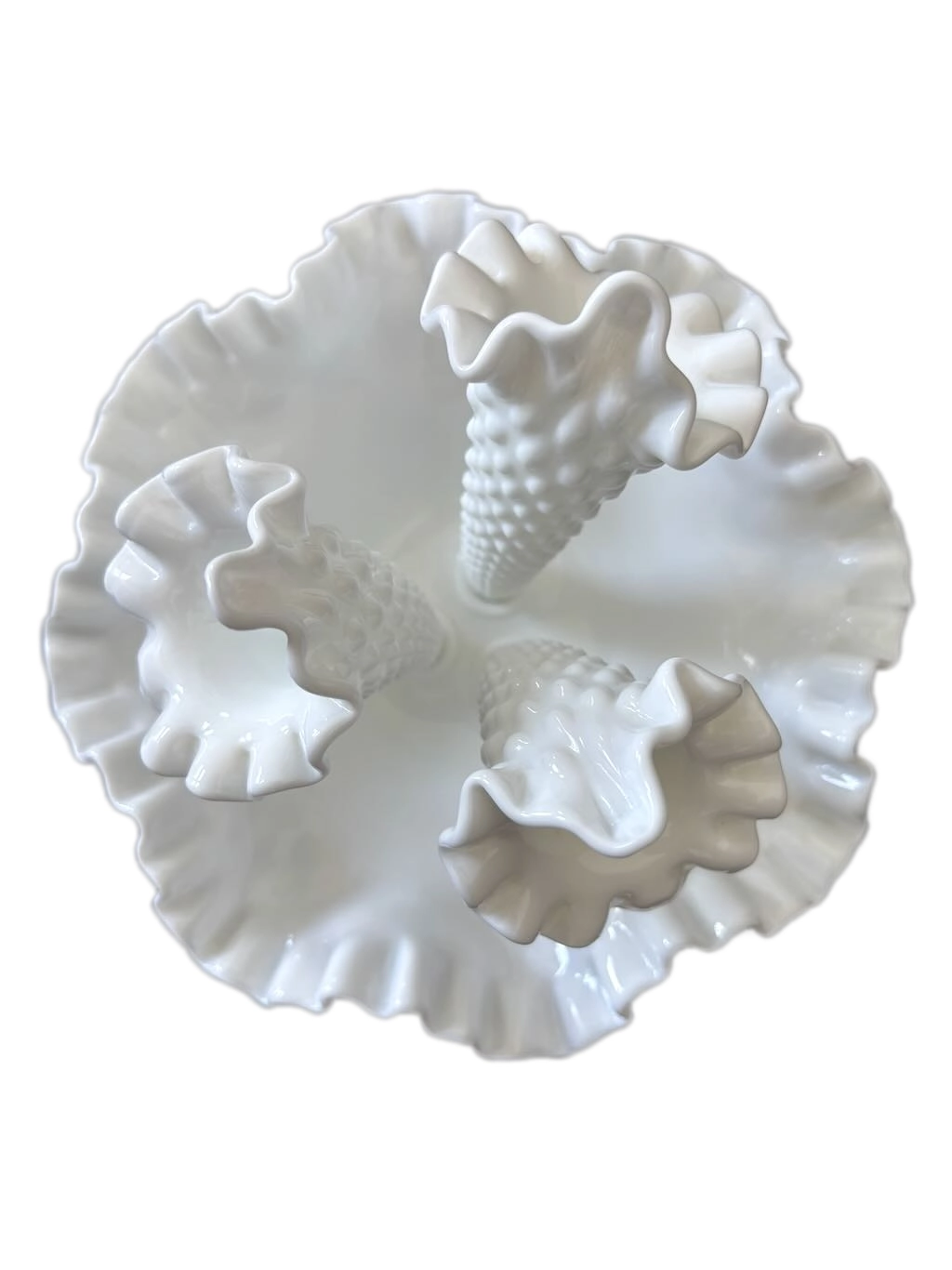
This Fenton Hobnail epergne transforms the familiar texture of white Hobnail milk glass into an elaborate four-piece floral centerpiece. The arrangement consists of a broad ruffled bowl fitted with three removable trumpet-form horn vases, each rising from the center and opening into a deeply ruffled mouth.
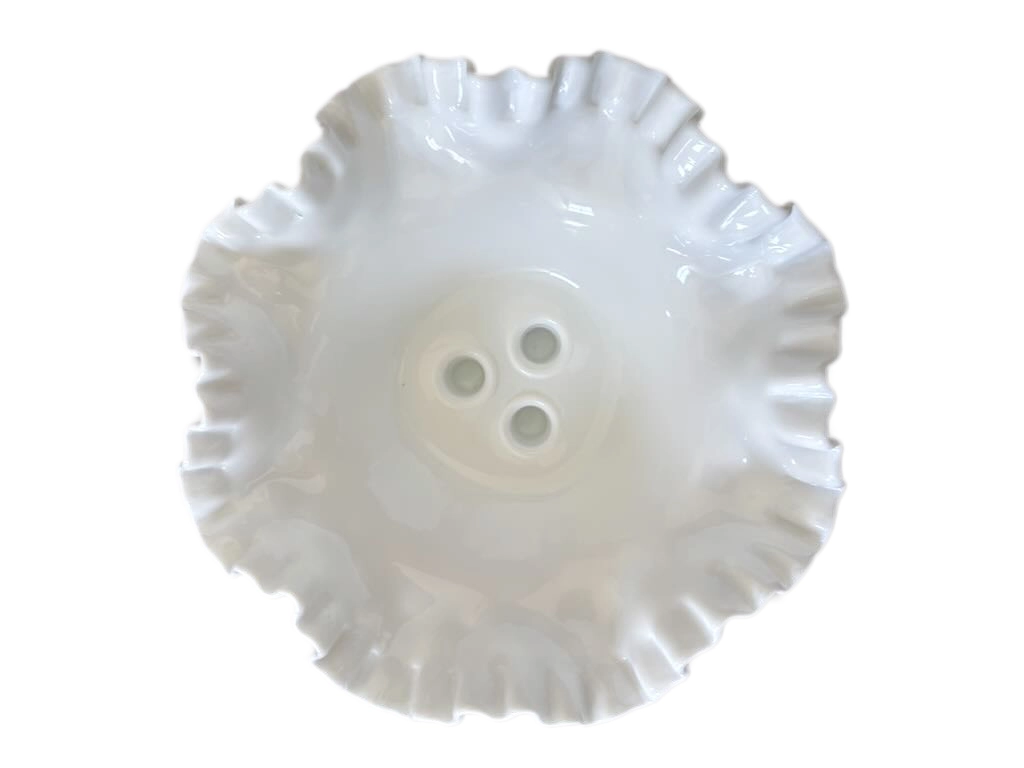
The bowl measures approximately 8.25 inches across and contains three integral sockets that securely receive the individual horns. Fully assembled, the epergne stands approximately 6.75 inches high.
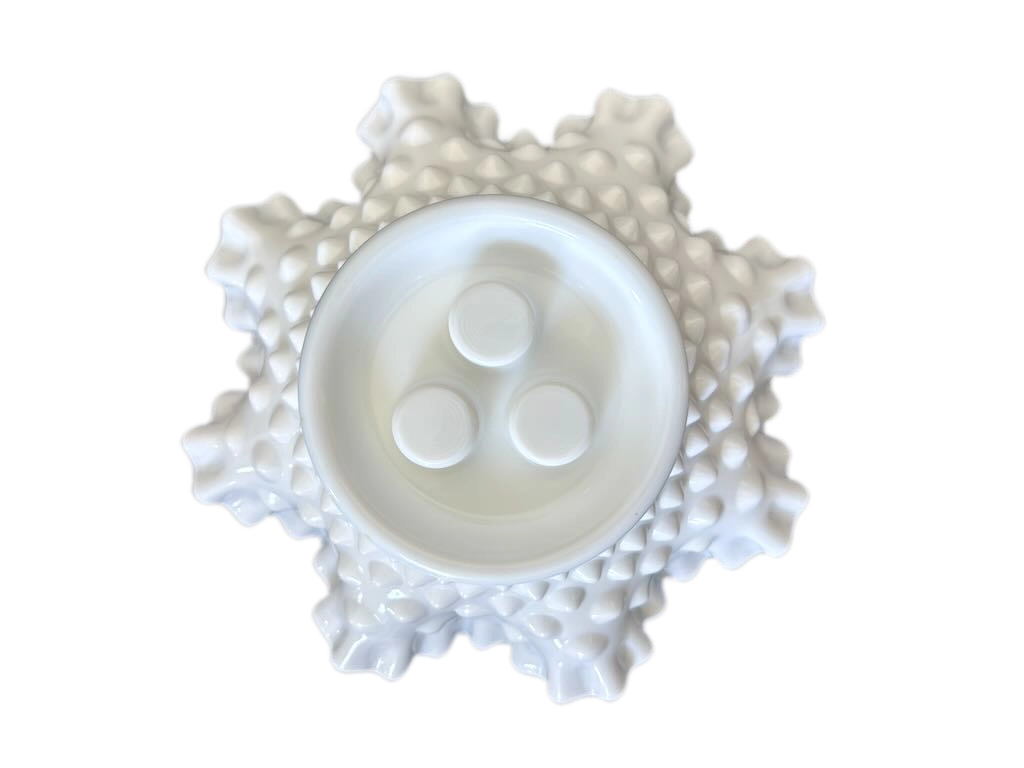
Dense rows of raised hobnails cover the exterior of the bowl and the tapering horns. In contrast, the interiors remain smooth and glossy. This example has a strongly opaque white appearance that emphasizes the shadows created by the Hobnail texture and the numerous folds of its ruffled edges.
Fenton Hobnail Milk Glass
The Fenton Art Glass Company became one of America’s best-known producers of decorative glass during the 20th century. Founded in 1905 by brothers Frank L. and John W. Fenton, the company produced an extraordinary range of colors, forms and surface treatments during its long history.
Hobnail became particularly closely associated with Fenton. Repeated raised projections create the characteristic textured surface, while hand-worked edges allowed glassworkers to introduce considerable variation and movement into bowls, vases and other decorative forms.
Opaque white milk glass proved especially effective for Hobnail designs. Its monochromatic surface allows light and shadow to define the individual projections and elaborate contours of the glass.
A Four-Piece Floral Centerpiece
An epergne traditionally serves as an ornamental table centerpiece, often combining several receptacles for flowers or other decorative arrangements. Fenton interpreted the form here with one large bowl and three individual removable horns.
Each tapering horn carries the Hobnail pattern along its exterior before expanding into a broad ruffled mouth. When all three are installed, the varying folds overlap visually with the ruffled bowl below, producing an abundant flower-like composition.
The horns can also be removed individually, revealing the three circular sockets incorporated into the center of the bowl. This removable construction makes the epergne both decorative and versatile while also allowing its four components to be handled separately.
Ruffled Bowl and Trumpet-Form Horns
The broad bowl rises from a circular foot and expands into a deeply undulating rim. Alternating folds create large projecting sections around its perimeter, while smaller fluted details add further movement to the edge.
The three matching horns repeat this treatment on a smaller scale. Their narrow bases fit into the bowl’s sockets, while their upper sections flare dramatically outward. Hobnails provide a regular geometric texture beneath the freely shaped ruffled mouths.
Together, the molded pattern and hand-worked edges give the assembled centerpiece a distinctly sculptural quality from every angle.
Dating This Fenton Hobnail Epergne
The epergne does not carry a molded Fenton signature that we can identify. Earlier Fenton glass commonly carried removable paper or foil labels, which frequently disappeared through decades of handling and washing.
Based on the Hobnail pattern, white milk glass, construction, form and absence of a molded signature, we believe this is a mid-20th-century Fenton example, probably produced before 1970. Without an original label or documented early purchase history, we prefer this broader dating rather than assigning the epergne to a particular decade.
Condition
This four-piece epergne remains in good vintage condition. The bowl and all three removable horns are present, and there are no chips.
The numerous ruffled edges, projecting folds and individual Hobnail elements have survived well. Minor surface wear consistent with age and previous use may be present. The photographs provide detailed views of the assembled centerpiece as well as its individual components and form an important part of the condition description.
Collecting Interest
Complete epergnes have particular visual appeal because their appearance depends on the relationship between several individual pieces. Here, three matching removable horns survive together with their original three-socket bowl, preserving the complete four-piece composition.
The relatively compact dimensions also make this an impressive centerpiece without requiring an unusually large table or display area. Flowers can be arranged among the three horns and surrounding bowl, while the piece remains highly decorative when displayed empty.
For collectors of Fenton, American art glass and vintage milk glass, the epergne offers an especially sculptural interpretation of the classic white Hobnail design.
Authenticity
We attribute this complete four-piece epergne to Fenton Art Glass Company based on its Hobnail pattern, white milk glass, construction, three-horn configuration, ruffled treatment and close comparison with known Fenton examples of the same form.
The epergne is unmarked and no original Fenton label survives. We therefore identify it through its physical characteristics and comparison with documented Fenton forms rather than representing it as a signed or labeled example.