
Description
Vintage Italian Sterling Silver Bas-Relief Jewelry Box with Wood Marquetry
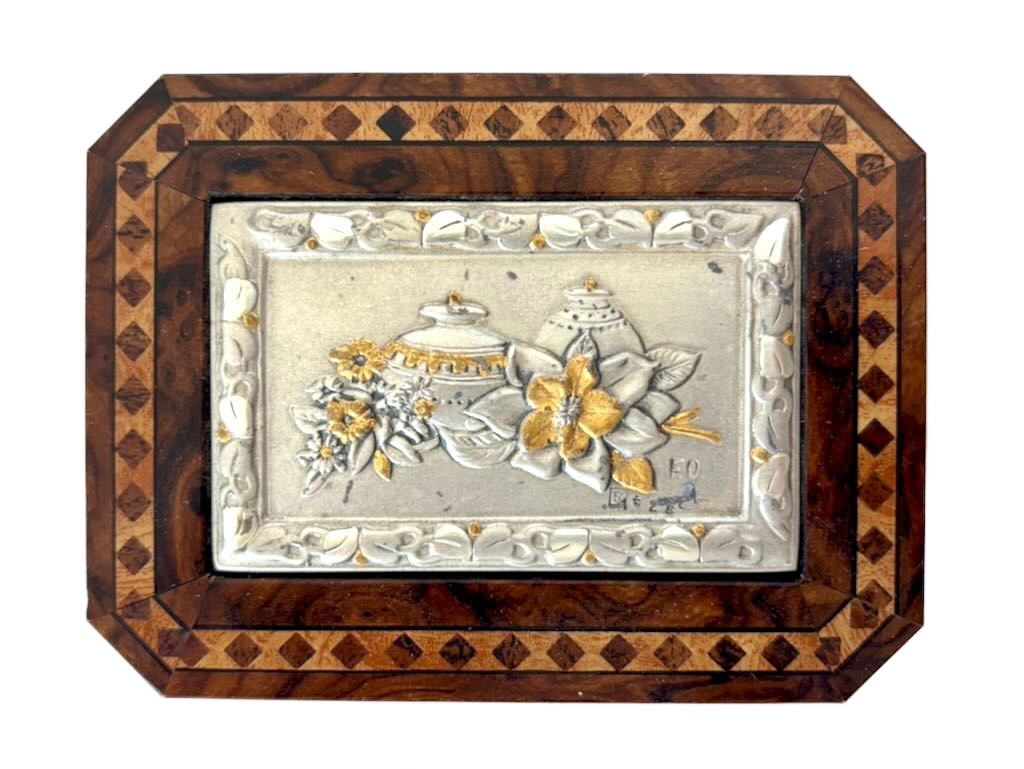
An elegant example of twentieth-century Italian decorative craftsmanship, this vintage jewelry box combines richly figured wood, geometric marquetry, and a finely detailed 925 sterling silver bas-relief accented with touches of gold. Signed F.O. and accompanied by its original Italian manufacturer’s certificate, the piece reflects the artistry and attention to detail associated with Italy’s decorative silverworking traditions.
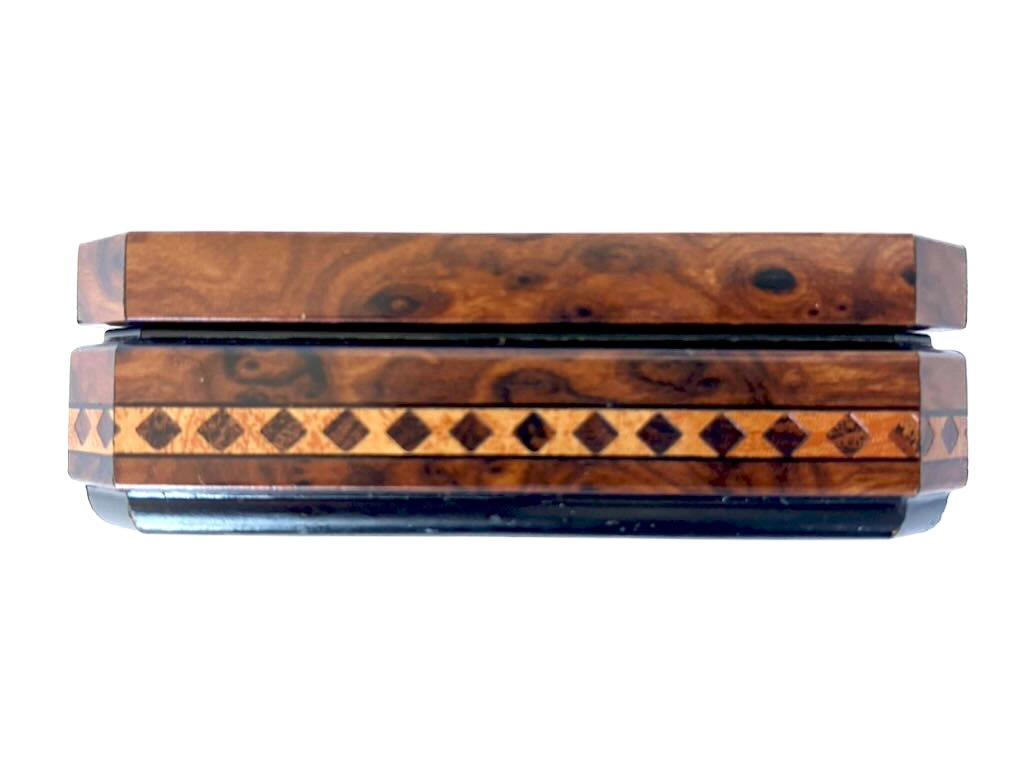
The rectangular box features distinctive clipped corners, giving its geometric form a softened, architectural character. Its lid displays warm, richly patterned wood framed by contrasting diamond-shaped inlays arranged in a continuous decorative border.
At the center, a raised sterling silver panel depicts a charming still life of two ornamental lidded vessels surrounded by flowers and foliage. Selective gold-colored highlights emphasize the blossoms, leaves, and details of the vessels, creating an attractive contrast with the softly luminous silver surface. An ornamental relief border surrounds the composition, while the natural figuring of the wood introduces warmth and visual depth.
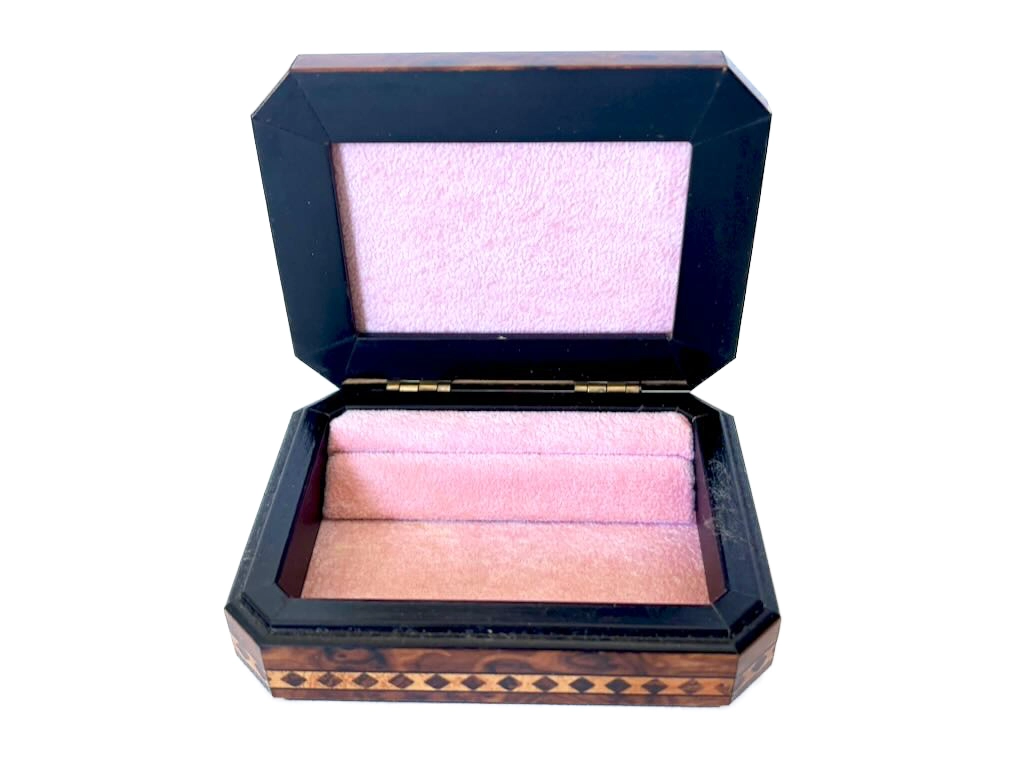
The hinged lid opens to reveal the original soft pink fabric lining, with a padded section suitable for rings, earrings, and other small personal treasures. Preserved unused since its acquisition in the 1980s, the box retains its original manufacturer’s label and accompanying Italian certificate. These surviving details add documentary interest to an already appealing decorative collectible.
F.O. and the Italian Ottaviani Silverworking Tradition
The silver panel bears the initials F.O., a mark associated with Italian decorative silverwork and attributed to Fratelli Ottaviani of Recanati, in the Marche region of Italy. The history of the Ottaviani enterprise extends to 1912, when Eraclio Ottaviani established a business in Recanati involving watches and related luxury goods. His son Romolo continued the family enterprise, expanding its activities into goldsmithing, silverwork, and decorative giftware.
During the twentieth century, the Ottaviani name became associated with Italian silver decorative objects, jewelry, and ornamental metalwork. The firm’s work reflects the broader Italian tradition of combining skilled craftsmanship with artistic design. Decorative reliefs, floral compositions, religious subjects, and ornamental objects formed part of the country’s flourishing silverworking and luxury giftware industries. Workshops combined traditional methods with contemporary designs, producing pieces intended both for everyday enjoyment and decorative display.
The F.O. signature, original registered-trademark label, and accompanying certificate support the attribution of this box to that decorative silverworking tradition. Although the initials are associated with Fratelli Ottaviani, the precise workshop attribution of this individual piece has not been independently established from a factory catalogue.
The Art of Italian Silver Bas-Relief
The original certificate describes the central decoration as bassorilievo in lamina argento 925, meaning bas-relief in 925 sterling silver sheet. Bas-relief is a sculptural technique in which figures and ornamental elements project from a relatively flat background. Artists have used this method for centuries in architectural decoration, religious art, medals, furniture ornament, and decorative metalwork.
In Italian silverworking, artisans can form thin sheets of precious metal over a prepared support or shaped relief, creating raised designs without the weight of a solid cast silver plaque. The resulting surface allows delicate modeling of flower petals, leaves, vessels, and ornamental details. Skilled engravers then refine the design with hand-finished lines and textures, giving the relief additional definition.
This jewelry box demonstrates the decorative possibilities of the technique. The flowers rise gracefully from the background, while the lidded vessels introduce a sense of classical still-life composition. The interplay of silver surfaces, shadowed recesses, and selective gold-colored accents gives the small panel an unusually rich appearance.
Floral Still Life and Probable Gilded Accents
The central composition features two covered decorative vessels accompanied by flowers and foliage. The vessels recall the elegant ornamental objects frequently depicted in European still-life painting and decorative arts. Their rounded forms and carefully modeled lids provide a pleasing contrast to the organic movement of the surrounding blossoms.
The flowers bring a softer, more romantic quality to the composition. Raised petals, layered leaves, and delicate stems create visual depth across the silver surface. Gold-colored highlights emphasize selected decorative details, particularly the blossoms and portions of the vessels. These accents appear consistent with selective gilding, although the precise finishing method and gold content have not been independently verified.
The surrounding floral border completes the composition, creating a miniature decorative panel that resembles a framed work of art. Rather than relying on the intrinsic value of silver alone, the appeal of the plaque lies in its design, sculptural modeling, and carefully finished ornamental details.
Italian Marquetry and Decorative Woodworking
The silver relief sits within a richly figured wooden lid surrounded by a geometric inlaid border. The contrasting light and dark diamond motifs create a rhythmic pattern around the central panel. This form of decorative woodworking belongs to the broader Italian tradition of intarsia, or marquetry, in which artisans arrange pieces of wood or veneer to create ornamental designs.
Italian craftsmen have employed marquetry for centuries, decorating furniture, writing boxes, cabinets, and smaller luxury objects with geometric and pictorial compositions. The tradition became especially associated with fine cabinetmaking and decorative objects produced in regions such as Sorrento, although the specific workshop responsible for this box’s woodwork has not been established. The wood displays attractive swirling, burl-like figuring, which contrasts beautifully with the orderly diamond pattern.
The clipped corners, carefully arranged border, and dark interior framing create a sophisticated setting for the silver plaque. Together, the woodwork and metal relief demonstrate the Italian decorative arts tradition of combining different materials to create objects that are both functional and ornamental.
Understanding the F.O. Signature and Italian Silver Hallmarks
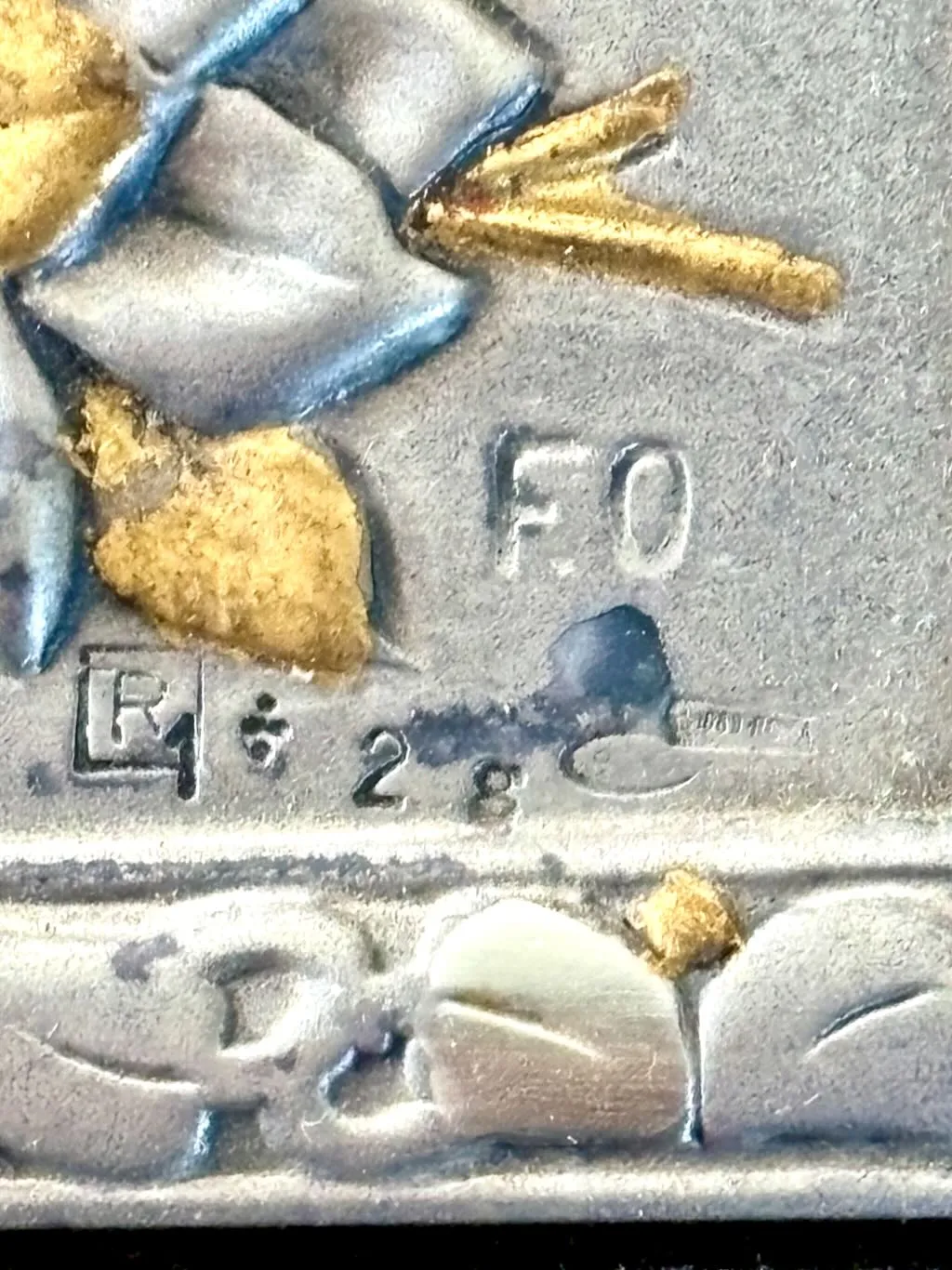
The central silver relief carries the F.O. signature and several additional impressed marks that provide useful information about its construction. One mark shows an R enclosed within a square, consistent with the Italian designation riempito, meaning filled. This marking convention identifies precious-metal sheet formed over a supporting material rather than an object made entirely from solid precious metal.
Beside it, the marking reads 1 ÷ 2 g, indicating a silver-content range of approximately 1 to 2 grams for the filled relief component. The original Italian certificate independently identifies the decorative surface as bassorilievo in lamina argento 925, or bas-relief in 925 sterling silver sheet. The 925 designation refers to an alloy containing 92.5% silver.
Together, the certificate and markings explain the construction of the decorative plaque: a thin layer of sterling silver formed over a supporting material to create the raised composition. A further small hallmark appears to the right of the weight designation. Its exact registration details are not sufficiently legible to establish a particular silversmith registration number or province.
The complete jewelry box weighs approximately 320 grams, including its wooden construction, lining, fittings, and silver decoration. This figure represents the total weight of the object rather than the weight of its sterling silver content. The use of supported silver relief is characteristic of a decorative metalworking tradition that values artistry, surface detail, and sculptural effect.
Original Italian Certificate and Manufacturer’s Label
One of the most appealing features of this example is the survival of its original Italian documentation.
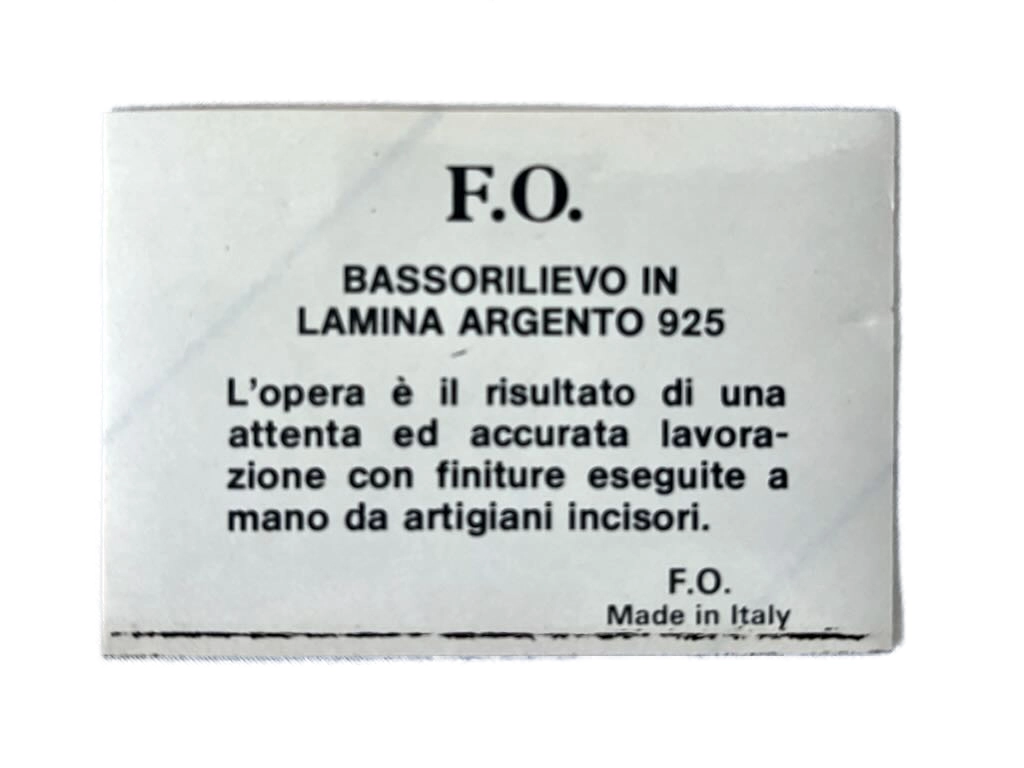
The accompanying certificate reads:
F.O. — BASSORILIEVO IN LAMINA ARGENTO 925
L’opera è il risultato di una attenta ed accurata lavorazione con finiture eseguite a mano da artigiani incisori.
Translated into English:
F.O. — Bas-Relief in 925 Sterling Silver Sheet
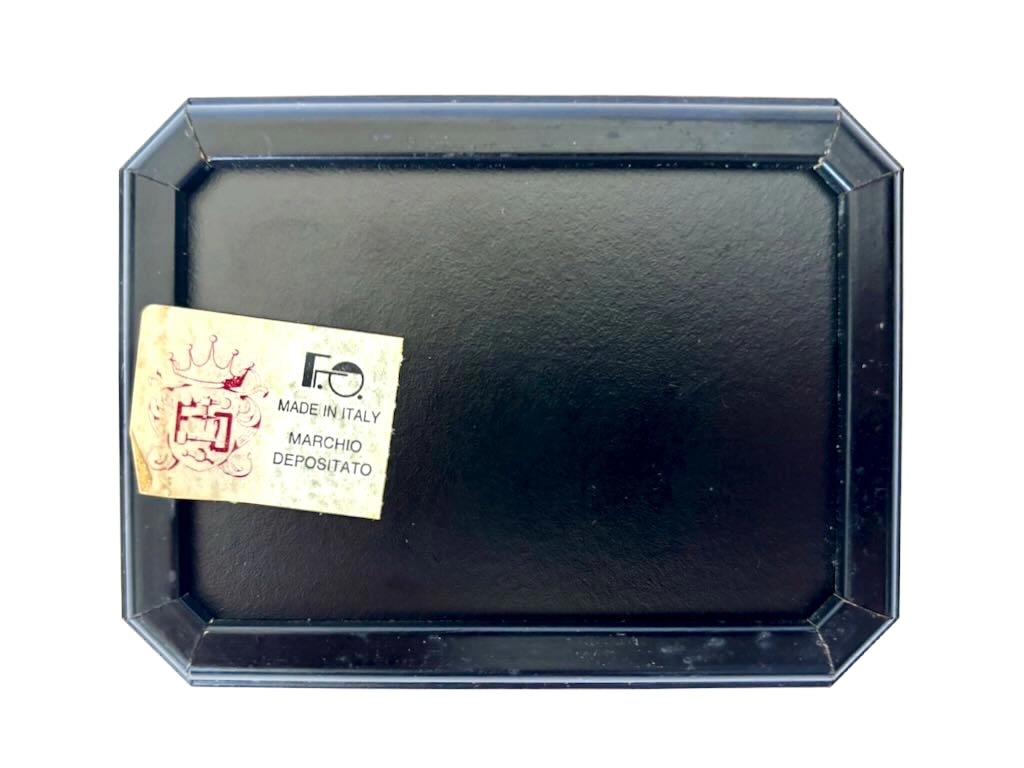
“This work is the result of careful and meticulous craftsmanship, with finishing carried out by hand by skilled artisan engravers.” The certificate concludes with F.O. and Made in Italy. The underside also retains the original F.O. manufacturer’s label, featuring a crowned heraldic emblem and the words Made in Italy — Marchio Depositato, meaning Registered Trademark.
These original details provide valuable evidence of the box’s Italian manufacture and the materials and finishing techniques used in its decoration. They also distinguish this example from similar vintage boxes that have lost their original documentation.
A Decorative Jewelry Box Preserved Unused
The hinged lid opens and closes securely, revealing the original soft pink interior, which has remained unused. The padded lining offers an attractive setting for small jewelry pieces and personal keepsakes. The box is equally appealing as a decorative object for a dressing table, vanity, desk, or collector’s cabinet. Its compact proportions make it easy to display, while the combination of wood marquetry and silver relief gives it a presence beyond its size.
The box remains in good vintage condition, with its original components, signature, certificate, and manufacturer’s label retained. As a vintage object, it may show minor characteristics of age and storage, as illustrated in the photographs. Carefully preserved as a collector’s piece since the 1980s, it offers an appealing combination of Italian craftsmanship, original documentation, and decorative charm.