
Description
Vintage Middle Eastern Bib Necklace with Metal Fringe
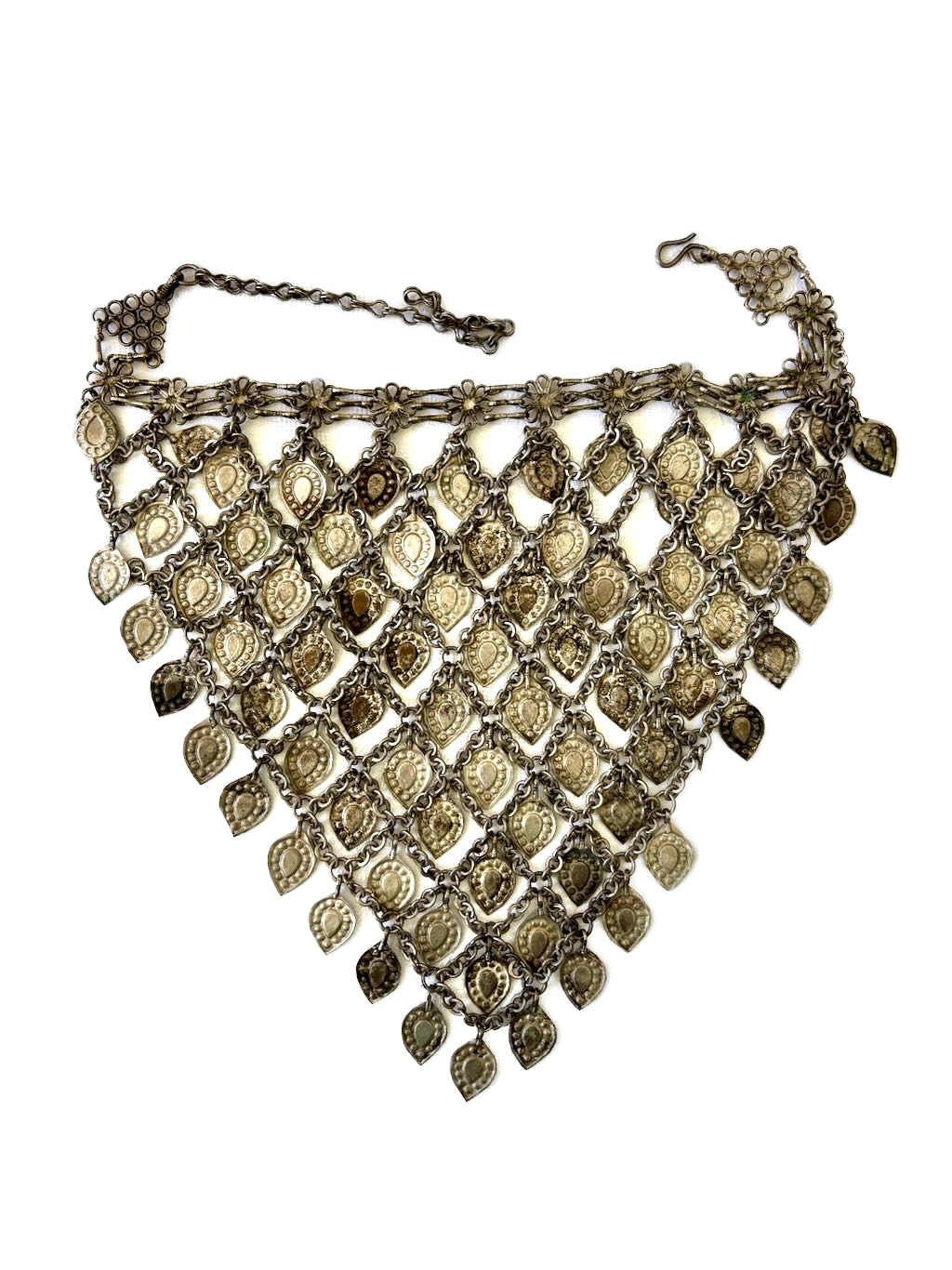
This striking Middle Eastern Bib Necklace creates a dramatic triangular cascade from dozens of individually suspended leaf-shaped metal pendants. Acquired from an antique store in Tehran during the 1960s, the necklace combines a flexible linked-metal structure with a bold scale that makes it equally fascinating as regional jewelry, wearable art, or a collectible ethnographic object.
The triangular bib measures approximately 10 inches (25.4 cm) across its upper edge and approximately 9.5 inches (24.1 cm) from top to bottom. Including the chain, the necklace reaches approximately 20 inches (50.8 cm) long and weighs 180 g (6.35 oz).
Despite its impressive visual presence, the articulated construction allows the necklace to remain flexible. Each movement shifts the overlapping metal elements independently, creating changing patterns of light across the surface.
Middle Eastern Bib Necklace with a Diamond-Link Lattice
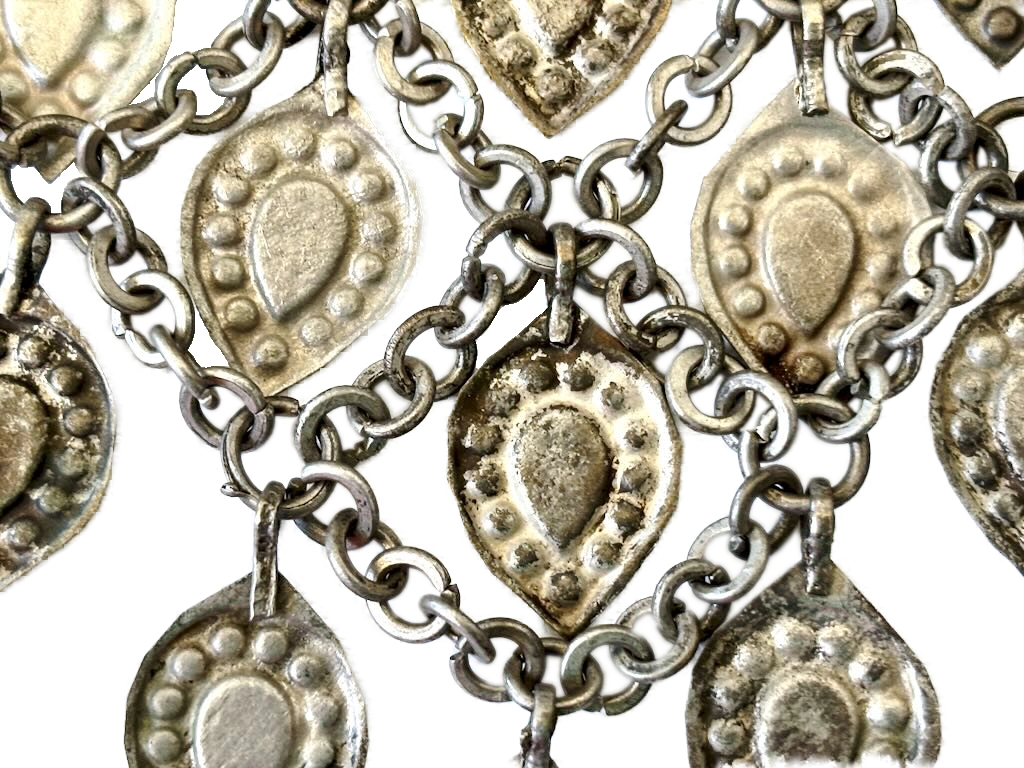
The structure of this Middle Eastern Bib Necklace is particularly interesting. Small metal rings connect into an open diamond-shaped lattice that gradually expands to create the broad triangular bib. Rows of leaf-shaped pendants hang individually from this network, filling the open structure without making it rigid.
The resulting construction is sometimes described in the antiques market as a leaf-net design. We use that term descriptively rather than as a documented historic name for the technique.
Each pendant has a pointed leaf or teardrop outline. A raised central form occupies its surface, while a border of small raised dots follows the outer edge. Subtle irregularities between the individual pieces contribute to the necklace’s handmade character. When viewed from a distance, the many separate elements merge into an almost textile-like metallic surface. Up close, the individual pendants, rings, loops, and connections reveal the complexity of its construction.
Rosette Details and Hand-Formed Closure
A row of small floral or rosette-shaped elements creates a decorative transition between the triangular bib and the neck chain. Above them, multiple linked strands draw the broad necklace inward toward its terminals. One end finishes in an openwork geometric connector, while a simple hand-formed metal hook provides the closure.
These details give the necklace a distinctly traditional character. Rather than relying on a modern commercial clasp, its components work as part of the overall metal construction.
The combination of linked rings, stamped pendants, rosette connectors, and simple fastening also demonstrates how the maker achieved substantial visual scale without constructing the necklace from large rigid plaques.
Baluchi, Afghan and Kuchi Jewelry Comparisons
The exact community that produced this necklace remains unknown. However, its articulated construction and numerous suspended metal elements show similarities to jewelry traditions found across southeastern Persia, Baluchistan, Afghanistan, and neighboring areas of Central and South Asia.
Traditional Baluchi jewelry belongs to a cultural region extending across southeastern Iran and adjoining areas of Pakistan and Afghanistan. Historical Afghan jewelry, including jewelry associated with nomadic Kuchi communities, also makes extensive use of chains, suspended metal plaques, pendants, and flexible constructions.
For these reasons, the necklace can reasonably be compared with Baluchi, Afghan, and Kuchi jewelry traditions. However, no documentation survives identifying its original maker or tribal community. We therefore do not present any one of these traditions as a definitive attribution.
The place of acquisition should also remain distinct from the place of manufacture. Tehran was an important center for the sale and collection of regional Persian and neighboring cultural arts. Purchase in Tehran therefore establishes an important part of the necklace’s history without proving where it was originally made.
A Different Character from Turkmen Jewelry
Regional jewelry traditions frequently overlap, and older metal jewelry from Iran, Afghanistan, and Central Asia is often broadly described in today’s market as Turkmen or Turkoman. This necklace, however, differs noticeably from many of the best-known historic Turkmen forms.
Classic Turkmen jewelry frequently relies upon substantial silver plaques, strongly architectural forms, applied and chased decoration, gilding, and prominent stones such as carnelian. By contrast, this necklace derives its visual impact from an open linked lattice and dozens of relatively small articulated pendants. For that reason, we have chosen the broader regional identification rather than assigning the necklace to the Turkmen tradition.
Untested Silver-Tone Metal
The metal has not been tested for composition. Silver played an important role in historic jewelry across Baluchistan and neighboring regions. At the same time, regional jewelers also worked with lower-grade silver and copper-based white-metal alloys. Afghan jewelry traditions likewise incorporated alloys often described today as nickel silver, German silver, or similar white metals.
Appearance, tarnish, and weight alone cannot reliably distinguish among these materials. We therefore describe this necklace simply as silver-tone metal, untested. It may contain silver, but no claim regarding silver content or purity is made.
At 180 g (6.35 oz), however, the necklace has pleasing substance in the hand. Its weight is distributed across the many small articulated components rather than concentrated in a few large elements.
Preserving the Original Patina
The varied surface is one of the most visually compelling characteristics of this Middle Eastern Bib Necklace. Some leaf-shaped pendants retain brighter silvery highlights, while others display deeper gray and darkened surfaces. Tarnish and oxidation remain particularly visible around recessed decoration, loops, and connections.
We have deliberately not polished the necklace. For collectors of antique and ethnographic jewelry, an aged surface can form an important part of an object’s historic character. Polishing would permanently alter that surface. We therefore chose to preserve the existing patina and allow the next owner to make that decision.
A collector may prefer to retain the necklace exactly as it is. Alternatively, someone purchasing it primarily to wear may choose to polish the metal for a brighter appearance.
Acquired in Tehran in the 1960s
The necklace has a known collecting history extending back more than half a century. It was acquired from an antique store in Tehran during the 1960s and has remained in the same family collection ever since. The exact date of manufacture is unknown, and the necklace may predate its acquisition.
We therefore describe it as mid-20th century or earlier rather than assigning an unsupported precise date. Its long-held provenance, unusual construction, generous dimensions, and untouched aged surface make it an intriguing survivor of the broad jewelry traditions that connected Persia with Afghanistan, Baluchistan, and Central Asia.
Collectible Jewelry with Dramatic Presence
Few materials can create the combination of movement and visual density achieved by this necklace.
Laid flat, its expanding diamond lattice reveals an almost architectural geometry. When worn, gravity transforms that structure into a broad cascade of overlapping leaves. The many articulated pendants can move independently, giving the necklace a completely different character from rigid metal collars and pectorals.
Its approximately 10-inch-wide bib also gives it enough scale to work as a genuine statement necklace. Yet the flexible construction makes it far more wearable than its dramatic appearance initially suggests. Whether preserved as a regional jewelry collectible or worn as a remarkable piece of vintage adornment, this Middle Eastern Bib Necklace combines craftsmanship, movement, patina, and an unusually strong sculptural presence.