


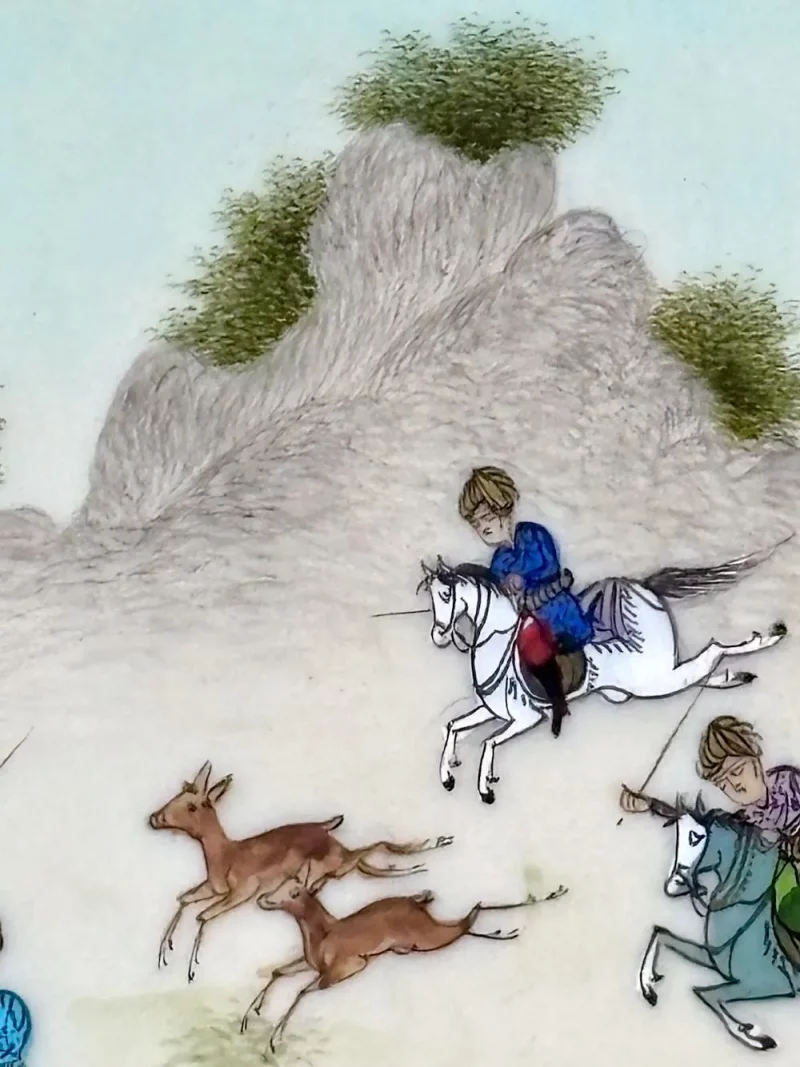
Few subjects appear more frequently in Persian art than the hunt. From ancient palace reliefs and silver vessels to miniature paintings, textiles, ceramics, and decorative objects, hunting scenes remained popular for more than two thousand years. Artists returned to the subject again and again because it offered far more than an opportunity to depict animals and horsemen. A hunting scene could celebrate royal authority, demonstrate courage and skill, illustrate famous literary episodes, or simply capture the beauty and excitement of life outdoors.
For modern collectors, Persian hunting scenes often provide a window into the values, ideals, and artistic traditions of Iran’s past. Whether painted on a manuscript page, engraved on metal, or rendered on a mother-of-pearl plaque, these images reveal a culture that admired horsemanship, valued mastery of nature, and celebrated the bond between humans, animals, and the landscape. Understanding why hunting became such an enduring theme helps explain the appeal of many Persian decorative arts that survive today.
The Royal Hunt in Ancient Persia
The story begins long before the emergence of Persian miniature painting. Hunting occupied an important place in the courts of ancient Persian rulers. Kings viewed the hunt as both recreation and training. Success in the field demonstrated many of the same qualities required of a capable ruler: courage, discipline, leadership, endurance, and skill.
The Achaemenid Empire, which ruled much of the ancient world between the sixth and fourth centuries BCE, celebrated these virtues through art and ceremonial imagery. Although relatively few hunting scenes survive from this period compared to later eras, royal ideology already linked kingship with strength and mastery over the natural world.
The tradition expanded further under the Sassanian Empire. Sassanian artists produced some of the most celebrated hunting imagery in Persian history. Silver plates often depict kings pursuing lions, wild boar, deer, and other animals while mounted on powerful horses. These scenes are dynamic and theatrical. Arrows fly through the air, horses rear dramatically, and rulers appear calm and confident despite the action surrounding them.
The purpose extended beyond decoration. These images reinforced the ruler’s legitimacy and power. A king who could conquer dangerous animals symbolically demonstrated his ability to govern and protect his realm.
Why Hunting Became a Symbol of Kingship
The connection between hunting and authority appears repeatedly throughout Persian history. While modern viewers may see a hunting scene primarily as an outdoor activity, historical audiences often recognized deeper meanings.
The hunt represented order confronting chaos. The ruler entered untamed wilderness and emerged victorious through skill, intelligence, and courage. In symbolic terms, this reflected the king’s responsibility to maintain stability throughout his kingdom.
At the same time, hunting allowed rulers to display refinement rather than brute force alone. Persian literature often emphasizes self-control, patience, and wisdom. A successful hunt required careful planning, trained animals, experienced riders, and disciplined execution. These qualities mirrored the ideal characteristics of a just ruler.
As Persian artistic traditions evolved, these symbolic associations remained intact. Even when hunting scenes appeared on decorative objects intended for private enjoyment, they continued to evoke ideas of nobility, honor, and leadership.
The Hunt in Persian Literature
Persian art and Persian literature developed side by side. Artists frequently drew inspiration from famous literary works, and hunting scenes appear throughout some of the most important texts in Persian culture.
No work influenced Persian visual art more than Ferdowsi’s Shahnameh, or Book of Kings. Completed around the year 1010, this monumental epic recounts the legendary history of Persia through stories of heroes, kings, warriors, and mythical creatures. Hunting episodes occur throughout the narrative and often serve as turning points in larger stories.
Heroes encounter rivals during hunts. Kings demonstrate their abilities through remarkable feats of horsemanship. Encounters with wild animals reveal courage, character, and destiny. As artists illustrated manuscripts of the Shahnameh, these scenes became some of the most visually dramatic subjects available.
Other literary works also contributed hunting imagery. The romantic epics of Nizami contain memorable scenes involving royal excursions, falconry, and encounters in garden landscapes. Poets frequently used hunting as a metaphor for love, fate, spiritual pursuit, and personal transformation.
As a result, many hunting scenes in Persian art operate on multiple levels. They may depict a literal hunt while simultaneously referencing literature, morality, romance, or spirituality.
Horses at the Heart of Persian Art
No discussion of Persian hunting scenes would be complete without mentioning horses. Persian civilization maintained a long and distinguished equestrian tradition. Horses served practical, military, and ceremonial roles, but they also occupied an important place in artistic imagination.
Artists devoted extraordinary attention to their depiction. Miniature painters carefully rendered bridles, saddles, harnesses, and decorative trappings. They studied movement closely, capturing horses at full gallop, mid-leap, or poised in elegant profile.
In many hunting scenes, the horse becomes nearly as important as the rider. Together they form a unified image of grace, speed, and control. A skilled horse allowed the hunter to pursue game across difficult terrain while maintaining precision and balance.
Collectors often notice that Persian artists gave horses distinct personalities. Some appear spirited and energetic. Others convey calm confidence. These subtle variations demonstrate the observational skills and artistic sensitivity of Persian painters.
Animals and Their Symbolic Meaning
The animals that appear in Persian hunting scenes rarely function as random decorative elements. Artists selected species that carried cultural significance and symbolic associations familiar to contemporary audiences.
Gazelles appear frequently in Persian art and literature. Their elegance, speed, and beauty made them natural symbols of grace and desirability. Poets often compared beloved figures to gazelles, creating layers of meaning when these animals appeared in visual art.
Deer similarly represented beauty and refinement. Their presence contributed to the idyllic atmosphere found in many Persian landscapes.
Falcons and hawks symbolized nobility, discipline, and mastery. Falconry occupied a respected place within elite culture, and artists frequently included trained birds in courtly hunting scenes.
Lions conveyed strength and authority. Encounters between rulers and lions carried obvious symbolic weight, transforming the hunt into a demonstration of royal courage.
Even when the imagery appears purely decorative, these symbolic associations often remain embedded within the composition.
Hunting Scenes in Persian Miniature Painting
Persian miniature painters embraced hunting subjects enthusiastically. The format allowed artists to combine narrative drama, vibrant color, and intricate detail within a single composition.
Many miniature hunting scenes unfold across elaborate landscapes filled with hills, trees, streams, flowers, and wildlife. Riders pursue game through carefully arranged environments that balance realism with artistic imagination. The resulting images feel both energetic and harmonious.
Unlike modern sporting illustrations, Persian miniatures rarely focus on a single moment. Instead, artists often depict multiple actions simultaneously. Hunters ride across the landscape while attendants follow behind. Animals appear at different stages of pursuit. Architectural elements, gardens, and natural features enrich the setting.
This approach transforms the hunt into a complete visual story rather than a simple record of an event.
The finest examples demonstrate extraordinary craftsmanship. Delicate brushwork, brilliant pigments, and subtle gold accents reward close examination. Every figure, animal, and plant contributes to the overall composition.
Beyond Manuscripts: Hunting Scenes in Decorative Arts
Metalworkers engraved horsemen and animals onto trays, bowls, vessels, and plaques. Ceramic painters decorated plates and tiles with hunting scenes inspired by manuscript illustrations. Textile designers incorporated mounted riders and animals into repeating patterns suitable for carpets, embroideries, and luxury fabrics.
During the Qajar period and later, miniature painters created hunting scenes on lacquer boxes, pen cases, mirror cases, and decorative plaques. These works allowed collectors to enjoy traditional imagery outside the context of manuscripts.
The theme continued into the twentieth century. Artists painted hunting scenes on mother-of-pearl, bone, ivory substitutes, and other decorative surfaces intended for display. Many of these objects appealed to both domestic collectors and international visitors seeking examples of traditional Persian craftsmanship.
The popularity of hunting imagery across so many media demonstrates its enduring importance within Persian visual culture.
Why Collectors Continue to Appreciate Persian Hunting Scenes
Modern collectors often encounter Persian hunting scenes before they know the stories behind them. The imagery possesses immediate visual appeal. Dynamic compositions, elegant horses, detailed costumes, and richly colored landscapes attract attention even without historical context.
However, understanding the symbolism adds another dimension to appreciation. A hunting scene represents more than a sporting activity. It reflects centuries of literary tradition, royal ceremony, artistic innovation, and cultural values. Each rider, animal, and landscape element participates in a visual language that Persian audiences understood instinctively.
Collectors also value the technical skill required to create these works. Whether engraved in metal, painted on a manuscript page, or executed on mother-of-pearl, successful hunting scenes demand careful observation and exceptional craftsmanship.
As a result, these images continue to resonate with contemporary audiences. They combine beauty, movement, storytelling, and symbolism in ways that remain engaging centuries after their creation.
An Enduring Legacy
Persian hunting scenes occupy a unique place within the history of world art. They connect ancient royal traditions with literary masterpieces, miniature painting, and decorative arts. Over countless generations, artists adapted the subject to changing tastes while preserving its essential themes of courage, skill, beauty, and noble conduct.
Today, these works survive in museums, private collections, manuscripts, decorative objects, and family heirlooms throughout the world. Their continued appeal speaks to the richness of Persian artistic culture and the universal fascination with stories of adventure, mastery, and human achievement.
Whether depicted on a royal manuscript page, engraved on a metal vessel, or painted on a delicate decorative plaque, the Persian hunt remains one of the most captivating subjects in the history of Iranian art. It offers not only visual excitement but also a deeper understanding of the values, traditions, and imagination that shaped Persian civilization for centuries.
Explore Authentic Persian Shikar Miniatures
The royal hunt, or Shikar, remained one of the most enduring subjects in Persian miniature painting for centuries. The Bernardi Family Collection includes two early twentieth-century hand-painted Persian hunting miniatures on natural bone, each illustrating a different interpretation of this celebrated theme. Although both depict mounted hunters pursuing gazelles through idealized landscapes, each artist approached the composition differently. One emphasizes the sweeping movement of the hunt across a panoramic format, while the other uses a vertical composition to create a more intimate and decorative interpretation of the Persian Shikar. Together they demonstrate both the continuity and variety of this enduring artistic tradition.