

During the late 1970s, Wedgwood expanded its long tradition of ceramic jewellery or jewelry into a striking series of Egyptian Revival pendants and ornamental pieces inspired by ancient Egypt. Produced during a renewed international fascination with Egyptology following the celebrated Tutankhamun exhibitions of the decade, these pendants combined Wedgwood’s historic mastery of jasperware and black basalt with fashionable jewellery forms intended for modern wear.
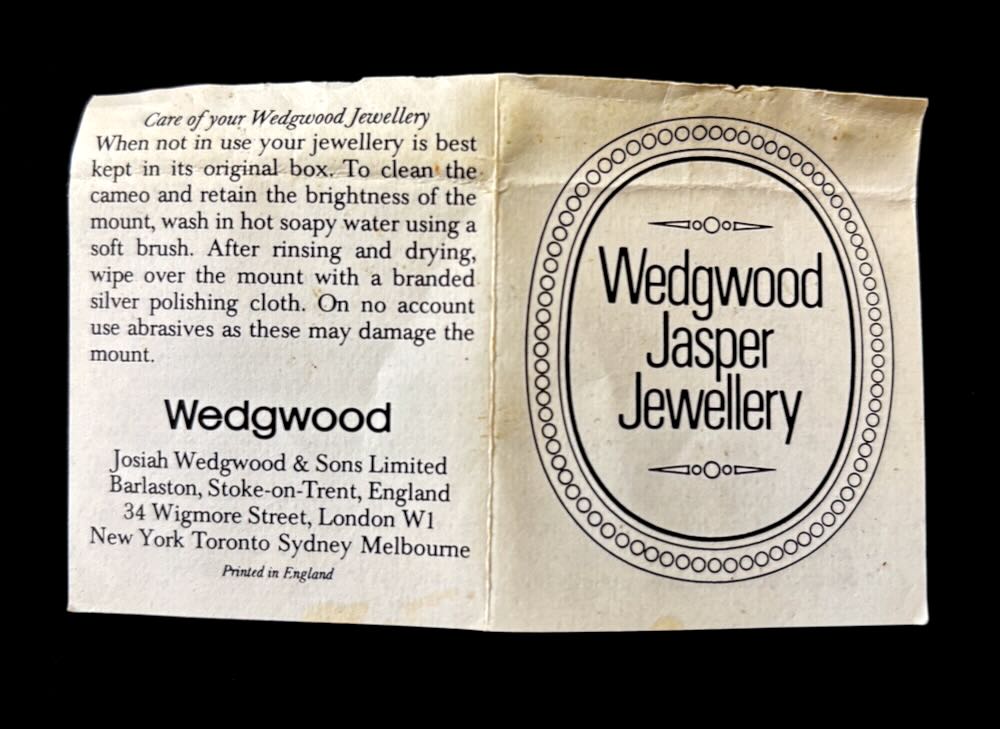
Among a group of surviving Wedgwood Egyptian Revival pendants, a period folded brochure titled Wedgwood Jasper Jewellery (Jasper Jewelry) was preserved inside one of the original boxes. While the leaflet appears to have been a general jewellery insert rather than one produced exclusively for the Egyptian Collection, its references to pendants, black basalt, gold-plated mounts, and Wedgwood’s continuing jewellery production align closely with the Egyptian Revival jewellery produced during the period.
Today, such surviving ephemera offers valuable insight into how Wedgwood presented and marketed its jewellery lines during the late twentieth century.
The Origins of Wedgwood Jewellery
Wedgwood’s jewellery tradition reaches back more than two centuries to the innovations of Josiah Wedgwood (1730–1795), founder of the Wedgwood pottery works and one of the most influential ceramic manufacturers in British history.
As described in the original brochure:
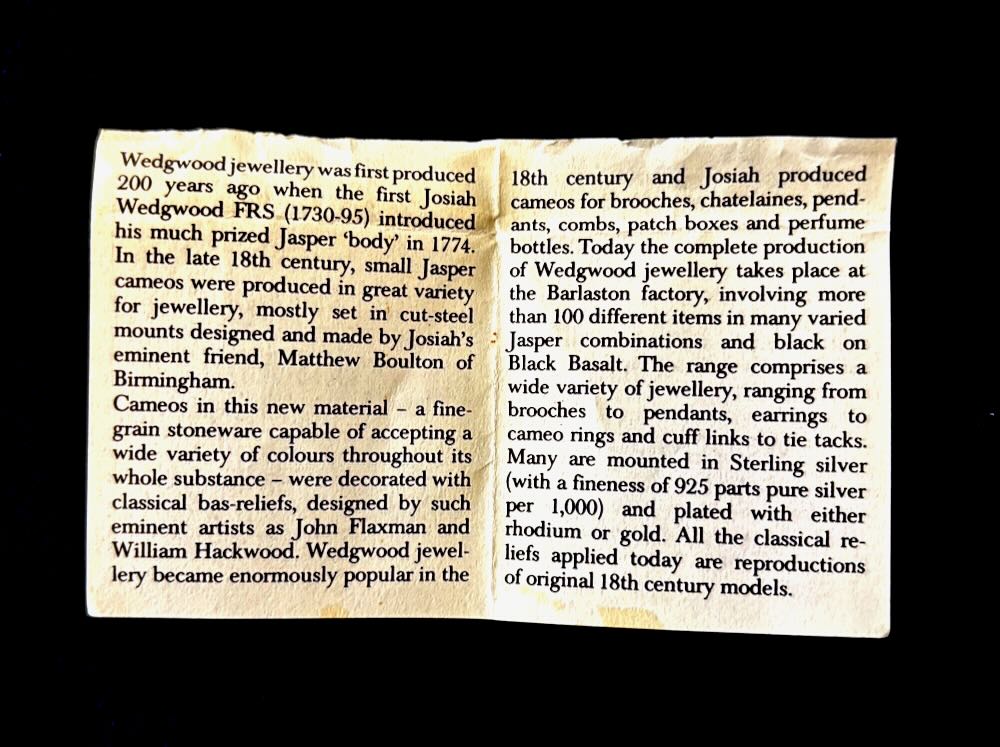
“Wedgwood jewellery was first produced 200 years ago when the first Josiah Wedgwood FRS (1730-95) introduced his much prized Jasper ‘body’ in 1774.”
Jasperware represented a major technical and artistic achievement. Unlike ordinary glazed pottery, jasper was a fine-grained unglazed stoneware capable of carrying colour throughout the body of the material itself. The matte finish and sculptural quality made it ideal for cameo-style decoration inspired by antiquity.
By the late eighteenth century, Wedgwood had begun producing small ceramic cameos for jewellery and ornamental accessories. These pieces reflected the growing European fascination with classical Greece and Rome during the Neoclassical period.
Matthew Boulton and Cut-Steel Mounts
The brochure also references one of the important historical collaborations behind early Wedgwood jewellery:
“In the late 18th century, small Jasper cameos were produced in great variety for jewellery, mostly set in cut-steel mounts designed and made by Josiah’s eminent friend, Matthew Boulton of Birmingham.”
Matthew Boulton was one of the leading manufacturers and industrialists of eighteenth-century England. His Soho Manufactory in Birmingham became internationally known for luxury metalwork, ormolu, silver, and decorative objects.
The partnership between Wedgwood and Boulton helped elevate jasper cameos from ceramic curiosities into fashionable luxury accessories worn throughout Europe.
Cut-steel mounts themselves became highly fashionable during the Georgian era. Tiny polished steel facets reflected candlelight with a brilliance that rivaled gemstones while remaining more affordable than diamonds. Combined with Wedgwood’s matte ceramic reliefs, they created a distinctive visual contrast that became strongly associated with neoclassical taste.
Flaxman, Hackwood, and Classical Relief Design
The sculptural reliefs used in Wedgwood jewellery were not random decorative motifs. Many were designed by important artists and modelers associated with the factory.
The brochure specifically mentions:
“Cameos in this new material… were decorated with classical bas-reliefs, designed by such eminent artists as John Flaxman and William Hackwood.”
John Flaxman became one of Britain’s most celebrated neoclassical sculptors and draftsmen. His simplified linear style translated exceptionally well into ceramic relief work and helped define Wedgwood’s classical visual language.
William Hackwood, one of Wedgwood’s master modelers, also played a major role in developing many of the factory’s relief designs and ornamental figures.
Together, these artists helped establish Wedgwood jewellery as more than decorative fashion. The pieces became miniature expressions of the neoclassical movement itself.
Jasperware and Black Basalt Jewellery
Although Wedgwood is best known for pale blue jasperware with white relief decoration, jewellery production eventually expanded into many colour combinations and materials.
One of the most interesting references within the brochure is its mention of:
“many varied Jasper combinations and black on Black Basalt.”
Black basalt was one of Wedgwood’s most important ceramic inventions. Developed in the eighteenth century, it was a dense, unglazed black stoneware named for its resemblance to volcanic basalt stone. The material provided a dramatic dark surface ideally suited to both classical and Egyptian-inspired decoration.
By the 1970s, black basalt became especially important during the Egyptian Revival period. Its deep matte black appearance naturally complemented ancient Egyptian motifs, gilt ornamentation, and archaeological aesthetics.
Many of the Egyptian Revival pendants produced by Wedgwood during this era used black basalt combined with gold decoration or gilt metal mounts, creating jewellery that felt simultaneously ancient and modern.
The Egyptian Revival of the 1970s
The late 1970s witnessed a major international resurgence of interest in ancient Egypt. Museum exhibitions featuring treasures from the tomb of Tutankhamun attracted enormous public attention across Europe and North America, influencing fashion, interior design, jewellery, and decorative arts.
Wedgwood responded by creating a range of Egyptian-themed decorative objects that included plaques, vases, boxes, limited edition display pieces, and jewellery.
Unlike traditional classical jasper cameos depicting Greco-Roman subjects, these Egyptian Revival designs drew inspiration from hieroglyphics, pharaonic imagery, temple ornament, and archaeological motifs.
The jewellery from this period often combined:
- black basalt bodies
- gilt decoration
- geometric framing
- Egyptian iconography
- pendant-oriented forms suitable for contemporary fashion
The result was distinctly different from earlier Wedgwood jewellery while still remaining rooted in the company’s long tradition of ceramic ornamentation.
Jewellery Production at Barlaston
The brochure provides valuable insight into Wedgwood’s jewellery production during the twentieth century:
“Today the complete production of Wedgwood jewellery takes place at the Barlaston factory…”
The Barlaston factory in Stoke-on-Trent became Wedgwood’s primary production center during the modern era. According to the brochure, the company was producing:
“more than 100 different items”
including:
- brooches
- pendants
- earrings
- cameo rings
- cuff links
- tie tacks
This demonstrates that jewellery remained an important part of Wedgwood’s identity well into the late twentieth century rather than simply a small historical sideline.
Sterling Silver, Rhodium, and Gold-Plated Mounts
Another important detail documented by the brochure is Wedgwood’s use of precious metal mounts.
The insert explains that many pieces were:
“mounted in Sterling silver… and plated with either rhodium or gold.”
This is significant because modern collectors sometimes assume Wedgwood jewellery was purely ceramic costume jewellery. In reality, many higher-end examples incorporated sterling silver settings and luxury finishes.
At the same time, other jewellery lines — particularly some Egyptian Revival pieces — used gilt metal or gold-tone mounts rather than sterling silver. This variation reflected differences in style, pricing, and intended market positioning.
Caring for Wedgwood Jewellery
The surviving brochure also preserves original Wedgwood care instructions for jasper jewellery:
“To clean the cameo and retain the brightness of the mount, wash in hot soapy water using a soft brush.”
It further advises owners not to use abrasive materials that could damage the mounts or relief surfaces.
These small details offer insight into how Wedgwood expected its jewellery to be worn, maintained, and valued by owners during the period.
A Small Brochure as Historical Documentation
Today, surviving Wedgwood jewellery brochures are increasingly interesting as collectible ephemera in their own right. While small and utilitarian when originally distributed, they now provide important documentation about:
- Wedgwood marketing language
- jewellery production
- material terminology
- factory locations
- international distribution
- product categories
- care recommendations
The brochure discussed here was preserved alongside several late 1970s Wedgwood Egyptian Revival pendants. Although likely intended as a general jewellery insert rather than one exclusive to the Egyptian Collection, its references strongly reflect the broader jewellery production of the era.
As many original boxes, inserts, and packaging materials disappear over time, these surviving documents help provide context for understanding Wedgwood’s jewellery legacy beyond the ceramic objects themselves.
The Enduring Appeal of Wedgwood Jewellery
From eighteenth-century jasper cameos mounted by Matthew Boulton to the Egyptian Revival pendants of the 1970s, Wedgwood jewellery has continually adapted historical design traditions for new generations.
The company’s ability to reinterpret classical and archaeological themes through ceramic craftsmanship remains one of the defining features of the Wedgwood aesthetic. Whether rendered in pale jasperware or dramatic black basalt, these miniature works combine sculpture, design, and ornament in a uniquely recognizable form.
For collectors today, the jewellery offers more than decoration alone. It represents an enduring connection between neoclassical artistry, industrial innovation, and the changing tastes of decorative fashion across more than two centuries.